




Recessed Mat Inserts
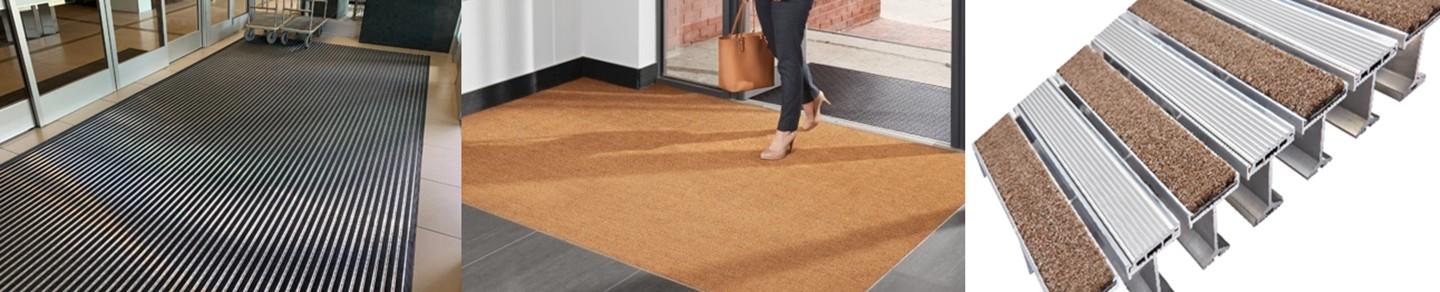
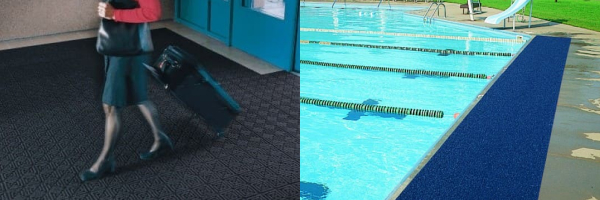
Recessed walk-off mat inserts for commercial entry wells where the threshold needs insert matting rather than a hinged rollup grate system. Five options below cover the range — Super Berber Matting for dense-pile carpet performance, Vinyl Link Mat for industrial-leaning entries where the grille-style face fits the use case, Custom Coco Mats for branded thresholds in natural coir, Coco Coir Rolls for cutting to non-standard well dimensions, and Design Links for modular interlocking tiles that fit architectural placements. Each construction handles a different combination of moisture, debris type, and aesthetic placement in the recessed well.
 Super Berber Matting
Starting at $60.00
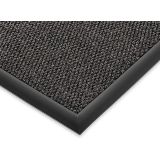
Super Berber Matting is a dense berber entrance mat that does the two hardest jobs at a busy door at once: it scrapes grit off shoes and soaks up the moisture they carry. The needle-punch berber surface is solution-dyed in up to 40 colors, and a custom logo can...
Super Berber Matting is a dense berber entrance mat that does the two hardest jobs at a busy door...
View Details
View Details
 Vinyl Link Mat
Starting at $209.00
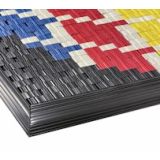
A vinyl link mat is an entrance mat made of short vinyl links woven tightly over steel wires. The close weave grips shoes, pulls dirt off at the door, and stays safe for high heels. It comes in thirteen colors and can carry a custom logo or lettering, so...
A vinyl link mat is an entrance mat made of short vinyl links woven tightly over steel wires. The...
View Details
View Details
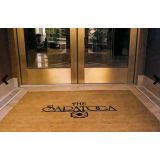 Custom Coco Mats$168.00Custom Coco Mats are made from real coconut fiber — coir — for entrances where a warm, natural-material look matters as much as keeping the floor clean. The coarse fiber scrapes grit and traps dirt at the door, while the organic texture gives a threshold a premium feel that
...
Custom Coco Mats are made from real coconut fiber — coir — for entrances where a warm, natural-material look...
View Details
View Details
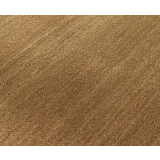 Coco Coir Rolls$711.00Coco coir rolls bring a natural-fiber entrance to a recessed well: warm, brush-textured coconut coir bonded to a sealed vinyl base, cut from the roll to fit your recess. The coir brushes grit off shoes and the vinyl backing keeps dirt and moisture on the mat instead of letting it
...
Coco coir rolls bring a natural-fiber entrance to a recessed well: warm, brush-textured coconut coir bonded to a sealed vinyl...
View Details
View Details
When Insert Matting Beats a Grate System
The recessed-entry decision usually presents as a binary — grate system or insert matting — but the choice has nothing to do with which is "better." It's about which fits the well, the use case, and the maintenance plan.
Insert matting is the right pick in three scenarios. First, when the well is shallow — typically 3/8" to 5/8" depth, below what hinged rollup grate systems require.
Second, when the threshold aesthetic calls for a textile or natural-fiber surface — a carpet-feel entry at a hospitality lobby, a coir-look threshold at a covered restaurant entrance, or a vinyl-link grille pattern at an industrial-leaning loading-adjacent door.
Third, when the entrance traffic and debris load don't justify the more involved spec and installation cycle of a hinged grate system. Mat inserts handle the full range of commercial entry traffic; they're not a downgrade from grate systems, they're a different installation approach for different installation requirements.
The Failure Mode for Insert Matting at Recessed Installations
Recessed installations create their own failure patterns, different from the curled-edge and migration issues surface-mounted matting deals with. Three common ones repeat.
First, moisture saturation when the well lacks proper drainage. Insert matting that absorbs water at the surface eventually wicks moisture through to the well floor underneath. If the well is sealed at the bottom — typical for retrofitted installations where drainage wasn't built in — water sits between the mat and the well floor, breaking down both surfaces and creating odor that surface cleaning can't resolve. Material choice matters: vinyl link and coir handle moisture trapping differently than carpet-pile matting because they don't hold water at the surface in the same way.
Second, dimensional mismatch with the well. Standard-size mat inserts leave gaps at the well edges when the well dimensions don't match catalog sizes. Cut-to-size matting handles this — coir rolls are sized off the well measurements rather than the other way around — but the gap problem is the most common reason a recessed insert installation looks unfinished compared to the spec.
Third, the wrong material for the entrance traffic. Coir at a continuous-wet entrance saturates in months. Carpet-face matting in a high-debris industrial entry pile-crushes and discolors faster than the replacement cycle anticipates. Vinyl link at a dry corporate lobby reads industrial against the surrounding finishes. Material choice matters more for inset installations than surface-mounted because the recessed well makes the matting an architectural element of the floor rather than a removable accessory.
How the Four Options Compare
Each option in the grid is the right pick for a different combination of well dimensions, traffic exposure, and aesthetic placement.
Super Berber Matting uses densely looped Berber yarn over a rubber backing. The carpet face absorbs and traps dirt at pile level while presenting a textile, carpeted appearance at the threshold — reading as a flush-installed carpet panel rather than as a separate mat. The dense, looped construction is what makes this work at commercial volumes; the loops hold their structure under continuous foot traffic where residential-grade carpet would crush within months.
Right pick when the recessed installation calls for a soft, carpeted aesthetic at a moderate-to-heavy commercial entry — corporate lobbies running on a regular cleaning schedule, hospitality entries where the threshold should feel residential-quality, healthcare administrative spaces where carpet-feel matters to the room.
Vinyl Link Mat has an open-link grille surface in PVC construction. The link-pattern face scrapes shoes while letting debris and moisture fall through to the well below — closer to a grate system functionally, but in a flat-insert format that fits shallower wells. The vinyl construction handles continuous wet conditions and aggressive debris better than textile matting; the link face presents a more industrial, functional appearance that fits manufacturing facility entrances, transportation-adjacent thresholds, and back-of-house commercial entries.
Color options accommodate brand color matching where the industrial aesthetic still has to coordinate with surrounding design. Right pick when the recessed well is wet, the debris load is aggressive, or the entrance is industrial-leaning and textile surfaces wouldn't hold up.
Custom Coco Mats use natural coconut husk fiber over a 3/16-inch heavy-duty vinyl backing. The coir face scrapes incoming shoes while presenting the natural-fiber aesthetic that fits covered architectural entries — restaurants with farmhouse or coastal design language, hospitality entries with natural-material themes, boutique retail thresholds where the natural look matches the brand.
Custom branding is the differentiating feature: the coir face can be cut, woven, or printed with logos, monograms, or branded designs that present at the recessed threshold without the formality of a grate-system insert. The vinyl backing prevents leak-through to the well floor and gives the mat the heft required for commercial use rather than residential.
Coco Coir Rolls are natural coir matting supplied in roll format rather than pre-cut sizes. The roll format is the practical answer to non-standard well dimensions and irregular installations — measuring the well, cutting the coir to fit, and installing in custom shapes that catalog sizes don't accommodate. Same natural coir face as Custom Coco Mats, same scraping action and moisture-absorption characteristics, but specified by the running foot rather than the unit. Right pick when the recessed well is non-standard — angled thresholds, curved entries, multi-zone installations, recess shapes that match architectural geometry rather than catalog dimensions.
Three Things to Check Before You Pick
First, the well depth. Insert matting works in shallower wells than hinged rollup grate systems — typically 3/8" to 5/8" — but the actual depth available determines which constructions will fit. Super Berber and Custom Coco Mats run thicker than Vinyl Link; coir rolls cut to the matting depth required. Send the well depth with the spec request.
Second, the moisture exposure. Continuous-wet recessed entries push the choice toward Vinyl Link (the open-link face channels water through to the well below) or coir products with proper drainage at the well bottom. Super Berber works at moderate-moisture entries with appropriate cleaning frequency but isn't the right pick for continuous-wet installations where the carpet face stays saturated.
Third, the aesthetic placement. Recessed installations make the matting visible as part of the floor design rather than as a separate accessory. The matting type reads as a design choice — carpet, link grille, natural fiber, branded coir — and stays visible through the entrance's full service life. Decide the aesthetic intent before the well's edge profile and frame system get specified, not after.
Why Mats Inc.
Recessed insert matting is the simpler installation cycle of the recessed-entrance choices — easier to specify, easier to replace, less constrained by well depth than hinged rollup grate systems. The four constructions above are what's left after the insert materials that didn't hold up in commercial recessed wells got pulled from the catalog. Specification consultation is part of how we work: send well dimensions, the entrance traffic profile, and the aesthetic intent, and we'll spec the construction that fits.
Frequently Asked Questions
How do these four options compare visually? Which fits a hospitality entrance vs an industrial one?
Answered by Jinna Hopson, Vice President of Marketing
The visual identities are distinct enough that the right pick is usually obvious once you know what the surrounding space looks like. Super Berber presents as flush-installed carpet — soft, textile, refined — fits corporate lobbies, hospitality grand entries, healthcare administrative spaces, and any threshold where the entrance should read residential-quality. Vinyl Link presents as a functional grille face — industrial, modular, more utility than refinement — fits manufacturing entries, transportation hubs, back-of-house commercial doors, and industrial-leaning installations where the threshold's job is more visible than its appearance.
Custom Coco Mats and Coco Coir Rolls present natural-fiber, coastal-or-farmhouse-or-boutique — fits covered restaurant entries, boutique retail with natural material themes, hospitality with coastal or farmhouse design language.
The wrong matching reads loudly — match the matting aesthetic to the space's design vocabulary before any other consideration.
Can we get custom branding or design on a recessed insert?
Answered by Jinna Hopson, Vice President of Marketing
Yes, with options across the construction range. Custom Coco Mats accept the most direct branding — logos, monograms, or branded patterns woven, cut, or printed into the coir face for high-impact branded thresholds. Super Berber accepts custom logo work in the looped carpet face, with color options that match brand palettes for non-logo branded approaches. Vinyl Link supports custom color combinations for color-blocking brand identity at the threshold without traditional logo work. Coco Coir Rolls support custom cut shapes for branded geometric layouts in non-standard wells.
For specific branding requirements, send brand guidelines (color palette, logo files, design intent) and well dimensions, and we'll scope what's manufacturable. Custom orders typically take three to five weeks depending on configuration complexity.
We have multiple locations — should we standardize on one insert type or vary by property?
Answered by Jinna Hopson, Vice President of Marketing
Standardization at the program level is usually the right move for multi-location recessed installations. Picking one insert family — Super Berber for branded carpet thresholds across all properties, Custom Coco for natural-fiber consistency at hospitality locations — creates immediate visual consistency across the locations without the operational complexity of managing different specs per property.
The exception is portfolios with genuinely different facility types, where a two-construction strategy works: one insert family for one portfolio segment, another for the other, with custom color palettes coordinating both. Either approach is easier to execute when specified centrally rather than per-property.
Does natural coir hold up commercially or is it more decorative?
Answered by Jinna Hopson, Vice President of Marketing
Coir is a commercial-grade matting material when specified with the right backing and construction — Custom Coco Mats and Coco Coir Rolls both use heavy-duty vinyl backing that distinguishes them from residential-grade coir products. The natural fiber face scrapes incoming shoes effectively, holds up to moderate-traffic commercial entries indefinitely with appropriate maintenance, and stays presentable longer than buyers initially expect from a natural material.
Where coir doesn't work commercially is continuous-wet placements — pool entries, kitchen-adjacent thresholds, gym shower exits — where the natural fiber saturates and breaks down faster than synthetic alternatives. At covered, dry-to-damp commercial entries, coir matches synthetic performance and adds the natural-fiber aesthetic that synthetic constructions can't provide. The visual difference shows up immediately and stays visible through the matting's full service life — natural coir reads as intentional design choice rather than functional necessity.
What's the realistic service life on insert matting in a recessed installation?
Answered by Dustin Thompson, Owner & CEO
Recessed installations affect the service life calculation because the well environment differs from surface-mounted exposure. Super Berber and Custom Coco Mats run three to five years at moderate-traffic recessed placements with appropriate cleaning; closer to two to three years at the busiest commercial entries. Vinyl Link runs longer than textile alternatives at high-debris and wet placements — five to seven years is realistic at industrial-leaning installations because the open-link face doesn't accumulate damage the way textile faces do.
Coir products run shorter at continuous-wet placements (one to three years) and longer at covered, dry-to-damp installations (three to five years) where the natural fiber doesn't see sustained saturation. Replacement cycles get shorter when the well isn't drained properly — moisture trapped against the matting from below breaks the construction down faster than surface wear does.
By Jinna Hopson, Vice President of Marketing, Mats Inc.