




Commercial Stair Treads
Stairs concentrate more risk into less square footage than anywhere else in a building. A stair tread is the surface that takes the step, and on most commercial jobs it goes over the stairs you already have rather than replacing them. The four groups below cover interior stairs, exterior stairs, the adhesives that hold either one down, and the full range in one place.
What Stair Treads Do Before Someone Misses a Step
A stair tread does two jobs at once. It gives the foot a textured surface to land on, and it protects the stair underneath from the wear that shows up first on the leading edge. Concrete pans, worn oak, chipped terrazzo, and bare steel all take a tread cover without demolition.
The nosing is where both jobs meet. That leading edge carries the most contact, sheds the most material, and is the part people actually see on the way down a flight. A tread with a formed nosing wraps that edge and keeps it square. Flooring cut to size does not.
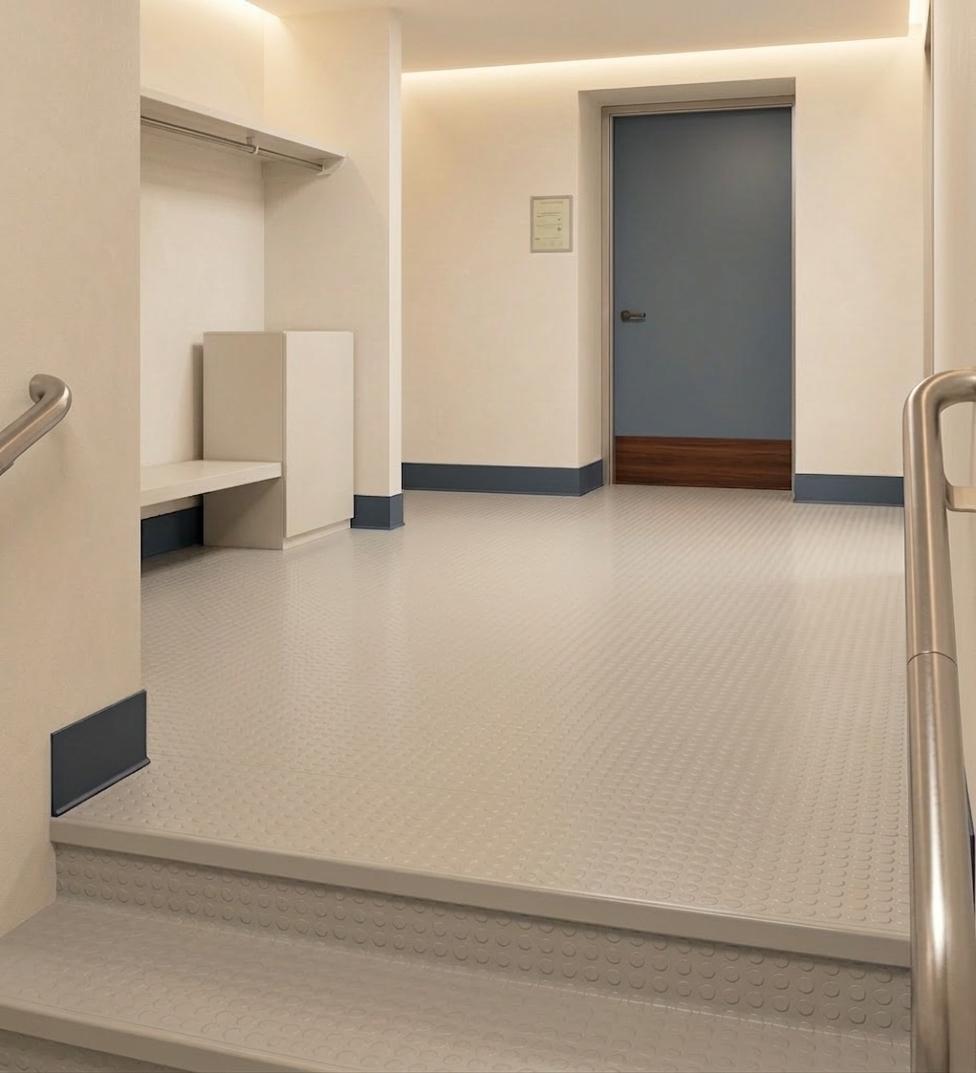
Risers and landing tiles finish the same run. Stair riser covers face the vertical between steps, and landing treads carry the surface across the flat platform at the top or turn of a flight, so the whole stairwell reads as one installation instead of patched pieces.
The Mistake That Wrecks the Leading Edge
The common failure is buying for the flat part of the step and ignoring the nose. Buyers order sheet flooring or a plain tread strip, cut it to depth, and end up with a raw edge at the front of every step. Within a season that edge lifts, catches a toe, and peels back — the exact spot where a lift is most likely to put someone down.
NFSI writes the B101 standards that rate a walkway on measured wet traction rather than on how textured the surface looks. That gap matters most on stairs, where federal injury surveillance puts stair-related emergency room visits at roughly a million a year. A slip on a flat floor is a stumble. A slip on a stair is a fall down the rest of the flight.
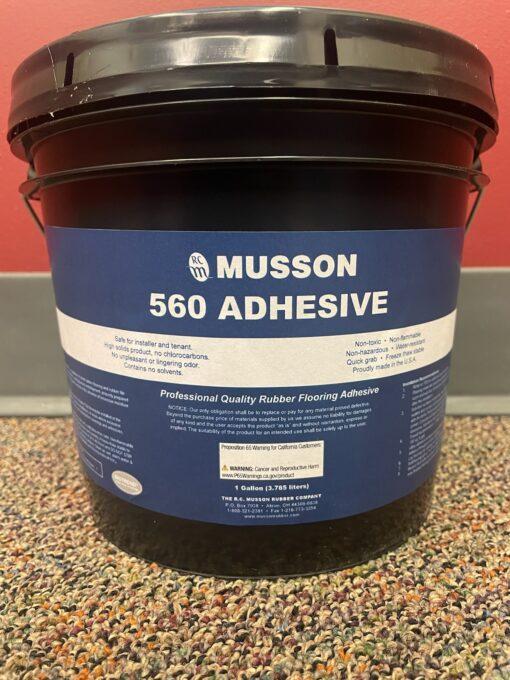
Adhesive choice is the other half of the same mistake. A tread bonded with the wrong compound for its substrate releases at the nose long before the tread itself wears out, and a released nose on a stairwell is a trip hazard that reappears every time someone re-glues it.
How the Four Groups Break Down
Interior Stair Treads
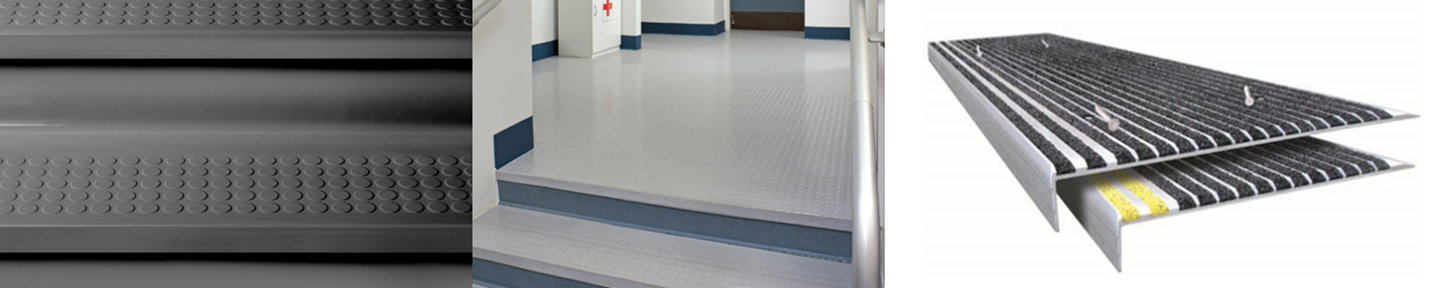
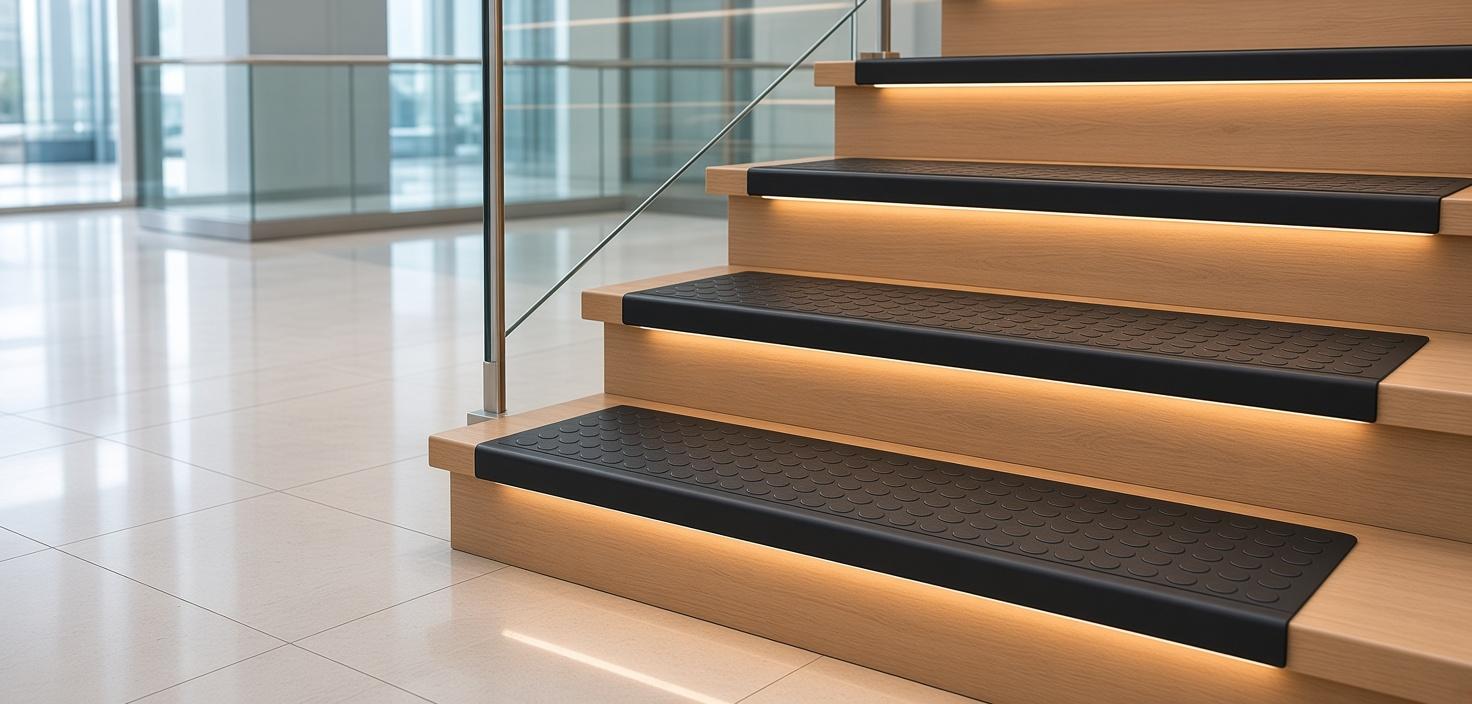
Interior covers the stairs inside the building envelope — lobby flights, stairwells, mezzanines, basement stairs, and the landings between them. Rubber and vinyl stair tread covers dominate here, with matching riser covers and landing tiles so a full flight finishes in one material and one color.
These are the treads for stairs that see steady foot traffic but no weather. Schools, office towers, healthcare corridors, apartment common stairs, and municipal buildings are the typical fit, especially where the existing stairs are sound and only the surface has worn out.
Exterior Stair Treads
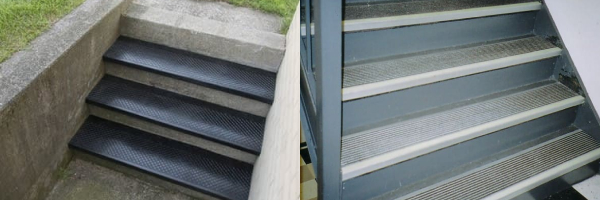
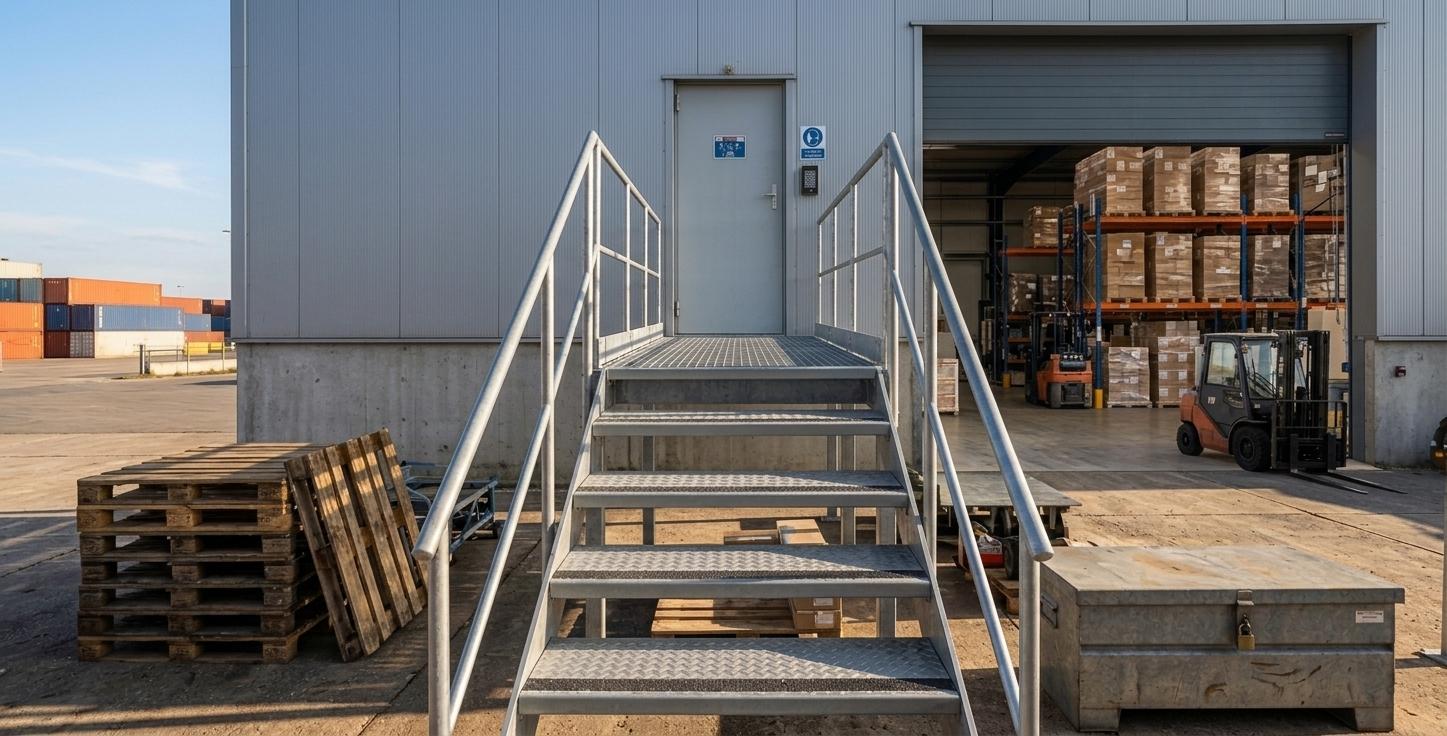
Exterior treads handle the conditions that end an indoor product early: standing water, freeze-thaw cycling, UV exposure, and grit tracked in from the parking lot. Heavier rubber and abrasive or metal surfaces carry the traction here, because an outdoor step is wet far more often than an indoor one.
Loading docks, entry stoops, concrete steps, deck stairs, and exterior fire stairs are the strongest fit — anywhere a stair sits outside the door and has to stay walkable through a winter.
Stair Tread Adhesives
Adhesives are stocked alongside the treads because the bond decides whether the installation lasts. The right compound depends on the tread material, the substrate underneath, and whether the stair is wet, dry, interior, or exposed.
Anyone installing rubber or vinyl treads over concrete, wood, or metal pans needs this group. Specifying it at the same time as the tread is what keeps a crew from improvising at the job site with whatever is on the truck.
All Stair Treads, Risers & Landing Tiles
This is the whole range in one grid — interior and exterior treads, safety treads with abrasive strips, matching stair riser covers, landing treads, and the adhesives. Use it when you are weighing both sides at once, or when a job has an interior flight and an exterior stoop that need to look related.
It is also the right place to start when the exposure is not settled yet. Sort on what you can see — nosing shape, surface texture, color — then narrow to interior or exterior once you know which conditions the stairs actually face.
Three Things to Check Before You Pick
Match the nosing to the existing stair. Square-nose and round-nose stairs take different treads, and a round-nose tread on a square edge leaves a void under the front lip that crushes down within months. Measure the leading edge before you measure anything else.
Read the exposure, not the location. A covered stair that gets soaked by wind-driven rain, or an unheated stairwell that cycles below freezing, belongs with the exterior group even though it sits under a roof. Steady, dry, conditioned traffic is what points to interior.
Buy the adhesive with the tread. Substrate governs the choice — porous concrete, sealed concrete, wood, and steel pans do not all take the same compound. Confirming it in the same order avoids a second call and a second delay before the stairs reopen.
Why Mats Inc.
Mats Inc. has supplied commercial flooring and matting since 1964. That length of time in one category is what lets us stock a stair program rather than a shelf of treads — interior and exterior surfaces, matching risers and landing tiles, and the adhesives to set them, sourced to work together on the same flight.
Most of what we ship goes to buildings that cannot close a stairwell for long: schools between terms, hospitals overnight, offices over a weekend. Carrying the full run of parts is what makes those windows workable, and it is why a single order can finish a flight instead of starting one.
Frequently Asked Questions
Do I have to replace my stairs, or can I cover them?
Answered by Dustin Thompson, Owner & CEO
Cover them, in most cases. Stair tread covers are designed to install over stairs that are structurally sound but worn on the surface — concrete, wood, terrazzo, or steel pans all accept them. The stair only needs to be clean, dry, and reasonably flat, with any loose material removed first. Replacement is the answer when the structure itself is failing, not when the surface has simply worn out. Retrofitting over existing stairs is the far more common commercial job.
Do I need risers and landing tiles, or just the treads?
Answered by Jinna Hopson, Vice President of Marketing
Treads alone work, but a stairwell shows the difference. Once new treads go down, the old risers behind them read as dated, and the landing at the turn reads as the piece nobody finished. Running matching risers and landing tiles gives the flight one continuous surface from the bottom step to the top platform. On a lobby stair or any flight the public uses, that continuity is usually worth doing in one pass rather than coming back for it later.
What holds up on outdoor steps through a winter?
Answered by Dustin Thompson, Owner & CEO
Exterior treads, specifically. The variables outside are water sitting on the step, ice forming in the texture, UV breaking down the surface, and salt and grit grinding across it every time someone walks up.
An interior rubber or vinyl tread put outside will typically stiffen, fade, and release at the nose faster than anything indoors would. The exterior group is built around those conditions, which is why heavier rubber and metal surfaces carry that side of the range.
How long do commercial stair treads last?
Answered by Dustin Thompson, Owner & CEO
Interior rubber treads in moderate commercial traffic commonly run 10 to 15 years, and vinyl closer to 7 to 12. Outside, expect a shorter window — roughly 5 to 10 years, depending on sun exposure and how many freeze-thaw cycles the stairs take.
What ends a tread early is almost never the walking surface. It is the nose lifting, and that traces back to a nosing profile that never matched the stair or an adhesive that was wrong for the substrate. Get those two right and the tread wears out on schedule instead of failing early.
Can treads match the flooring we already have?
Answered by Jinna Hopson, Vice President of Marketing
Usually close, and closer than most people expect. The interior range covers the neutrals that show up in commercial buildings — blacks, grays, browns, and speckled patterns that hide grit between cleanings rather than showing every footprint. Solid colors read cleaner in a modern lobby; speckled and marbled surfaces are more forgiving in a high-traffic stairwell. Tell us what the adjacent floor is and we will point you at the treads that sit next to it without looking like a repair.
Can treads be cut to fit our stair width?
Answered by Jinna Hopson, Vice President of Marketing
Yes. Treads come in standard widths that cover most commercial stairs and can be cut down to the exact run you have, which is how odd-width and older stairways get handled. Depth and nosing profile matter more than width, so measure the front edge and the tread depth before ordering. For anything unusual — curved flights, open-sided stairs, or non-standard landings — send the dimensions and we will confirm what fits before anything ships.
By Dustin Thompson, Owner & CEO, Mats Inc.