





Interlocking Garage Flooring
A garage floor takes abuse that most commercial floors never see. Hot tires, dripped oil, dropped tools, and the point load of a jack stand all land on the same slab. PennyLok and TredLok are interlocking PVC tiles that take that abuse and lift right back out when you need to get underneath them.
Both snap together without adhesive, cut with a utility knife, and cover a two-car garage in an afternoon. The choice between them comes down to one thing, and it is not performance.
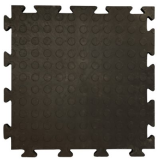 PennyLok Interlocking Garage Tiles$178.00PennyLok is an interlocking PVC floor tile with a classic coin pattern — raised round discs across the face. It lays straight over concrete with no adhesive, locks together at the edges, and lifts back out whenever you need to get underneath it. At 9/16" thick and 18" x 18"
...
PennyLok is an interlocking PVC floor tile with a classic coin pattern — raised round discs across the face. It...
View Details
View Details
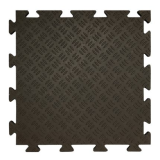 TredLok Interlocking Garage Tiles$178.00TredLok is an interlocking PVC floor tile with a three-bar checker-plate face — the same surface language as the steel plate on a truck bed or a stair landing. It looks like a working floor because it is one. Tiles are 18" x 18" and 9/16" thick. They lock together
...
TredLok is an interlocking PVC floor tile with a three-bar checker-plate face — the same surface language as the steel...
View Details
View Details
What Garage Flooring Protects You From
Bare concrete is porous. It drinks oil, brake fluid, and road salt, and it holds them. Once a slab is stained it stays stained, and once salt starts working into the surface it spalls and dusts. A sealed slab slows that down. It does not stop it, and resealing means clearing the whole garage.
A tile floor puts a non-porous layer between the slab and everything you spill on it. Flexible PVC resists most oils and acids, so a leak sits on the surface until you mop it instead of soaking in. The slab underneath stays clean, which matters most in a leased bay where you hand the space back at the end of the term.
The tiles also lift. If one section takes damage you pull that tile and drop in a replacement, rather than pricing out a whole floor. That single trait is what separates tile from a poured or rolled surface.
The Mistake That Shows Up Six Months In
Rubber tires stain vinyl. It is a chemical reaction between the antioxidant in some tire compounds and the plasticizer in the tile, and it leaves a permanent mark where the tire sits. On black and gray tiles you never see it. On light colors it shows badly, and it shows exactly where a car parks.
This is the single most common regret on a garage tile floor, and it is entirely avoidable. Choose black or gray anywhere a vehicle parks. If a lighter color matters for the look of the space, an anti-stain treatment or sealer helps, and the light tiles belong in walkways and work zones rather than under the tires.
The second issue is point loads. Tiles handle rolling traffic and parked vehicles without complaint, but a jack stand or a floor jack concentrates weight onto a few square inches. Put a spreader plate or a scrap of plywood under any stand before it takes load.
The third is edges. An unfinished tile edge at a doorway or an open floor line is a trip point and a place for a wheel to catch. Ramped edging pieces solve it, and they are worth specifying at the same time as the tiles rather than after someone catches a toe.
How the Two Options Compare
These two tiles are the same floor with a different face. Same flexible PVC, same 9/16" height, same 18" x 18" tile, same resistance to oils and acids, same interlocking system and ramped edging. Anyone telling you one outperforms the other is selling you a pattern. The decision is what you want the room to look like.
PennyLok carries a classic coin pattern — raised round discs in a regular grid. It reads as a finished floor rather than shop equipment, with a soft, even texture that holds up in photographs and does not fight with whatever else is in the room. That matters when the garage is part of the house, when a customer walks through it, or when the space doubles as a home gym. Strongest fit for home garages, showroom and display bays, dealership service entries, and fitness corners built into a garage.
TredLok carries a three-bar checker-plate pattern — the same language as the steel plate on a truck bed or a stair landing. It reads industrial on purpose. The busier surface also breaks up scuffing and tire marks visually, so a floor that gets worked on daily looks tired later than a smoother one would. Strongest fit for workshops, service and repair bays, tool rooms, equipment stores, and locker rooms.
Both come in black and gray as stock colors, with other colors available to order. That is enough to build a layout without any custom order at all. A black-and-gray checkerboard is the most common treatment and it reads deliberate rather than plain. Blocks of one color mark out a parking bay against a walkway, or set a workbench zone apart from the rest of the floor.
The ramped edging strips do double duty here. They come in black and yellow, so a yellow edge frames an aisle or a work zone as a visible boundary while it solves the trip point at an open floor line. Both tiles use the same edging, so the layout options are identical either way.
Three Things to Check Before You Pick
First, confirm tile is the right format at all. Interlocking tile suits a floor you want covered wall to wall, walked on, parked on, and worked on. If what you actually need is containment under one leaking vehicle, or a single stand-up work zone, a mat is the cheaper and more sensible answer and you should not tile the room.
Second, plan your colors around where the cars sit, not around the room as a whole. The staining rule above is a layout constraint more than a warning. Black and gray go under the tires, where they are unaffected and where the tile mold pattern matters least. Color goes in the walkways, the work zones, and the borders, where people look and where nothing parks. Set the layout that way and you can use color freely without ever risking a permanent mark.
Third, measure the whole floor and order it in one go. Color is matched within a single production batch, and a batch run months later is not guaranteed to match the one on your floor. Order the full area plus a few spare tiles at the same time. Those spares are your repair stock, and they are the reason a damaged tile is a five-minute fix instead of a visible patch.
Why Mats Inc.
We have been specifying commercial flooring since 1964, and the value we add on a floor like this is knowing what goes wrong before you find out. The tire staining rule, the batch-matching problem, the spreader plate under the jack stand — none of that is on a spec sheet, and all of it decides whether you are happy with the floor two years in.
We will also tell you when tile is the wrong call. Plenty of garage jobs are better served by a runner, a containment mat, or an anti-fatigue mat at a single station, and we would rather size the job correctly than sell you square footage you do not need.
Frequently Asked Questions
Which pattern should I choose, coin or checker-plate?
Answered by Jinna Hopson, Vice President of Marketing
It is purely a look decision, because the two tiles are built identically. Coin reads cleaner and more finished, so it suits a garage that is part of the house, a display space, or anywhere a customer sees the floor. Checker-plate reads like a working shop and hides day-to-day scuffing better because the pattern is busier.
If you are torn, think about who walks in. A space customers see leans coin. A space your team works in leans checker-plate.
Do these tiles need adhesive, and can I install them myself?
Answered by Dustin Thompson, Owner and CEO
No adhesive and no special tools. The tiles lock together with a jigsaw edge and lie loose over the slab, so a two-car garage is a straightforward afternoon for one or two people. Cuts at walls and around posts are made with a sharp utility knife and a straightedge.
The slab should be clean, dry, and reasonably flat before you start. Tiles bridge minor imperfections, but they follow a badly humped or dished slab rather than correcting it, so grind or level anything significant first.
Will this work for a home gym set up in a garage?
Answered by Dustin Thompson, Owner and CEO
Yes, and it is a common use for these. The PVC absorbs shock and cuts noise transfer, which matters if there is living space on the other side of the wall or above. Both tiles are rated by the manufacturer for fitness areas as well as garages and workshops.
One caution: this is a floor-protection tile, not a dedicated lifting platform. If you drop loaded barbells from height, build a plywood-and-rubber platform in that one spot and let the tile handle the rest of the room.
How long will an interlocking PVC floor last, and what ends its life early?
Answered by Dustin Thompson, Owner and CEO
Service life depends far more on what happens on the floor than on the tile itself, which is why we do not quote a fixed number of years. Three things end these floors early: point-load damage from jack stands used without a spreader plate, permanent tire staining on light-colored tiles, and sun exposure in an open bay, since the recycled black tile has no rated UV stability.
The advantage of tile is that failure is local. A damaged section is one tile, not the floor, so a floor with spare tiles on the shelf effectively keeps going as long as you keep swapping.
Will tires leave marks on the tiles?
Answered by Jinna Hopson, Vice President of Marketing
On light-colored tiles, yes. Some tire compounds react with the plasticizer in vinyl and leave a permanent stain where the tire sits. It is not a defect and it cannot be cleaned out once it happens.
Black and gray are unaffected, which is why they are the standard colors and why we recommend them anywhere a vehicle parks. If you want a lighter or brighter floor, apply an anti-stain treatment or sealer first, and keep the light tiles out of the parking footprint.
Can I get custom colors, or tiles cut to fit an odd-shaped garage?
Answered by Jinna Hopson, Vice President of Marketing
Black and gray are stock. Other colors are available to order, which opens up two-tone layouts, checkerboard patterns, or a colored border marking a walkway or a work zone. Call us for a quote on anything outside the standard colors.
Odd shapes are handled on site rather than in the factory. The tiles cut cleanly with a utility knife, so angled walls, posts, and door thresholds are trimmed as you lay the floor. Add roughly ten percent to your square footage to cover cuts and give yourself spare tiles.
By Dustin Thompson, Owner and CEO, Mats Inc.