






- Home
- Application Areas
- Electrical Matting
Electrical Safety Matting
At Mats Inc., our electrical safety matting provides an essential layer of protection in your workspace. Designed to withstand high-voltage equipment, these mats insulate and safeguard your employees from potential electrical shocks.
Our electrical safety mats are not only functional but also durable. They can withstand the rigors of daily use in high-traffic areas and continue to perform at the highest level. The anti-slip surface ensures additional safety, minimizing unfortunate slips and falls.
Investing in switchboard matting is a wise decision. It protects your team and conveys your commitment to creating a safe and secure working environment. With Mats Inc., you’ll choose a partner that understands the importance of workplace safety. Trust us to deliver products that meet your needs and exceed your expectations. Choose safety; choose Mats Inc.
 Smooth Marbleized Vinyl Switchboard Matting (Mil Spec)$1,249.00This is marbleized vinyl insulating sheet flooring built to MIL-DTL-15562G, Type I — the version installed in naval vessels in high-voltage compartments. Unlike a portable runner, it's laid as continuous flooring with heat-welded seams that give the finished surface water-tight integrity. It comes in blue standard or blue high gloss
...
This is marbleized vinyl insulating sheet flooring built to MIL-DTL-15562G, Type I — the version installed in naval vessels in...
This is marbleized vinyl insulating sheet flooring built to MIL-DTL-15562G, Type I — the version installed in naval vessels in high-voltage compartments. Unlike a portable runner, it's laid as continuous flooring with heat-welded seams that give the finished surface water-tight integrity. It comes in blue standard or blue high gloss at 1/8 inch thick.
What a Welded Insulating Floor Does That a Portable Mat Cannot
The insulating principle is the same across every product in this family. Current needs a complete circuit, and a person standing on bare deck in front of energized equipment is half of one. A non-conductive surface underfoot means the circuit has nowhere to close.
What changes here is coverage. A portable mat protects the footprint it occupies, and it has edges — places where the protection stops and somebody can step off without noticing. Sheet flooring with welded seams protects the whole compartment. There is no edge to step past because the floor itself is the barrier.
That distinction matters most in spaces where people work all around energized equipment rather than standing at one panel. In a shipboard high-voltage compartment, there isn't a single spot to place a mat. The protection has to be the deck.
The welded seams do a second job. Heat-welding the joints with matching thread produces a water-tight surface, so moisture can't get beneath the flooring and sit between the covering and the deck. On a vessel that matters for corrosion as much as for insulation, and it's the reason this product is installed rather than laid down.
The trade is permanence. This isn't something you roll out, use, and move. It's installed, and it stays. If you need coverage you can reposition, a portable runner is the right product and this one isn't.
Why Type I Marbleized, and What Gets Certified
MIL-DTL-15562G is the military detail specification for insulating switchboard matting and sheet floor covering. It's approved for use by the Department of the Navy and available across all departments and agencies of the Department of Defense. It supersedes MIL-M-15562F, which still appears on older drawings.
Type I within that specification is the marbleized sheeting. It has no connection to ASTM D178's Type I — same words, unrelated numbering systems, and both standards appear side by side in this catalog. Check which standard a drawing names before reading the type number.
The voltage figures are identical across all three MIL types, because the type describes surface and installation method rather than electrical rating. Dielectric test voltage is 30,000 VAC. Proof testing runs at 15,000 VAC across the entire surface of every roll. Recommended maximum use voltage is 3,000 VAC.
Read that last figure carefully. Military specification does not mean higher rated — commercial ASTM D178 Class 2 matting is cleared to 17,000 volts, well above this. The military standard applies a much wider margin between test voltage and service voltage. Different philosophy, not a different capability.
Where the military specification does go further is durability. The material meets additional property requirements for oxygen bomb aging, sulfuric acid exposure, and ultraviolet light exposure. Those test how the compound survives over years rather than what it withstands in a single dielectric test — which is the right emphasis for flooring that gets installed permanently.
The surface is fire-retardant, every roll is certified to the specification, and it's manufactured in blue standard or blue high gloss finish. Matching color welding thread is available for the seams.
Where It Belongs, and Where It Doesn't
Naval vessels first — high-voltage compartments are the application this was designed around. Beyond that, it suits any permanently occupied electrical space where a continuous insulating floor makes more sense than placed mats: control rooms, equipment compartments, and dedicated electrical spaces operating within the rated voltage. It sits with the rest of our electrical and switchboard matting, which covers the portable types and the commercial standards.
The finish choice follows the room. Blue standard is the workhorse and hides marks better in a working compartment. Blue high gloss reflects more light, which brightens a windowless space and reads as a more finished installation — worth considering where the compartment gets visitors or inspections.
The voltage boundary is 3,000 VAC. Equipment above that needs a different product regardless of what the specification package says, and that conflict belongs with whoever wrote the drawing rather than resolved on the deck.
Where it's the wrong choice: any application needing portability. If the requirement is a mat in front of one panel, or coverage that moves with the work, Type II smooth and Type III diamond plate exist for exactly that and install in minutes rather than requiring a flooring crew.
What it is not: an ESD or anti-static floor. Those are conductive by design, built to drain static charge to ground and protect sensitive electronics. This is an insulator — it blocks the path to ground entirely, offers no static control, and must never be grounded.
And it is not primary protection. De-energizing, verification, protective equipment, and trained procedure come first. This is the layer beneath all of that.
Three Things to Check Before You Spec It
First, confirm you want installed flooring rather than a mat. This is bonded down and welded at the seams, which means a proper installation and a permanent result. That's the right answer for a compartment and the wrong answer for a single panel. If the coverage needs to move, buy a runner instead.
Second, plan the seams before you measure. Rolls are 36 inches wide, so any space wider than that has seams, and every seam has to be heat-welded with matching thread for the water-tight integrity to hold. Lay out the seam positions with the installer, and order the welding thread with the material rather than after it.
Third, check 3,000 VAC against your equipment. Find the real working voltage rather than assuming, because the military designation implies capability the rating doesn't support. This is the most common error on MIL spec products, and permanent flooring is an expensive place to discover it.
Why Mats Inc.
Since 1964 we've learned to ask one question early on this product: is this a mat or a floor? People arrive asking for switchboard matting and describe a compartment, which is a flooring job with welded seams and an installer. Others describe a panel, which is a runner they can roll out this afternoon. We'll ask which one you actually have, along with your voltage and your specification call-out, before we quote anything.
Product Type Insulating (non-conductive) switchboard matting and sheet floor covering Standard MIL-DTL-15562G (formerly MIL-M-15562F), Type I Approvals Approved for use by the Department of the Navy; available to all Department of Defense departments and agencies Dielectric Test Voltage 30,000 VAC Proof Test 15,000 VAC, tested over the entire surface Recommended Max Use Voltage 3,000 VAC Additional Testing Oxygen bomb aging, sulfuric acid, ultraviolet light exposure Material Vinyl, fire-retardant Surface Marbleized Finishes Blue standard or blue high gloss Seaming Heat-welded seams for water-tight integrity; matching color welding thread available Thickness 1/8 inch Size 36 inch width x 75 ft. length Roll Weight 225 lb. Certification Every roll certified to MIL-DTL-15562G Recommended For Naval vessel high-voltage compartments, permanently installed electrical spaces Static Control None — this is an insulator, not an ESD or anti-static product Warranty 1-year limited (Mats Inc.) Frequently Asked Questions
What makes Type I different from the other military spec options?
Installation method, and it's a bigger difference than it sounds. Type I is sheet floor covering — bonded down and joined with heat-welded seams so the finished surface is continuous and water-tight. Type II smooth and Type III diamond plate are portable runners you roll out in front of equipment or across a bench.
The electrical performance is identical across all three: 30,000 VAC dielectric test, 15,000 VAC proof test over the entire surface, 3,000 VAC recommended maximum use. What you're choosing between is coverage and permanence. A runner protects where it sits and has edges somebody can step past. Welded sheet flooring protects the whole compartment with no edge at all, which is why it's what goes into naval high-voltage spaces. — Dustin Thompson, Owner & CEO, Mats Inc.
What are the ratings, and what does the additional testing cover?
Dielectric test voltage is 30,000 VAC, proof testing runs at 15,000 VAC across the entire surface of every roll rather than sampled sections, and the recommended maximum use voltage is 3,000 VAC. That last number governs placement. The margin above it is deliberate rather than capacity to draw on.
The additional requirements are what set this specification apart from a pure voltage standard. The material has to perform against oxygen bomb aging, sulfuric acid exposure, and ultraviolet light. Those test how the vinyl survives over years and against conditions that degrade it — which matters far more on permanently installed flooring than on a mat you can replace in an afternoon. The surface is also fire-retardant, and every roll is certified to the specification. — Dustin Thompson, Owner & CEO, Mats Inc.
How does it install, and does it need grounding?
It's bonded to the existing deck or floor and the seams are heat-welded with matching color thread. That welding is what delivers the water-tight integrity, so it isn't optional finishing — it's what makes the installation perform as specified. This is work for someone experienced with welded vinyl flooring, not a roll-and-trim job.
No grounding, and that deserves emphasis on a permanent installation. Grounding an insulating floor destroys its entire function, because the mechanism is that no path runs from a person through the covering to ground. Anyone used to conductive or ESD flooring may expect a ground connection as part of the install. On this product that expectation is dangerous, and it's much harder to undo once the floor is down and welded. — Dustin Thompson, Owner & CEO, Mats Inc.
What size does it come in, and how do I estimate a compartment?
It ships in 36 inch by 75 foot rolls at 1/8 inch thick, and each roll weighs 225 pounds — plan on two people and equipment to move it.
For estimating, measure the length and width of each space and calculate square footage, then think in strips rather than area. At 36 inches wide, work out how many runs the room takes and where the seams land, adding a few inches of overlap at each joint for trimming and welding. Add margin for cuts around equipment bases, hatches, and fixtures. Order the matching welding thread at the same time — you'll need it, and it's frustrating to have the flooring on site without it. Send us the room dimensions and we'll work the strip layout with you. — Jinna Hopson, Vice President of Marketing, Mats Inc.
What's the difference between blue standard and blue high gloss?
Both are the same marbleized blue with identical specification, thickness, certification, and rating. The difference is the finish, and it changes how a compartment reads more than you'd expect.
Blue standard has a lower sheen that diffuses light and forgives scuffs, marks, and foot traffic — the practical choice for a working space that sees daily use. Blue high gloss reflects considerably more light, which genuinely brightens a windowless compartment where lighting is limited, and it presents as a finished, maintained installation. That makes it worth considering in spaces that get inspections, tours, or visitors. The trade is that gloss shows wear and scuffing sooner, so it asks for more upkeep to keep looking the way it did on day one. — Jinna Hopson, Vice President of Marketing, Mats Inc.
Do I need this, a portable runner, or a commercial mat?
Three questions sort it out. Does your paperwork name MIL-DTL-15562G or the older MIL-M-15562F? If so, you're in the military line, and a commercial mat won't satisfy that call-out however it's rated. Is the equipment within 3,000 volts? Above that, you need the commercial ASTM line, where Class 2 reaches 17,000 and higher classes go further.
Then the question that actually separates this product from its siblings: are you covering a compartment or protecting a position? A whole space with people working all around energized equipment wants continuous welded flooring with no edges to step past. A single panel or a bench wants a portable runner — Type II smooth for benches and clean-down, Type III diamond plate where traction matters. Describe the space and the specification to us and we'll tell you which of the three fits. — Jinna Hopson, Vice President of Marketing, Mats Inc.
Written by Jinna Hopson, Vice President of Marketing, Mats Inc.
↑
This is marbleized vinyl insulating sheet flooring built to MIL-DTL-15562G, Type I — the version installed in naval vessels in high-voltage compartments. Unlike a portable runner, it's laid as continuous flooring with heat-welded seams that give the finished surface water-tight integrity. It comes in blue standard or blue high gloss at 1/8 inch thick.
What a Welded Insulating Floor Does That a Portable Mat Cannot
The insulating principle is the same across every product in this family. Current needs a complete circuit, and a person standing on bare deck in front of energized equipment is half of one. A non-conductive surface underfoot means the circuit has nowhere to close.
What changes here is coverage. A portable mat protects the footprint it occupies, and it has edges — places where the protection stops and somebody can step off without noticing. Sheet flooring with welded seams protects the whole compartment. There is no edge to step past because the floor itself is the barrier.
That distinction matters most in spaces where people work all around energized equipment rather than standing at one panel. In a shipboard high-voltage compartment, there isn't a single spot to place a mat. The protection has to be the deck.
The welded seams do a second job. Heat-welding the joints with matching thread produces a water-tight surface, so moisture can't get beneath the flooring and sit between the covering and the deck. On a vessel that matters for corrosion as much as for insulation, and it's the reason this product is installed rather than laid down.
The trade is permanence. This isn't something you roll out, use, and move. It's installed, and it stays. If you need coverage you can reposition, a portable runner is the right product and this one isn't.
Why Type I Marbleized, and What Gets Certified
MIL-DTL-15562G is the military detail specification for insulating switchboard matting and sheet floor covering. It's approved for use by the Department of the Navy and available across all departments and agencies of the Department of Defense. It supersedes MIL-M-15562F, which still appears on older drawings.
Type I within that specification is the marbleized sheeting. It has no connection to ASTM D178's Type I — same words, unrelated numbering systems, and both standards appear side by side in this catalog. Check which standard a drawing names before reading the type number.
The voltage figures are identical across all three MIL types, because the type describes surface and installation method rather than electrical rating. Dielectric test voltage is 30,000 VAC. Proof testing runs at 15,000 VAC across the entire surface of every roll. Recommended maximum use voltage is 3,000 VAC.
Read that last figure carefully. Military specification does not mean higher rated — commercial ASTM D178 Class 2 matting is cleared to 17,000 volts, well above this. The military standard applies a much wider margin between test voltage and service voltage. Different philosophy, not a different capability.
Where the military specification does go further is durability. The material meets additional property requirements for oxygen bomb aging, sulfuric acid exposure, and ultraviolet light exposure. Those test how the compound survives over years rather than what it withstands in a single dielectric test — which is the right emphasis for flooring that gets installed permanently.
The surface is fire-retardant, every roll is certified to the specification, and it's manufactured in blue standard or blue high gloss finish. Matching color welding thread is available for the seams.
Where It Belongs, and Where It Doesn't
Naval vessels first — high-voltage compartments are the application this was designed around. Beyond that, it suits any permanently occupied electrical space where a continuous insulating floor makes more sense than placed mats: control rooms, equipment compartments, and dedicated electrical spaces operating within the rated voltage. It sits with the rest of our electrical and switchboard matting, which covers the portable types and the commercial standards.
The finish choice follows the room. Blue standard is the workhorse and hides marks better in a working compartment. Blue high gloss reflects more light, which brightens a windowless space and reads as a more finished installation — worth considering where the compartment gets visitors or inspections.
The voltage boundary is 3,000 VAC. Equipment above that needs a different product regardless of what the specification package says, and that conflict belongs with whoever wrote the drawing rather than resolved on the deck.
Where it's the wrong choice: any application needing portability. If the requirement is a mat in front of one panel, or coverage that moves with the work, Type II smooth and Type III diamond plate exist for exactly that and install in minutes rather than requiring a flooring crew.
What it is not: an ESD or anti-static floor. Those are conductive by design, built to drain static charge to ground and protect sensitive electronics. This is an insulator — it blocks the path to ground entirely, offers no static control, and must never be grounded.
And it is not primary protection. De-energizing, verification, protective equipment, and trained procedure come first. This is the layer beneath all of that.
Three Things to Check Before You Spec It
First, confirm you want installed flooring rather than a mat. This is bonded down and welded at the seams, which means a proper installation and a permanent result. That's the right answer for a compartment and the wrong answer for a single panel. If the coverage needs to move, buy a runner instead.
Second, plan the seams before you measure. Rolls are 36 inches wide, so any space wider than that has seams, and every seam has to be heat-welded with matching thread for the water-tight integrity to hold. Lay out the seam positions with the installer, and order the welding thread with the material rather than after it.
Third, check 3,000 VAC against your equipment. Find the real working voltage rather than assuming, because the military designation implies capability the rating doesn't support. This is the most common error on MIL spec products, and permanent flooring is an expensive place to discover it.
Why Mats Inc.
Since 1964 we've learned to ask one question early on this product: is this a mat or a floor? People arrive asking for switchboard matting and describe a compartment, which is a flooring job with welded seams and an installer. Others describe a panel, which is a runner they can roll out this afternoon. We'll ask which one you actually have, along with your voltage and your specification call-out, before we quote anything.
Product Type Insulating (non-conductive) switchboard matting and sheet floor covering Standard MIL-DTL-15562G (formerly MIL-M-15562F), Type I Approvals Approved for use by the Department of the Navy; available to all Department of Defense departments and agencies Dielectric Test Voltage 30,000 VAC Proof Test 15,000 VAC, tested over the entire surface Recommended Max Use Voltage 3,000 VAC Additional Testing Oxygen bomb aging, sulfuric acid, ultraviolet light exposure Material Vinyl, fire-retardant Surface Marbleized Finishes Blue standard or blue high gloss Seaming Heat-welded seams for water-tight integrity; matching color welding thread available Thickness 1/8 inch Size 36 inch width x 75 ft. length Roll Weight 225 lb. Certification Every roll certified to MIL-DTL-15562G Recommended For Naval vessel high-voltage compartments, permanently installed electrical spaces Static Control None — this is an insulator, not an ESD or anti-static product Warranty 1-year limited (Mats Inc.) Frequently Asked Questions
What makes Type I different from the other military spec options?
Installation method, and it's a bigger difference than it sounds. Type I is sheet floor covering — bonded down and joined with heat-welded seams so the finished surface is continuous and water-tight. Type II smooth and Type III diamond plate are portable runners you roll out in front of equipment or across a bench.
The electrical performance is identical across all three: 30,000 VAC dielectric test, 15,000 VAC proof test over the entire surface, 3,000 VAC recommended maximum use. What you're choosing between is coverage and permanence. A runner protects where it sits and has edges somebody can step past. Welded sheet flooring protects the whole compartment with no edge at all, which is why it's what goes into naval high-voltage spaces. — Dustin Thompson, Owner & CEO, Mats Inc.
What are the ratings, and what does the additional testing cover?
Dielectric test voltage is 30,000 VAC, proof testing runs at 15,000 VAC across the entire surface of every roll rather than sampled sections, and the recommended maximum use voltage is 3,000 VAC. That last number governs placement. The margin above it is deliberate rather than capacity to draw on.
The additional requirements are what set this specification apart from a pure voltage standard. The material has to perform against oxygen bomb aging, sulfuric acid exposure, and ultraviolet light. Those test how the vinyl survives over years and against conditions that degrade it — which matters far more on permanently installed flooring than on a mat you can replace in an afternoon. The surface is also fire-retardant, and every roll is certified to the specification. — Dustin Thompson, Owner & CEO, Mats Inc.
How does it install, and does it need grounding?
It's bonded to the existing deck or floor and the seams are heat-welded with matching color thread. That welding is what delivers the water-tight integrity, so it isn't optional finishing — it's what makes the installation perform as specified. This is work for someone experienced with welded vinyl flooring, not a roll-and-trim job.
No grounding, and that deserves emphasis on a permanent installation. Grounding an insulating floor destroys its entire function, because the mechanism is that no path runs from a person through the covering to ground. Anyone used to conductive or ESD flooring may expect a ground connection as part of the install. On this product that expectation is dangerous, and it's much harder to undo once the floor is down and welded. — Dustin Thompson, Owner & CEO, Mats Inc.
What size does it come in, and how do I estimate a compartment?
It ships in 36 inch by 75 foot rolls at 1/8 inch thick, and each roll weighs 225 pounds — plan on two people and equipment to move it.
For estimating, measure the length and width of each space and calculate square footage, then think in strips rather than area. At 36 inches wide, work out how many runs the room takes and where the seams land, adding a few inches of overlap at each joint for trimming and welding. Add margin for cuts around equipment bases, hatches, and fixtures. Order the matching welding thread at the same time — you'll need it, and it's frustrating to have the flooring on site without it. Send us the room dimensions and we'll work the strip layout with you. — Jinna Hopson, Vice President of Marketing, Mats Inc.
What's the difference between blue standard and blue high gloss?
Both are the same marbleized blue with identical specification, thickness, certification, and rating. The difference is the finish, and it changes how a compartment reads more than you'd expect.
Blue standard has a lower sheen that diffuses light and forgives scuffs, marks, and foot traffic — the practical choice for a working space that sees daily use. Blue high gloss reflects considerably more light, which genuinely brightens a windowless compartment where lighting is limited, and it presents as a finished, maintained installation. That makes it worth considering in spaces that get inspections, tours, or visitors. The trade is that gloss shows wear and scuffing sooner, so it asks for more upkeep to keep looking the way it did on day one. — Jinna Hopson, Vice President of Marketing, Mats Inc.
Do I need this, a portable runner, or a commercial mat?
Three questions sort it out. Does your paperwork name MIL-DTL-15562G or the older MIL-M-15562F? If so, you're in the military line, and a commercial mat won't satisfy that call-out however it's rated. Is the equipment within 3,000 volts? Above that, you need the commercial ASTM line, where Class 2 reaches 17,000 and higher classes go further.
Then the question that actually separates this product from its siblings: are you covering a compartment or protecting a position? A whole space with people working all around energized equipment wants continuous welded flooring with no edges to step past. A single panel or a bench wants a portable runner — Type II smooth for benches and clean-down, Type III diamond plate where traction matters. Describe the space and the specification to us and we'll tell you which of the three fits. — Jinna Hopson, Vice President of Marketing, Mats Inc.
Written by Jinna Hopson, Vice President of Marketing, Mats Inc.
↑
View Details
View Details
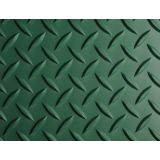 Diamond Plate Vinyl Switchboard Matting (Mil Spec)$1,099.00This is diamond plate vinyl switchboard matting built to MIL-DTL-15562G, Type III — the military specification for electrical insulating matting. It carries a dielectric test voltage of 30,000 VAC, is proof tested across its entire surface at 15,000 VAC, and has a recommended maximum use voltage of 3,000 VAC. It
...
This is diamond plate vinyl switchboard matting built to MIL-DTL-15562G, Type III — the military specification for electrical insulating matting....
This is diamond plate vinyl switchboard matting built to MIL-DTL-15562G, Type III — the military specification for electrical insulating matting. It carries a dielectric test voltage of 30,000 VAC, is proof tested across its entire surface at 15,000 VAC, and has a recommended maximum use voltage of 3,000 VAC. It ships in 36 inch by 75 foot rolls at 3/16 inch thick.
What This Matting Does, and the Assumption That Gets It Specified Wrong
The mechanism is the same as any insulating mat. Current needs a complete circuit, and a worker standing on bare floor in front of live equipment is half of one. Put an insulating barrier underfoot and the circuit has nowhere to close, so contact with an energized part stops being a path through a person.
Here's where this product needs a plain warning. "Military specification" sounds like a higher rating, and people reach for it on that basis. The recommended maximum use voltage on this mat is 3,000 VAC. Commercial ASTM D178 Class 2 matting is rated to 17,000. The military spec is not the higher-rated product.
That gap trips up buyers who reasonably assume defense standards outrank commercial ones. What MIL-DTL-15562G actually does is apply a much wider safety margin between what the material survives in testing and what it's cleared for in service. It's a more conservative philosophy, not a more capable material.
So the specification decision is straightforward once you know it. Buy this when a contract, drawing, or facility standard names MIL-DTL-15562G. If you're selecting on voltage alone, check the number against your equipment before anything else, because the name on the standard tells you nothing useful about the rating.
Why MIL-DTL-15562G Type III, and What the Numbers Mean
MIL-DTL-15562G is the current designation for the military detail specification covering electrical insulating matting. It replaced MIL-M-15562F, and older drawings still reference that earlier number — worth knowing when you're reading a legacy spec package and trying to work out whether it's been superseded.
Type III is a classification within the military spec, and it has no relationship to ASTM's Type I and Type II. Same word, entirely different numbering system. A drawing calling for Type III under MIL-DTL-15562G is not asking for anything ASTM Type designations describe.
The three voltage figures do different jobs. Dielectric test voltage of 30,000 VAC is the level the material is proven to withstand under laboratory conditions. Proof testing at 15,000 VAC runs across the entire surface of every roll — not sampled sections, because a barrier is only as good as its weakest square inch.
Recommended maximum use voltage of 3,000 VAC is the only one that governs where the mat goes. The distance between 15,000 and 3,000 is the margin the military specification builds in deliberately, and it isn't reserve capacity you're meant to draw on.
Construction is vinyl at 3/16 inch with a diamond plate surface. The raised pattern is multidirectional, so traction holds regardless of which way somebody plants a foot — useful around equipment where people pivot and sidestep rather than walking a straight line. It also gives debris no continuous channel to travel along.
Where It Belongs, and Where It Doesn't
This belongs wherever MIL-DTL-15562G is called out by name: military installations, shipboard and naval facilities, defense contractor floors, and any site working to federal specification packages. It also fits industrial work at lower voltages where the diamond plate surface and the insulation both matter. It sits with the rest of our electrical and switchboard matting, which covers the ASTM types and classes.
The practical boundary is the 3,000 VAC rating. Control cabinets, distribution panels, and workbench areas operating within that limit are a good fit. Medium and high voltage switchgear are not, and no amount of military-specification pedigree changes that.
If your requirement is voltage rather than compliance, look at the commercial standard instead. ASTM D178 offers classes rated well above this one, and there's no advantage in specifying a military standard for equipment it wasn't rated to cover.
What it is not: an ESD or anti-static mat. Those are conductive by design, built to drain static charge to ground and protect sensitive electronics. This blocks that path entirely. Grounding it would defeat its purpose, and the two are not interchangeable in either direction.
It's also not an anti-fatigue mat or general floor protection, and it is not primary protection. De-energizing, verification, protective equipment, and trained procedure come first. This is the layer beneath all of that — the one still working when something else doesn't.
Three Things to Check Before You Spec It
First, confirm the standard is what your job actually requires. If a contract or drawing names MIL-DTL-15562G, or references the older MIL-M-15562F, this is the product. If nothing names it, ask why you're buying to a military specification — the commercial standard covers a wider voltage range and may fit your equipment better.
Second, check 3,000 VAC against your equipment before anything else. Find the actual working voltage at each panel or cabinet rather than assuming. This is the single most common error on this product, because the specification name suggests capability the rating doesn't support. If your voltage exceeds 3,000, you need a different product regardless of what the drawing says.
Third, plan coverage around movement. This comes 36 inches wide. Watch how people work the equipment — how far they step back, how far they reach sideways — and confirm one run keeps them on the mat throughout. Cutting a 75-foot roll into sections is normal, so a single roll usually serves several positions.
Why Mats Inc.
Since 1964 we've handled enough specification packages to know that the hardest part is often reading what the drawing actually asks for. On this product we'll ask two questions before quoting: does your paperwork name the military standard, and what voltage are you working at. Those answers point to different products often enough that we'd rather ask than assume, and we'd rather send you to the commercial line than sell you a mat your equipment outranks.
Product Type Insulating (non-conductive) switchboard matting Standard MIL-DTL-15562G (formerly MIL-M-15562F), Type III Dielectric Test Voltage 30,000 VAC Proof Test 15,000 VAC, tested over the entire surface Recommended Max Use Voltage 3,000 VAC Material Vinyl Surface Diamond plate Thickness 3/16 inch Size 36 inch width x 75 ft. length Recommended For Military and defense facilities, industrial electrical work within the rated voltage Static Control None — this is an insulator, not an ESD or anti-static product Warranty 1-year limited (Mats Inc.) Frequently Asked Questions
What does MIL-DTL-15562G Type III mean, and is Type III the same as ASTM Type I or II?
MIL-DTL-15562G is the military detail specification for electrical insulating matting. It supersedes MIL-M-15562F, which still shows up on older drawings — so if you're reading a legacy package that cites the F revision, this is the current product answering it.
On the second question: no, and it's a genuine trap. Type III belongs to the military specification's own classification system and has no connection to ASTM D178's Type I and Type II. The word is identical, the numbering systems are unrelated, and the two standards sit side by side in most catalogs. A drawing calling for Type III under MIL-DTL-15562G is not asking for anything an ASTM Type designation describes, and vice versa. Read which standard is named before you read the type number. — Dustin Thompson, Owner & CEO, Mats Inc.
Why is the maximum use voltage only 3,000 when it's tested at 15,000?
Because the military specification builds in a much wider safety margin than the commercial one does. The 30,000 VAC dielectric figure is what the material withstands in laboratory testing. The 15,000 VAC proof test is applied across the entire surface of every roll, not sampled sections. The 3,000 VAC recommended maximum use voltage is what governs where you can actually put it.
That margin is deliberate and it is not reserve capacity to draw on. It's also why this product needs care in specification: people see "military grade" and assume a higher rating, when commercial ASTM D178 Class 2 matting is rated to 17,000 volts — more than five times this one. Neither product is better. They're written to different philosophies, and the only thing that matters is whether the published use voltage covers your equipment. — Dustin Thompson, Owner & CEO, Mats Inc.
Where should it go, and does it need grounding or fastening?
Put it in front of equipment operating within 3,000 VAC — control cabinets, distribution panels, and workbench areas — and anywhere a contract or facility standard names the military specification. It should cover the full area a worker occupies, with enough margin that they can shift, step back, or reach sideways without a foot landing on bare floor.
No grounding, and this deserves bluntness. Grounding an insulating mat destroys its entire function, because the mechanism is that no path runs from the worker through the floor to ground. Anyone used to ESD matting may reach for a ground cord from habit, and here that habit is dangerous. On fastening, it's meant to lie loose so it can be lifted, inspected underneath, and replaced without demolition — adhesives and mechanical fasteners can puncture or contaminate the barrier. Let it relax flat after unrolling, then cut with a sharp blade against a straightedge. — Dustin Thompson, Owner & CEO, Mats Inc.
What size does it come in, and how much should I order?
One configuration: 36 inches wide by 75 feet long at 3/16 inch thick, sold as a full roll. At 3/16 inch it's thinner than the 1/4 inch commercial mats, which makes it a bit easier to handle and means less of a step at the edge — worth knowing if door clearance or a transition is tight.
For quantity, work position by position rather than room by room. Measure the width of each panel, cabinet, or bench, add margin on both sides so a worker never runs out of mat when they move, and total those lengths. Seventy-five feet usually covers several positions once it's cut to length. Send us your equipment list with the voltages and the specification your drawing calls for, and we'll size it with you. — Jinna Hopson, Vice President of Marketing, Mats Inc.
What does it look like and what's it like to work with?
Black with a raised diamond pattern — the same visual language as a steel stair tread or a truck bed, which reads correctly as equipment rather than as flooring. Underfoot it's a low, broad pattern that grips without feeling like standing on texture.
The practical advantage of the pattern is that it works in every direction. Corrugated ridges grip best across their line and less well along it; a diamond layout doesn't care which way you plant a foot, which matters when someone is pivoting between adjacent cabinets rather than walking a straight path. It also stays presentable, because there's no continuous channel for grit and shavings to collect in — a sweep keeps it looking maintained. — Jinna Hopson, Vice President of Marketing, Mats Inc.
Do I need the military spec version or the commercial one?
Let your paperwork decide it. If a contract, drawing, or facility standard names MIL-DTL-15562G or the older MIL-M-15562F, buy this one — a commercial mat won't satisfy that call-out no matter how it's rated. Defense work, shipboard installations, and federal facilities often specify it directly.
If nothing names the military standard, the commercial line is usually the better fit. ASTM D178 covers a much wider voltage range, with Class 2 rated to 17,000 volts and higher classes above that, so it can serve equipment this product can't. And if your paperwork names the military spec but your equipment runs above 3,000 volts, that's a conflict to raise with whoever wrote the drawing rather than a decision to make on the floor. Send us the call-out and the voltage and we'll help you sort out which one you actually need. — Jinna Hopson, Vice President of Marketing, Mats Inc.
Written by Dustin Thompson, Owner & CEO, Mats Inc.
↑
This is diamond plate vinyl switchboard matting built to MIL-DTL-15562G, Type III — the military specification for electrical insulating matting. It carries a dielectric test voltage of 30,000 VAC, is proof tested across its entire surface at 15,000 VAC, and has a recommended maximum use voltage of 3,000 VAC. It ships in 36 inch by 75 foot rolls at 3/16 inch thick.
What This Matting Does, and the Assumption That Gets It Specified Wrong
The mechanism is the same as any insulating mat. Current needs a complete circuit, and a worker standing on bare floor in front of live equipment is half of one. Put an insulating barrier underfoot and the circuit has nowhere to close, so contact with an energized part stops being a path through a person.
Here's where this product needs a plain warning. "Military specification" sounds like a higher rating, and people reach for it on that basis. The recommended maximum use voltage on this mat is 3,000 VAC. Commercial ASTM D178 Class 2 matting is rated to 17,000. The military spec is not the higher-rated product.
That gap trips up buyers who reasonably assume defense standards outrank commercial ones. What MIL-DTL-15562G actually does is apply a much wider safety margin between what the material survives in testing and what it's cleared for in service. It's a more conservative philosophy, not a more capable material.
So the specification decision is straightforward once you know it. Buy this when a contract, drawing, or facility standard names MIL-DTL-15562G. If you're selecting on voltage alone, check the number against your equipment before anything else, because the name on the standard tells you nothing useful about the rating.
Why MIL-DTL-15562G Type III, and What the Numbers Mean
MIL-DTL-15562G is the current designation for the military detail specification covering electrical insulating matting. It replaced MIL-M-15562F, and older drawings still reference that earlier number — worth knowing when you're reading a legacy spec package and trying to work out whether it's been superseded.
Type III is a classification within the military spec, and it has no relationship to ASTM's Type I and Type II. Same word, entirely different numbering system. A drawing calling for Type III under MIL-DTL-15562G is not asking for anything ASTM Type designations describe.
The three voltage figures do different jobs. Dielectric test voltage of 30,000 VAC is the level the material is proven to withstand under laboratory conditions. Proof testing at 15,000 VAC runs across the entire surface of every roll — not sampled sections, because a barrier is only as good as its weakest square inch.
Recommended maximum use voltage of 3,000 VAC is the only one that governs where the mat goes. The distance between 15,000 and 3,000 is the margin the military specification builds in deliberately, and it isn't reserve capacity you're meant to draw on.
Construction is vinyl at 3/16 inch with a diamond plate surface. The raised pattern is multidirectional, so traction holds regardless of which way somebody plants a foot — useful around equipment where people pivot and sidestep rather than walking a straight line. It also gives debris no continuous channel to travel along.
Where It Belongs, and Where It Doesn't
This belongs wherever MIL-DTL-15562G is called out by name: military installations, shipboard and naval facilities, defense contractor floors, and any site working to federal specification packages. It also fits industrial work at lower voltages where the diamond plate surface and the insulation both matter. It sits with the rest of our electrical and switchboard matting, which covers the ASTM types and classes.
The practical boundary is the 3,000 VAC rating. Control cabinets, distribution panels, and workbench areas operating within that limit are a good fit. Medium and high voltage switchgear are not, and no amount of military-specification pedigree changes that.
If your requirement is voltage rather than compliance, look at the commercial standard instead. ASTM D178 offers classes rated well above this one, and there's no advantage in specifying a military standard for equipment it wasn't rated to cover.
What it is not: an ESD or anti-static mat. Those are conductive by design, built to drain static charge to ground and protect sensitive electronics. This blocks that path entirely. Grounding it would defeat its purpose, and the two are not interchangeable in either direction.
It's also not an anti-fatigue mat or general floor protection, and it is not primary protection. De-energizing, verification, protective equipment, and trained procedure come first. This is the layer beneath all of that — the one still working when something else doesn't.
Three Things to Check Before You Spec It
First, confirm the standard is what your job actually requires. If a contract or drawing names MIL-DTL-15562G, or references the older MIL-M-15562F, this is the product. If nothing names it, ask why you're buying to a military specification — the commercial standard covers a wider voltage range and may fit your equipment better.
Second, check 3,000 VAC against your equipment before anything else. Find the actual working voltage at each panel or cabinet rather than assuming. This is the single most common error on this product, because the specification name suggests capability the rating doesn't support. If your voltage exceeds 3,000, you need a different product regardless of what the drawing says.
Third, plan coverage around movement. This comes 36 inches wide. Watch how people work the equipment — how far they step back, how far they reach sideways — and confirm one run keeps them on the mat throughout. Cutting a 75-foot roll into sections is normal, so a single roll usually serves several positions.
Why Mats Inc.
Since 1964 we've handled enough specification packages to know that the hardest part is often reading what the drawing actually asks for. On this product we'll ask two questions before quoting: does your paperwork name the military standard, and what voltage are you working at. Those answers point to different products often enough that we'd rather ask than assume, and we'd rather send you to the commercial line than sell you a mat your equipment outranks.
Product Type Insulating (non-conductive) switchboard matting Standard MIL-DTL-15562G (formerly MIL-M-15562F), Type III Dielectric Test Voltage 30,000 VAC Proof Test 15,000 VAC, tested over the entire surface Recommended Max Use Voltage 3,000 VAC Material Vinyl Surface Diamond plate Thickness 3/16 inch Size 36 inch width x 75 ft. length Recommended For Military and defense facilities, industrial electrical work within the rated voltage Static Control None — this is an insulator, not an ESD or anti-static product Warranty 1-year limited (Mats Inc.) Frequently Asked Questions
What does MIL-DTL-15562G Type III mean, and is Type III the same as ASTM Type I or II?
MIL-DTL-15562G is the military detail specification for electrical insulating matting. It supersedes MIL-M-15562F, which still shows up on older drawings — so if you're reading a legacy package that cites the F revision, this is the current product answering it.
On the second question: no, and it's a genuine trap. Type III belongs to the military specification's own classification system and has no connection to ASTM D178's Type I and Type II. The word is identical, the numbering systems are unrelated, and the two standards sit side by side in most catalogs. A drawing calling for Type III under MIL-DTL-15562G is not asking for anything an ASTM Type designation describes, and vice versa. Read which standard is named before you read the type number. — Dustin Thompson, Owner & CEO, Mats Inc.
Why is the maximum use voltage only 3,000 when it's tested at 15,000?
Because the military specification builds in a much wider safety margin than the commercial one does. The 30,000 VAC dielectric figure is what the material withstands in laboratory testing. The 15,000 VAC proof test is applied across the entire surface of every roll, not sampled sections. The 3,000 VAC recommended maximum use voltage is what governs where you can actually put it.
That margin is deliberate and it is not reserve capacity to draw on. It's also why this product needs care in specification: people see "military grade" and assume a higher rating, when commercial ASTM D178 Class 2 matting is rated to 17,000 volts — more than five times this one. Neither product is better. They're written to different philosophies, and the only thing that matters is whether the published use voltage covers your equipment. — Dustin Thompson, Owner & CEO, Mats Inc.
Where should it go, and does it need grounding or fastening?
Put it in front of equipment operating within 3,000 VAC — control cabinets, distribution panels, and workbench areas — and anywhere a contract or facility standard names the military specification. It should cover the full area a worker occupies, with enough margin that they can shift, step back, or reach sideways without a foot landing on bare floor.
No grounding, and this deserves bluntness. Grounding an insulating mat destroys its entire function, because the mechanism is that no path runs from the worker through the floor to ground. Anyone used to ESD matting may reach for a ground cord from habit, and here that habit is dangerous. On fastening, it's meant to lie loose so it can be lifted, inspected underneath, and replaced without demolition — adhesives and mechanical fasteners can puncture or contaminate the barrier. Let it relax flat after unrolling, then cut with a sharp blade against a straightedge. — Dustin Thompson, Owner & CEO, Mats Inc.
What size does it come in, and how much should I order?
One configuration: 36 inches wide by 75 feet long at 3/16 inch thick, sold as a full roll. At 3/16 inch it's thinner than the 1/4 inch commercial mats, which makes it a bit easier to handle and means less of a step at the edge — worth knowing if door clearance or a transition is tight.
For quantity, work position by position rather than room by room. Measure the width of each panel, cabinet, or bench, add margin on both sides so a worker never runs out of mat when they move, and total those lengths. Seventy-five feet usually covers several positions once it's cut to length. Send us your equipment list with the voltages and the specification your drawing calls for, and we'll size it with you. — Jinna Hopson, Vice President of Marketing, Mats Inc.
What does it look like and what's it like to work with?
Black with a raised diamond pattern — the same visual language as a steel stair tread or a truck bed, which reads correctly as equipment rather than as flooring. Underfoot it's a low, broad pattern that grips without feeling like standing on texture.
The practical advantage of the pattern is that it works in every direction. Corrugated ridges grip best across their line and less well along it; a diamond layout doesn't care which way you plant a foot, which matters when someone is pivoting between adjacent cabinets rather than walking a straight path. It also stays presentable, because there's no continuous channel for grit and shavings to collect in — a sweep keeps it looking maintained. — Jinna Hopson, Vice President of Marketing, Mats Inc.
Do I need the military spec version or the commercial one?
Let your paperwork decide it. If a contract, drawing, or facility standard names MIL-DTL-15562G or the older MIL-M-15562F, buy this one — a commercial mat won't satisfy that call-out no matter how it's rated. Defense work, shipboard installations, and federal facilities often specify it directly.
If nothing names the military standard, the commercial line is usually the better fit. ASTM D178 covers a much wider voltage range, with Class 2 rated to 17,000 volts and higher classes above that, so it can serve equipment this product can't. And if your paperwork names the military spec but your equipment runs above 3,000 volts, that's a conflict to raise with whoever wrote the drawing rather than a decision to make on the floor. Send us the call-out and the voltage and we'll help you sort out which one you actually need. — Jinna Hopson, Vice President of Marketing, Mats Inc.
Written by Dustin Thompson, Owner & CEO, Mats Inc.
↑
View Details
View Details
 Discovery ESD Carpet Tile$379.00Discovery ESD Carpet Tile is a static dissipative modular tile built to drain electrostatic charge out of a room instead of letting it build up in the people walking through it. A continuous conductive monofilament runs through the yarn, tying the whole floor to a ground path. It's a 24
...
Discovery ESD Carpet Tile is a static dissipative modular tile built to drain electrostatic charge out of a room instead...
Discovery ESD Carpet Tile is a static dissipative modular tile built to drain electrostatic charge out of a room instead of letting it build up in the people walking through it. A continuous conductive monofilament runs through the yarn, tying the whole floor to a ground path. It's a 24 by 24 inch tufted tile that meets ANSI/ESD S20.20 and reads as ordinary commercial carpet.
What ESD Carpet Tile Does Before a Charge Reaches Your Equipment
Walking generates static. Every footstep separates and rejoins two surfaces, and ordinary carpet is good at holding the charge that comes off that. The person carrying it usually feels nothing at all. The charge is simply there, riding along, waiting for the first grounded thing they touch.
In a room full of sensitive electronics, that first grounded thing is often a circuit board, a connector, or a rack. Static dissipative flooring interrupts the sequence earlier. Conductive fiber gives the charge a controlled path to ground continuously as the person walks, so it drains away instead of accumulating to the point where it can jump.
The numbers here are measured, not estimated. Tested to ESD STM 97.2 with conductive footwear, this floor holds body voltage under 20 volts. Tested to AATCC 134-06 without conductive footwear, it stays under 0.4 kV. That gap between the two is worth sitting with, because it tells you the flooring is half of a system.
What makes electrostatic damage expensive is that it's usually invisible. A component takes a hit, keeps working, and fails weeks later in the field. This tile meets the recommended guidelines in DoD HDBK 236A, Section 40.1.2 for Class 1 sensitive devices, which is the category where that latent failure risk is highest.
Why Conductive Monofilament Construction, and Why This Tile
There are two ways to make carpet dissipative. One is a topical antistatic treatment sprayed onto finished carpet, which works until it wears off or gets cleaned away. The other is building conductive material into the fiber itself. This tile does the second — a continuous conductive monofilament runs through the yarn as a permanent structural element.
Permanent is the operative word. There's no treatment to reapply, no performance curve that decays over the maintenance cycle, and no moment three years in where the floor quietly stops doing its job while everyone assumes it still is.
Electrical resistance measures 1.0 x 10⁶ to 1.0 x 10⁹ ohms under ANSI/ESD S7.1. Under ANSI/ESD S20.20-2014, the flooring and footwear system together stays inside the required limits of under 1 x 10⁹ ohms and under 100 volts peak when used with approved footwear.
Underneath the static story is a genuinely heavy-duty commercial carpet tile. It's tufted in a textured loop at 1/10 gauge, 10 stitches per inch, with a density of 7,642 and 24 oz. per square yard of tufted yarn weight. Average pile height is 0.114 inch. Its TARR texture and appearance retention rating is above 3.0, which is the heavy-duty classification.
The fiber is premium branded solution-dyed nylon, meaning color is locked into the polymer rather than applied to the surface, and it carries a mill-applied soil protection treatment. Recycled content runs 61%. The primary backing is non-woven synthetic; the secondary backing is 100% PVC-free, phthalate-free, recyclable, and made from recycled material.
Certifications stack up in a way that matters on institutional specs. Flammability passes ASTM E-648 Flooring Radiant Panel at Class 1, smoke density passes ASTM E-662 NBS at less than 450, indoor air quality carries Green Label Plus certification, and the tile is Cradle to Cradle Certified at the Silver level.
Where It Belongs, and Where It Doesn't
The environments this tile was built for are specific: E911 dispatch centers, air traffic control facilities, electronics manufacturing, test and R&D labs, and broadcast studios and recording suites. What those share is around-the-clock staffing, sensitive equipment, and a compliance requirement someone has to sign off on.
The compliance list follows from that. It's FAA-STD-019f compliant for aviation facilities, Motorola R56 compliant for communications sites, and ATIS-0600321.2010 compliant for telecom. If your spec cites any of those by name, this tile answers it directly. It sits with the rest of our commercial carpet tiles, though it solves a problem none of the others touch.
It installs over standard subfloors or over access flooring, which matters because so many of these rooms are built on raised floor systems. Both installation methods are documented, and the access flooring approach is different enough that you want the right instructions in hand before the crew starts.
Here's what it is not. It isn't a padded or cushion-backed tile — there's no foam, felt, or underlay, and it isn't built for impact absorption or plush underfoot softness. It also isn't a loose-lay or peel-and-stick product. It requires conductive adhesive and a proper ground connection, because a dissipative floor with nowhere to send the charge is just carpet.
And it isn't the right answer if you only want general antistatic comfort in an ordinary office — somewhere to stop the doorknob shock. This is engineered compliance flooring with the documentation and installation requirements that come with that. For a standard office floor, a conventional commercial tile costs less to install and does everything you actually need.
Three Things to Check Before You Spec It
First, confirm whether your requirement is antistatic or true ESD. Those are different performance classes and people use the words interchangeably, which causes real problems at inspection. Find the standard your specification actually cites. If it names ANSI/ESD S20.20, FAA-STD-019f, Motorola R56, or ATIS-0600321, you need dissipative flooring with documentation, not an antistatic treatment.
Second, plan the grounding before you plan the floor. This system needs one ground connection per 1,000 square feet, installed with conductive adhesive and tied in with a ground strip or connector kit. That's an electrical scope item as much as a flooring one. Get it into the drawings early rather than discovering it the week of installation.
Third, budget for footwear. The flooring and the footwear are one system, and the test data says so plainly — under 20 volts with conductive footwear, under 400 volts without. Both numbers are good, but only the first meets the tightest requirements. If your facility can't enforce a footwear protocol, know that going in so nobody is surprised by a field measurement later.
Why Mats Inc.
We've been specifying commercial flooring since 1964, and ESD work is where the difference between a distributor and a specifier actually shows. This tile arrives with a full submittal package — product specifications, separate installation instructions for standard and access flooring, and maintenance documentation — because the people buying it have to hand that to an inspector. It's available with no order minimums, so a single control room is as workable as a full facility. We'll walk the grounding plan with you before anything ships.
Product Type Static dissipative modular carpet tile Standard Size 24 in. x 24 in. (60.9 cm x 60.9 cm) Packaging 12 tiles per carton / 5.33 sq. yd. Construction Tufted, textured loop Gauge / Stitches per Inch 1/10 gauge / 10.0 stitches per inch Density 7,642 Tufted Yarn Weight 24 oz. per sq. yd. (813.74 g/m²) Average Pile Height 0.114 inch (2.9 mm) Fiber Premium branded ECO solution nylon, 100% solution dyed Conductive Technology Continuous conductive monofilament Electrical Resistance 1.0 x 10⁶ – 1.0 x 10⁹ ohms (ANSI/ESD S7.1) Electrostatic Propensity Less than 20 V with conductive footwear (ESD STM 97.2); less than 0.4 kV without (AATCC 134-06) System Compliance ANSI/ESD S20.20-2014, with approved footwear: under 1 x 10⁹ ohms and under 100 V peak Additional Compliance DoD HDBK 236A Sec. 40.1.2 (Class 1), FAA-STD-019f, Motorola R56, ATIS-0600321.2010 Primary Backing Non-woven synthetic Secondary Backing 100% PVC-free, phthalate-free, recyclable, made from recycled material Recycled Content 61% Flammability / Smoke ASTM E-648 Class 1 / ASTM E-662 NBS less than 450 TARR Rating Heavy Duty: greater than 3.0 Certifications Green Label Plus, Cradle to Cradle Certified Silver Grounding Ground strip or connector kit, 1 per 1,000 sq. ft. Adhesive Conductive adhesive required Standard Colors Seven standard colorways Availability No minimums Warranty 1-year limited (Mats Inc.) Frequently Asked Questions
What makes this carpet static dissipative, and will it wear off?
It won't, and that's the main thing to understand about it. There are two approaches to dissipative carpet. One sprays an antistatic treatment onto finished carpet, which is inexpensive and degrades — it wears with traffic and washes out with cleaning. The other builds conductive material directly into the yarn as a permanent part of the structure. This tile takes the second approach, using a continuous conductive monofilament running through the fiber.
Because the conductivity is structural rather than applied, the electrical performance you measure on day one is what you measure years later. Resistance sits between 1.0 x 10⁶ and 1.0 x 10⁹ ohms under ANSI/ESD S7.1. There's nothing to reapply and no maintenance step that quietly undoes it. — Dustin Thompson, Owner & CEO, Mats Inc.
Is it durable enough for a facility running around the clock?
Yes, and the specification numbers say so independently of the static performance. The TARR texture and appearance retention rating is above 3.0, which is the heavy-duty classification. Density measures 7,642 with 24 oz. per square yard of tufted yarn weight in a textured loop at 1/10 gauge, so there's real fiber in the pile resisting crush under continuous occupancy.
Flammability passes ASTM E-648 Flooring Radiant Panel at Class 1 and smoke density passes ASTM E-662 NBS at under 450 — both of which get asked about in facilities that run continuously. And because it's a modular tile, a damaged square in a rack aisle lifts and gets replaced without taking the room out of service, which in a 24-hour facility is often the deciding factor. — Dustin Thompson, Owner & CEO, Mats Inc.
What does installation involve, and can it go over access flooring?
It can, and that's common in these rooms. Documented installation methods exist for both standard subfloors and raised access flooring, and the two are different enough that the crew needs the correct instructions in hand before starting rather than improvising at the panel seams.
The part people underestimate is grounding. This installs with conductive adhesive, not loose-lay and not peel-and-stick, and it needs one ground connection per 1,000 square feet tied in with a ground strip or connector kit. That's an electrical scope item. Get it into the drawings during design, because a dissipative floor with no path to ground doesn't perform, and that gets discovered at commissioning when it's expensive to fix. — Dustin Thompson, Owner & CEO, Mats Inc.
What size are the tiles, and how much does a carton cover?
Tiles are 24 by 24 inches — the standard commercial module, which makes takeoffs simple since each tile covers exactly four square feet. Cartons hold 12 tiles at 5.33 square yards, so one carton covers about 48 square feet.
To estimate, measure each room's length and width in feet, multiply, add your rooms together, then add roughly ten percent for cuts around cabinets, racks, and floor penetrations plus attic stock for later replacement. Divide by 48 and round up for cartons. One thing worth knowing: there are no order minimums, so a single dispatch room or test bench area is a perfectly normal order. Send us the dimensions and we'll run it with you. — Jinna Hopson, Vice President of Marketing, Mats Inc.
What does it look like, and what colors are available?
It's a tweed textural solid — a fine multi-tone flecked loop that reads as sophisticated commercial carpet rather than as technical equipment. Seven standard colorways span cool blues, warm neutrals, and greys, from a saturated blue through mid-tone blends to deep browns and a soft grey.
The fiber is 100% solution dyed, which matters more than it sounds. Color is locked into the polymer before the fiber is formed rather than applied to the outside, so it holds up under both intense lighting and the aggressive cleaning schedules these facilities usually run. The floor in year five still matches the sample you approved. — Jinna Hopson, Vice President of Marketing, Mats Inc.
Does specifying ESD flooring mean the space has to look industrial?
Not even slightly, and this is the thing worth pushing back on when someone assumes compliance means ugly. A lot of ESD flooring historically did look like equipment. This doesn't. The tweed texture and the seven-colorway palette put it comfortably in the same visual conversation as any premium commercial carpet tile.
That matters more than it used to, because these rooms aren't hidden anymore. Broadcast studios appear on camera. Dispatch centers host tours and press. Manufacturing floors get walked by customers and auditors. You can meet ANSI/ESD S20.20 and still have a space that looks considered — and if you're coordinating to a brand palette or an existing interior scheme, send it over and we'll talk through which colorway sits best. — Jinna Hopson, Vice President of Marketing, Mats Inc.
Written by Dustin Thompson, Owner & CEO, Mats Inc.
↑
Discovery ESD Carpet Tile is a static dissipative modular tile built to drain electrostatic charge out of a room instead of letting it build up in the people walking through it. A continuous conductive monofilament runs through the yarn, tying the whole floor to a ground path. It's a 24 by 24 inch tufted tile that meets ANSI/ESD S20.20 and reads as ordinary commercial carpet.
What ESD Carpet Tile Does Before a Charge Reaches Your Equipment
Walking generates static. Every footstep separates and rejoins two surfaces, and ordinary carpet is good at holding the charge that comes off that. The person carrying it usually feels nothing at all. The charge is simply there, riding along, waiting for the first grounded thing they touch.
In a room full of sensitive electronics, that first grounded thing is often a circuit board, a connector, or a rack. Static dissipative flooring interrupts the sequence earlier. Conductive fiber gives the charge a controlled path to ground continuously as the person walks, so it drains away instead of accumulating to the point where it can jump.
The numbers here are measured, not estimated. Tested to ESD STM 97.2 with conductive footwear, this floor holds body voltage under 20 volts. Tested to AATCC 134-06 without conductive footwear, it stays under 0.4 kV. That gap between the two is worth sitting with, because it tells you the flooring is half of a system.
What makes electrostatic damage expensive is that it's usually invisible. A component takes a hit, keeps working, and fails weeks later in the field. This tile meets the recommended guidelines in DoD HDBK 236A, Section 40.1.2 for Class 1 sensitive devices, which is the category where that latent failure risk is highest.
Why Conductive Monofilament Construction, and Why This Tile
There are two ways to make carpet dissipative. One is a topical antistatic treatment sprayed onto finished carpet, which works until it wears off or gets cleaned away. The other is building conductive material into the fiber itself. This tile does the second — a continuous conductive monofilament runs through the yarn as a permanent structural element.
Permanent is the operative word. There's no treatment to reapply, no performance curve that decays over the maintenance cycle, and no moment three years in where the floor quietly stops doing its job while everyone assumes it still is.
Electrical resistance measures 1.0 x 10⁶ to 1.0 x 10⁹ ohms under ANSI/ESD S7.1. Under ANSI/ESD S20.20-2014, the flooring and footwear system together stays inside the required limits of under 1 x 10⁹ ohms and under 100 volts peak when used with approved footwear.
Underneath the static story is a genuinely heavy-duty commercial carpet tile. It's tufted in a textured loop at 1/10 gauge, 10 stitches per inch, with a density of 7,642 and 24 oz. per square yard of tufted yarn weight. Average pile height is 0.114 inch. Its TARR texture and appearance retention rating is above 3.0, which is the heavy-duty classification.
The fiber is premium branded solution-dyed nylon, meaning color is locked into the polymer rather than applied to the surface, and it carries a mill-applied soil protection treatment. Recycled content runs 61%. The primary backing is non-woven synthetic; the secondary backing is 100% PVC-free, phthalate-free, recyclable, and made from recycled material.
Certifications stack up in a way that matters on institutional specs. Flammability passes ASTM E-648 Flooring Radiant Panel at Class 1, smoke density passes ASTM E-662 NBS at less than 450, indoor air quality carries Green Label Plus certification, and the tile is Cradle to Cradle Certified at the Silver level.
Where It Belongs, and Where It Doesn't
The environments this tile was built for are specific: E911 dispatch centers, air traffic control facilities, electronics manufacturing, test and R&D labs, and broadcast studios and recording suites. What those share is around-the-clock staffing, sensitive equipment, and a compliance requirement someone has to sign off on.
The compliance list follows from that. It's FAA-STD-019f compliant for aviation facilities, Motorola R56 compliant for communications sites, and ATIS-0600321.2010 compliant for telecom. If your spec cites any of those by name, this tile answers it directly. It sits with the rest of our commercial carpet tiles, though it solves a problem none of the others touch.
It installs over standard subfloors or over access flooring, which matters because so many of these rooms are built on raised floor systems. Both installation methods are documented, and the access flooring approach is different enough that you want the right instructions in hand before the crew starts.
Here's what it is not. It isn't a padded or cushion-backed tile — there's no foam, felt, or underlay, and it isn't built for impact absorption or plush underfoot softness. It also isn't a loose-lay or peel-and-stick product. It requires conductive adhesive and a proper ground connection, because a dissipative floor with nowhere to send the charge is just carpet.
And it isn't the right answer if you only want general antistatic comfort in an ordinary office — somewhere to stop the doorknob shock. This is engineered compliance flooring with the documentation and installation requirements that come with that. For a standard office floor, a conventional commercial tile costs less to install and does everything you actually need.
Three Things to Check Before You Spec It
First, confirm whether your requirement is antistatic or true ESD. Those are different performance classes and people use the words interchangeably, which causes real problems at inspection. Find the standard your specification actually cites. If it names ANSI/ESD S20.20, FAA-STD-019f, Motorola R56, or ATIS-0600321, you need dissipative flooring with documentation, not an antistatic treatment.
Second, plan the grounding before you plan the floor. This system needs one ground connection per 1,000 square feet, installed with conductive adhesive and tied in with a ground strip or connector kit. That's an electrical scope item as much as a flooring one. Get it into the drawings early rather than discovering it the week of installation.
Third, budget for footwear. The flooring and the footwear are one system, and the test data says so plainly — under 20 volts with conductive footwear, under 400 volts without. Both numbers are good, but only the first meets the tightest requirements. If your facility can't enforce a footwear protocol, know that going in so nobody is surprised by a field measurement later.
Why Mats Inc.
We've been specifying commercial flooring since 1964, and ESD work is where the difference between a distributor and a specifier actually shows. This tile arrives with a full submittal package — product specifications, separate installation instructions for standard and access flooring, and maintenance documentation — because the people buying it have to hand that to an inspector. It's available with no order minimums, so a single control room is as workable as a full facility. We'll walk the grounding plan with you before anything ships.
Product Type Static dissipative modular carpet tile Standard Size 24 in. x 24 in. (60.9 cm x 60.9 cm) Packaging 12 tiles per carton / 5.33 sq. yd. Construction Tufted, textured loop Gauge / Stitches per Inch 1/10 gauge / 10.0 stitches per inch Density 7,642 Tufted Yarn Weight 24 oz. per sq. yd. (813.74 g/m²) Average Pile Height 0.114 inch (2.9 mm) Fiber Premium branded ECO solution nylon, 100% solution dyed Conductive Technology Continuous conductive monofilament Electrical Resistance 1.0 x 10⁶ – 1.0 x 10⁹ ohms (ANSI/ESD S7.1) Electrostatic Propensity Less than 20 V with conductive footwear (ESD STM 97.2); less than 0.4 kV without (AATCC 134-06) System Compliance ANSI/ESD S20.20-2014, with approved footwear: under 1 x 10⁹ ohms and under 100 V peak Additional Compliance DoD HDBK 236A Sec. 40.1.2 (Class 1), FAA-STD-019f, Motorola R56, ATIS-0600321.2010 Primary Backing Non-woven synthetic Secondary Backing 100% PVC-free, phthalate-free, recyclable, made from recycled material Recycled Content 61% Flammability / Smoke ASTM E-648 Class 1 / ASTM E-662 NBS less than 450 TARR Rating Heavy Duty: greater than 3.0 Certifications Green Label Plus, Cradle to Cradle Certified Silver Grounding Ground strip or connector kit, 1 per 1,000 sq. ft. Adhesive Conductive adhesive required Standard Colors Seven standard colorways Availability No minimums Warranty 1-year limited (Mats Inc.) Frequently Asked Questions
What makes this carpet static dissipative, and will it wear off?
It won't, and that's the main thing to understand about it. There are two approaches to dissipative carpet. One sprays an antistatic treatment onto finished carpet, which is inexpensive and degrades — it wears with traffic and washes out with cleaning. The other builds conductive material directly into the yarn as a permanent part of the structure. This tile takes the second approach, using a continuous conductive monofilament running through the fiber.
Because the conductivity is structural rather than applied, the electrical performance you measure on day one is what you measure years later. Resistance sits between 1.0 x 10⁶ and 1.0 x 10⁹ ohms under ANSI/ESD S7.1. There's nothing to reapply and no maintenance step that quietly undoes it. — Dustin Thompson, Owner & CEO, Mats Inc.
Is it durable enough for a facility running around the clock?
Yes, and the specification numbers say so independently of the static performance. The TARR texture and appearance retention rating is above 3.0, which is the heavy-duty classification. Density measures 7,642 with 24 oz. per square yard of tufted yarn weight in a textured loop at 1/10 gauge, so there's real fiber in the pile resisting crush under continuous occupancy.
Flammability passes ASTM E-648 Flooring Radiant Panel at Class 1 and smoke density passes ASTM E-662 NBS at under 450 — both of which get asked about in facilities that run continuously. And because it's a modular tile, a damaged square in a rack aisle lifts and gets replaced without taking the room out of service, which in a 24-hour facility is often the deciding factor. — Dustin Thompson, Owner & CEO, Mats Inc.
What does installation involve, and can it go over access flooring?
It can, and that's common in these rooms. Documented installation methods exist for both standard subfloors and raised access flooring, and the two are different enough that the crew needs the correct instructions in hand before starting rather than improvising at the panel seams.
The part people underestimate is grounding. This installs with conductive adhesive, not loose-lay and not peel-and-stick, and it needs one ground connection per 1,000 square feet tied in with a ground strip or connector kit. That's an electrical scope item. Get it into the drawings during design, because a dissipative floor with no path to ground doesn't perform, and that gets discovered at commissioning when it's expensive to fix. — Dustin Thompson, Owner & CEO, Mats Inc.
What size are the tiles, and how much does a carton cover?
Tiles are 24 by 24 inches — the standard commercial module, which makes takeoffs simple since each tile covers exactly four square feet. Cartons hold 12 tiles at 5.33 square yards, so one carton covers about 48 square feet.
To estimate, measure each room's length and width in feet, multiply, add your rooms together, then add roughly ten percent for cuts around cabinets, racks, and floor penetrations plus attic stock for later replacement. Divide by 48 and round up for cartons. One thing worth knowing: there are no order minimums, so a single dispatch room or test bench area is a perfectly normal order. Send us the dimensions and we'll run it with you. — Jinna Hopson, Vice President of Marketing, Mats Inc.
What does it look like, and what colors are available?
It's a tweed textural solid — a fine multi-tone flecked loop that reads as sophisticated commercial carpet rather than as technical equipment. Seven standard colorways span cool blues, warm neutrals, and greys, from a saturated blue through mid-tone blends to deep browns and a soft grey.
The fiber is 100% solution dyed, which matters more than it sounds. Color is locked into the polymer before the fiber is formed rather than applied to the outside, so it holds up under both intense lighting and the aggressive cleaning schedules these facilities usually run. The floor in year five still matches the sample you approved. — Jinna Hopson, Vice President of Marketing, Mats Inc.
Does specifying ESD flooring mean the space has to look industrial?
Not even slightly, and this is the thing worth pushing back on when someone assumes compliance means ugly. A lot of ESD flooring historically did look like equipment. This doesn't. The tweed texture and the seven-colorway palette put it comfortably in the same visual conversation as any premium commercial carpet tile.
That matters more than it used to, because these rooms aren't hidden anymore. Broadcast studios appear on camera. Dispatch centers host tours and press. Manufacturing floors get walked by customers and auditors. You can meet ANSI/ESD S20.20 and still have a space that looks considered — and if you're coordinating to a brand palette or an existing interior scheme, send it over and we'll talk through which colorway sits best. — Jinna Hopson, Vice President of Marketing, Mats Inc.
Written by Dustin Thompson, Owner & CEO, Mats Inc.
↑
View Details
View Details