




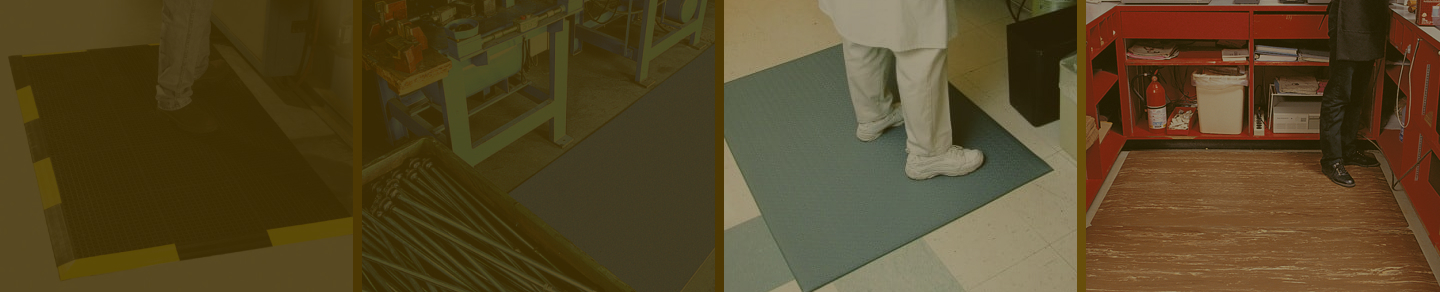

Pharmacy Floor Mats
Pharmacy floor mats are designed to enhance safety, cleanliness, and comfort in high-traffic areas. Ideal for use in pharmacies, hospitals, and healthcare facilities, these mats provide slip-resistant surfaces and cushioning to reduce fatigue for employees who stand for long periods. Pharmacy mats also help trap dirt and moisture, keeping floors clean and preventing slips, ensuring a safe environment for both staff and customers.
 Comfort King Anti-Fatigue Matting
Starting at $83.00
What Comfort King Does Before a Standing Shift Wears People Down Comfort King is a cushioned anti-fatigue mat built for dry-area standing work. Its foam core delivers three times more resilience than a regular mat — every small weight shift gets a gentle push back instead of dead compression, and...
What Comfort King Does Before a Standing Shift Wears People Down Comfort King is a cushioned anti-fatigue mat built for...
What Comfort King Does Before a Standing Shift Wears People Down
Comfort King is a cushioned anti-fatigue mat built for dry-area standing work. Its foam core delivers three times more resilience than a regular mat — every small weight shift gets a gentle push back instead of dead compression, and that steady rebound relieves stress on knees, feet, ankle joints, and pressure points over a long stretch of standing.
Anyone who has stood on bare concrete all day knows how it ends: sore feet, stiff knees, a back that complains before the shift does. Left alone, that fatigue turns into slower work, more breaks, and a higher risk of injury at cashier stations, benches, and counters. A standing mat with real rebound changes what the floor asks of the body.
Why This Foam, and Why This One
Plenty of foam mats feel soft the first week and flat by the third. Comfort King's core is a patented anti-fatigue PVC foam engineered for rebound rather than plain squish — measured at 30 percent resiliency per ASTM D-2632. That spring is what actually eases pressure on knee, foot, and ankle joints; softness alone doesn't do it.
The surface holds up too. A pebble-textured top gives shoes something to grip, and abrasion testing comes in at half a gram or less of material lost under the Taber method — a genuine wear surface, not a throwaway pad. Anti-microbial additives throughout the mat help hold off mold, mildew, and bacterial growth between cleanings.
Two thicknesses cover different kinds of days. The 3/8-inch version suits typical standing stations, while the 1/2-inch version adds 33 percent more cushioning for long hours over hard floors. Both come as standard mats, long runners, and full rolls, so one construction can serve a single register or a whole assembly line.
Where It Belongs, and What It Is Not
Comfort King belongs anywhere people stand in a dry area: workstations, finishing and assembly benches, cashier stations, pharmacy counters, and standing posts in hospitals and care facilities. It's equally at home on a salon or barber shop floor, where a stylist holds the same spot behind a chair for hours, and at a dry home kitchen sink or standing desk.
What it is not: a wet-area mat. There are no drainage holes here, and the foam is meant to stay dry — greasy dish lines and washdown zones call for the drainage-style options elsewhere in our anti-fatigue mats and runners lineup. Keeping Comfort King in dry service is what keeps the cushion doing its job.
Three Things to Check Before You Spec It
First, match the thickness to the hours. Where people rotate through a station, the 3/8-inch version carries the load comfortably. Where one person holds the same spot on concrete most of the day, the 1/2-inch version's 33 percent extra cushioning earns its place.
Second, size to the actual standing path. Standard mats run from 2 by 3 feet up to 4 by 12 feet, rolls come in widths from 2 to 6 feet at 60-foot lengths, and custom lengths up to 60 feet let one continuous mat trace a counter or work line without seams underfoot.
Third, pick the color for the setting. Black hides scuffs in back-of-house spaces, black with yellow borders makes the mat edge obvious where foot traffic and equipment mix, and blue or steel gray sit comfortably in front-of-house and clinical settings. One note: the 6-foot-wide roll isn't offered with yellow borders.
Why Mats Inc.
We've been matching mats to standing work since 1964, and Comfort King earns its spot in our line because it answers the most common complaint about foam mats: losing their bounce. We verify the construction and test figures behind every product we carry, and we back this one with a 1-year limited Mats Inc. warranty — so the mat that arrives is the mat the spec promised.
Material Patented anti-fatigue PVC foam Thickness 3/8" and 1/2" (1/2" provides 33% more cushioning) Standard Sizes 2' x 3', 3' x 5', 3' x 12', 4' x 6', 4' x 12' Roll Sizes 2' x 60', 3' x 60', 4' x 60', 6' x 60' Custom Lengths Up to 60' Colors Black, Black/Yellow, Blue, Steel Gray (6' x 60' roll not available with yellow borders) Surface Pattern Pebble Resiliency 30% per ASTM D-2632 Abrasion ≤ 0.5 gram (Taber) Electrical Resistance 10⁹ ohms per square (ASTM D-257) Use Area Dry areas only Warranty 1-year limited (Mats Inc.) Frequently Asked Questions
What makes this different from an ordinary foam kitchen mat?
Answered by Dustin Thompson, Owner & CEO
Most household foam pads compress once and stay compressed — soft on day one, flat by the end of the month. Comfort King's core is a patented anti-fatigue PVC foam engineered for rebound, delivering three times more resilience than a regular mat and measuring 30 percent resiliency under ASTM D-2632. That spring, not plain softness, is what relieves pressure on knees, feet, and ankles. The foam also carries anti-microbial additives to help resist mold, mildew, and bacterial growth.
How well does the surface hold up under daily use?
Answered by Dustin Thompson, Owner & CEO
The pebble-textured top is a tested wear surface: Taber abrasion results show half a gram or less of material lost, which is the difference between a mat that keeps its texture through years of shoe traffic and a pad that scuffs smooth. The one condition is keeping it in dry service — this construction has no drainage and isn't built for greasy or washdown environments. In a dry station with routine cleaning, the surface and the cushion age together gracefully.
Should I choose the 3/8-inch or the 1/2-inch thickness?
Answered by Dustin Thompson, Owner & CEO
Think about how long one person holds one spot. The 3/8-inch version handles stations where staff rotate through — checkout lanes with shift changes, shared benches, a home kitchen sink. The 1/2-inch version provides 33 percent more cushioning, and that extra give matters most where someone stands on concrete in the same footprint for most of a shift: an assembly post, a pharmacy fill counter, a machine station. When in doubt for all-day concrete work, go thicker.
Does it work in customer-facing spaces like salons and checkout lanes?
Answered by Jinna Hopson, Vice President of Marketing
That's exactly where it shines. Cashier stations, pharmacy counters, and salon and barber floors are dry areas where staff stand for hours in full view of customers — the mat has to work hard and still look like it belongs. The pebble surface reads clean and intentional rather than industrial, and the blue and steel gray colorways sit comfortably in front-of-house and clinical settings where a plain black shop mat would feel out of place.
Can I get it sized to a full counter run or work line?
Answered by Jinna Hopson, Vice President of Marketing
Yes — this is one of the few anti-fatigue constructions offered as a true roll. Widths run 2, 3, 4, and 6 feet at 60-foot lengths, and custom lengths up to 60 feet mean one continuous mat can follow your counter, line, or corridor without seams underfoot. That matters day to day: no edges creeping apart mid-shift, no gaps collecting debris, and a run that looks like it was planned for the space rather than pieced together.
Which color should I pick for my space?
Answered by Jinna Hopson, Vice President of Marketing
Let the setting decide. Black is the workhorse for back-of-house stations because it hides scuffs and shoe marks. Black with yellow borders makes the mat edge unmistakable where foot traffic and rolling equipment share an aisle. Blue and steel gray belong out front — salons, pharmacies, retail counters — where the mat is part of what customers see. One planning note: the 6-foot-wide roll isn't offered with yellow borders, so wide safety-bordered runs should be built from the narrower widths.
By Jinna Hopson, Vice President of Marketing, Mats Inc.
↑
What Comfort King Does Before a Standing Shift Wears People Down
Comfort King is a cushioned anti-fatigue mat built for dry-area standing work. Its foam core delivers three times more resilience than a regular mat — every small weight shift gets a gentle push back instead of dead compression, and that steady rebound relieves stress on knees, feet, ankle joints, and pressure points over a long stretch of standing.
Anyone who has stood on bare concrete all day knows how it ends: sore feet, stiff knees, a back that complains before the shift does. Left alone, that fatigue turns into slower work, more breaks, and a higher risk of injury at cashier stations, benches, and counters. A standing mat with real rebound changes what the floor asks of the body.
Why This Foam, and Why This One
Plenty of foam mats feel soft the first week and flat by the third. Comfort King's core is a patented anti-fatigue PVC foam engineered for rebound rather than plain squish — measured at 30 percent resiliency per ASTM D-2632. That spring is what actually eases pressure on knee, foot, and ankle joints; softness alone doesn't do it.
The surface holds up too. A pebble-textured top gives shoes something to grip, and abrasion testing comes in at half a gram or less of material lost under the Taber method — a genuine wear surface, not a throwaway pad. Anti-microbial additives throughout the mat help hold off mold, mildew, and bacterial growth between cleanings.
Two thicknesses cover different kinds of days. The 3/8-inch version suits typical standing stations, while the 1/2-inch version adds 33 percent more cushioning for long hours over hard floors. Both come as standard mats, long runners, and full rolls, so one construction can serve a single register or a whole assembly line.
Where It Belongs, and What It Is Not
Comfort King belongs anywhere people stand in a dry area: workstations, finishing and assembly benches, cashier stations, pharmacy counters, and standing posts in hospitals and care facilities. It's equally at home on a salon or barber shop floor, where a stylist holds the same spot behind a chair for hours, and at a dry home kitchen sink or standing desk.
What it is not: a wet-area mat. There are no drainage holes here, and the foam is meant to stay dry — greasy dish lines and washdown zones call for the drainage-style options elsewhere in our anti-fatigue mats and runners lineup. Keeping Comfort King in dry service is what keeps the cushion doing its job.
Three Things to Check Before You Spec It
First, match the thickness to the hours. Where people rotate through a station, the 3/8-inch version carries the load comfortably. Where one person holds the same spot on concrete most of the day, the 1/2-inch version's 33 percent extra cushioning earns its place.
Second, size to the actual standing path. Standard mats run from 2 by 3 feet up to 4 by 12 feet, rolls come in widths from 2 to 6 feet at 60-foot lengths, and custom lengths up to 60 feet let one continuous mat trace a counter or work line without seams underfoot.
Third, pick the color for the setting. Black hides scuffs in back-of-house spaces, black with yellow borders makes the mat edge obvious where foot traffic and equipment mix, and blue or steel gray sit comfortably in front-of-house and clinical settings. One note: the 6-foot-wide roll isn't offered with yellow borders.
Why Mats Inc.
We've been matching mats to standing work since 1964, and Comfort King earns its spot in our line because it answers the most common complaint about foam mats: losing their bounce. We verify the construction and test figures behind every product we carry, and we back this one with a 1-year limited Mats Inc. warranty — so the mat that arrives is the mat the spec promised.
Material Patented anti-fatigue PVC foam Thickness 3/8" and 1/2" (1/2" provides 33% more cushioning) Standard Sizes 2' x 3', 3' x 5', 3' x 12', 4' x 6', 4' x 12' Roll Sizes 2' x 60', 3' x 60', 4' x 60', 6' x 60' Custom Lengths Up to 60' Colors Black, Black/Yellow, Blue, Steel Gray (6' x 60' roll not available with yellow borders) Surface Pattern Pebble Resiliency 30% per ASTM D-2632 Abrasion ≤ 0.5 gram (Taber) Electrical Resistance 10⁹ ohms per square (ASTM D-257) Use Area Dry areas only Warranty 1-year limited (Mats Inc.) Frequently Asked Questions
What makes this different from an ordinary foam kitchen mat?
Answered by Dustin Thompson, Owner & CEO
Most household foam pads compress once and stay compressed — soft on day one, flat by the end of the month. Comfort King's core is a patented anti-fatigue PVC foam engineered for rebound, delivering three times more resilience than a regular mat and measuring 30 percent resiliency under ASTM D-2632. That spring, not plain softness, is what relieves pressure on knees, feet, and ankles. The foam also carries anti-microbial additives to help resist mold, mildew, and bacterial growth.
How well does the surface hold up under daily use?
Answered by Dustin Thompson, Owner & CEO
The pebble-textured top is a tested wear surface: Taber abrasion results show half a gram or less of material lost, which is the difference between a mat that keeps its texture through years of shoe traffic and a pad that scuffs smooth. The one condition is keeping it in dry service — this construction has no drainage and isn't built for greasy or washdown environments. In a dry station with routine cleaning, the surface and the cushion age together gracefully.
Should I choose the 3/8-inch or the 1/2-inch thickness?
Answered by Dustin Thompson, Owner & CEO
Think about how long one person holds one spot. The 3/8-inch version handles stations where staff rotate through — checkout lanes with shift changes, shared benches, a home kitchen sink. The 1/2-inch version provides 33 percent more cushioning, and that extra give matters most where someone stands on concrete in the same footprint for most of a shift: an assembly post, a pharmacy fill counter, a machine station. When in doubt for all-day concrete work, go thicker.
Does it work in customer-facing spaces like salons and checkout lanes?
Answered by Jinna Hopson, Vice President of Marketing
That's exactly where it shines. Cashier stations, pharmacy counters, and salon and barber floors are dry areas where staff stand for hours in full view of customers — the mat has to work hard and still look like it belongs. The pebble surface reads clean and intentional rather than industrial, and the blue and steel gray colorways sit comfortably in front-of-house and clinical settings where a plain black shop mat would feel out of place.
Can I get it sized to a full counter run or work line?
Answered by Jinna Hopson, Vice President of Marketing
Yes — this is one of the few anti-fatigue constructions offered as a true roll. Widths run 2, 3, 4, and 6 feet at 60-foot lengths, and custom lengths up to 60 feet mean one continuous mat can follow your counter, line, or corridor without seams underfoot. That matters day to day: no edges creeping apart mid-shift, no gaps collecting debris, and a run that looks like it was planned for the space rather than pieced together.
Which color should I pick for my space?
Answered by Jinna Hopson, Vice President of Marketing
Let the setting decide. Black is the workhorse for back-of-house stations because it hides scuffs and shoe marks. Black with yellow borders makes the mat edge unmistakable where foot traffic and rolling equipment share an aisle. Blue and steel gray belong out front — salons, pharmacies, retail counters — where the mat is part of what customers see. One planning note: the 6-foot-wide roll isn't offered with yellow borders, so wide safety-bordered runs should be built from the narrower widths.
By Jinna Hopson, Vice President of Marketing, Mats Inc.
↑
View Details
View Details
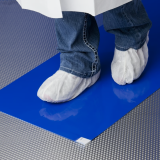 Walk-N-Clean Indoor Adhesive Mats
Starting at $125.00
Keep Critical Spaces Clean with Walk-N-Clean Mats Walk-N-Clean tacky mats are engineered to trap dirt, dust, and debris before they can enter clean-sensitive environments. Designed for use in labs, medical facilities, food processing areas, and cleanrooms, these mats feature peel-away adhesive layers that remove particles from shoes and wheeled equipment,...
Keep Critical Spaces Clean with Walk-N-Clean Mats Walk-N-Clean tacky mats are engineered to trap dirt, dust, and debris before they...
Keep Critical Spaces Clean with Walk-N-Clean Mats
Walk-N-Clean tacky mats are engineered to trap dirt, dust, and debris before they can enter clean-sensitive environments. Designed for use in labs, medical facilities, food processing areas, and cleanrooms, these mats feature peel-away adhesive layers that remove particles from shoes and wheeled equipment, maintaining hygienic flooring at all times.
Features & Benefits
- 60-Layer Adhesive Pads: Disposable tacky sheets peel away easily for constant freshness and performance.
- Non-Slip Base: Rugged reusable base prevents shifting, ensuring safety and durability in high-traffic areas.
- Contamination Control: Effectively removes particulate matter to reduce airborne contaminants and maintain compliance.
- Low Profile: Designed to lay flat without obstructing foot or cart traffic.
- Ideal for Sensitive Areas: Recommended for pharmaceutical labs, hospitals, electronics production, and food prep zones.
A Smarter Solution for Hygiene Control
Walk-N-Clean is the trusted choice for facilities that demand superior cleanliness and contamination prevention. With its easy-to-maintain adhesive surface and secure base, it provides reliable protection for your workspace and peace of mind for your team.
↑
Keep Critical Spaces Clean with Walk-N-Clean Mats
Walk-N-Clean tacky mats are engineered to trap dirt, dust, and debris before they can enter clean-sensitive environments. Designed for use in labs, medical facilities, food processing areas, and cleanrooms, these mats feature peel-away adhesive layers that remove particles from shoes and wheeled equipment, maintaining hygienic flooring at all times.
Features & Benefits
- 60-Layer Adhesive Pads: Disposable tacky sheets peel away easily for constant freshness and performance.
- Non-Slip Base: Rugged reusable base prevents shifting, ensuring safety and durability in high-traffic areas.
- Contamination Control: Effectively removes particulate matter to reduce airborne contaminants and maintain compliance.
- Low Profile: Designed to lay flat without obstructing foot or cart traffic.
- Ideal for Sensitive Areas: Recommended for pharmaceutical labs, hospitals, electronics production, and food prep zones.
A Smarter Solution for Hygiene Control
Walk-N-Clean is the trusted choice for facilities that demand superior cleanliness and contamination prevention. With its easy-to-maintain adhesive surface and secure base, it provides reliable protection for your workspace and peace of mind for your team.
↑
View Details
View Details
 Hog Heaven Fashion Anti-Fatigue Mat$64.00Anti-fatigue kitchen mats earn their keep in the first hour on your feet, not the tenth. Standing still on tile, stone, or concrete pushes pressure straight into your heels, knees, and lower back. This cushioned kitchen mat softens that load. It pairs a fabric top that reads like an area
...
Anti-fatigue kitchen mats earn their keep in the first hour on your feet, not the tenth. Standing still on tile,...
Anti-fatigue kitchen mats earn their keep in the first hour on your feet, not the tenth. Standing still on tile, stone, or concrete pushes pressure straight into your heels, knees, and lower back. This cushioned kitchen mat softens that load. It pairs a fabric top that reads like an area rug with a dense nitrile cushion built for indoor floors.
What a Cushioned Kitchen Mat Does Before Your Legs Feel It
A hard kitchen floor gives you nothing back. Every step lands and stops, and your legs absorb the whole thing. Stand at a sink or a prep counter for forty minutes and you feel it in your calves first, then your lower back.
A padded kitchen mat works by putting something compressible under you. This one uses a high-density, closed-cell nitrile-blended cushion, which helps eliminate pressure on the lower back and legs. That small amount of give is what keeps a long stretch of standing from turning into an ache.
The second job is traction. Kitchen floor mats sit in the one spot where water, oil, and dropped food all show up. A mat that slides, curls, or goes slick underfoot creates the exact hazard it was bought to prevent. This one is certified high-traction by the National Floor Safety Institute, which runs independent slip-resistance testing for commercial floor products.
The edges matter as much as the surface. They will not crack or curl, and they give a safe transition from the floor onto the mat. A curled corner is the most common way a comfort mat turns into a trip hazard.
Why a Fabric Top, and Why This One
Most anti-fatigue mats are black rubber or vinyl. They work, and they look like they belong in a warehouse. This one swaps that surface for needle-punched, solution-dyed PET fabric at 14 ounces per square yard. Solution-dyed means the color goes into the fiber itself rather than sitting on top of it, and the surface is fade-resistant as a result.
The part that matters most is how the two layers are joined. The fabric is molded to the nitrile-blended cushion, not glued to it, so it will not separate. That is the difference that shows up years in, when a glued mat starts lifting at a corner and this one does not.
Underneath sits high-density, closed-cell nitrile and PVC-blended foam. Closed-cell is the useful part of that description: the cells are sealed, so the cushion is not an absorbent layer. A spill stays where you can deal with it.
Overall thickness is 5/8 inch over a 48-mil backing. A Max version runs 7/8 inch over a 52-mil backing if you want more underfoot. Both come in the same three stock sizes.
Two more things worth knowing. The PET fabric surface is made from at least 90% recycled content reclaimed from plastic, which is unusual for a comfort mat and matters if you are specifying against sustainability targets. And the mat is made in the USA.
Where It Belongs, and Where It Does Not
This mat is made for dry indoor settings. Home kitchens are the obvious fit: the sink, the range, the prep counter, the island where someone stands and chops. It also works well at coffee bars, break rooms, hostess stands, retail counters, registration desks, copy stations, and standing desks. Retail floors are one of its most common homes.
It is not a wet-area mat, and this is the one thing to get right. A commercial cook line, a dish pit, or a bar well means standing water and grease all day. A fabric surface in that environment holds what lands on it and stays damp.
That is the failure mode with fabric-topped comfort mats, and it is almost always a placement mistake rather than a product problem. If the floor you are covering gets hosed down, drained, or mopped through a shift, you want a drainage or grease-rated mat instead. The wider range of kitchen mats covers those wet and greasy zones.
Put simply: if the floor is dry most of the day and the mat is going somewhere people can see it, this is the right call. If the floor is wet most of the day, it is the wrong one.
Three Things to Check Before You Spec It
First, be honest about how wet the floor gets. Not "does it ever get wet" — every kitchen floor gets wet. The question is whether water sits. A splash at the sink that gets wiped up is fine. A floor that is damp for hours is not. This is the single check that decides whether this mat is the right choice.
Second, size to the work zone, not to the room. Measure where your feet actually go. Stock sizes are 2' x 3' (23" x 32"), 3' x 5' (32" x 58"), and 3' x 12' (32" x 142"). The 3' x 12' is a true kitchen runner for a galley layout or a long counter. Custom sizes come in 3-foot (32-inch) widths at whole-foot lengths up to 60 feet.
Third, check thickness against your clearances. The 5/8-inch version clears most cabinet toe kicks and interior doors without trouble. The 7/8-inch Max gives more cushion but needs more room, so check any door that swings over the mat. Also remember that mat sizes are approximate — rubber shrinks and expands with temperature and time, and manufacturing variance runs 3% to 5%.
Why Mats Inc.
We stock this mat because customers kept asking the same question: something that helps my feet, but that I am not embarrassed to have in a kitchen people walk through. Most anti-fatigue matting answers the first half and ignores the second. Mats Inc. has been sourcing commercial matting since 1964, and we carry this construction specifically for the dry, visible spots where a black rubber mat would look wrong.
Specifications
Surface material Needle-punched, solution-dyed PET fabric, 14 oz/yd², molded (not glued) to nitrile rubber Recycled content PET fabric surface made from at least 90% recycled content reclaimed from plastic Cushion High-density, closed-cell nitrile/PVC-blended foam Overall thickness 5/8" (0.625") on 48-mil backing; Max version 7/8" (0.875") on 52-mil backing Traction Certified high-traction by the National Floor Safety Institute (NFSI) Edges Will not crack or curl; safe transition from floor to mat Stock sizes & weights (5/8") 2' x 3' (23" x 32") — 5.5 lbs.
3' x 5' (32" x 58") — 14.2 lbs.
3' x 12' (32" x 142") — 35.5 lbs.Stock sizes & weights (7/8" Max) 2' x 3' (23" x 32") — 6.5 lbs.
3' x 5' (32" x 58") — 16 lbs.
3' x 12' (32" x 142") — 38.3 lbs.Custom sizes 3' (32") widths, whole-foot lengths up to 60' Size tolerance 3–5% manufacturing variance Colors Coal Black, Cobalt Blue, Cocoa Brown, Granite Recommended use Dry, indoor settings where a fabric-topped anti-fatigue mat is preferred to a vinyl or rubber top Cleaning Rinse with a hose or pressure washer; lay flat or hang to dry; return to service dry Origin Made in the USA Warranty 1-year limited (Mats Inc.) Frequently Asked Questions
What is this kitchen mat actually made of?
Answered by Dustin Thompson, Owner & CEO
Two layers. The top is needle-punched, solution-dyed PET fabric at 14 ounces per square yard. Underneath is high-density, closed-cell nitrile and PVC-blended foam over a 48-mil backing. Overall thickness is 5/8 inch, or 7/8 inch on a 52-mil backing if you go with the Max version.
The detail that separates this from cheaper fabric-topped mats is the bond. The fabric is molded into the nitrile-blended cushion rather than glued on top of it, so the two layers will not separate. On a glued mat, the corner lifts, the top layer peels, and you are looking at a trip hazard. The mat is made in the USA.
How do I clean it, and what shortens its life?
Answered by Dustin Thompson, Owner & CEO
Cleaning is simple. Rinse it with a hose or a pressure washer, then lay it flat or hang it to dry. Put it back down only once it is dry — a damp mat on a hard floor traps moisture underneath and can leave a mark on some finishes.
What shortens its life is almost always placement rather than wear. This is a dry-area mat. Put it somewhere that stays wet and the fabric surface is working against what it was designed for. Keep it on a dry floor and clean it on a normal schedule, and the solution-dyed surface holds its color because the color is in the fiber, not printed on it.
Can I use this in a restaurant or commercial kitchen?
Answered by Dustin Thompson, Owner & CEO
In the front of house, yes. Host stands, register counters, coffee bars, back-office prep areas, and service corridors are all dry-floor zones where this mat performs and looks right.
On the cook line or in a dish pit, no. Those floors carry standing water and grease through an entire shift, and a fabric surface holds both. The manufacturer recommends this mat for dry indoor settings, and that recommendation is worth following. For wet zones you want a drainage-style or grease-resistant rubber mat that lets liquid pass through and gets scrubbed daily. Ask us and we will point you at the right construction for the zone.
What sizes can I get, and is there a runner length for a galley kitchen?
Answered by Jinna Hopson, Vice President of Marketing
Three stock sizes: 2' x 3' (23" x 32") for a sink or single station, 3' x 5' (32" x 58") for a prep counter or island, and 3' x 12' (32" x 142") as a kitchen runner. That last one is the answer for galley layouts and long counter runs where a small mat just leaves you stepping on and off it.
If none of those fit, custom sizes come in 3-foot (32-inch) widths at whole-foot lengths up to 60 feet. Measure where you actually stand rather than the room itself. And build in a little tolerance — the rubber shrinks and expands with temperature and time, so finished sizes run within about 3% to 5% of nominal.
Will it look like an area rug or like a shop mat?
Answered by Jinna Hopson, Vice President of Marketing
Like a rug, which is the whole point of it. The fabric surface has the texture and matte finish of a low-pile commercial carpet rather than the gloss of vinyl or the ribbing of rubber. Four colors are available: Coal Black, Cobalt Blue, Cocoa Brown, and Granite. All four are neutral enough to sit quietly next to cabinetry and countertops instead of announcing themselves.
Because the fabric is solution-dyed, the color runs through each fiber rather than sitting on the surface, and the surface is fade-resistant. That is what keeps it from going chalky in a kitchen with a lot of natural light.
Does this work in a home kitchen, or is it meant for businesses?
Answered by Jinna Hopson, Vice President of Marketing
Both, and home kitchens are one of the places it does its best work. Residential kitchen mats sold at big-box stores are usually thin foam with a printed surface. This is a commercial construction that happens to look residential.
Where it really earns its place at home is the spot you stand longest: the sink, or the counter where someone preps dinner every night. It is also the mat to choose when the kitchen is open to a living or dining area and you did not want something that looks like equipment. Just hold to the same rule a commercial buyer follows — dry floors only.
By Jinna Hopson, Vice President of Marketing, Mats Inc.
↑
Anti-fatigue kitchen mats earn their keep in the first hour on your feet, not the tenth. Standing still on tile, stone, or concrete pushes pressure straight into your heels, knees, and lower back. This cushioned kitchen mat softens that load. It pairs a fabric top that reads like an area rug with a dense nitrile cushion built for indoor floors.
What a Cushioned Kitchen Mat Does Before Your Legs Feel It
A hard kitchen floor gives you nothing back. Every step lands and stops, and your legs absorb the whole thing. Stand at a sink or a prep counter for forty minutes and you feel it in your calves first, then your lower back.
A padded kitchen mat works by putting something compressible under you. This one uses a high-density, closed-cell nitrile-blended cushion, which helps eliminate pressure on the lower back and legs. That small amount of give is what keeps a long stretch of standing from turning into an ache.
The second job is traction. Kitchen floor mats sit in the one spot where water, oil, and dropped food all show up. A mat that slides, curls, or goes slick underfoot creates the exact hazard it was bought to prevent. This one is certified high-traction by the National Floor Safety Institute, which runs independent slip-resistance testing for commercial floor products.
The edges matter as much as the surface. They will not crack or curl, and they give a safe transition from the floor onto the mat. A curled corner is the most common way a comfort mat turns into a trip hazard.
Why a Fabric Top, and Why This One
Most anti-fatigue mats are black rubber or vinyl. They work, and they look like they belong in a warehouse. This one swaps that surface for needle-punched, solution-dyed PET fabric at 14 ounces per square yard. Solution-dyed means the color goes into the fiber itself rather than sitting on top of it, and the surface is fade-resistant as a result.
The part that matters most is how the two layers are joined. The fabric is molded to the nitrile-blended cushion, not glued to it, so it will not separate. That is the difference that shows up years in, when a glued mat starts lifting at a corner and this one does not.
Underneath sits high-density, closed-cell nitrile and PVC-blended foam. Closed-cell is the useful part of that description: the cells are sealed, so the cushion is not an absorbent layer. A spill stays where you can deal with it.
Overall thickness is 5/8 inch over a 48-mil backing. A Max version runs 7/8 inch over a 52-mil backing if you want more underfoot. Both come in the same three stock sizes.
Two more things worth knowing. The PET fabric surface is made from at least 90% recycled content reclaimed from plastic, which is unusual for a comfort mat and matters if you are specifying against sustainability targets. And the mat is made in the USA.
Where It Belongs, and Where It Does Not
This mat is made for dry indoor settings. Home kitchens are the obvious fit: the sink, the range, the prep counter, the island where someone stands and chops. It also works well at coffee bars, break rooms, hostess stands, retail counters, registration desks, copy stations, and standing desks. Retail floors are one of its most common homes.
It is not a wet-area mat, and this is the one thing to get right. A commercial cook line, a dish pit, or a bar well means standing water and grease all day. A fabric surface in that environment holds what lands on it and stays damp.
That is the failure mode with fabric-topped comfort mats, and it is almost always a placement mistake rather than a product problem. If the floor you are covering gets hosed down, drained, or mopped through a shift, you want a drainage or grease-rated mat instead. The wider range of kitchen mats covers those wet and greasy zones.
Put simply: if the floor is dry most of the day and the mat is going somewhere people can see it, this is the right call. If the floor is wet most of the day, it is the wrong one.
Three Things to Check Before You Spec It
First, be honest about how wet the floor gets. Not "does it ever get wet" — every kitchen floor gets wet. The question is whether water sits. A splash at the sink that gets wiped up is fine. A floor that is damp for hours is not. This is the single check that decides whether this mat is the right choice.
Second, size to the work zone, not to the room. Measure where your feet actually go. Stock sizes are 2' x 3' (23" x 32"), 3' x 5' (32" x 58"), and 3' x 12' (32" x 142"). The 3' x 12' is a true kitchen runner for a galley layout or a long counter. Custom sizes come in 3-foot (32-inch) widths at whole-foot lengths up to 60 feet.
Third, check thickness against your clearances. The 5/8-inch version clears most cabinet toe kicks and interior doors without trouble. The 7/8-inch Max gives more cushion but needs more room, so check any door that swings over the mat. Also remember that mat sizes are approximate — rubber shrinks and expands with temperature and time, and manufacturing variance runs 3% to 5%.
Why Mats Inc.
We stock this mat because customers kept asking the same question: something that helps my feet, but that I am not embarrassed to have in a kitchen people walk through. Most anti-fatigue matting answers the first half and ignores the second. Mats Inc. has been sourcing commercial matting since 1964, and we carry this construction specifically for the dry, visible spots where a black rubber mat would look wrong.
Specifications
Surface material Needle-punched, solution-dyed PET fabric, 14 oz/yd², molded (not glued) to nitrile rubber Recycled content PET fabric surface made from at least 90% recycled content reclaimed from plastic Cushion High-density, closed-cell nitrile/PVC-blended foam Overall thickness 5/8" (0.625") on 48-mil backing; Max version 7/8" (0.875") on 52-mil backing Traction Certified high-traction by the National Floor Safety Institute (NFSI) Edges Will not crack or curl; safe transition from floor to mat Stock sizes & weights (5/8") 2' x 3' (23" x 32") — 5.5 lbs.
3' x 5' (32" x 58") — 14.2 lbs.
3' x 12' (32" x 142") — 35.5 lbs.Stock sizes & weights (7/8" Max) 2' x 3' (23" x 32") — 6.5 lbs.
3' x 5' (32" x 58") — 16 lbs.
3' x 12' (32" x 142") — 38.3 lbs.Custom sizes 3' (32") widths, whole-foot lengths up to 60' Size tolerance 3–5% manufacturing variance Colors Coal Black, Cobalt Blue, Cocoa Brown, Granite Recommended use Dry, indoor settings where a fabric-topped anti-fatigue mat is preferred to a vinyl or rubber top Cleaning Rinse with a hose or pressure washer; lay flat or hang to dry; return to service dry Origin Made in the USA Warranty 1-year limited (Mats Inc.) Frequently Asked Questions
What is this kitchen mat actually made of?
Answered by Dustin Thompson, Owner & CEO
Two layers. The top is needle-punched, solution-dyed PET fabric at 14 ounces per square yard. Underneath is high-density, closed-cell nitrile and PVC-blended foam over a 48-mil backing. Overall thickness is 5/8 inch, or 7/8 inch on a 52-mil backing if you go with the Max version.
The detail that separates this from cheaper fabric-topped mats is the bond. The fabric is molded into the nitrile-blended cushion rather than glued on top of it, so the two layers will not separate. On a glued mat, the corner lifts, the top layer peels, and you are looking at a trip hazard. The mat is made in the USA.
How do I clean it, and what shortens its life?
Answered by Dustin Thompson, Owner & CEO
Cleaning is simple. Rinse it with a hose or a pressure washer, then lay it flat or hang it to dry. Put it back down only once it is dry — a damp mat on a hard floor traps moisture underneath and can leave a mark on some finishes.
What shortens its life is almost always placement rather than wear. This is a dry-area mat. Put it somewhere that stays wet and the fabric surface is working against what it was designed for. Keep it on a dry floor and clean it on a normal schedule, and the solution-dyed surface holds its color because the color is in the fiber, not printed on it.
Can I use this in a restaurant or commercial kitchen?
Answered by Dustin Thompson, Owner & CEO
In the front of house, yes. Host stands, register counters, coffee bars, back-office prep areas, and service corridors are all dry-floor zones where this mat performs and looks right.
On the cook line or in a dish pit, no. Those floors carry standing water and grease through an entire shift, and a fabric surface holds both. The manufacturer recommends this mat for dry indoor settings, and that recommendation is worth following. For wet zones you want a drainage-style or grease-resistant rubber mat that lets liquid pass through and gets scrubbed daily. Ask us and we will point you at the right construction for the zone.
What sizes can I get, and is there a runner length for a galley kitchen?
Answered by Jinna Hopson, Vice President of Marketing
Three stock sizes: 2' x 3' (23" x 32") for a sink or single station, 3' x 5' (32" x 58") for a prep counter or island, and 3' x 12' (32" x 142") as a kitchen runner. That last one is the answer for galley layouts and long counter runs where a small mat just leaves you stepping on and off it.
If none of those fit, custom sizes come in 3-foot (32-inch) widths at whole-foot lengths up to 60 feet. Measure where you actually stand rather than the room itself. And build in a little tolerance — the rubber shrinks and expands with temperature and time, so finished sizes run within about 3% to 5% of nominal.
Will it look like an area rug or like a shop mat?
Answered by Jinna Hopson, Vice President of Marketing
Like a rug, which is the whole point of it. The fabric surface has the texture and matte finish of a low-pile commercial carpet rather than the gloss of vinyl or the ribbing of rubber. Four colors are available: Coal Black, Cobalt Blue, Cocoa Brown, and Granite. All four are neutral enough to sit quietly next to cabinetry and countertops instead of announcing themselves.
Because the fabric is solution-dyed, the color runs through each fiber rather than sitting on the surface, and the surface is fade-resistant. That is what keeps it from going chalky in a kitchen with a lot of natural light.
Does this work in a home kitchen, or is it meant for businesses?
Answered by Jinna Hopson, Vice President of Marketing
Both, and home kitchens are one of the places it does its best work. Residential kitchen mats sold at big-box stores are usually thin foam with a printed surface. This is a commercial construction that happens to look residential.
Where it really earns its place at home is the spot you stand longest: the sink, or the counter where someone preps dinner every night. It is also the mat to choose when the kitchen is open to a living or dining area and you did not want something that looks like equipment. Just hold to the same rule a commercial buyer follows — dry floors only.
By Jinna Hopson, Vice President of Marketing, Mats Inc.
↑
View Details
View Details
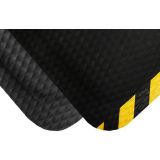 Hog Heaven Anti-Fatigue Mat
Starting at $64.00
Anti-fatigue kitchen mats have to survive the floor they are standing on. In a working kitchen that means grease, dropped oil, hot water, and cleaning chemicals, every day. This one is built from nitrile rubber for exactly that. It is the mat you put where a softer, prettier mat would...
Anti-fatigue kitchen mats have to survive the floor they are standing on. In a working kitchen that means grease, dropped...
Anti-fatigue kitchen mats have to survive the floor they are standing on. In a working kitchen that means grease, dropped oil, hot water, and cleaning chemicals, every day. This one is built from nitrile rubber for exactly that. It is the mat you put where a softer, prettier mat would be ruined inside a season.
What an Anti-Fatigue Mat Does Before a Hard Floor Catches Up With You
Standing still on quarry tile or sealed concrete is harder on a body than walking. Your legs lock in one position and take the load with no relief. The ache starts in the calves, moves to the knees, and settles in the lower back by the end of a shift.
A cushioned kitchen mat interrupts that. This one uses a high-density nitrile-blended cushion, which helps eliminate pressure on the lower back and legs. The cushion is what you are actually buying; the rubber on top is what keeps the cushion alive on a hostile floor.
The other half of the job is grip, and this is where the mat separates itself. Under ASTM C1028-96 it holds a static coefficient of friction of 0.87 dry and 0.85 wet. That wet figure is the one that matters on a kitchen floor, and it is barely below the dry number.
It is also certified high-traction by the National Floor Safety Institute, which runs independent slip-resistance testing for commercial floor products. Sloped edges give a safe transition from the floor onto the mat, and those edges will not crack or curl.
Why Nitrile Rubber, and Why This One
Most comfort mats fail from the top down. Vinyl goes brittle, foam compresses flat, and anything absorbent turns into a sponge for whatever is on the floor. Nitrile rubber is the answer to all three, which is why this construction shows up in the roughest indoor rooms.
The surface is grease and oil proof, and the cushion underneath is grease and oil resistant. It is chemical resistant, so a floor that gets sanitized daily does not degrade it. It is also welding safe, which matters more in a fabrication shop than a kitchen but tells you what the surface tolerates.
Underneath sits high-density, closed-cell nitrile and PVC-blended foam. Closed-cell means the cells are sealed, so the cushion is not an absorbent layer. The manufacturer states the cushion provides years of useful service life.
The two layers are molded together, not glued, so they will not separate. That is the failure you see on cheaper dual-layer mats, where the top lifts at a corner and the whole thing becomes a trip hazard within a year.
Cushion performance is measured, not claimed. The 5/8-inch version compresses 47.8% at 20 psi and 61.6% at 40 psi. The 7/8-inch version compresses 51.0% at 20 psi and 66.0% at 40 psi. In plain terms, the thicker mat gives more under the same weight, which is what you want for longer stretches of standing.
Two more specifications worth knowing. The mat carries an ESD rating of electrically conductive, so it can go in static-sensitive rooms. And it passes flammability standard BS-4790, tested by the metal nut method.
Where It Belongs, and Where It Is Overkill
This is the mat for the wet and greasy side of a kitchen. Cook lines, fry stations, prep tables, dish pits, bar wells, and walk-in approaches all qualify. Anywhere the floor gets mopped, drained, or hosed through a shift, this construction holds up where a fabric or foam mat would not.
It carries the same performance outside the kitchen. Assembly benches, packing stations, welding cells, labs, and any indoor floor where slag, oil, or chemicals are present are all standard placements. That is the same reasoning, applied to a different room.
Where it is more mat than you need is a quiet, dry, front-of-house spot. A hostess stand, a boutique counter, or a home kitchen island does not test any of this. Those spots want a fabric-topped comfort mat that looks like it belongs. The full range of kitchen mats covers both ends.
The real mistake with this mat is undersizing it. Buy one too small and people stand half on and half off it, which puts a foot on greasy tile and defeats the whole purpose. Cover the standing zone, not a token square of it.
Three Things to Check Before You Spec It
First, measure the working zone, not the room. Walk the station during a shift and mark where feet actually land. Stock sizes run 2' x 3' (23" x 32"), 3' x 5' (32" x 58"), 3' x 12' (32" x 142"), 4' x 6' (46" x 69"), and 4.8' x 8' (58" x 96"). A cook line usually needs a runner length rather than a mat.
Second, pick your thickness by how long people stand. The 5/8-inch version suits stations where staff move between tasks. The 7/8-inch version gives more compression and makes sense where someone holds one spot for hours. Check door swing and cart clearance before committing to the thicker one.
Third, decide whether you need the marked border. The mat comes with a solid black border or with OSHA-approved caution yellow borders on two sides. The yellow version makes the edge visible in a busy room, which is worth having where carts and foot traffic cross the same lane.
Why Mats Inc.
Buyers usually come to us after a comfort mat failed early, and it is almost always the same story: the mat was fine, but it was the wrong construction for that floor. We stock this nitrile mat because it is the one that survives a room with grease, chemicals, and constant washdown. Mats Inc. has been matching matting to real conditions since 1964, and this is what we reach for when the floor is the problem.
Specifications
Surface material Nitrile rubber; molded (not glued) to the cushion so it will not separate Cushion High-density, closed-cell nitrile/PVC-blended foam Overall thickness 5/8" (0.6250") or 7/8" (0.8750") Border options Solid black, or OSHA-approved caution yellow borders on two sides Traction Certified high-traction by the National Floor Safety Institute (NFSI); ASTM C1028-96 static coefficient of friction: dry 0.87, wet 0.85 Compression deflection 5/8": 47.8% at 20 psi, 61.6% at 40 psi
7/8": 51.0% at 20 psi, 66.0% at 40 psiStatic ESD rating of electrically conductive Resistance Welding safe; chemical resistant; surface grease/oil proof; cushion grease/oil resistant Flammability Passes BS-4790 (metal nut method) Edges Sloped for safe floor-to-mat transition; will not crack or curl Stock sizes 2' x 3' (23" x 32")
3' x 5' (32" x 58")
3' x 12' (32" x 142")
4' x 6' (46" x 69")
4.8' x 8' (58" x 96")Custom sizes Widths of 2' (23"), 3' (32"), 4' (46"), and 4.8' (58"); whole-foot lengths up to 100'. Mats over 60' have up to 2 seams. Size tolerance 3–5% manufacturing variance Recommended use Indoor commercial and industrial settings, including where slag, grease and oil, or chemicals are present Customization Can be customized with a logo, design, or message Cleaning Clean with a neutral pH detergent and rinse with a hose; lay flat or hang to dry; return to service dry Warranty 1-year limited (Mats Inc.) Frequently Asked Questions
What makes this different from a foam kitchen mat?
Answered by Dustin Thompson, Owner & CEO
Two layers instead of one. The top is nitrile rubber, and underneath is a high-density, closed-cell nitrile and PVC-blended foam cushion. A foam mat is just the cushion with nothing protecting it, which is why it flattens and tears.
The two layers here are molded together rather than glued, so they will not separate. Overall thickness is either 5/8 inch or 7/8 inch. The nitrile surface is grease and oil proof and chemical resistant, so a floor that gets sanitized every night does not eat the mat.
How well does it grip when the floor is wet?
Answered by Dustin Thompson, Owner & CEO
Better than most, and there are numbers for it. Under ASTM C1028-96 the static coefficient of friction measures 0.87 dry and 0.85 wet. The small gap between those two is the useful part — a lot of surfaces test well dry and fall apart wet. The mat is also certified high-traction by the National Floor Safety Institute.
Grip only helps if the mat is where feet are, though. The sloped edges give a safe transition on and off, and they will not crack or curl. If you undersize the mat, staff end up with one foot on greasy tile and the traction rating stops mattering.
Can I use this on a cook line, in a dish pit, or near a welding station?
Answered by Dustin Thompson, Owner & CEO
Yes to all three. This construction is made for indoor commercial and industrial rooms where slag, grease and oil, or chemicals are present. The surface is grease and oil proof, the cushion is grease and oil resistant, and the mat is welding safe.
It also carries an ESD rating of electrically conductive, which lets it go into static-sensitive areas that would rule out most comfort matting. Clean it with a neutral pH detergent and a hose rinse, then lay it flat or hang it to dry. Do not put it back down until it is dry.
What sizes are available, and can I get a length for a full cook line?
Answered by Jinna Hopson, Vice President of Marketing
Five stock sizes: 2' x 3' (23" x 32"), 3' x 5' (32" x 58"), 3' x 12' (32" x 142"), 4' x 6' (46" x 69"), and 4.8' x 8' (58" x 96"). The 3' x 12' is the usual answer for a galley kitchen or a long counter run.
For a full line, custom sizes come in widths of 2' (23"), 3' (32"), 4' (46"), and 4.8' (58") at whole-foot lengths up to 100 feet. Anything over 60 feet will have up to two seams. Allow a little tolerance in your measurements, since rubber shrinks and expands with temperature and time and finished sizes run within about 3% to 5% of nominal.
What does it actually look like on the floor?
Answered by Jinna Hopson, Vice President of Marketing
Purposeful rather than decorative. It reads as working equipment, which is right for a back-of-house kitchen and wrong for a dining room. Two border treatments are available: a solid black border, or OSHA-approved caution yellow borders on two sides.
The yellow border is worth considering in any room where carts, deliveries, and staff share the same lane, because it makes the mat's edge easy to see. If the mat is going somewhere customers look, a fabric-topped comfort mat is the better-looking choice for that spot.
Can I get one with our logo or a safety message on it?
Answered by Jinna Hopson, Vice President of Marketing
Yes. This construction can be customized with a logo, design, or message, which turns a functional comfort mat into something that also carries your branding or a standing safety reminder.
Custom work is quoted rather than ordered off a size chart, so tell us the artwork, the finished size, and where the mat is going. If the spot is greasy or gets washed down, say so up front, because that decides which construction the printed version should be built on.
By Dustin Thompson, Owner & CEO, Mats Inc.
↑
Anti-fatigue kitchen mats have to survive the floor they are standing on. In a working kitchen that means grease, dropped oil, hot water, and cleaning chemicals, every day. This one is built from nitrile rubber for exactly that. It is the mat you put where a softer, prettier mat would be ruined inside a season.
What an Anti-Fatigue Mat Does Before a Hard Floor Catches Up With You
Standing still on quarry tile or sealed concrete is harder on a body than walking. Your legs lock in one position and take the load with no relief. The ache starts in the calves, moves to the knees, and settles in the lower back by the end of a shift.
A cushioned kitchen mat interrupts that. This one uses a high-density nitrile-blended cushion, which helps eliminate pressure on the lower back and legs. The cushion is what you are actually buying; the rubber on top is what keeps the cushion alive on a hostile floor.
The other half of the job is grip, and this is where the mat separates itself. Under ASTM C1028-96 it holds a static coefficient of friction of 0.87 dry and 0.85 wet. That wet figure is the one that matters on a kitchen floor, and it is barely below the dry number.
It is also certified high-traction by the National Floor Safety Institute, which runs independent slip-resistance testing for commercial floor products. Sloped edges give a safe transition from the floor onto the mat, and those edges will not crack or curl.
Why Nitrile Rubber, and Why This One
Most comfort mats fail from the top down. Vinyl goes brittle, foam compresses flat, and anything absorbent turns into a sponge for whatever is on the floor. Nitrile rubber is the answer to all three, which is why this construction shows up in the roughest indoor rooms.
The surface is grease and oil proof, and the cushion underneath is grease and oil resistant. It is chemical resistant, so a floor that gets sanitized daily does not degrade it. It is also welding safe, which matters more in a fabrication shop than a kitchen but tells you what the surface tolerates.
Underneath sits high-density, closed-cell nitrile and PVC-blended foam. Closed-cell means the cells are sealed, so the cushion is not an absorbent layer. The manufacturer states the cushion provides years of useful service life.
The two layers are molded together, not glued, so they will not separate. That is the failure you see on cheaper dual-layer mats, where the top lifts at a corner and the whole thing becomes a trip hazard within a year.
Cushion performance is measured, not claimed. The 5/8-inch version compresses 47.8% at 20 psi and 61.6% at 40 psi. The 7/8-inch version compresses 51.0% at 20 psi and 66.0% at 40 psi. In plain terms, the thicker mat gives more under the same weight, which is what you want for longer stretches of standing.
Two more specifications worth knowing. The mat carries an ESD rating of electrically conductive, so it can go in static-sensitive rooms. And it passes flammability standard BS-4790, tested by the metal nut method.
Where It Belongs, and Where It Is Overkill
This is the mat for the wet and greasy side of a kitchen. Cook lines, fry stations, prep tables, dish pits, bar wells, and walk-in approaches all qualify. Anywhere the floor gets mopped, drained, or hosed through a shift, this construction holds up where a fabric or foam mat would not.
It carries the same performance outside the kitchen. Assembly benches, packing stations, welding cells, labs, and any indoor floor where slag, oil, or chemicals are present are all standard placements. That is the same reasoning, applied to a different room.
Where it is more mat than you need is a quiet, dry, front-of-house spot. A hostess stand, a boutique counter, or a home kitchen island does not test any of this. Those spots want a fabric-topped comfort mat that looks like it belongs. The full range of kitchen mats covers both ends.
The real mistake with this mat is undersizing it. Buy one too small and people stand half on and half off it, which puts a foot on greasy tile and defeats the whole purpose. Cover the standing zone, not a token square of it.
Three Things to Check Before You Spec It
First, measure the working zone, not the room. Walk the station during a shift and mark where feet actually land. Stock sizes run 2' x 3' (23" x 32"), 3' x 5' (32" x 58"), 3' x 12' (32" x 142"), 4' x 6' (46" x 69"), and 4.8' x 8' (58" x 96"). A cook line usually needs a runner length rather than a mat.
Second, pick your thickness by how long people stand. The 5/8-inch version suits stations where staff move between tasks. The 7/8-inch version gives more compression and makes sense where someone holds one spot for hours. Check door swing and cart clearance before committing to the thicker one.
Third, decide whether you need the marked border. The mat comes with a solid black border or with OSHA-approved caution yellow borders on two sides. The yellow version makes the edge visible in a busy room, which is worth having where carts and foot traffic cross the same lane.
Why Mats Inc.
Buyers usually come to us after a comfort mat failed early, and it is almost always the same story: the mat was fine, but it was the wrong construction for that floor. We stock this nitrile mat because it is the one that survives a room with grease, chemicals, and constant washdown. Mats Inc. has been matching matting to real conditions since 1964, and this is what we reach for when the floor is the problem.
Specifications
Surface material Nitrile rubber; molded (not glued) to the cushion so it will not separate Cushion High-density, closed-cell nitrile/PVC-blended foam Overall thickness 5/8" (0.6250") or 7/8" (0.8750") Border options Solid black, or OSHA-approved caution yellow borders on two sides Traction Certified high-traction by the National Floor Safety Institute (NFSI); ASTM C1028-96 static coefficient of friction: dry 0.87, wet 0.85 Compression deflection 5/8": 47.8% at 20 psi, 61.6% at 40 psi
7/8": 51.0% at 20 psi, 66.0% at 40 psiStatic ESD rating of electrically conductive Resistance Welding safe; chemical resistant; surface grease/oil proof; cushion grease/oil resistant Flammability Passes BS-4790 (metal nut method) Edges Sloped for safe floor-to-mat transition; will not crack or curl Stock sizes 2' x 3' (23" x 32")
3' x 5' (32" x 58")
3' x 12' (32" x 142")
4' x 6' (46" x 69")
4.8' x 8' (58" x 96")Custom sizes Widths of 2' (23"), 3' (32"), 4' (46"), and 4.8' (58"); whole-foot lengths up to 100'. Mats over 60' have up to 2 seams. Size tolerance 3–5% manufacturing variance Recommended use Indoor commercial and industrial settings, including where slag, grease and oil, or chemicals are present Customization Can be customized with a logo, design, or message Cleaning Clean with a neutral pH detergent and rinse with a hose; lay flat or hang to dry; return to service dry Warranty 1-year limited (Mats Inc.) Frequently Asked Questions
What makes this different from a foam kitchen mat?
Answered by Dustin Thompson, Owner & CEO
Two layers instead of one. The top is nitrile rubber, and underneath is a high-density, closed-cell nitrile and PVC-blended foam cushion. A foam mat is just the cushion with nothing protecting it, which is why it flattens and tears.
The two layers here are molded together rather than glued, so they will not separate. Overall thickness is either 5/8 inch or 7/8 inch. The nitrile surface is grease and oil proof and chemical resistant, so a floor that gets sanitized every night does not eat the mat.
How well does it grip when the floor is wet?
Answered by Dustin Thompson, Owner & CEO
Better than most, and there are numbers for it. Under ASTM C1028-96 the static coefficient of friction measures 0.87 dry and 0.85 wet. The small gap between those two is the useful part — a lot of surfaces test well dry and fall apart wet. The mat is also certified high-traction by the National Floor Safety Institute.
Grip only helps if the mat is where feet are, though. The sloped edges give a safe transition on and off, and they will not crack or curl. If you undersize the mat, staff end up with one foot on greasy tile and the traction rating stops mattering.
Can I use this on a cook line, in a dish pit, or near a welding station?
Answered by Dustin Thompson, Owner & CEO
Yes to all three. This construction is made for indoor commercial and industrial rooms where slag, grease and oil, or chemicals are present. The surface is grease and oil proof, the cushion is grease and oil resistant, and the mat is welding safe.
It also carries an ESD rating of electrically conductive, which lets it go into static-sensitive areas that would rule out most comfort matting. Clean it with a neutral pH detergent and a hose rinse, then lay it flat or hang it to dry. Do not put it back down until it is dry.
What sizes are available, and can I get a length for a full cook line?
Answered by Jinna Hopson, Vice President of Marketing
Five stock sizes: 2' x 3' (23" x 32"), 3' x 5' (32" x 58"), 3' x 12' (32" x 142"), 4' x 6' (46" x 69"), and 4.8' x 8' (58" x 96"). The 3' x 12' is the usual answer for a galley kitchen or a long counter run.
For a full line, custom sizes come in widths of 2' (23"), 3' (32"), 4' (46"), and 4.8' (58") at whole-foot lengths up to 100 feet. Anything over 60 feet will have up to two seams. Allow a little tolerance in your measurements, since rubber shrinks and expands with temperature and time and finished sizes run within about 3% to 5% of nominal.
What does it actually look like on the floor?
Answered by Jinna Hopson, Vice President of Marketing
Purposeful rather than decorative. It reads as working equipment, which is right for a back-of-house kitchen and wrong for a dining room. Two border treatments are available: a solid black border, or OSHA-approved caution yellow borders on two sides.
The yellow border is worth considering in any room where carts, deliveries, and staff share the same lane, because it makes the mat's edge easy to see. If the mat is going somewhere customers look, a fabric-topped comfort mat is the better-looking choice for that spot.
Can I get one with our logo or a safety message on it?
Answered by Jinna Hopson, Vice President of Marketing
Yes. This construction can be customized with a logo, design, or message, which turns a functional comfort mat into something that also carries your branding or a standing safety reminder.
Custom work is quoted rather than ordered off a size chart, so tell us the artwork, the finished size, and where the mat is going. If the spot is greasy or gets washed down, say so up front, because that decides which construction the printed version should be built on.
By Dustin Thompson, Owner & CEO, Mats Inc.
↑
View Details
View Details
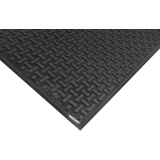 Comfort Scrape Anti Fatigue Mats$62.00What Comfort Scrape Does Before Grit and Grease Leave the Station Comfort Scrape is two mats doing one job: a scraper mat and an anti-fatigue mat in a single bi-level design. The raised standing surface cushions long shifts over a hard floor, while the lower level traps dirt, debris, and
...
What Comfort Scrape Does Before Grit and Grease Leave the Station Comfort Scrape is two mats doing one job: a...
What Comfort Scrape Does Before Grit and Grease Leave the Station
Comfort Scrape is two mats doing one job: a scraper mat and an anti-fatigue mat in a single bi-level design. The raised standing surface cushions long shifts over a hard floor, while the lower level traps dirt, debris, and drips beneath shoe level — so what lands at the station stays at the station.
Without it, the messiest spot on the floor travels. Grit and grease ride out on shoe soles, spreading a slip hazard down every walkway and grinding into flooring far from where the work happens. Meanwhile the person standing in that spot all shift absorbs the hard floor through their feet, knees, and back. One mat can interrupt both problems.
Why a Bi-Level Scraper Over Nitrile, and Why This One
The bi-level construction is the heart of it. Shoes ride on the upper surface while the recessed wells below collect what falls — dirt, metal shavings, food debris, drips — holding it out of the standing path and off the soles that would otherwise track it through the building.
The material is built for the environments that need scraping most. High-density, closed-cell nitrile rubber foam gives the cushion its anti-fatigue quality and shrugs off the mess: grease and oil proof, chemical resistant, and welding safe. A lifetime anti-microbial treatment protects the mat itself against odors and degradation between cleanings.
Safety is certified rather than assumed — the surface is certified high-traction by the National Floor Safety Institute, and beveled edges give feet and cart wheels a safe transition from floor to mat. When the wells fill up, the lightweight, flexible design lifts easily, and the mat can be commercially laundered to strip out oil, grease, and soil completely.
Where It Belongs, and What It Is Not
Comfort Scrape belongs at working stations where grease, oil, or chemicals meet foot traffic: prep and dish areas, machine and fabrication stations, parts-washing benches, and packing posts where debris gathers underfoot. It earns a special place at the boundary between a messy zone and the rest of the floor — the last stop before shoes carry the mess onward.
What it is not: an entrance doormat, and not a flow-through drainage mat. This design contains what falls rather than draining it through, so wash-down zones with steady standing water are better matched to the drainage-style options in our anti-fatigue mats and runners lineup. Comfort Scrape is for the station where debris, not water volume, is the daily enemy.
Three Things to Check Before You Spec It
First, look at what actually ends up underfoot. If the station generates grit, shavings, food debris, or greasy drips, the bi-level wells earn their place by capturing it. If the real problem is water by the gallon, a flow-through drainage mat is the honest answer — trapping isn't the same job as draining.
Second, plan the emptying and cleaning rhythm before the mat arrives. The wells do their job by filling, so build a routine around lifting the mat, clearing what it caught, and giving it a real wash — it's launderable, so oil, grease, and ground-in soil come all the way out rather than accumulating for good.
Third, place it across the step-off path. The scraping only helps if shoes cross the mat before leaving the zone, so position it where people actually pivot and exit — with the beveled edges facing the traffic so every transition on and off stays a safe one.
Why Mats Inc.
Tracked grit is one of the quietest problems we've watched wear down facilities since 1964 — it dulls floors, spreads slip hazards, and doubles the housekeeping load one shoe sole at a time. We carry this mat because it stops that at the source, we verify every claim on this page against published product data, and we back it with a 1-year limited Mats Inc. warranty.
Construction Bi-level scraper and anti-fatigue mat; traps dirt and debris to prevent tracking Cushion High-density, closed-cell nitrile rubber foam Resistance Grease and oil proof; chemical resistant; welding safe Traction Certified high-traction by NFSI Edges Beveled for safe floor-to-mat transition Hygiene Lifetime anti-microbial treatment against odors and mat degradation Cleaning Lightweight, flexible handling; commercially launderable to remove oil, grease, and soil Use Area Areas where grease, oil, or chemicals may be present Warranty 1-year limited (Mats Inc.) Frequently Asked Questions
How does the bi-level design actually work?
Answered by Dustin Thompson, Owner & CEO
Think of it as a standing deck over a catch basin. Shoes stay on the raised upper surface, and everything that falls — grit, shavings, food debris, greasy drips — settles into the recessed wells below, out of the standing path. That's what prevents tracking: the mess never sits where soles can pick it up. The cushion underneath is high-density, closed-cell nitrile rubber foam, so the mat is doing genuine anti-fatigue work the entire time it's scraping.
Will grease, chemicals, or welding work wear it out?
Answered by Dustin Thompson, Owner & CEO
This construction is specified for exactly those exposures: the nitrile rubber is grease and oil proof, chemical resistant, and welding safe, and the closed-cell foam resists soaking up what the shift drops on it. A lifetime anti-microbial treatment protects the mat against odors and material breakdown between cleanings. The practical habit that keeps any grease-rated mat at its best is not letting buildup sit indefinitely — and since this one launders, a real reset is always available.
Is it safe where people move quickly on and off it?
Answered by Dustin Thompson, Owner & CEO
Yes — the surface is certified high-traction by the National Floor Safety Institute, independent testing rather than a marketing claim, and the beveled edges slope to the floor so a hurried step doesn't catch a raised lip. Placement does the rest: set the mat so the natural pivot-and-exit path crosses it fully, keeping fast feet on the certified surface instead of on a greasy strip of bare floor beside it.
Isn't a scraper mat something for the front door?
Answered by Jinna Hopson, Vice President of Marketing
That's the natural instinct — most of us picture scraping happening at an entrance. This one scrapes where the mess is made instead. A dish station, a machine post, or a prep line generates its own debris all day, and an entrance mat forty feet away does nothing about it. Comfort Scrape puts the capture right at the source, while cushioning the person standing there — a combination an entrance mat was never designed to offer.
Will it really keep the floors around the station cleaner?
Answered by Jinna Hopson, Vice President of Marketing
That's the change facilities notice first. When debris drops into the wells instead of lying in the standing path, it stops riding out on shoe soles — so the hallway past the kitchen stays presentable, the showroom floor beside the shop keeps its finish, and housekeeping stops chasing the same trail of grit every day. The mat quietly shrinks the messy zone down to its own footprint, and the rest of the building shows it.
How much of the station should it cover?
Answered by Jinna Hopson, Vice President of Marketing
Cover the standing zone and the step-off path together. Watch the station during a real shift: where feet plant for the work, and which direction people leave. The mat should span both, because a mat that ends one stride short of the exit path lets shoes step from debris straight onto clean floor. Size to the work zone with margin on the exit side, and our team can help match available sizes to the station's footprint.
By Dustin Thompson, Owner & CEO, Mats Inc.
↑
What Comfort Scrape Does Before Grit and Grease Leave the Station
Comfort Scrape is two mats doing one job: a scraper mat and an anti-fatigue mat in a single bi-level design. The raised standing surface cushions long shifts over a hard floor, while the lower level traps dirt, debris, and drips beneath shoe level — so what lands at the station stays at the station.
Without it, the messiest spot on the floor travels. Grit and grease ride out on shoe soles, spreading a slip hazard down every walkway and grinding into flooring far from where the work happens. Meanwhile the person standing in that spot all shift absorbs the hard floor through their feet, knees, and back. One mat can interrupt both problems.
Why a Bi-Level Scraper Over Nitrile, and Why This One
The bi-level construction is the heart of it. Shoes ride on the upper surface while the recessed wells below collect what falls — dirt, metal shavings, food debris, drips — holding it out of the standing path and off the soles that would otherwise track it through the building.
The material is built for the environments that need scraping most. High-density, closed-cell nitrile rubber foam gives the cushion its anti-fatigue quality and shrugs off the mess: grease and oil proof, chemical resistant, and welding safe. A lifetime anti-microbial treatment protects the mat itself against odors and degradation between cleanings.
Safety is certified rather than assumed — the surface is certified high-traction by the National Floor Safety Institute, and beveled edges give feet and cart wheels a safe transition from floor to mat. When the wells fill up, the lightweight, flexible design lifts easily, and the mat can be commercially laundered to strip out oil, grease, and soil completely.
Where It Belongs, and What It Is Not
Comfort Scrape belongs at working stations where grease, oil, or chemicals meet foot traffic: prep and dish areas, machine and fabrication stations, parts-washing benches, and packing posts where debris gathers underfoot. It earns a special place at the boundary between a messy zone and the rest of the floor — the last stop before shoes carry the mess onward.
What it is not: an entrance doormat, and not a flow-through drainage mat. This design contains what falls rather than draining it through, so wash-down zones with steady standing water are better matched to the drainage-style options in our anti-fatigue mats and runners lineup. Comfort Scrape is for the station where debris, not water volume, is the daily enemy.
Three Things to Check Before You Spec It
First, look at what actually ends up underfoot. If the station generates grit, shavings, food debris, or greasy drips, the bi-level wells earn their place by capturing it. If the real problem is water by the gallon, a flow-through drainage mat is the honest answer — trapping isn't the same job as draining.
Second, plan the emptying and cleaning rhythm before the mat arrives. The wells do their job by filling, so build a routine around lifting the mat, clearing what it caught, and giving it a real wash — it's launderable, so oil, grease, and ground-in soil come all the way out rather than accumulating for good.
Third, place it across the step-off path. The scraping only helps if shoes cross the mat before leaving the zone, so position it where people actually pivot and exit — with the beveled edges facing the traffic so every transition on and off stays a safe one.
Why Mats Inc.
Tracked grit is one of the quietest problems we've watched wear down facilities since 1964 — it dulls floors, spreads slip hazards, and doubles the housekeeping load one shoe sole at a time. We carry this mat because it stops that at the source, we verify every claim on this page against published product data, and we back it with a 1-year limited Mats Inc. warranty.
Construction Bi-level scraper and anti-fatigue mat; traps dirt and debris to prevent tracking Cushion High-density, closed-cell nitrile rubber foam Resistance Grease and oil proof; chemical resistant; welding safe Traction Certified high-traction by NFSI Edges Beveled for safe floor-to-mat transition Hygiene Lifetime anti-microbial treatment against odors and mat degradation Cleaning Lightweight, flexible handling; commercially launderable to remove oil, grease, and soil Use Area Areas where grease, oil, or chemicals may be present Warranty 1-year limited (Mats Inc.) Frequently Asked Questions
How does the bi-level design actually work?
Answered by Dustin Thompson, Owner & CEO
Think of it as a standing deck over a catch basin. Shoes stay on the raised upper surface, and everything that falls — grit, shavings, food debris, greasy drips — settles into the recessed wells below, out of the standing path. That's what prevents tracking: the mess never sits where soles can pick it up. The cushion underneath is high-density, closed-cell nitrile rubber foam, so the mat is doing genuine anti-fatigue work the entire time it's scraping.
Will grease, chemicals, or welding work wear it out?
Answered by Dustin Thompson, Owner & CEO
This construction is specified for exactly those exposures: the nitrile rubber is grease and oil proof, chemical resistant, and welding safe, and the closed-cell foam resists soaking up what the shift drops on it. A lifetime anti-microbial treatment protects the mat against odors and material breakdown between cleanings. The practical habit that keeps any grease-rated mat at its best is not letting buildup sit indefinitely — and since this one launders, a real reset is always available.
Is it safe where people move quickly on and off it?
Answered by Dustin Thompson, Owner & CEO
Yes — the surface is certified high-traction by the National Floor Safety Institute, independent testing rather than a marketing claim, and the beveled edges slope to the floor so a hurried step doesn't catch a raised lip. Placement does the rest: set the mat so the natural pivot-and-exit path crosses it fully, keeping fast feet on the certified surface instead of on a greasy strip of bare floor beside it.
Isn't a scraper mat something for the front door?
Answered by Jinna Hopson, Vice President of Marketing
That's the natural instinct — most of us picture scraping happening at an entrance. This one scrapes where the mess is made instead. A dish station, a machine post, or a prep line generates its own debris all day, and an entrance mat forty feet away does nothing about it. Comfort Scrape puts the capture right at the source, while cushioning the person standing there — a combination an entrance mat was never designed to offer.
Will it really keep the floors around the station cleaner?
Answered by Jinna Hopson, Vice President of Marketing
That's the change facilities notice first. When debris drops into the wells instead of lying in the standing path, it stops riding out on shoe soles — so the hallway past the kitchen stays presentable, the showroom floor beside the shop keeps its finish, and housekeeping stops chasing the same trail of grit every day. The mat quietly shrinks the messy zone down to its own footprint, and the rest of the building shows it.
How much of the station should it cover?
Answered by Jinna Hopson, Vice President of Marketing
Cover the standing zone and the step-off path together. Watch the station during a real shift: where feet plant for the work, and which direction people leave. The mat should span both, because a mat that ends one stride short of the exit path lets shoes step from debris straight onto clean floor. Size to the work zone with margin on the exit side, and our team can help match available sizes to the station's footprint.
By Dustin Thompson, Owner & CEO, Mats Inc.
↑
View Details
View Details
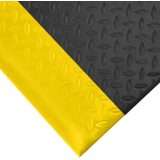 Safety Striped Tuff-Spun Anti-Fatigue Matting
Starting at $51.00
What Safety Striped Tuff-Spun Does Before Traffic and Standing Work Collide Safety Striped Tuff-Spun is a dry-area anti-fatigue mat that does two safety jobs at once. High-visibility yellow striping marks exactly where the mat — and the person standing on it — begins, while the cushioned vinyl-top construction eases the...
What Safety Striped Tuff-Spun Does Before Traffic and Standing Work Collide Safety Striped Tuff-Spun is a dry-area anti-fatigue mat that...
What Safety Striped Tuff-Spun Does Before Traffic and Standing Work Collide
Safety Striped Tuff-Spun is a dry-area anti-fatigue mat that does two safety jobs at once. High-visibility yellow striping marks exactly where the mat — and the person standing on it — begins, while the cushioned vinyl-top construction eases the long hours a worker spends planted at that station.
In a busy facility, the standing zones and the traffic lanes share real estate. Carts clip unmarked mat edges, hurried feet misjudge transitions, and the fatigue of a full shift on hard flooring slows everything down by the afternoon. A mat that announces its own footprint keeps the zone visible; the cushion keeps the worker fresh inside it.
Why a Vinyl Top Over Fused Sponge, and Why This One
The working surface is a durable, abrasion-resistant vinyl top — tested at 0.4 gram or less of material lost under the Taber method — bonded to a low-density PVC sponge that supplies the anti-fatigue give. The surface is also strongly puncture-resistant, so dropped tools and sharp debris don't open the cushion to wear.
How the layers join matters as much as what they are. The top and sponge are fused together without adhesives, which means there's no glue line to fail under years of foot traffic — the classic way layered mats delaminate at the edges. The result is a non-slip surface built to reduce the risk of falls for the long haul.
The figures behind the comfort: resiliency of 32 percent or better per ASTM D-2632, compression of .17 at 7 psi per ASTM D1667, a working weight of 7.2 pounds per square yard, and a 9/16-inch profile. Flammability passes DOC FF1-1-70 under the pill test, and the surface comes in diamond or pebble emboss.
Where It Belongs, and What It Is Not
Safety Striped Tuff-Spun is a medium-duty answer for dry standing areas where visibility matters: work stations along shared aisles, pick modules where carts and people interleave, pharmacy fill counters, and packaging lines. The yellow striping earns its keep wherever rolling traffic passes close to planted feet.
What it is not: a wet-area or grease-zone mat. This construction is built for dry duty, and floors that see water, oil, or washdown belong to the drainage-style options in our anti-fatigue mats and runners lineup. Keep it dry, and the vinyl top's wear numbers get to prove themselves for years.
Three Things to Check Before You Spec It
First, choose the surface emboss for the work. The diamond pattern gives shoes a more aggressive texture for active stations, while the pebble emboss offers a smoother feel where workers shift and pivot in place all day. Both share the same vinyl top and fused construction underneath.
Second, size to the station or the run. Standard mats span 2 by 3 feet up to 4 by 12 feet, full rolls run 75 feet in 2, 3, and 4 foot widths, and custom cuts are available in those same widths. One planning note: full rolls are not beveled on the ends unless specified — say so at order time if a roll end lands in a walking path.
Third, confirm the striping is doing real work. Yellow borders belong where mixed traffic makes the mat edge a genuine hazard line — beside forklift lanes, at aisle-facing stations, along marked walkways. Where the mat sits in a closed room away from traffic, the plain version of this same construction may be the quieter fit.
Why Mats Inc.
Marked standing zones are one of the simplest safety upgrades a facility can make, and we've been helping operations draw those lines since 1964 — with matting that holds up to the traffic it's warning about. Every figure on this page is verified against the manufacturer's published testing, and the mat is backed by a 1-year limited Mats Inc. warranty.
Construction Abrasion-resistant vinyl top bonded to low-density PVC sponge; layers fused without adhesives Color Black with yellow safety striping Surface Patterns Diamond emboss, pebble emboss Thickness 9/16" Standard Sizes 2' x 3', 3' x 5', 3' x 12', 4' x 6', 4' x 12' Roll Sizes 2' x 75', 3' x 75', 4' x 75' (roll ends not beveled unless specified) Customization Custom cuts in 2', 3', and 4' widths Abrasion ≤ 0.4 gram (Taber) Resiliency ≥ 32% per ASTM D-2632 Compression .17 at 7 psi per ASTM D1667 Weight 7.2 lbs per square yard Flammability DOC FF1-1-70 (pill test) Use Area Dry areas; medium duty Warranty 1-year limited (Mats Inc.) Frequently Asked Questions
What holds the layers together if there's no adhesive?
Answered by Dustin Thompson, Owner & CEO
The vinyl top and the PVC sponge beneath it are fused directly to each other — no glue layer in between. That's a durability decision: adhesive bonds are where layered mats traditionally fail, peeling at the edges under years of heel strikes and cart wheels until the mat becomes its own trip hazard. Fused construction removes that failure point entirely, so the wear surface and the cushion age as one piece instead of two.
How do the durability numbers translate to real shifts?
Answered by Dustin Thompson, Owner & CEO
Three figures tell the story. Taber abrasion of 0.4 gram or less means the vinyl top sheds almost no material under standardized wear — that's years of shoe traffic, not months. The puncture-resistant surface shrugs off dropped tools and sharp debris that would open up a foam mat. And resiliency of 32 percent or better per ASTM D-2632 means the cushion keeps pushing back shift after shift rather than compressing flat under the same pair of boots.
Can it handle a station that occasionally gets damp?
Answered by Dustin Thompson, Owner & CEO
Spec it for the floor's normal day, and this mat's normal day is dry. It's built as a dry-area construction — work stations, pick modules, pharmacies, packaging lines — where the non-slip vinyl surface does its fall-reduction work on solid footing. If water, oil, or washdown is part of the routine rather than the exception, a drainage-style wet-area mat is the honest spec; asking a dry-area mat to live wet shortens everyone's patience with it.
What does the yellow striping actually change day to day?
Answered by Jinna Hopson, Vice President of Marketing
It turns the mat into signage. The yellow border draws a bright, permanent line around the standing zone, so forklift operators see the workstation before they're beside it, visitors read the walkway without a tour guide, and new hires learn the floor's geography on day one. It's wayfinding that never needs repainting and moves with the mat if the layout changes — the safety message and the safety equipment in a single piece.
Mats, rolls, or custom cuts — how do I choose?
Answered by Jinna Hopson, Vice President of Marketing
Let the length of the standing path decide. Individual stations suit the standard mats, from 2 by 3 up to 4 by 12 feet. A full line or long marked walkway is a job for the 75-foot rolls in 2, 3, or 4 foot widths — one continuous striped run instead of a chain of mats. Custom cuts in the same widths handle the in-between lengths. One ordering note: roll ends aren't beveled unless you ask, so specify it where a cut end meets foot traffic.
When should I pick the striped version over the plain one?
Answered by Jinna Hopson, Vice President of Marketing
Ask who else uses the space. If the mat sits where carts, lifts, or through-traffic pass close to planted workers — aisle-facing stations, pick modules, shared corridors — the striping is doing genuine safety work and belongs there. If the station lives in a closed room or a quiet corner where nobody crosses the zone but the person working it, the plain version of the same construction keeps the floor visually calm. Same mat underneath; the border is about the traffic around it.
By Dustin Thompson, Owner & CEO, Mats Inc.
↑
What Safety Striped Tuff-Spun Does Before Traffic and Standing Work Collide
Safety Striped Tuff-Spun is a dry-area anti-fatigue mat that does two safety jobs at once. High-visibility yellow striping marks exactly where the mat — and the person standing on it — begins, while the cushioned vinyl-top construction eases the long hours a worker spends planted at that station.
In a busy facility, the standing zones and the traffic lanes share real estate. Carts clip unmarked mat edges, hurried feet misjudge transitions, and the fatigue of a full shift on hard flooring slows everything down by the afternoon. A mat that announces its own footprint keeps the zone visible; the cushion keeps the worker fresh inside it.
Why a Vinyl Top Over Fused Sponge, and Why This One
The working surface is a durable, abrasion-resistant vinyl top — tested at 0.4 gram or less of material lost under the Taber method — bonded to a low-density PVC sponge that supplies the anti-fatigue give. The surface is also strongly puncture-resistant, so dropped tools and sharp debris don't open the cushion to wear.
How the layers join matters as much as what they are. The top and sponge are fused together without adhesives, which means there's no glue line to fail under years of foot traffic — the classic way layered mats delaminate at the edges. The result is a non-slip surface built to reduce the risk of falls for the long haul.
The figures behind the comfort: resiliency of 32 percent or better per ASTM D-2632, compression of .17 at 7 psi per ASTM D1667, a working weight of 7.2 pounds per square yard, and a 9/16-inch profile. Flammability passes DOC FF1-1-70 under the pill test, and the surface comes in diamond or pebble emboss.
Where It Belongs, and What It Is Not
Safety Striped Tuff-Spun is a medium-duty answer for dry standing areas where visibility matters: work stations along shared aisles, pick modules where carts and people interleave, pharmacy fill counters, and packaging lines. The yellow striping earns its keep wherever rolling traffic passes close to planted feet.
What it is not: a wet-area or grease-zone mat. This construction is built for dry duty, and floors that see water, oil, or washdown belong to the drainage-style options in our anti-fatigue mats and runners lineup. Keep it dry, and the vinyl top's wear numbers get to prove themselves for years.
Three Things to Check Before You Spec It
First, choose the surface emboss for the work. The diamond pattern gives shoes a more aggressive texture for active stations, while the pebble emboss offers a smoother feel where workers shift and pivot in place all day. Both share the same vinyl top and fused construction underneath.
Second, size to the station or the run. Standard mats span 2 by 3 feet up to 4 by 12 feet, full rolls run 75 feet in 2, 3, and 4 foot widths, and custom cuts are available in those same widths. One planning note: full rolls are not beveled on the ends unless specified — say so at order time if a roll end lands in a walking path.
Third, confirm the striping is doing real work. Yellow borders belong where mixed traffic makes the mat edge a genuine hazard line — beside forklift lanes, at aisle-facing stations, along marked walkways. Where the mat sits in a closed room away from traffic, the plain version of this same construction may be the quieter fit.
Why Mats Inc.
Marked standing zones are one of the simplest safety upgrades a facility can make, and we've been helping operations draw those lines since 1964 — with matting that holds up to the traffic it's warning about. Every figure on this page is verified against the manufacturer's published testing, and the mat is backed by a 1-year limited Mats Inc. warranty.
Construction Abrasion-resistant vinyl top bonded to low-density PVC sponge; layers fused without adhesives Color Black with yellow safety striping Surface Patterns Diamond emboss, pebble emboss Thickness 9/16" Standard Sizes 2' x 3', 3' x 5', 3' x 12', 4' x 6', 4' x 12' Roll Sizes 2' x 75', 3' x 75', 4' x 75' (roll ends not beveled unless specified) Customization Custom cuts in 2', 3', and 4' widths Abrasion ≤ 0.4 gram (Taber) Resiliency ≥ 32% per ASTM D-2632 Compression .17 at 7 psi per ASTM D1667 Weight 7.2 lbs per square yard Flammability DOC FF1-1-70 (pill test) Use Area Dry areas; medium duty Warranty 1-year limited (Mats Inc.) Frequently Asked Questions
What holds the layers together if there's no adhesive?
Answered by Dustin Thompson, Owner & CEO
The vinyl top and the PVC sponge beneath it are fused directly to each other — no glue layer in between. That's a durability decision: adhesive bonds are where layered mats traditionally fail, peeling at the edges under years of heel strikes and cart wheels until the mat becomes its own trip hazard. Fused construction removes that failure point entirely, so the wear surface and the cushion age as one piece instead of two.
How do the durability numbers translate to real shifts?
Answered by Dustin Thompson, Owner & CEO
Three figures tell the story. Taber abrasion of 0.4 gram or less means the vinyl top sheds almost no material under standardized wear — that's years of shoe traffic, not months. The puncture-resistant surface shrugs off dropped tools and sharp debris that would open up a foam mat. And resiliency of 32 percent or better per ASTM D-2632 means the cushion keeps pushing back shift after shift rather than compressing flat under the same pair of boots.
Can it handle a station that occasionally gets damp?
Answered by Dustin Thompson, Owner & CEO
Spec it for the floor's normal day, and this mat's normal day is dry. It's built as a dry-area construction — work stations, pick modules, pharmacies, packaging lines — where the non-slip vinyl surface does its fall-reduction work on solid footing. If water, oil, or washdown is part of the routine rather than the exception, a drainage-style wet-area mat is the honest spec; asking a dry-area mat to live wet shortens everyone's patience with it.
What does the yellow striping actually change day to day?
Answered by Jinna Hopson, Vice President of Marketing
It turns the mat into signage. The yellow border draws a bright, permanent line around the standing zone, so forklift operators see the workstation before they're beside it, visitors read the walkway without a tour guide, and new hires learn the floor's geography on day one. It's wayfinding that never needs repainting and moves with the mat if the layout changes — the safety message and the safety equipment in a single piece.
Mats, rolls, or custom cuts — how do I choose?
Answered by Jinna Hopson, Vice President of Marketing
Let the length of the standing path decide. Individual stations suit the standard mats, from 2 by 3 up to 4 by 12 feet. A full line or long marked walkway is a job for the 75-foot rolls in 2, 3, or 4 foot widths — one continuous striped run instead of a chain of mats. Custom cuts in the same widths handle the in-between lengths. One ordering note: roll ends aren't beveled unless you ask, so specify it where a cut end meets foot traffic.
When should I pick the striped version over the plain one?
Answered by Jinna Hopson, Vice President of Marketing
Ask who else uses the space. If the mat sits where carts, lifts, or through-traffic pass close to planted workers — aisle-facing stations, pick modules, shared corridors — the striping is doing genuine safety work and belongs there. If the station lives in a closed room or a quiet corner where nobody crosses the zone but the person working it, the plain version of the same construction keeps the floor visually calm. Same mat underneath; the border is about the traffic around it.
By Dustin Thompson, Owner & CEO, Mats Inc.
↑
View Details
View Details
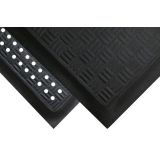 Cushion Station Anti-Fatigue Mats$64.00What Cushion Station Does Before Fatigue and Hygiene Become Competing Problems Cushion Station is an anti-fatigue mat built for floors where comfort alone isn't enough — the mat itself has to stay sanitary. A 7/16-inch high-density nitrile rubber foam cushions long standing shifts, while a lifetime anti-microbial treatment protects the
...
What Cushion Station Does Before Fatigue and Hygiene Become Competing Problems Cushion Station is an anti-fatigue mat built for floors...
What Cushion Station Does Before Fatigue and Hygiene Become Competing Problems
Cushion Station is an anti-fatigue mat built for floors where comfort alone isn't enough — the mat itself has to stay sanitary. A 7/16-inch high-density nitrile rubber foam cushions long standing shifts, while a lifetime anti-microbial treatment protects the mat against odors and degradation between cleanings.
In healthcare and food environments, an ordinary mat becomes a liability twice over: the crew still aches by mid-shift, and the mat quietly turns into the hardest thing in the room to keep clean. Floors like these need a mat that supports the people standing on it and survives the sanitation regimen the space demands.
Why Closed-Cell Nitrile, and Why This One
The cushion is a high-density, closed-cell nitrile foam — a material chosen for what it refuses to absorb. It's grease and oil proof, chemical resistant, and welding safe, so the exposures that soak into and destroy open foams simply stay on the surface here, where cleaning can remove them completely.
Safety is certified rather than claimed: the surface carries high-traction certification from the National Floor Safety Institute, and beveled edges give feet and cart wheels a safe transition from floor to mat. Two surface options cover both floor types — a solid top for dry areas, or drainage holes that carry liquids away from feet in wet zones.
Then comes the part that sets it apart: the sanitation ceiling. The flexible construction scrubs clean with a deck brush and neutral-pH detergent, rinses with a hose or pressure washer, hangs to dry — and when the protocol demands more, the mat can be autoclave sterilized. It also meets FDA and USDA standards for non-contact surfaces in food processing and preparation areas.
Where It Belongs, and What It Is Not
Cushion Station belongs where standing work and strict hygiene share a floor: healthcare facilities, food service and food manufacturing lines, and the industrial or commercial stations that get sanitized on a schedule. The holes version handles dish, prep, and washdown zones; the solid version covers dry stations in the same demanding buildings.
What it is not: the default for every standing post. Where hygiene protocols aren't part of the floor's life — a dry workshop bench, a cashier stand — the simpler dry-area options in our anti-fatigue mats and runners lineup do that job well. This mat earns its place where the cleaning regimen would defeat anything less.
Three Things to Check Before You Spec It
First, choose the surface by the floor's normal day. If liquid reaches the floor daily — dish spray, rinse-down, prep runoff — the drainage-hole version keeps water moving away from feet. If the station stays dry, the solid top gives a continuous standing surface with nothing for small items to fall through.
Second, size to the full working path. Eleven standard sizes run from a compact 2 by 3.2 feet up to 4 by 20.1 feet, in 38-inch and 48-inch widths — enough range to cover a single scrub sink or a whole production line in one piece. Sizes are approximate, with a 3 to 5 percent manufacturing variance, so leave allowance where the fit is tight.
Third, match the mat to your sanitation protocol before it arrives. Decide how it will be cleaned — deck brush and hose on the floor, pulled and pressure-washed, or autoclave sterilized — and who owns that cycle. A mat that fits the existing protocol gets cleaned on schedule; one that doesn't gets cleaned around.
Why Mats Inc.
Hygiene-critical floors are where mat choices get audited — by inspectors, infection-control teams, and food-safety programs — and we've been helping facilities pass those checks since 1964. We carry this mat because it's the rare cushion that keeps up with a sanitation regimen, we verify every claim against the manufacturer's published data, and we back it with a 1-year limited Mats Inc. warranty.
Material High-density, closed-cell nitrile rubber foam Thickness 7/16" Surface Options Solid (dry areas) or drainage holes (wet areas) Resistance Grease and oil proof; chemical resistant; welding safe Hygiene Lifetime anti-microbial treatment; autoclave sterilizable; meets FDA and USDA standards for non-contact surfaces Traction Certified high-traction by NFSI Edges Beveled for safe floor-to-mat transition Sizes Eleven standard sizes from 2' x 3.2' up to 4' x 20.1', in 38" and 48" widths; approximate, 3–5% variance Cleaning Deck brush with neutral-pH detergent; hose or pressure-washer rinse; hang to dry; autoclave sterilizable Use Area Healthcare, food service and manufacturing, industrial and commercial settings; wet or dry per surface option Warranty 1-year limited (Mats Inc.) Frequently Asked Questions
Why closed-cell nitrile for a hygiene-critical floor?
Answered by Dustin Thompson, Owner & CEO
Because sanitation only works on surfaces that don't absorb. Closed-cell nitrile foam keeps grease, oil, chemicals, and wash water on the outside of the material, where a brush and rinse can remove them completely — open foams drink those things in and slowly become what you're trying to clean off. Add the lifetime anti-microbial treatment guarding against odors and degradation, and the mat stays part of the sanitation solution instead of joining the problem.
How does it keep footing safe in wet, greasy conditions?
Answered by Dustin Thompson, Owner & CEO
Two certified and built-in ways. The surface carries high-traction certification from the National Floor Safety Institute — independent slip-resistance testing, not a marketing line — and the beveled edges slope to the floor so a hurried step on or off never catches a raised lip. In wet zones, the drainage-hole version adds the third layer: liquids pass through and away from feet rather than pooling where the next step lands.
Should I choose the solid top or the drainage holes?
Answered by Dustin Thompson, Owner & CEO
Walk the station during a real shift and watch the floor. Daily liquid — dish spray, prep runoff, washdown — calls for the holes, which keep water moving instead of sitting underfoot. A floor that stays dry calls for the solid top, which gives a continuous surface where dropped items stay in reach and cleaning is a straight wipe-down. Same nitrile construction, same certifications either way; the surface is purely a match to the floor's habits.
Can it really live in a healthcare facility?
Answered by Jinna Hopson, Vice President of Marketing
That's the environment it was designed to satisfy. The detail that wins over infection-control teams is the sterilization ceiling: beyond daily scrubbing and rinsing, the mat can be autoclave sterilized — the same standard the most demanding equipment in the building is held to. Combined with the lifetime anti-microbial treatment, it means the comfort under a standing team doesn't have to be the exception to the facility's hygiene rules.
What sizes make sense for a full production line?
Answered by Jinna Hopson, Vice President of Marketing
Think in continuous runs. With eleven standard sizes reaching 4 feet wide and just over 20 feet long, one mat can trace an entire line or sink row without seams collecting debris between sections. Choose the 38-inch width for standard aisleside stations and the 48-inch width where workers step back and pivot. And plan with a little slack: sizes are approximate, varying 3 to 5 percent as rubber expands and contracts, so a tight alcove deserves a measuring margin.
How much work is it to keep clean?
Answered by Jinna Hopson, Vice President of Marketing
Less than the environments it serves would suggest. The routine is honest floor-crew work: scrub with a deck brush and neutral-pH detergent as needed, rinse with a hose or pressure washer, hang it to dry. The flexible construction means lifting and moving it isn't a two-person project, which is what keeps the floor beneath it in the cleaning rotation too. When protocol calls for a deeper reset, the autoclave option is there — most mats can't follow you that far.
By Dustin Thompson, Owner & CEO, Mats Inc.
↑
What Cushion Station Does Before Fatigue and Hygiene Become Competing Problems
Cushion Station is an anti-fatigue mat built for floors where comfort alone isn't enough — the mat itself has to stay sanitary. A 7/16-inch high-density nitrile rubber foam cushions long standing shifts, while a lifetime anti-microbial treatment protects the mat against odors and degradation between cleanings.
In healthcare and food environments, an ordinary mat becomes a liability twice over: the crew still aches by mid-shift, and the mat quietly turns into the hardest thing in the room to keep clean. Floors like these need a mat that supports the people standing on it and survives the sanitation regimen the space demands.
Why Closed-Cell Nitrile, and Why This One
The cushion is a high-density, closed-cell nitrile foam — a material chosen for what it refuses to absorb. It's grease and oil proof, chemical resistant, and welding safe, so the exposures that soak into and destroy open foams simply stay on the surface here, where cleaning can remove them completely.
Safety is certified rather than claimed: the surface carries high-traction certification from the National Floor Safety Institute, and beveled edges give feet and cart wheels a safe transition from floor to mat. Two surface options cover both floor types — a solid top for dry areas, or drainage holes that carry liquids away from feet in wet zones.
Then comes the part that sets it apart: the sanitation ceiling. The flexible construction scrubs clean with a deck brush and neutral-pH detergent, rinses with a hose or pressure washer, hangs to dry — and when the protocol demands more, the mat can be autoclave sterilized. It also meets FDA and USDA standards for non-contact surfaces in food processing and preparation areas.
Where It Belongs, and What It Is Not
Cushion Station belongs where standing work and strict hygiene share a floor: healthcare facilities, food service and food manufacturing lines, and the industrial or commercial stations that get sanitized on a schedule. The holes version handles dish, prep, and washdown zones; the solid version covers dry stations in the same demanding buildings.
What it is not: the default for every standing post. Where hygiene protocols aren't part of the floor's life — a dry workshop bench, a cashier stand — the simpler dry-area options in our anti-fatigue mats and runners lineup do that job well. This mat earns its place where the cleaning regimen would defeat anything less.
Three Things to Check Before You Spec It
First, choose the surface by the floor's normal day. If liquid reaches the floor daily — dish spray, rinse-down, prep runoff — the drainage-hole version keeps water moving away from feet. If the station stays dry, the solid top gives a continuous standing surface with nothing for small items to fall through.
Second, size to the full working path. Eleven standard sizes run from a compact 2 by 3.2 feet up to 4 by 20.1 feet, in 38-inch and 48-inch widths — enough range to cover a single scrub sink or a whole production line in one piece. Sizes are approximate, with a 3 to 5 percent manufacturing variance, so leave allowance where the fit is tight.
Third, match the mat to your sanitation protocol before it arrives. Decide how it will be cleaned — deck brush and hose on the floor, pulled and pressure-washed, or autoclave sterilized — and who owns that cycle. A mat that fits the existing protocol gets cleaned on schedule; one that doesn't gets cleaned around.
Why Mats Inc.
Hygiene-critical floors are where mat choices get audited — by inspectors, infection-control teams, and food-safety programs — and we've been helping facilities pass those checks since 1964. We carry this mat because it's the rare cushion that keeps up with a sanitation regimen, we verify every claim against the manufacturer's published data, and we back it with a 1-year limited Mats Inc. warranty.
Material High-density, closed-cell nitrile rubber foam Thickness 7/16" Surface Options Solid (dry areas) or drainage holes (wet areas) Resistance Grease and oil proof; chemical resistant; welding safe Hygiene Lifetime anti-microbial treatment; autoclave sterilizable; meets FDA and USDA standards for non-contact surfaces Traction Certified high-traction by NFSI Edges Beveled for safe floor-to-mat transition Sizes Eleven standard sizes from 2' x 3.2' up to 4' x 20.1', in 38" and 48" widths; approximate, 3–5% variance Cleaning Deck brush with neutral-pH detergent; hose or pressure-washer rinse; hang to dry; autoclave sterilizable Use Area Healthcare, food service and manufacturing, industrial and commercial settings; wet or dry per surface option Warranty 1-year limited (Mats Inc.) Frequently Asked Questions
Why closed-cell nitrile for a hygiene-critical floor?
Answered by Dustin Thompson, Owner & CEO
Because sanitation only works on surfaces that don't absorb. Closed-cell nitrile foam keeps grease, oil, chemicals, and wash water on the outside of the material, where a brush and rinse can remove them completely — open foams drink those things in and slowly become what you're trying to clean off. Add the lifetime anti-microbial treatment guarding against odors and degradation, and the mat stays part of the sanitation solution instead of joining the problem.
How does it keep footing safe in wet, greasy conditions?
Answered by Dustin Thompson, Owner & CEO
Two certified and built-in ways. The surface carries high-traction certification from the National Floor Safety Institute — independent slip-resistance testing, not a marketing line — and the beveled edges slope to the floor so a hurried step on or off never catches a raised lip. In wet zones, the drainage-hole version adds the third layer: liquids pass through and away from feet rather than pooling where the next step lands.
Should I choose the solid top or the drainage holes?
Answered by Dustin Thompson, Owner & CEO
Walk the station during a real shift and watch the floor. Daily liquid — dish spray, prep runoff, washdown — calls for the holes, which keep water moving instead of sitting underfoot. A floor that stays dry calls for the solid top, which gives a continuous surface where dropped items stay in reach and cleaning is a straight wipe-down. Same nitrile construction, same certifications either way; the surface is purely a match to the floor's habits.
Can it really live in a healthcare facility?
Answered by Jinna Hopson, Vice President of Marketing
That's the environment it was designed to satisfy. The detail that wins over infection-control teams is the sterilization ceiling: beyond daily scrubbing and rinsing, the mat can be autoclave sterilized — the same standard the most demanding equipment in the building is held to. Combined with the lifetime anti-microbial treatment, it means the comfort under a standing team doesn't have to be the exception to the facility's hygiene rules.
What sizes make sense for a full production line?
Answered by Jinna Hopson, Vice President of Marketing
Think in continuous runs. With eleven standard sizes reaching 4 feet wide and just over 20 feet long, one mat can trace an entire line or sink row without seams collecting debris between sections. Choose the 38-inch width for standard aisleside stations and the 48-inch width where workers step back and pivot. And plan with a little slack: sizes are approximate, varying 3 to 5 percent as rubber expands and contracts, so a tight alcove deserves a measuring margin.
How much work is it to keep clean?
Answered by Jinna Hopson, Vice President of Marketing
Less than the environments it serves would suggest. The routine is honest floor-crew work: scrub with a deck brush and neutral-pH detergent as needed, rinse with a hose or pressure washer, hang it to dry. The flexible construction means lifting and moving it isn't a two-person project, which is what keeps the floor beneath it in the cleaning rotation too. When protocol calls for a deeper reset, the autoclave option is there — most mats can't follow you that far.
By Dustin Thompson, Owner & CEO, Mats Inc.
↑
View Details
View Details
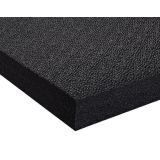 Double Thick Anti-Fatigue Comfort Mat$180.00What This Double-Thick Mat Does Before a Standing Shift Turns Into Sore Knees Double Thick Super Foot Lover is the softest anti-fatigue mat in our dry-area lineup — a full 7/8 inch of patented foam engineered to balance softness with genuine support. That balance is the point: plush enough to
...
What This Double-Thick Mat Does Before a Standing Shift Turns Into Sore Knees Double Thick Super Foot Lover is the...
What This Double-Thick Mat Does Before a Standing Shift Turns Into Sore Knees
Double Thick Super Foot Lover is the softest anti-fatigue mat in our dry-area lineup — a full 7/8 inch of patented foam engineered to balance softness with genuine support. That balance is the point: plush enough to feel immediately, structured enough to keep relieving stress on knee, foot, and ankle pressure points hour after hour.
The people this mat is built for stand in one place all day with a smile on: cashiers, front-desk teams, pharmacy staff, retail counter crews. By closing time, a hard floor has quietly collected its toll from every one of them. A standing surface designed for exactly that post changes how the last hour of the shift feels.
Why Double-Thick Patented Foam, and Why This One
The core is a double-thick layer of patented anti-fatigue foam (U.S. Patent 5,965,650) — the construction that makes this the most comfortable and soft foam mat in its maker's line. Softness alone isn't the engineering feat; it's pairing that plush first impression with support that doesn't bottom out under a planted stance.
The figures behind the feel: compression of .28 at 7 psi per ASTM D-1667, so the cushion yields progressively rather than collapsing; abrasion of 0.5 gram maximum under ASTM D-4060, a genuine wear surface; and a substantial 13.3 pounds per square yard of mat, which helps a long runner lie flat and stay planted at a busy counter.
The details are commercial-grade throughout: flammability passes DOC FF-1-70 under the pill test, and electrical resistance measures 10⁹ ohms per square under ASTM D-257. The color is a clean, professional black — the mat that disappears politely behind a front desk while doing its loudest work underfoot.
Where It Belongs, and What It Is Not
This mat belongs at the dry-area posts where one person holds one spot for hours: cashier stations, hotel front desks, pharmacy counters, and retail work counters. It was specifically designed for employee workstations — the places where standing is the job description and comfort decides how the day ends.
What it is not: a wet-area or grease-zone mat. The foam is built for dry duty, and floors that meet water, oil, or washdown belong to the drainage constructions in our anti-fatigue mats and runners lineup. Keep this one dry and stationed, and the double-thick cushion gets to do exactly what it was patented for.
Three Things to Check Before You Spec It
First, confirm the post is truly dry. This foam earns its softness by not compromising for wet duty — so if the station sees daily liquid, choose a drainage-rated construction instead and save this one for the front desk it was designed around.
Second, size to the standing pattern. The 2 by 3 and 3 by 5 foot mats suit a single fixed post, the 3 by 12 covers a multi-register counter, and rolls run 2, 3, and 4 feet wide at 30-foot lengths, with custom lengths up to 30 feet — one continuous soft surface down an entire service counter.
Third, give it a true standing post. A double-thick mat rewards placement where feet live on the mat — planted at a register, a desk, a fill counter — rather than a high-crossing corridor. Match the mat's footprint to where the person actually stands, and the comfort stays exactly where the shift needs it.
Why Mats Inc.
Some stations just need the softest thing we can honestly recommend — and after decades of putting mats under cashiers and front-desk teams since 1964, this is that mat. We verify the patent, the test figures, and the construction behind every claim on this page, and the mat is backed by a 1-year limited Mats Inc. warranty.
Material Double-thick patented anti-fatigue foam (U.S. Patent 5,965,650) Thickness 7/8" Color Black Standard Sizes 2' x 3', 3' x 5', 3' x 12' Roll Sizes 2' x 30', 3' x 30', 4' x 30' Custom Lengths Up to 30' Compression .28 at 7 psi per ASTM D-1667 Abrasion 0.5 gram max per ASTM D-4060 Weight 13.3 lbs per square yard Flammability DOC FF-1-70 (pill test) Electrical Resistance 10⁹ ohms per square (ASTM D-257) Use Area Dry areas only Warranty 1-year limited (Mats Inc.) Frequently Asked Questions
What does "double-thick" actually mean in the construction?
Answered by Dustin Thompson, Owner & CEO
It's a full 7/8 inch of the patented anti-fatigue foam — double the depth of a standard comfort mat built on the same material. More depth isn't just more softness; it's more working range. The foam yields progressively under a planted stance (compression of .28 at 7 psi per ASTM D-1667), which means the cushion keeps responding to weight shifts deep into an eight-hour day instead of bottoming out by lunch.
Will a mat this soft wear out faster?
Answered by Dustin Thompson, Owner & CEO
Soft on top doesn't mean fragile — the wear surface tests at 0.5 gram maximum material loss under ASTM D-4060, which is standard-mat durability on the softest construction in the family. The honest condition is duty match: this is a dry-area mat, and keeping it out of wet and greasy service is what lets those wear numbers play out in real years. At 13.3 pounds per square yard, it also stays planted rather than creeping across the floor.
Why is it limited to dry areas?
Answered by Dustin Thompson, Owner & CEO
Because every design choice here spent its budget on comfort. There are no drainage holes, and the foam is engineered for cushion rather than for shrugging off grease and washdown — that's what makes it the softest option available, and it's also what makes a dish line the wrong home for it. Cashier stations, front desks, pharmacies, and retail counters are dry posts, and that's precisely the duty this mat was designed around.
Will staff actually notice the difference from a standard mat?
Answered by Jinna Hopson, Vice President of Marketing
Immediately — that's the product's whole reputation. The first step onto double-thick foam registers as plush in a way standard mats don't, and the difference that matters shows up later: hour six at a front desk, when knees and lower backs usually start negotiating. Teams standing through full shifts feel this mat as a genuine upgrade rather than a technicality, which is exactly why it's the one we suggest when someone asks for the most comfortable option, full stop.
Does black work at a hotel front desk or a nice retail counter?
Answered by Jinna Hopson, Vice President of Marketing
Black is the right instinct for exactly those settings. Behind a front desk or counter, the mat lives mostly out of the guest's sightline — and when it does show, a clean black surface reads as intentional equipment rather than decor competing with the space. It hides scuffs and daily soil between cleanings, pairs with any floor finish, and lets the desk, the branding, and the person at the counter carry the visual story.
How do I cover a long service counter?
Answered by Jinna Hopson, Vice President of Marketing
Run it as one piece. Rolls come 2, 3, and 4 feet wide at 30-foot lengths, and custom lengths up to 30 feet mean a single continuous mat can trace an entire registration desk, pharmacy fill line, or multi-register checkout — no seams underfoot and no comfort gaps where someone slides one station over. For a single fixed post, the 2 by 3 or 3 by 5 sizes give the full double-thick benefit in a compact footprint.
By Jinna Hopson, Vice President of Marketing, Mats Inc.
↑
What This Double-Thick Mat Does Before a Standing Shift Turns Into Sore Knees
Double Thick Super Foot Lover is the softest anti-fatigue mat in our dry-area lineup — a full 7/8 inch of patented foam engineered to balance softness with genuine support. That balance is the point: plush enough to feel immediately, structured enough to keep relieving stress on knee, foot, and ankle pressure points hour after hour.
The people this mat is built for stand in one place all day with a smile on: cashiers, front-desk teams, pharmacy staff, retail counter crews. By closing time, a hard floor has quietly collected its toll from every one of them. A standing surface designed for exactly that post changes how the last hour of the shift feels.
Why Double-Thick Patented Foam, and Why This One
The core is a double-thick layer of patented anti-fatigue foam (U.S. Patent 5,965,650) — the construction that makes this the most comfortable and soft foam mat in its maker's line. Softness alone isn't the engineering feat; it's pairing that plush first impression with support that doesn't bottom out under a planted stance.
The figures behind the feel: compression of .28 at 7 psi per ASTM D-1667, so the cushion yields progressively rather than collapsing; abrasion of 0.5 gram maximum under ASTM D-4060, a genuine wear surface; and a substantial 13.3 pounds per square yard of mat, which helps a long runner lie flat and stay planted at a busy counter.
The details are commercial-grade throughout: flammability passes DOC FF-1-70 under the pill test, and electrical resistance measures 10⁹ ohms per square under ASTM D-257. The color is a clean, professional black — the mat that disappears politely behind a front desk while doing its loudest work underfoot.
Where It Belongs, and What It Is Not
This mat belongs at the dry-area posts where one person holds one spot for hours: cashier stations, hotel front desks, pharmacy counters, and retail work counters. It was specifically designed for employee workstations — the places where standing is the job description and comfort decides how the day ends.
What it is not: a wet-area or grease-zone mat. The foam is built for dry duty, and floors that meet water, oil, or washdown belong to the drainage constructions in our anti-fatigue mats and runners lineup. Keep this one dry and stationed, and the double-thick cushion gets to do exactly what it was patented for.
Three Things to Check Before You Spec It
First, confirm the post is truly dry. This foam earns its softness by not compromising for wet duty — so if the station sees daily liquid, choose a drainage-rated construction instead and save this one for the front desk it was designed around.
Second, size to the standing pattern. The 2 by 3 and 3 by 5 foot mats suit a single fixed post, the 3 by 12 covers a multi-register counter, and rolls run 2, 3, and 4 feet wide at 30-foot lengths, with custom lengths up to 30 feet — one continuous soft surface down an entire service counter.
Third, give it a true standing post. A double-thick mat rewards placement where feet live on the mat — planted at a register, a desk, a fill counter — rather than a high-crossing corridor. Match the mat's footprint to where the person actually stands, and the comfort stays exactly where the shift needs it.
Why Mats Inc.
Some stations just need the softest thing we can honestly recommend — and after decades of putting mats under cashiers and front-desk teams since 1964, this is that mat. We verify the patent, the test figures, and the construction behind every claim on this page, and the mat is backed by a 1-year limited Mats Inc. warranty.
Material Double-thick patented anti-fatigue foam (U.S. Patent 5,965,650) Thickness 7/8" Color Black Standard Sizes 2' x 3', 3' x 5', 3' x 12' Roll Sizes 2' x 30', 3' x 30', 4' x 30' Custom Lengths Up to 30' Compression .28 at 7 psi per ASTM D-1667 Abrasion 0.5 gram max per ASTM D-4060 Weight 13.3 lbs per square yard Flammability DOC FF-1-70 (pill test) Electrical Resistance 10⁹ ohms per square (ASTM D-257) Use Area Dry areas only Warranty 1-year limited (Mats Inc.) Frequently Asked Questions
What does "double-thick" actually mean in the construction?
Answered by Dustin Thompson, Owner & CEO
It's a full 7/8 inch of the patented anti-fatigue foam — double the depth of a standard comfort mat built on the same material. More depth isn't just more softness; it's more working range. The foam yields progressively under a planted stance (compression of .28 at 7 psi per ASTM D-1667), which means the cushion keeps responding to weight shifts deep into an eight-hour day instead of bottoming out by lunch.
Will a mat this soft wear out faster?
Answered by Dustin Thompson, Owner & CEO
Soft on top doesn't mean fragile — the wear surface tests at 0.5 gram maximum material loss under ASTM D-4060, which is standard-mat durability on the softest construction in the family. The honest condition is duty match: this is a dry-area mat, and keeping it out of wet and greasy service is what lets those wear numbers play out in real years. At 13.3 pounds per square yard, it also stays planted rather than creeping across the floor.
Why is it limited to dry areas?
Answered by Dustin Thompson, Owner & CEO
Because every design choice here spent its budget on comfort. There are no drainage holes, and the foam is engineered for cushion rather than for shrugging off grease and washdown — that's what makes it the softest option available, and it's also what makes a dish line the wrong home for it. Cashier stations, front desks, pharmacies, and retail counters are dry posts, and that's precisely the duty this mat was designed around.
Will staff actually notice the difference from a standard mat?
Answered by Jinna Hopson, Vice President of Marketing
Immediately — that's the product's whole reputation. The first step onto double-thick foam registers as plush in a way standard mats don't, and the difference that matters shows up later: hour six at a front desk, when knees and lower backs usually start negotiating. Teams standing through full shifts feel this mat as a genuine upgrade rather than a technicality, which is exactly why it's the one we suggest when someone asks for the most comfortable option, full stop.
Does black work at a hotel front desk or a nice retail counter?
Answered by Jinna Hopson, Vice President of Marketing
Black is the right instinct for exactly those settings. Behind a front desk or counter, the mat lives mostly out of the guest's sightline — and when it does show, a clean black surface reads as intentional equipment rather than decor competing with the space. It hides scuffs and daily soil between cleanings, pairs with any floor finish, and lets the desk, the branding, and the person at the counter carry the visual story.
How do I cover a long service counter?
Answered by Jinna Hopson, Vice President of Marketing
Run it as one piece. Rolls come 2, 3, and 4 feet wide at 30-foot lengths, and custom lengths up to 30 feet mean a single continuous mat can trace an entire registration desk, pharmacy fill line, or multi-register checkout — no seams underfoot and no comfort gaps where someone slides one station over. For a single fixed post, the 2 by 3 or 3 by 5 sizes give the full double-thick benefit in a compact footprint.
By Jinna Hopson, Vice President of Marketing, Mats Inc.
↑
View Details
View Details
 Comfort King Anti-Static Anti-Fatigue Matting$97.00What Anti-Static Anti-Fatigue Matting Does Before Static Reaches Your Components Standing at a bench all shift is hard on your body, and the static charge your body builds along the way is hard on your work. One casual touch can discharge through a circuit board and quietly ruin it —
...
What Anti-Static Anti-Fatigue Matting Does Before Static Reaches Your Components Standing at a bench all shift is hard on your...
What Anti-Static Anti-Fatigue Matting Does Before Static Reaches Your Components
Standing at a bench all shift is hard on your body, and the static charge your body builds along the way is hard on your work. One casual touch can discharge through a circuit board and quietly ruin it — no spark you'd feel, just a component that fails testing later, or worse, fails in the field. Anti-static anti-fatigue matting works both problems at once.
Comfort King Anti-Static Anti-Fatigue Matting is a cushioned standing mat that also gives static a safe way out. The foam underfoot keeps legs and backs fresher through long hours on hard floors, while the mat's static-dissipative construction routes built-up charge to a grounding cord instead of letting it jump into sensitive electronics.
That matters anywhere people stand and handle boards, chips, drives, or test equipment. Static damage rarely announces itself. It shows up later as intermittent faults, failed QC runs, and lost data — the kind of trouble that eats hours of diagnosis before anyone suspects the floor.
Why Energized Sponge Foam, and Why This One
Plenty of ESD mats are hard vinyl sheets that protect components but do nothing for feet. This mat takes the opposite approach. It's built from a highly energized sponge foam that's static-dissipative all the way through, not a comfort layer with a coating on top. The softness, the resilience, and the static control all come from the same material.
The numbers back that up. The foam runs 3/8" thick with a durometer of 50±5 — soft enough that your weight keeps shifting naturally, firm enough that you're never fighting for balance. Electrical resistivity measures approximately 10⁵ ohms per square, squarely in the static-dissipative range, so charge bleeds off in a controlled way rather than all at once.
The compound is engineered to last three times longer than conventional sponge foam, so the cushion doesn't pack down into a flat pad after one hard season. At roughly 0.72 pounds per square foot, the mat stays planted through a workday yet lifts easily for floor cleaning, and beveled edges ease the step up so feet and cart wheels don't catch.
A pebbled surface texture gives shoes something to hold in dry conditions, and the format flexes with the job. It comes as individual standing mats and as 60-foot rolls, so you can cushion a single test station or run a continuous anti-fatigue mat roll down an entire assembly line.
Where It Belongs, and What It Is Not
This is a dry-area mat, and it's happiest where electronics work happens: assembly benches, electronic testing stations in laboratories, repair counters, and offices where standing workers share space with sensitive equipment. It earns a spot at standing desks too, anywhere a stray discharge could cost you hardware or the data sitting on it.
It is not a wet-area mat. Wash-down water, oils, and food-service grease belong on drainage matting built for those conditions, and this foam isn't that. It's also static-dissipative rather than conductive — it bleeds charge off gradually and safely, which is exactly the behavior you want around circuit boards. If your floor problem is fatigue without the static risk, our full range of anti-fatigue mats and runners covers dry and wet work areas alike.
Three Things to Check Before You Spec It
First, plan the grounding. A static-dissipative mat only does its job when charge has somewhere to go. Every stock-size mat ships with one grounding cord included. Full rolls and custom cuts don't — cords for those are ordered separately, and the working rule is one grounding cord for every 10 feet of matting. Specify where you want the cord connections placed when ordering rolls or custom cuts.
Second, size it to the workstation, not just the person. Stock mats run from 2' x 3' up through 4' x 12', and rolls come in 2', 3', 4', and 6' widths at 60 feet long, with custom cuts available in those same widths. One detail worth knowing before you order: 6-foot custom cuts are not beveled on the cut ends.
Third, confirm the environment stays dry year-round. A bench that catches occasional wash-down spray or condensation calls for a wet-area product instead. While you're at it, settle the color question — black disappears into most industrial floors, while steel gray reads lighter and shows debris sooner, which some supervisors prefer because the mat gets swept before grit grinds in.
Why Mats Inc.
We've been matching floors to the work done on them since 1964, and static-sensitive work is where guesswork shows up as failed boards and lost data. Every spec on this page is verified against the manufacturer's published data, we'll help you plan grounding-cord counts and placement before the order goes in, and the mat is backed by a 1-year limited warranty from Mats Inc.
Material Static-dissipative energized sponge foam (single-compound construction) Thickness 3/8" Electrical resistivity Approx. 10⁵ ohms per square (static-dissipative range) Durometer 50±5 Weight 0.72 lbs per sq ft (average) Stock sizes 2' x 3', 3' x 5', 3' x 12', 4' x 6', 4' x 12' Roll sizes 2' x 60', 3' x 60', 4' x 60', 6' x 60' Custom cuts Available in 2', 3', 4', and 6' widths (6' custom cuts not beveled on cut ends) Grounding One grounding cord included with stock mats; one cord per 10' recommended for rolls and custom cuts (sold separately) Colors Black, Steel Gray Surface / edges Pebbled surface, beveled edges Use area Dry areas only Warranty 1-year limited (Mats Inc.) Frequently Asked Questions
How does this mat actually dissipate static?
Answered by Dustin Thompson, Owner & CEO
The dissipation is built into the foam itself, not applied as a surface layer. As you shift and walk in place at a bench, the charge your body generates migrates through the energized foam and out the attached grounding cord to ground. With resistivity around 10⁵ ohms per square, that transfer happens gradually — a controlled bleed rather than a sudden discharge, which is what keeps nearby components safe. The practical upshot: a technician can work a full shift at a test station without carrying a charge to the first board they pick up.
How long will the cushioning hold up under daily use?
Answered by Dustin Thompson, Owner & CEO
The foam compound is engineered to last three times longer than conventional sponge foam, and the 50±5 durometer is the figure to watch — it's the balance point where the mat rebounds under every weight shift instead of gradually crushing flat. At about 0.72 pounds per square foot it holds position through a workday of foot traffic. Like everything we sell, it's backed by a 1-year limited warranty from Mats Inc.
What do I need to know about grounding cords before I order?
Answered by Dustin Thompson, Owner & CEO
Every stock-size mat includes one grounding cord, so a single bench install is ready out of the box. Full 60-foot rolls and custom cuts are different: cords are purchased separately there, and the recommendation is one grounding cord for every 10 feet of matting. If you're lining a full assembly row, count your footage, order cords to match, and tell us where along the run you want the connections placed — placement is specified at order time for rolls and custom cuts.
What sizes does it come in, and can I get a custom length?
Answered by Jinna Hopson, Vice President of Marketing
Stock mats come in 2' x 3', 3' x 5', 3' x 12', 4' x 6', and 4' x 12', which covers everything from a single soldering station to a shared workbench. For longer runs there are 60-foot rolls in 2', 3', 4', and 6' widths, and custom cuts are available in those same widths — handy when a bench row measures an awkward 17 feet and you'd rather have one clean piece than a patchwork. One note for planning: 6-foot custom cuts aren't beveled on the cut ends.
What does it look like on the floor?
Answered by Jinna Hopson, Vice President of Marketing
You've got two colors: black, which settles quietly into most shop and lab floors, and steel gray, which reads lighter and gives a cleaner, more finished look in customer-visible spaces like repair counters. The surface carries a subtle pebbled texture, and at 3/8" with beveled edges the profile stays low and tidy — it looks like part of the workstation, not an afterthought laid over the floor.
Is this the right mat for my space?
Answered by Jinna Hopson, Vice President of Marketing
If your people stand in a dry area around anything static-sensitive — electronics assembly, testing stations in a lab, an IT repair counter, a standing desk beside expensive equipment — this is the mat built for that exact overlap of comfort and protection. If your floors see water, oil, or kitchen grease, look to a wet-area drainage mat instead. And if you love the cushioning but don't need static control, we carry plenty of dry-area anti-fatigue options without the grounding hardware.
By Dustin Thompson, Owner & CEO, Mats Inc.
↑
What Anti-Static Anti-Fatigue Matting Does Before Static Reaches Your Components
Standing at a bench all shift is hard on your body, and the static charge your body builds along the way is hard on your work. One casual touch can discharge through a circuit board and quietly ruin it — no spark you'd feel, just a component that fails testing later, or worse, fails in the field. Anti-static anti-fatigue matting works both problems at once.
Comfort King Anti-Static Anti-Fatigue Matting is a cushioned standing mat that also gives static a safe way out. The foam underfoot keeps legs and backs fresher through long hours on hard floors, while the mat's static-dissipative construction routes built-up charge to a grounding cord instead of letting it jump into sensitive electronics.
That matters anywhere people stand and handle boards, chips, drives, or test equipment. Static damage rarely announces itself. It shows up later as intermittent faults, failed QC runs, and lost data — the kind of trouble that eats hours of diagnosis before anyone suspects the floor.
Why Energized Sponge Foam, and Why This One
Plenty of ESD mats are hard vinyl sheets that protect components but do nothing for feet. This mat takes the opposite approach. It's built from a highly energized sponge foam that's static-dissipative all the way through, not a comfort layer with a coating on top. The softness, the resilience, and the static control all come from the same material.
The numbers back that up. The foam runs 3/8" thick with a durometer of 50±5 — soft enough that your weight keeps shifting naturally, firm enough that you're never fighting for balance. Electrical resistivity measures approximately 10⁵ ohms per square, squarely in the static-dissipative range, so charge bleeds off in a controlled way rather than all at once.
The compound is engineered to last three times longer than conventional sponge foam, so the cushion doesn't pack down into a flat pad after one hard season. At roughly 0.72 pounds per square foot, the mat stays planted through a workday yet lifts easily for floor cleaning, and beveled edges ease the step up so feet and cart wheels don't catch.
A pebbled surface texture gives shoes something to hold in dry conditions, and the format flexes with the job. It comes as individual standing mats and as 60-foot rolls, so you can cushion a single test station or run a continuous anti-fatigue mat roll down an entire assembly line.
Where It Belongs, and What It Is Not
This is a dry-area mat, and it's happiest where electronics work happens: assembly benches, electronic testing stations in laboratories, repair counters, and offices where standing workers share space with sensitive equipment. It earns a spot at standing desks too, anywhere a stray discharge could cost you hardware or the data sitting on it.
It is not a wet-area mat. Wash-down water, oils, and food-service grease belong on drainage matting built for those conditions, and this foam isn't that. It's also static-dissipative rather than conductive — it bleeds charge off gradually and safely, which is exactly the behavior you want around circuit boards. If your floor problem is fatigue without the static risk, our full range of anti-fatigue mats and runners covers dry and wet work areas alike.
Three Things to Check Before You Spec It
First, plan the grounding. A static-dissipative mat only does its job when charge has somewhere to go. Every stock-size mat ships with one grounding cord included. Full rolls and custom cuts don't — cords for those are ordered separately, and the working rule is one grounding cord for every 10 feet of matting. Specify where you want the cord connections placed when ordering rolls or custom cuts.
Second, size it to the workstation, not just the person. Stock mats run from 2' x 3' up through 4' x 12', and rolls come in 2', 3', 4', and 6' widths at 60 feet long, with custom cuts available in those same widths. One detail worth knowing before you order: 6-foot custom cuts are not beveled on the cut ends.
Third, confirm the environment stays dry year-round. A bench that catches occasional wash-down spray or condensation calls for a wet-area product instead. While you're at it, settle the color question — black disappears into most industrial floors, while steel gray reads lighter and shows debris sooner, which some supervisors prefer because the mat gets swept before grit grinds in.
Why Mats Inc.
We've been matching floors to the work done on them since 1964, and static-sensitive work is where guesswork shows up as failed boards and lost data. Every spec on this page is verified against the manufacturer's published data, we'll help you plan grounding-cord counts and placement before the order goes in, and the mat is backed by a 1-year limited warranty from Mats Inc.
Material Static-dissipative energized sponge foam (single-compound construction) Thickness 3/8" Electrical resistivity Approx. 10⁵ ohms per square (static-dissipative range) Durometer 50±5 Weight 0.72 lbs per sq ft (average) Stock sizes 2' x 3', 3' x 5', 3' x 12', 4' x 6', 4' x 12' Roll sizes 2' x 60', 3' x 60', 4' x 60', 6' x 60' Custom cuts Available in 2', 3', 4', and 6' widths (6' custom cuts not beveled on cut ends) Grounding One grounding cord included with stock mats; one cord per 10' recommended for rolls and custom cuts (sold separately) Colors Black, Steel Gray Surface / edges Pebbled surface, beveled edges Use area Dry areas only Warranty 1-year limited (Mats Inc.) Frequently Asked Questions
How does this mat actually dissipate static?
Answered by Dustin Thompson, Owner & CEO
The dissipation is built into the foam itself, not applied as a surface layer. As you shift and walk in place at a bench, the charge your body generates migrates through the energized foam and out the attached grounding cord to ground. With resistivity around 10⁵ ohms per square, that transfer happens gradually — a controlled bleed rather than a sudden discharge, which is what keeps nearby components safe. The practical upshot: a technician can work a full shift at a test station without carrying a charge to the first board they pick up.
How long will the cushioning hold up under daily use?
Answered by Dustin Thompson, Owner & CEO
The foam compound is engineered to last three times longer than conventional sponge foam, and the 50±5 durometer is the figure to watch — it's the balance point where the mat rebounds under every weight shift instead of gradually crushing flat. At about 0.72 pounds per square foot it holds position through a workday of foot traffic. Like everything we sell, it's backed by a 1-year limited warranty from Mats Inc.
What do I need to know about grounding cords before I order?
Answered by Dustin Thompson, Owner & CEO
Every stock-size mat includes one grounding cord, so a single bench install is ready out of the box. Full 60-foot rolls and custom cuts are different: cords are purchased separately there, and the recommendation is one grounding cord for every 10 feet of matting. If you're lining a full assembly row, count your footage, order cords to match, and tell us where along the run you want the connections placed — placement is specified at order time for rolls and custom cuts.
What sizes does it come in, and can I get a custom length?
Answered by Jinna Hopson, Vice President of Marketing
Stock mats come in 2' x 3', 3' x 5', 3' x 12', 4' x 6', and 4' x 12', which covers everything from a single soldering station to a shared workbench. For longer runs there are 60-foot rolls in 2', 3', 4', and 6' widths, and custom cuts are available in those same widths — handy when a bench row measures an awkward 17 feet and you'd rather have one clean piece than a patchwork. One note for planning: 6-foot custom cuts aren't beveled on the cut ends.
What does it look like on the floor?
Answered by Jinna Hopson, Vice President of Marketing
You've got two colors: black, which settles quietly into most shop and lab floors, and steel gray, which reads lighter and gives a cleaner, more finished look in customer-visible spaces like repair counters. The surface carries a subtle pebbled texture, and at 3/8" with beveled edges the profile stays low and tidy — it looks like part of the workstation, not an afterthought laid over the floor.
Is this the right mat for my space?
Answered by Jinna Hopson, Vice President of Marketing
If your people stand in a dry area around anything static-sensitive — electronics assembly, testing stations in a lab, an IT repair counter, a standing desk beside expensive equipment — this is the mat built for that exact overlap of comfort and protection. If your floors see water, oil, or kitchen grease, look to a wet-area drainage mat instead. And if you love the cushioning but don't need static control, we carry plenty of dry-area anti-fatigue options without the grounding hardware.
By Dustin Thompson, Owner & CEO, Mats Inc.
↑
View Details
View Details
 Cushion Step Marbleized Rubber Anti-Fatigue Mat$132.00What a Marbleized Anti-Fatigue Mat Solves Before Tired Feet Reach the Counter Most anti-fatigue mats look like shop equipment — black waffle patterns and drainage holes that make sense on a factory line but feel wrong at a pharmacy counter or a school front office. So in customer-visible spaces, the
...
What a Marbleized Anti-Fatigue Mat Solves Before Tired Feet Reach the Counter Most anti-fatigue mats look like shop equipment —...
What a Marbleized Anti-Fatigue Mat Solves Before Tired Feet Reach the Counter
Most anti-fatigue mats look like shop equipment — black waffle patterns and drainage holes that make sense on a factory line but feel wrong at a pharmacy counter or a school front office. So in customer-visible spaces, the mat often just doesn't happen. The people standing there pay for that decision in aching feet, stiff backs, and long afternoons.
The Cushion Step Marbleized Rubber Anti-Fatigue Mat closes that gap. It's a cushioned standing mat with a smooth, marbleized rubber surface — a finish that reads as part of the room rather than an industrial add-on. Underneath, a foam base takes the punishment out of hard floors so cashiers, techs, and staff stay comfortable through a full shift.
Standing fatigue isn't just discomfort. Over a workday it shows up as slower service, shortened attention, and the kind of shifting-and-leaning that wears people down by mid-afternoon. A cushioned surface underfoot keeps weight moving naturally, which is the whole mechanism behind ergonomic floor mats.
Why Rubber Over Foam, and Why This One
The construction is two layers doing two jobs. The wear surface is puncture-resistant rubber in a smooth marble pattern, built for traction, stability, and durability where feet, stools, and carts do their daily damage. That surface is fused to a PVC sponge foam base, which supplies the cushioning — a combined 9/16" of mat between shoes and hard flooring.
The rubber top also carries serious chemical tolerance for a mat this comfortable. It resists oil, grease, all common acids and alkalis, and organic solvents, so an incidental splash at a workstation or pharmacy bench doesn't stain or degrade the surface. Cleanup is deliberately simple: sweep it, or damp mop it, and it's presentable again.
At 1.6 pounds per square foot, the mat has enough body to stay planted where you put it, and the flammability rating meets D.O.C. FF-1-70. Safety beveled edges are available on standard-size mats, easing the transition from floor to mat so the mat itself never becomes the thing people catch a toe on.
Where It Belongs, and What It Is Not
This mat is built for interior dry areas, and its natural homes are the places where standing work meets public view: cashier stations, pharmacy counters, school offices, medical settings, and factory workstations where a smooth, cleanable surface beats an open-grid mat. It's a strong pick for a rubber anti-fatigue mat that has to look presentable while it works.
What it is not: a wet-area mat. The smooth surface that makes it easy to clean also means it belongs on floors that stay dry — wash-down zones, dish pits, and greasy line-cook stations need drainage matting designed for standing liquid. If you're weighing dry-area comfort against wet-area drainage, our full lineup of anti-fatigue mats and runners covers both sides of that line.
Three Things to Check Before You Spec It
First, confirm the environment is genuinely dry. The chemical resistance covers incidental contact — a dripped solvent, an oily part set down at a workstation — not standing water or routine wash-downs. If the floor gets hosed or mopped heavily during shifts, spec a wet-area drainage mat instead and save this one for the counter.
Second, size it to the standing path. Stock mats come in 2' x 3' for a single register or bench, 3' x 5' for a roomier station, and 3' x 12' to run the length of a counter line. Custom cuts are available in 2', 3', and 4' widths. Since safety beveled edges are offered on standard-size mats, confirm edge treatment when you order a custom cut.
Third, pick the color that fits the room. Black settles into darker floors and hides scuffs in high-traffic factory settings; gray reads lighter and pairs well with the tile and terrazzo you find in schools, pharmacies, and medical spaces. The marbleized pattern does quiet work in both colors, breaking up dust and traffic marks between cleanings.
Why Mats Inc.
Since 1964 we've helped buyers solve the standing-fatigue problem in rooms where appearance is part of the spec, not an afterthought. Every figure on this page is verified against the manufacturer's published data, we'll talk through sizing and edge options before you commit, and the mat is backed by a 1-year limited warranty from Mats Inc.
Surface material Puncture-resistant marbleized rubber, smooth marble pattern Backing PVC sponge foam, fused to the rubber surface Thickness 9/16" Weight 1.6 lbs per sq ft Stock sizes 2' x 3', 3' x 5', 3' x 12' Custom cuts Available in 2', 3', and 4' widths Colors Black, Gray Edges Safety beveled edges available on standard-size mats Chemical resistance Oil, grease, all common acids and alkalis, organic solvents Flammability D.O.C. FF-1-70 Cleaning Sweep clean or damp mop Use area Interior dry areas Warranty 1-year limited (Mats Inc.) Frequently Asked Questions
What is this mat actually made of?
Answered by Dustin Thompson, Owner & CEO
It's a fused two-layer construction, and the split matters. The top is a puncture-resistant rubber wear surface with a smooth marble pattern — that's the layer taking foot traffic, stool legs, and the occasional dropped tool. Bonded beneath it is a PVC sponge foam base that does the cushioning. Together they measure 9/16" thick, so you get real anti-fatigue relief without the soft layer ever being exposed to wear.
How does it hold up in a hard-use environment?
Answered by Dustin Thompson, Owner & CEO
The rubber surface is the workhorse: puncture-resistant, and rated to shrug off oil, grease, all common acids and alkalis, and organic solvents — the everyday chemistry of a factory workstation or pharmacy bench. At 1.6 pounds per square foot it stays put under traffic, and the flammability rating meets D.O.C. FF-1-70. Like everything we carry, it's backed by a 1-year limited warranty from Mats Inc.
Where should I place it, and how do I keep it clean?
Answered by Dustin Thompson, Owner & CEO
Place it anywhere someone stands in one spot on a dry interior floor — a register, a fill counter, a workstation, a school reception desk. The one rule is dry: standing water and wash-down zones call for drainage matting instead. Maintenance is about as light as it gets. Sweep it during the shift, damp mop it at close, and the smooth surface releases grime that would sink into an open-textured mat.
What sizes can I get, and can it be cut to fit my counter?
Answered by Jinna Hopson, Vice President of Marketing
Stock sizes run 2' x 3' for a single station, 3' x 5' where the work spreads out a bit, and 3' x 12' to cover a full counter run behind two or three registers. If none of those match your layout, custom cuts come in 2', 3', and 4' widths. One planning note: safety beveled edges are offered on standard-size mats, so ask about edge treatment when you're specifying a custom length.
Will it actually look good in a customer-facing space?
Answered by Jinna Hopson, Vice President of Marketing
That's the reason this mat exists. The marbleized pattern comes in black or gray, and the veining does two quiet jobs: it reads as a finished surface rather than shop matting, and it visually breaks up dust and traffic marks between cleanings. Gray tends to flatter the tile and terrazzo common in pharmacies, schools, and medical spaces; black anchors darker floors and busy industrial settings without showing every scuff.
Is this the right anti-fatigue mat for my space?
Answered by Jinna Hopson, Vice President of Marketing
If your standing work happens on a dry interior floor where appearance counts — a cashier line, a pharmacy, a school office, a medical setting, or a tidy factory workstation — this is the mat built for that overlap of comfort and presentation. If your floor sees standing water, heavy grease, or hose-down cleaning, you'll be happier with a wet-area drainage mat. And if you need cushioning for a long line rather than a station, we carry runner formats sized for that job too.
By Jinna Hopson, Vice President of Marketing, Mats Inc.
↑
What a Marbleized Anti-Fatigue Mat Solves Before Tired Feet Reach the Counter
Most anti-fatigue mats look like shop equipment — black waffle patterns and drainage holes that make sense on a factory line but feel wrong at a pharmacy counter or a school front office. So in customer-visible spaces, the mat often just doesn't happen. The people standing there pay for that decision in aching feet, stiff backs, and long afternoons.
The Cushion Step Marbleized Rubber Anti-Fatigue Mat closes that gap. It's a cushioned standing mat with a smooth, marbleized rubber surface — a finish that reads as part of the room rather than an industrial add-on. Underneath, a foam base takes the punishment out of hard floors so cashiers, techs, and staff stay comfortable through a full shift.
Standing fatigue isn't just discomfort. Over a workday it shows up as slower service, shortened attention, and the kind of shifting-and-leaning that wears people down by mid-afternoon. A cushioned surface underfoot keeps weight moving naturally, which is the whole mechanism behind ergonomic floor mats.
Why Rubber Over Foam, and Why This One
The construction is two layers doing two jobs. The wear surface is puncture-resistant rubber in a smooth marble pattern, built for traction, stability, and durability where feet, stools, and carts do their daily damage. That surface is fused to a PVC sponge foam base, which supplies the cushioning — a combined 9/16" of mat between shoes and hard flooring.
The rubber top also carries serious chemical tolerance for a mat this comfortable. It resists oil, grease, all common acids and alkalis, and organic solvents, so an incidental splash at a workstation or pharmacy bench doesn't stain or degrade the surface. Cleanup is deliberately simple: sweep it, or damp mop it, and it's presentable again.
At 1.6 pounds per square foot, the mat has enough body to stay planted where you put it, and the flammability rating meets D.O.C. FF-1-70. Safety beveled edges are available on standard-size mats, easing the transition from floor to mat so the mat itself never becomes the thing people catch a toe on.
Where It Belongs, and What It Is Not
This mat is built for interior dry areas, and its natural homes are the places where standing work meets public view: cashier stations, pharmacy counters, school offices, medical settings, and factory workstations where a smooth, cleanable surface beats an open-grid mat. It's a strong pick for a rubber anti-fatigue mat that has to look presentable while it works.
What it is not: a wet-area mat. The smooth surface that makes it easy to clean also means it belongs on floors that stay dry — wash-down zones, dish pits, and greasy line-cook stations need drainage matting designed for standing liquid. If you're weighing dry-area comfort against wet-area drainage, our full lineup of anti-fatigue mats and runners covers both sides of that line.
Three Things to Check Before You Spec It
First, confirm the environment is genuinely dry. The chemical resistance covers incidental contact — a dripped solvent, an oily part set down at a workstation — not standing water or routine wash-downs. If the floor gets hosed or mopped heavily during shifts, spec a wet-area drainage mat instead and save this one for the counter.
Second, size it to the standing path. Stock mats come in 2' x 3' for a single register or bench, 3' x 5' for a roomier station, and 3' x 12' to run the length of a counter line. Custom cuts are available in 2', 3', and 4' widths. Since safety beveled edges are offered on standard-size mats, confirm edge treatment when you order a custom cut.
Third, pick the color that fits the room. Black settles into darker floors and hides scuffs in high-traffic factory settings; gray reads lighter and pairs well with the tile and terrazzo you find in schools, pharmacies, and medical spaces. The marbleized pattern does quiet work in both colors, breaking up dust and traffic marks between cleanings.
Why Mats Inc.
Since 1964 we've helped buyers solve the standing-fatigue problem in rooms where appearance is part of the spec, not an afterthought. Every figure on this page is verified against the manufacturer's published data, we'll talk through sizing and edge options before you commit, and the mat is backed by a 1-year limited warranty from Mats Inc.
Surface material Puncture-resistant marbleized rubber, smooth marble pattern Backing PVC sponge foam, fused to the rubber surface Thickness 9/16" Weight 1.6 lbs per sq ft Stock sizes 2' x 3', 3' x 5', 3' x 12' Custom cuts Available in 2', 3', and 4' widths Colors Black, Gray Edges Safety beveled edges available on standard-size mats Chemical resistance Oil, grease, all common acids and alkalis, organic solvents Flammability D.O.C. FF-1-70 Cleaning Sweep clean or damp mop Use area Interior dry areas Warranty 1-year limited (Mats Inc.) Frequently Asked Questions
What is this mat actually made of?
Answered by Dustin Thompson, Owner & CEO
It's a fused two-layer construction, and the split matters. The top is a puncture-resistant rubber wear surface with a smooth marble pattern — that's the layer taking foot traffic, stool legs, and the occasional dropped tool. Bonded beneath it is a PVC sponge foam base that does the cushioning. Together they measure 9/16" thick, so you get real anti-fatigue relief without the soft layer ever being exposed to wear.
How does it hold up in a hard-use environment?
Answered by Dustin Thompson, Owner & CEO
The rubber surface is the workhorse: puncture-resistant, and rated to shrug off oil, grease, all common acids and alkalis, and organic solvents — the everyday chemistry of a factory workstation or pharmacy bench. At 1.6 pounds per square foot it stays put under traffic, and the flammability rating meets D.O.C. FF-1-70. Like everything we carry, it's backed by a 1-year limited warranty from Mats Inc.
Where should I place it, and how do I keep it clean?
Answered by Dustin Thompson, Owner & CEO
Place it anywhere someone stands in one spot on a dry interior floor — a register, a fill counter, a workstation, a school reception desk. The one rule is dry: standing water and wash-down zones call for drainage matting instead. Maintenance is about as light as it gets. Sweep it during the shift, damp mop it at close, and the smooth surface releases grime that would sink into an open-textured mat.
What sizes can I get, and can it be cut to fit my counter?
Answered by Jinna Hopson, Vice President of Marketing
Stock sizes run 2' x 3' for a single station, 3' x 5' where the work spreads out a bit, and 3' x 12' to cover a full counter run behind two or three registers. If none of those match your layout, custom cuts come in 2', 3', and 4' widths. One planning note: safety beveled edges are offered on standard-size mats, so ask about edge treatment when you're specifying a custom length.
Will it actually look good in a customer-facing space?
Answered by Jinna Hopson, Vice President of Marketing
That's the reason this mat exists. The marbleized pattern comes in black or gray, and the veining does two quiet jobs: it reads as a finished surface rather than shop matting, and it visually breaks up dust and traffic marks between cleanings. Gray tends to flatter the tile and terrazzo common in pharmacies, schools, and medical spaces; black anchors darker floors and busy industrial settings without showing every scuff.
Is this the right anti-fatigue mat for my space?
Answered by Jinna Hopson, Vice President of Marketing
If your standing work happens on a dry interior floor where appearance counts — a cashier line, a pharmacy, a school office, a medical setting, or a tidy factory workstation — this is the mat built for that overlap of comfort and presentation. If your floor sees standing water, heavy grease, or hose-down cleaning, you'll be happier with a wet-area drainage mat. And if you need cushioning for a long line rather than a station, we carry runner formats sized for that job too.
By Jinna Hopson, Vice President of Marketing, Mats Inc.
↑
View Details
View Details
 Workers Delight Marbleized Rubber Anti-Fatigue Mat$131.00What Workers Delight Marbleized Rubber Does Before the Concrete Wins Concrete doesn't negotiate. Stand on it for a full shift at a workstation and it collects its toll in aching feet, tight calves, and a lower back that complains by hour six. By the end of the week, that toll
...
What Workers Delight Marbleized Rubber Does Before the Concrete Wins Concrete doesn't negotiate. Stand on it for a full shift...
What Workers Delight Marbleized Rubber Does Before the Concrete Wins
Concrete doesn't negotiate. Stand on it for a full shift at a workstation and it collects its toll in aching feet, tight calves, and a lower back that complains by hour six. By the end of the week, that toll shows up in the work itself — slower movements, shortened patience, and more of the small mistakes tired people make.
The Workers Delight Marbleized Rubber Anti-Fatigue Mat puts a cushioned layer between your crew and that floor. The sponge base under its rubber surface gives slightly with every weight shift, keeping muscles engaged instead of locked — the working principle behind every good anti-fatigue mat, delivered here in a format tough enough for daily industrial use.
It's a standing mat for the places where fatigue and mess arrive together: assembly benches where oil migrates onto everything, pick stations, inspection tables, and counters that see eight hours of foot traffic a day. The mat cushions the standing while its surface stands up to what the work drops on it.
Why a Fused Rubber-Over-Sponge Build, and Why This One
Soft mats with soft surfaces die young on shop floors — punctured by dropped parts, chewed up by stool legs, stained by the first solvent spill. This mat splits the job between two fused layers: a puncture-resistant rubber wear surface on top, engineered for traction, stability, and durability, and a PVC sponge foam base underneath doing the cushioning work.
The chemical tolerance is the spec that separates it from ordinary cushioned mats. The rubber surface resists oil, grease, all common acids and alkalis, and organic solvents, so the everyday chemistry of a workstation wipes off instead of soaking in. Cleanup fits into a normal shift: sweep it clean, or damp mop it when the floor gets its turn.
The full build measures 9/16" thick and weighs 1.6 pounds per square foot — enough mass to hold its position under constant foot traffic without creeping across the floor. Flammability meets D.O.C. FF-1-70, and safety beveled edges are available on standard-size mats to keep the transition from floor to mat from becoming its own hazard.
The smooth marble-pattern finish earns its keep in work areas, too. Between cleanings, the veined surface visually swallows the dust, footprints, and traffic marks that turn a solid-color mat shabby by lunch, so the workspace keeps looking maintained even when the maintenance is still hours away.
Where It Belongs, and What It Is Not
This is an interior dry-area mat. Its home turf is the factory workstation, and it carries the same value into cashier stations, school offices, medical settings, and pharmacy counters — anywhere a person stands in one place on a hard floor and the mat needs to survive real use. Rubber anti-fatigue mats in this class are working equipment first, and this one is built accordingly.
What it is not: a mat for wet or wash-down floors. Its chemical resistance handles splashes and drips, not standing liquid — smooth-surface mats and hosed-down floors are a bad match. For dish pits, wet prep lines, and drainage zones, look to the wet-area side of our anti-fatigue mats and runners lineup, which is built to move water away from feet.
Three Things to Check Before You Spec It
First, read your floor honestly. Dry interior concrete or tile with incidental oil, solvent, or grease exposure is exactly what this mat wants. A floor that's routinely wet, hosed down mid-shift, or slicked with fryer grease is a different problem calling for drainage matting — putting a smooth dry-area mat there trades a fatigue problem for a slip problem.
Second, measure the standing zone before you pick a size. Stock mats run 2' x 3' for a single bench position, 3' x 5' where the operator moves around, and 3' x 12' for a multi-station run. Custom cuts come in 2', 3', and 4' widths; since safety beveled edges are offered on standard sizes, confirm edge treatment when speccing a custom length.
Third, plan the cleaning rhythm. This mat asks very little — a sweep during the shift, a damp mop at close — but it rewards consistency. Grit left underfoot grinds between shoes and any mat's surface, so the sweep matters as much as the mop. Pick black to hide industrial scuffing or gray to match lighter floors, and either color holds its look between cleanings.
Why Mats Inc.
Workstation matting is where we've spent decades earning trust: floors where the mat has to cushion a person and survive the job at the same time. We build pages like this one only from the manufacturer's published specifications, we'll help you match sizes and edge options to your actual layout, and this mat carries a 1-year limited warranty from Mats Inc.
Surface material Puncture-resistant marbleized rubber, smooth marble pattern Backing PVC sponge foam, fused to the rubber surface Thickness 9/16" Weight 1.6 lbs per sq ft Stock sizes 2' x 3', 3' x 5', 3' x 12' Custom cuts Available in 2', 3', and 4' widths Colors Black, Gray Edges Safety beveled edges available on standard-size mats Chemical resistance Oil, grease, all common acids and alkalis, organic solvents Flammability D.O.C. FF-1-70 Cleaning Sweep clean or damp mop Use area Interior dry areas Warranty 1-year limited (Mats Inc.) Frequently Asked Questions
What's underneath the marbleized surface?
Answered by Dustin Thompson, Owner & CEO
A PVC sponge foam layer, fused directly to the rubber top — and that fused build is the point. The foam does the anti-fatigue work, compressing slightly under every weight shift, while the puncture-resistant rubber above it takes the abuse a workstation dishes out. The foam never touches a dropped part or a stool leg, which is why the cushioning survives in settings where soft-top mats get destroyed. Total thickness is 9/16".
Will oil and solvents ruin it?
Answered by Dustin Thompson, Owner & CEO
No — resisting them is one of this mat's defining specs. The rubber surface is rated against oil, grease, all common acids and alkalis, and organic solvents, so the drips and splashes of ordinary bench work wipe away rather than staining or breaking down the surface. The line to respect is incidental contact versus immersion: splashes are fine, but a floor with standing liquid needs a wet-area drainage mat instead.
Will it stay in place on a busy shop floor?
Answered by Dustin Thompson, Owner & CEO
At 1.6 pounds per square foot, it has real mass — a 3' x 5' mat weighs 24 pounds — so it holds its position under all-day foot traffic instead of creeping toward the aisle. Safety beveled edges, available on standard-size mats, take care of the other placement worry by ramping the transition so a hurried boot or cart wheel rolls up rather than catching the edge.
What sizes are available, and can I get one cut to my bench line?
Answered by Jinna Hopson, Vice President of Marketing
Three stock sizes cover most stations: 2' x 3' for a fixed position, 3' x 5' where the work spreads out, and 3' x 12' to run behind a row of benches or registers. For layouts that don't fit those footprints, custom cuts are available in 2', 3', and 4' widths. Because beveled edges are offered on the standard sizes, mention edge treatment when you spec a custom length so there are no surprises at delivery.
Does the marble pattern actually matter in a work area?
Answered by Jinna Hopson, Vice President of Marketing
More than you'd think. A solid-color mat broadcasts every footprint and dust trail within an hour of mopping; the marbleized veining breaks that up visually, so the station looks maintained through the whole shift. It also means the same mat works in front-of-house spots — a cashier station or pharmacy counter — without looking like it wandered in from the loading dock. Choose black for darker industrial floors or gray for lighter tile.
Is this the right mat for my operation?
Answered by Jinna Hopson, Vice President of Marketing
If people stand at fixed positions on dry interior floors — factory workstations, inspection benches, cashier lines, school offices, medical settings, pharmacies — and the mat needs to shrug off oil and daily wear while staying presentable, yes. If your floors run wet, get hosed down, or collect kitchen grease, a drainage mat is the honest recommendation. And for cushioning a long walking route rather than a standing station, ask us about runner formats instead.
By Dustin Thompson, Owner & CEO, Mats Inc.
↑
What Workers Delight Marbleized Rubber Does Before the Concrete Wins
Concrete doesn't negotiate. Stand on it for a full shift at a workstation and it collects its toll in aching feet, tight calves, and a lower back that complains by hour six. By the end of the week, that toll shows up in the work itself — slower movements, shortened patience, and more of the small mistakes tired people make.
The Workers Delight Marbleized Rubber Anti-Fatigue Mat puts a cushioned layer between your crew and that floor. The sponge base under its rubber surface gives slightly with every weight shift, keeping muscles engaged instead of locked — the working principle behind every good anti-fatigue mat, delivered here in a format tough enough for daily industrial use.
It's a standing mat for the places where fatigue and mess arrive together: assembly benches where oil migrates onto everything, pick stations, inspection tables, and counters that see eight hours of foot traffic a day. The mat cushions the standing while its surface stands up to what the work drops on it.
Why a Fused Rubber-Over-Sponge Build, and Why This One
Soft mats with soft surfaces die young on shop floors — punctured by dropped parts, chewed up by stool legs, stained by the first solvent spill. This mat splits the job between two fused layers: a puncture-resistant rubber wear surface on top, engineered for traction, stability, and durability, and a PVC sponge foam base underneath doing the cushioning work.
The chemical tolerance is the spec that separates it from ordinary cushioned mats. The rubber surface resists oil, grease, all common acids and alkalis, and organic solvents, so the everyday chemistry of a workstation wipes off instead of soaking in. Cleanup fits into a normal shift: sweep it clean, or damp mop it when the floor gets its turn.
The full build measures 9/16" thick and weighs 1.6 pounds per square foot — enough mass to hold its position under constant foot traffic without creeping across the floor. Flammability meets D.O.C. FF-1-70, and safety beveled edges are available on standard-size mats to keep the transition from floor to mat from becoming its own hazard.
The smooth marble-pattern finish earns its keep in work areas, too. Between cleanings, the veined surface visually swallows the dust, footprints, and traffic marks that turn a solid-color mat shabby by lunch, so the workspace keeps looking maintained even when the maintenance is still hours away.
Where It Belongs, and What It Is Not
This is an interior dry-area mat. Its home turf is the factory workstation, and it carries the same value into cashier stations, school offices, medical settings, and pharmacy counters — anywhere a person stands in one place on a hard floor and the mat needs to survive real use. Rubber anti-fatigue mats in this class are working equipment first, and this one is built accordingly.
What it is not: a mat for wet or wash-down floors. Its chemical resistance handles splashes and drips, not standing liquid — smooth-surface mats and hosed-down floors are a bad match. For dish pits, wet prep lines, and drainage zones, look to the wet-area side of our anti-fatigue mats and runners lineup, which is built to move water away from feet.
Three Things to Check Before You Spec It
First, read your floor honestly. Dry interior concrete or tile with incidental oil, solvent, or grease exposure is exactly what this mat wants. A floor that's routinely wet, hosed down mid-shift, or slicked with fryer grease is a different problem calling for drainage matting — putting a smooth dry-area mat there trades a fatigue problem for a slip problem.
Second, measure the standing zone before you pick a size. Stock mats run 2' x 3' for a single bench position, 3' x 5' where the operator moves around, and 3' x 12' for a multi-station run. Custom cuts come in 2', 3', and 4' widths; since safety beveled edges are offered on standard sizes, confirm edge treatment when speccing a custom length.
Third, plan the cleaning rhythm. This mat asks very little — a sweep during the shift, a damp mop at close — but it rewards consistency. Grit left underfoot grinds between shoes and any mat's surface, so the sweep matters as much as the mop. Pick black to hide industrial scuffing or gray to match lighter floors, and either color holds its look between cleanings.
Why Mats Inc.
Workstation matting is where we've spent decades earning trust: floors where the mat has to cushion a person and survive the job at the same time. We build pages like this one only from the manufacturer's published specifications, we'll help you match sizes and edge options to your actual layout, and this mat carries a 1-year limited warranty from Mats Inc.
Surface material Puncture-resistant marbleized rubber, smooth marble pattern Backing PVC sponge foam, fused to the rubber surface Thickness 9/16" Weight 1.6 lbs per sq ft Stock sizes 2' x 3', 3' x 5', 3' x 12' Custom cuts Available in 2', 3', and 4' widths Colors Black, Gray Edges Safety beveled edges available on standard-size mats Chemical resistance Oil, grease, all common acids and alkalis, organic solvents Flammability D.O.C. FF-1-70 Cleaning Sweep clean or damp mop Use area Interior dry areas Warranty 1-year limited (Mats Inc.) Frequently Asked Questions
What's underneath the marbleized surface?
Answered by Dustin Thompson, Owner & CEO
A PVC sponge foam layer, fused directly to the rubber top — and that fused build is the point. The foam does the anti-fatigue work, compressing slightly under every weight shift, while the puncture-resistant rubber above it takes the abuse a workstation dishes out. The foam never touches a dropped part or a stool leg, which is why the cushioning survives in settings where soft-top mats get destroyed. Total thickness is 9/16".
Will oil and solvents ruin it?
Answered by Dustin Thompson, Owner & CEO
No — resisting them is one of this mat's defining specs. The rubber surface is rated against oil, grease, all common acids and alkalis, and organic solvents, so the drips and splashes of ordinary bench work wipe away rather than staining or breaking down the surface. The line to respect is incidental contact versus immersion: splashes are fine, but a floor with standing liquid needs a wet-area drainage mat instead.
Will it stay in place on a busy shop floor?
Answered by Dustin Thompson, Owner & CEO
At 1.6 pounds per square foot, it has real mass — a 3' x 5' mat weighs 24 pounds — so it holds its position under all-day foot traffic instead of creeping toward the aisle. Safety beveled edges, available on standard-size mats, take care of the other placement worry by ramping the transition so a hurried boot or cart wheel rolls up rather than catching the edge.
What sizes are available, and can I get one cut to my bench line?
Answered by Jinna Hopson, Vice President of Marketing
Three stock sizes cover most stations: 2' x 3' for a fixed position, 3' x 5' where the work spreads out, and 3' x 12' to run behind a row of benches or registers. For layouts that don't fit those footprints, custom cuts are available in 2', 3', and 4' widths. Because beveled edges are offered on the standard sizes, mention edge treatment when you spec a custom length so there are no surprises at delivery.
Does the marble pattern actually matter in a work area?
Answered by Jinna Hopson, Vice President of Marketing
More than you'd think. A solid-color mat broadcasts every footprint and dust trail within an hour of mopping; the marbleized veining breaks that up visually, so the station looks maintained through the whole shift. It also means the same mat works in front-of-house spots — a cashier station or pharmacy counter — without looking like it wandered in from the loading dock. Choose black for darker industrial floors or gray for lighter tile.
Is this the right mat for my operation?
Answered by Jinna Hopson, Vice President of Marketing
If people stand at fixed positions on dry interior floors — factory workstations, inspection benches, cashier lines, school offices, medical settings, pharmacies — and the mat needs to shrug off oil and daily wear while staying presentable, yes. If your floors run wet, get hosed down, or collect kitchen grease, a drainage mat is the honest recommendation. And for cushioning a long walking route rather than a standing station, ask us about runner formats instead.
By Dustin Thompson, Owner & CEO, Mats Inc.
↑
View Details
View Details
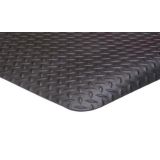 Conductive Diamond Deck Plate Anti-Fatigue Mat$188.00The Conductive Diamond Deck Plate Anti-Fatigue Mat does two jobs at one workstation: it carries static charge off the person standing on it, and it gives that person a cushioned floor for the shift. It is a conductive vinyl diamond plate surface bonded to a closed-cell vinyl foam base, beveled
...
The Conductive Diamond Deck Plate Anti-Fatigue Mat does two jobs at one workstation: it carries static charge off the person...
The Conductive Diamond Deck Plate Anti-Fatigue Mat does two jobs at one workstation: it carries static charge off the person standing on it, and it gives that person a cushioned floor for the shift. It is a conductive vinyl diamond plate surface bonded to a closed-cell vinyl foam base, beveled on the edges, made for the industrial stations where sensitive electronics are handled and someone stands in one place for hours.
What a Conductive Anti-Fatigue Mat Does Before a Charge Reaches the Bench
A technician standing at a bench builds up a static charge just by shifting their weight and moving their feet. On an ordinary floor that charge waits for the first grounded thing it touches, which is often the component in their hand. A conductive floor mat under the technician, connected to building ground, gives the charge a path out through the shoes and the mat instead of through the part.
This mat sits in the conductive band, not the dissipative one. The maker publishes resistance-to-ground and resistance top-to-top of 10⁴ to 10⁵ ohms, which is well below the 10⁶ line where dissipative floors begin. That means charge drains fast, which is what a station handling bare boards, drives, or components is usually specified to have.
The same station is almost always a standing station. A hard floor for eight hours wears down a worker's attention and precision by the afternoon, and a plain anti-fatigue mat fixes that while doing nothing about static. Here the foam base carries the comfort job so the operator is not choosing between a grounded floor and one they can stand on.
Why a Diamond Plate Top on Closed-Cell Foam, and Why This One
The surface is a vinyl diamond plate pattern, which is there for footing: the maker rates it for anti-slip traction and wear resistance, and the raised pattern keeps its grip when a dry floor picks up dust or dropped hardware. Vinyl also makes it water repellent by the maker's rating, so a spilled coffee or a mopped floor next to it does not soak in. It is still a dry-area mat; water repellent is not the same as rated for washdown.
Under the vinyl is a closed-cell vinyl foam base bonded to the surface. Closed-cell foam holds its shape because the cells do not collapse into each other under repeated load, which is what separates an anti-fatigue mat that still works in year three from one that has gone flat. The edges are beveled so a heel or a cart wheel rides up rather than catching.
The maker makes this mat in the USA and will install a grounding snap on any standard-size mat on request. The snap is the connection point for a grounding cord to a building ground; without it, the mat has nowhere to send the charge it collects. Ask for the snap when you order rather than after the mat arrives.
Where It Belongs, and What It Is Not
The maker's recommended use is industrial workstations receptive to static electricity. In practice that is a standing assembly or inspection station, a soldering or rework bench, a test position, a kitting area for boards and drives, and any spot on a production floor where a person stands still with a sensitive part in hand. Its conductive-band rating suits the stations where a dissipative floor would not drain charge quickly enough.
It is a station mat first. In 2' by 3', 3' by 5', and 3' by 10' it covers one standing position. In 3-foot and 4-foot rolls up to 75 feet it can run a whole bench line, but the foam is doing its work where someone stands, not where carts cross. For a grounded walkway with no standing traffic, a conductive runner without the foam layer is the lighter tool, and the rest of the conductive floor mats range covers that case.
It is not an electrical safety mat. A conductive mat is built to carry charge from a person to ground, which in front of a live switchboard is exactly the path you do not want. Insulating switchboard matting stops current so a worker at live panels is not the route to ground. Keep this mat at the workstation and keep it away from open switchgear.
Three Things to Check Before You Spec It
First, the band your program requires. At 10⁴ to 10⁵ ohms this mat is conductive by the numbers. If your ESD program specifies a conductive floor, that is the fit. If it specifies dissipative only, with a floor on the resistance, ask us before you order; some programs want charge to bleed off more slowly than a conductive surface allows. Read the requirement against the figure, not the product name.
Second, the snap and the ground. Order the grounding snap with the mat, then walk the station and confirm a grounded outlet or ground point is within cord reach of where the snap will sit. Verify the outlet is actually grounded before you rely on it. A cord clipped to a painted surface or an ungrounded outlet is not a ground, and a mat with no path to ground is just a comfortable place to stand.
Third, what lands on the surface. Floor finish, wax, and some cleaning residues leave an insulating film on a conductive top, and the mat stops draining charge while it looks fine. Keep the polish machine off it, wipe it with a damp cloth or a static-control floor cleaner, and test resistance from the surface to ground on a schedule rather than trusting the mat by eye.
Why Mats Inc.
We carry this mat because it answers the question a standing ESD station actually asks, which is how to ground the worker without making them stand on a hard floor all day. Tell us the station size, how many positions the bench has, and your program's resistance requirement, and we will confirm the size, the snap, and whether a station mat or a runner is the right shape. If the maker's published figure does not meet your spec, we will say so before you order, not after.
Construction Conductive vinyl diamond plate surface bonded to closed-cell vinyl foam Resistance to ground (RTG) 10⁴ to 10⁵ ohms Resistance top-to-top (RTT) 10⁴ to 10⁵ ohms Standard mat sizes 2' x 3', 3' x 5', 3' x 10' Roll sizes 3' x 75', 4' x 75' Custom 3' and 4' widths to 75' length; custom shapes on request Color Black Edges Beveled Grounding Grounding snap installed on standard mats on request Surface ratings Anti-slip traction, water repellent, wear resistant Origin Made in the USA Warranty 1-year limited (Mats Inc.) Frequently Asked Questions
What is this mat made of, and is it conductive or dissipative?
Answered by Dustin Thompson, Owner & CEO
A conductive vinyl surface with a diamond plate pattern, bonded to a closed-cell vinyl foam base. It is conductive by the numbers: the maker publishes resistance-to-ground and resistance top-to-top of 10⁴ to 10⁵ ohms, which is below the 10⁶ line where the dissipative band starts. That is the band most stations handling bare components specify, because charge leaves fast.
If your program calls for a dissipative floor with a minimum resistance, this mat may be lower than it allows. Compare the figure to the written requirement before you order.
How long does the mat last, and what shortens its life?
Answered by Dustin Thompson, Owner & CEO
The maker rates the surface wear resistant and the foam closed-cell, and does not publish a year figure or an abrasion number, so we will not invent one. In practice a closed-cell foam base is the reason an anti-fatigue mat still has spring in year three; open-cell foam packs down where a chair or a person stays in one spot. The vinyl top outlasts the foam under normal station use.
What ends its static life is different from what ends its physical life. Floor finish tracked onto the top, a cord knocked loose from the snap, or oil soaked into the surface all stop it draining charge while it looks new. Test resistance from mat to ground periodically. The mat carries a 1-year limited (Mats Inc.) warranty.
How do I ground it?
Answered by Dustin Thompson, Owner & CEO
Order the mat with a grounding snap, which the maker installs on any standard-size mat on request. A grounding cord runs from the snap to a verified building ground, usually the ground screw on an outlet cover or a dedicated ground point. A long run from a roll needs more than one connection so every part of the mat has a short path to ground; tell us the run length and we will confirm the snap count.
Confirm the outlet is grounded before you trust the mat. Facilities with an ESD program test the path from mat surface to ground on a schedule, and that test, not the cord being attached, is what proves the station is working.
What size should I order for a workstation?
Answered by Jinna Hopson, Vice President of Marketing
Measure the space the person actually stands in, not the bench. A single operator at a fixed position is covered by a 2' by 3' or 3' by 5'. A bench where the operator moves between two or three positions wants the 3' by 10'. A line of stations along a wall is a roll, in 3-foot or 4-foot width, cut to the run.
The 4-foot width matters where chairs roll back from the bench; it keeps the wheels on the mat instead of dropping off the edge. Leave the beveled edge exposed on the side people step onto.
What does it look like on the floor, and does it come in other colors?
Answered by Jinna Hopson, Vice President of Marketing
Black only, with a raised diamond plate pattern that reads as industrial and matches most production floors. The beveled edge gives it a finished outline rather than a cut-sheet look. It is not meant to disappear into an office; if a station sits in a client-facing space, a static-dissipative carpet tile is the better visual fit for the room, with this mat only at the bench where components are handled.
Because it is a single color, mats from different orders match, so a station added next year will not stand out from the ones installed today.
Can it be made in a custom size or shape?
Answered by Jinna Hopson, Vice President of Marketing
Yes, more than most mats in this class. The maker cuts custom lengths at 3-foot and 4-foot widths up to 75 feet, and will build custom configurations, meaning shapes cut to fit a workspace, an L-shaped bench, or a cutout around a fixed leg. Send us a sketch with dimensions and we will confirm what the maker can produce before you commit.
Remember that a grounding snap is added on request, so specify where on a custom piece you want it so it lands near the ground point rather than at the far end.
By Dustin Thompson, Owner & CEO, Mats Inc.
↑
The Conductive Diamond Deck Plate Anti-Fatigue Mat does two jobs at one workstation: it carries static charge off the person standing on it, and it gives that person a cushioned floor for the shift. It is a conductive vinyl diamond plate surface bonded to a closed-cell vinyl foam base, beveled on the edges, made for the industrial stations where sensitive electronics are handled and someone stands in one place for hours.
What a Conductive Anti-Fatigue Mat Does Before a Charge Reaches the Bench
A technician standing at a bench builds up a static charge just by shifting their weight and moving their feet. On an ordinary floor that charge waits for the first grounded thing it touches, which is often the component in their hand. A conductive floor mat under the technician, connected to building ground, gives the charge a path out through the shoes and the mat instead of through the part.
This mat sits in the conductive band, not the dissipative one. The maker publishes resistance-to-ground and resistance top-to-top of 10⁴ to 10⁵ ohms, which is well below the 10⁶ line where dissipative floors begin. That means charge drains fast, which is what a station handling bare boards, drives, or components is usually specified to have.
The same station is almost always a standing station. A hard floor for eight hours wears down a worker's attention and precision by the afternoon, and a plain anti-fatigue mat fixes that while doing nothing about static. Here the foam base carries the comfort job so the operator is not choosing between a grounded floor and one they can stand on.
Why a Diamond Plate Top on Closed-Cell Foam, and Why This One
The surface is a vinyl diamond plate pattern, which is there for footing: the maker rates it for anti-slip traction and wear resistance, and the raised pattern keeps its grip when a dry floor picks up dust or dropped hardware. Vinyl also makes it water repellent by the maker's rating, so a spilled coffee or a mopped floor next to it does not soak in. It is still a dry-area mat; water repellent is not the same as rated for washdown.
Under the vinyl is a closed-cell vinyl foam base bonded to the surface. Closed-cell foam holds its shape because the cells do not collapse into each other under repeated load, which is what separates an anti-fatigue mat that still works in year three from one that has gone flat. The edges are beveled so a heel or a cart wheel rides up rather than catching.
The maker makes this mat in the USA and will install a grounding snap on any standard-size mat on request. The snap is the connection point for a grounding cord to a building ground; without it, the mat has nowhere to send the charge it collects. Ask for the snap when you order rather than after the mat arrives.
Where It Belongs, and What It Is Not
The maker's recommended use is industrial workstations receptive to static electricity. In practice that is a standing assembly or inspection station, a soldering or rework bench, a test position, a kitting area for boards and drives, and any spot on a production floor where a person stands still with a sensitive part in hand. Its conductive-band rating suits the stations where a dissipative floor would not drain charge quickly enough.
It is a station mat first. In 2' by 3', 3' by 5', and 3' by 10' it covers one standing position. In 3-foot and 4-foot rolls up to 75 feet it can run a whole bench line, but the foam is doing its work where someone stands, not where carts cross. For a grounded walkway with no standing traffic, a conductive runner without the foam layer is the lighter tool, and the rest of the conductive floor mats range covers that case.
It is not an electrical safety mat. A conductive mat is built to carry charge from a person to ground, which in front of a live switchboard is exactly the path you do not want. Insulating switchboard matting stops current so a worker at live panels is not the route to ground. Keep this mat at the workstation and keep it away from open switchgear.
Three Things to Check Before You Spec It
First, the band your program requires. At 10⁴ to 10⁵ ohms this mat is conductive by the numbers. If your ESD program specifies a conductive floor, that is the fit. If it specifies dissipative only, with a floor on the resistance, ask us before you order; some programs want charge to bleed off more slowly than a conductive surface allows. Read the requirement against the figure, not the product name.
Second, the snap and the ground. Order the grounding snap with the mat, then walk the station and confirm a grounded outlet or ground point is within cord reach of where the snap will sit. Verify the outlet is actually grounded before you rely on it. A cord clipped to a painted surface or an ungrounded outlet is not a ground, and a mat with no path to ground is just a comfortable place to stand.
Third, what lands on the surface. Floor finish, wax, and some cleaning residues leave an insulating film on a conductive top, and the mat stops draining charge while it looks fine. Keep the polish machine off it, wipe it with a damp cloth or a static-control floor cleaner, and test resistance from the surface to ground on a schedule rather than trusting the mat by eye.
Why Mats Inc.
We carry this mat because it answers the question a standing ESD station actually asks, which is how to ground the worker without making them stand on a hard floor all day. Tell us the station size, how many positions the bench has, and your program's resistance requirement, and we will confirm the size, the snap, and whether a station mat or a runner is the right shape. If the maker's published figure does not meet your spec, we will say so before you order, not after.
Construction Conductive vinyl diamond plate surface bonded to closed-cell vinyl foam Resistance to ground (RTG) 10⁴ to 10⁵ ohms Resistance top-to-top (RTT) 10⁴ to 10⁵ ohms Standard mat sizes 2' x 3', 3' x 5', 3' x 10' Roll sizes 3' x 75', 4' x 75' Custom 3' and 4' widths to 75' length; custom shapes on request Color Black Edges Beveled Grounding Grounding snap installed on standard mats on request Surface ratings Anti-slip traction, water repellent, wear resistant Origin Made in the USA Warranty 1-year limited (Mats Inc.) Frequently Asked Questions
What is this mat made of, and is it conductive or dissipative?
Answered by Dustin Thompson, Owner & CEO
A conductive vinyl surface with a diamond plate pattern, bonded to a closed-cell vinyl foam base. It is conductive by the numbers: the maker publishes resistance-to-ground and resistance top-to-top of 10⁴ to 10⁵ ohms, which is below the 10⁶ line where the dissipative band starts. That is the band most stations handling bare components specify, because charge leaves fast.
If your program calls for a dissipative floor with a minimum resistance, this mat may be lower than it allows. Compare the figure to the written requirement before you order.
How long does the mat last, and what shortens its life?
Answered by Dustin Thompson, Owner & CEO
The maker rates the surface wear resistant and the foam closed-cell, and does not publish a year figure or an abrasion number, so we will not invent one. In practice a closed-cell foam base is the reason an anti-fatigue mat still has spring in year three; open-cell foam packs down where a chair or a person stays in one spot. The vinyl top outlasts the foam under normal station use.
What ends its static life is different from what ends its physical life. Floor finish tracked onto the top, a cord knocked loose from the snap, or oil soaked into the surface all stop it draining charge while it looks new. Test resistance from mat to ground periodically. The mat carries a 1-year limited (Mats Inc.) warranty.
How do I ground it?
Answered by Dustin Thompson, Owner & CEO
Order the mat with a grounding snap, which the maker installs on any standard-size mat on request. A grounding cord runs from the snap to a verified building ground, usually the ground screw on an outlet cover or a dedicated ground point. A long run from a roll needs more than one connection so every part of the mat has a short path to ground; tell us the run length and we will confirm the snap count.
Confirm the outlet is grounded before you trust the mat. Facilities with an ESD program test the path from mat surface to ground on a schedule, and that test, not the cord being attached, is what proves the station is working.
What size should I order for a workstation?
Answered by Jinna Hopson, Vice President of Marketing
Measure the space the person actually stands in, not the bench. A single operator at a fixed position is covered by a 2' by 3' or 3' by 5'. A bench where the operator moves between two or three positions wants the 3' by 10'. A line of stations along a wall is a roll, in 3-foot or 4-foot width, cut to the run.
The 4-foot width matters where chairs roll back from the bench; it keeps the wheels on the mat instead of dropping off the edge. Leave the beveled edge exposed on the side people step onto.
What does it look like on the floor, and does it come in other colors?
Answered by Jinna Hopson, Vice President of Marketing
Black only, with a raised diamond plate pattern that reads as industrial and matches most production floors. The beveled edge gives it a finished outline rather than a cut-sheet look. It is not meant to disappear into an office; if a station sits in a client-facing space, a static-dissipative carpet tile is the better visual fit for the room, with this mat only at the bench where components are handled.
Because it is a single color, mats from different orders match, so a station added next year will not stand out from the ones installed today.
Can it be made in a custom size or shape?
Answered by Jinna Hopson, Vice President of Marketing
Yes, more than most mats in this class. The maker cuts custom lengths at 3-foot and 4-foot widths up to 75 feet, and will build custom configurations, meaning shapes cut to fit a workspace, an L-shaped bench, or a cutout around a fixed leg. Send us a sketch with dimensions and we will confirm what the maker can produce before you commit.
Remember that a grounding snap is added on request, so specify where on a custom piece you want it so it lands near the ground point rather than at the far end.
By Dustin Thompson, Owner & CEO, Mats Inc.
↑
View Details
View Details
Benefits of Pharmacy Floor Mats
- Slip-Resistant Surface: Designed with a textured surface that provides excellent traction, reducing the risk of slips and falls in high-traffic areas.
- Anti-Fatigue Properties: The cushioned design helps reduce fatigue for employees standing for extended periods, improving comfort and productivity.
- Dirt and Moisture Control: Traps dirt and moisture at the entrance, helping maintain cleanliness in sensitive healthcare environments.
- Durable and Easy to Clean: Made from high-quality materials, pharmacy mats are built to withstand daily use and are easy to clean and maintain.
- Versatile Applications: Suitable for pharmacies, hospitals, clinics, and other healthcare facilities where safety and cleanliness are essential.
Ensure Safety and Comfort with Pharmacy Floor Mats
Our pharmacy floor mats provide the perfect solution for maintaining a safe and comfortable environment in healthcare settings. With slip-resistant surfaces and anti-fatigue properties, these mats are an essential addition to any pharmacy or healthcare facility.