




Entrance Mats & Door Mats
Entrance mats from Mats Inc. handle the first 6 to 15 feet of every commercial entry — the zone that decides whether tracked-in dirt and moisture stay at the door or migrate onto your interior floors. This collection routes to four paths: indoor, outdoor, custom logo, and all-weather, for mixed-condition entries. The right one depends on where the mat sits — fully exterior, fully interior, or a covered transition — and whether branding is part of the entrance experience. The pages below sort by placement and intent.



How Mats Inc. Approaches Entrance Matting
Since 1964, Mats Inc. has supplied commercial entrances across hospitals, schools, retail, government facilities, and corporate campuses. The catalog is organized around a simple idea: an entrance is not one matting decision — it's a sequence of decisions about placement, traffic exposure, branding, and replacement cycles. This page routes you to the right sub-category based on where the mat sits and what job it's doing. The deeper specs and product comparisons live one click down.
The Mistake Most Buyers Make at the Entrance
The most common mistake we see is treating the entrance as one matting problem instead of a sequence of zones. ISSA field data shows that 15 feet of properly placed matting captures up to 75% of tracked-in soil, and 30 feet captures close to 100%. A single 3x5 mat at the door catches roughly four footsteps — not enough to do the job, and it ends up saturated within months under real foot traffic. The result is a 12-month replacement cycle on a mat that should have lasted 4 to 5 years, plus the slip-and-fall risk that NFSI tracks as a leading liability category at building entrances during wet weather.
The fix is to plan the entrance as a 3-zone sequence: an exterior scraper that handles mud, grit, and snow before the door; a transitional mat in the vestibule or threshold that handles fine debris and starts wicking moisture; and an interior wiper that finishes drying the shoe and traps the last fines. Pick the placement first, size each zone second, then choose the construction. The four sub-categories below are organized to support that decision.
Choose Your Path
Indoor Mats & Runners
The interior side of the 3-zone sequence — wiper mats and runners that finish drying shoes and trap fine particles after the exterior and transitional zones have done their work. Best for office lobbies, reception areas, hospital corridors, school vestibules, and anywhere the mat sits fully inside the building. View Indoor Mats & Runners for placement-by-placement product breakdowns.
Outdoor Mats & Runners
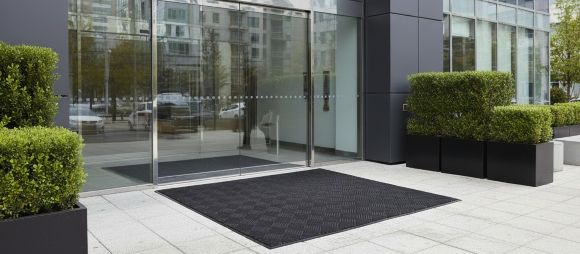
The exterior side of the sequence — scraper mats designed to handle mud, snow, gravel, oil, and weather exposure before traffic reaches the door. UV-resistant constructions, drainage-oriented surfaces, and backings rated for freeze/thaw cycles. Best for fully-exposed exterior thresholds, service entrances, loading docks, and any door where the mat takes the first hit from outdoor conditions. View Outdoor Mats & Runners for the construction options that survive exterior placement.
Custom Logo Mats
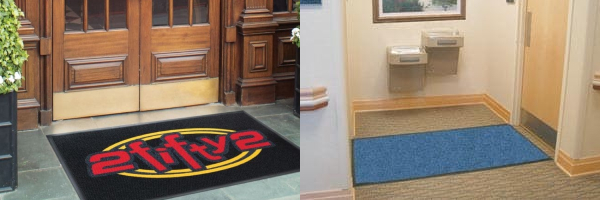
The branding-driven path — entrance mats that double as a brand statement at the door. Same matting performance as the indoor and outdoor categories, with the customer's logo, brand colors, or building identity integrated into the construction. Best for corporate offices, multi-tenant lobbies, hospitality entries, retail storefronts, and any program where the entrance is part of the brand experience. View Custom Logo Mats for placement-specific options that match the construction to the door.
All Weather Floor Mats
The all-conditions browse — entrance mats specified to handle mixed exposure across the year, from heavy summer foot traffic to winter melt and salt. Best when one mat needs to cover seasonal variation at a single placement, when the climate runs through wet, dry, snowy, and muddy conditions in the same year, or when comparing constructions that hold up across all of them. View All Weather Floor Mats for the full all-conditions catalog.
Recessed Entry Mats & Floor Grates
The flush-mounted path — recessed walk-off systems that sit level with the floor in a recess frame, so there's no raised edge at the threshold. Grate systems and mat inserts drop into a frame set into the floor. Best for grand entrances, high-traffic lobbies, and buildings where a flush transition matters. View Recessed Entry Mats & Floor Grates for grate systems, mat inserts, and frames.
How to Pick the Right Sub-Category in Three Questions
Three questions narrow the choice quickly. First, where does the mat sit — fully outside, fully inside, or in a covered transition zone like a vestibule? That picks indoor or outdoor (or routes you to a hybrid construction via the Custom Logo Mats path if branding is also a factor). Second, is branding part of the entrance experience — logo, brand colors, building identity? If yes, Custom Logo Mats takes precedence regardless of placement, because logo construction options exist for outdoor, indoor, and hybrid placements alike. Third, does the entrance face mixed seasonal conditions across the year — snow and salt in winter, mud in spring, heat and dust in summer? If yes, the All Weather Floor Mats path covers constructions specifically built to handle the full seasonal range.
Why Trust Mats Inc.
Mats Inc. has worked with commercial entrances across more than six decades — long enough to have seen what fails and what lasts in real facilities. That experience shows in how the catalog is organized: by the zone the mat works in and the job it has to do, not by price or product family. Every order ships with free shipping, and the pages below are built to support a real entrance plan, not just a product browse.
Frequently Asked Questions
Do I really need three mats at one entrance, or can I get by with one good one?
Answered by Dustin Thompson, Owner & CEO
You can get by with one mat at low-traffic entries with mild weather exposure, but at any commercial doorway with regular traffic the math works against you. The average stride is 2 feet 6 inches, so a single 3x5 mat catches four footsteps at most — well short of the six to eight footfalls ISSA research says it takes to capture the bulk of tracked-in soil. At a busier door, that single mat saturates fast and starts spreading dirt instead of trapping it. The 3-zone sequence handles the work properly, and at high-traffic doors getting the sequence right keeps the interior floor cleaner across the day and reduces the maintenance burden compared to a single-mat setup that can't keep up.
How do I know if I need indoor mats, outdoor mats, or both?
Answered by Dustin Thompson, Owner & CEO
Look at the door first. If the mat will sit fully outside the building (uncovered exterior threshold, service entrance, loading dock), it needs an outdoor construction — UV-resistant, drainage-oriented, with a backing rated for freeze/thaw cycles. If the mat will sit fully inside (lobby, corridor, reception), it needs an indoor construction — softer fibers, absorbent surface, indoor-rated backing that grips the floor without scratching. If the entrance has a vestibule or covered threshold, you're usually running both — exterior scraper outside the door, indoor wiper inside the door.
When does a custom logo mat make sense versus a standard entrance mat?
Answered by Jinna Hopson, Vice President of Marketing
Custom logo mats make sense when the entrance is part of the brand experience — corporate lobbies, hospitality entries, retail storefronts, and multi-location programs where consistent branding matters at every door. The matting performance is the same as standard entrance mats; the logo just adds a brand layer at the placement. For a back-of-house service entrance or a utility door where nobody's seeing the brand, a standard entrance mat from indoor or outdoor sub-categories is usually the right call.
What's the difference between an indoor mat and a runner?
Answered by Dustin Thompson, Owner & CEO
A mat is sized to a doorway — typically 3x5, 4x6, or 4x8 — and sits at a specific placement. A runner is a longer, narrower mat — often 3 feet wide and 10 to 30 feet long — that extends coverage further into the building. Runners are how you reach the 15 to 30 foot ISSA-recommended walk-off distance at busier entrances, especially in school corridors, hospital lobbies, and large commercial buildings where the interior path from door to elevators or main floor takes longer than a single mat can cover.
How long should an entrance mat last in a commercial building?
Answered by Jinna Hopson, Vice President of Marketing
Service life depends on the spec at order plus the maintenance routine after install. A properly-spec'd commercial entrance mat runs 3 to 5 years in medium-traffic placements and 1 to 3 years in heavy-traffic placements like school entries, retail storefronts, and high-volume office lobbies. The variables that end the lifespan first are usually undersizing, wrong-zone placement (indoor mat used outdoors or vice versa), and inconsistent maintenance — mats not lifted regularly so the floor underneath can dry, no rotation across positions, no scheduled cleaning. For multi-location buildings, building a maintenance protocol into the program is what consistently gets buyers to the upper end of the range. Single locations work fine on a less formal routine as long as someone owns lifting and drying.
Where do I start if I'm outfitting multiple entrances at once?
Answered by Jinna Hopson, Vice President of Marketing
Start by grouping your entrances by zone type — exterior thresholds, covered vestibules, fully-interior lobbies — and assign a construction class to each group. For mixed-condition placements that face seasonal variation, All Weather Floor Mats provides the right starting point. For multi-location programs where consistency at every door matters, Custom Logo Mats handle the branding side and the matting side simultaneously. Send us the location list with entry types and we can scope a focused spec sheet across the program.
By Dustin Thompson, Owner & CEO, Mats Inc.