




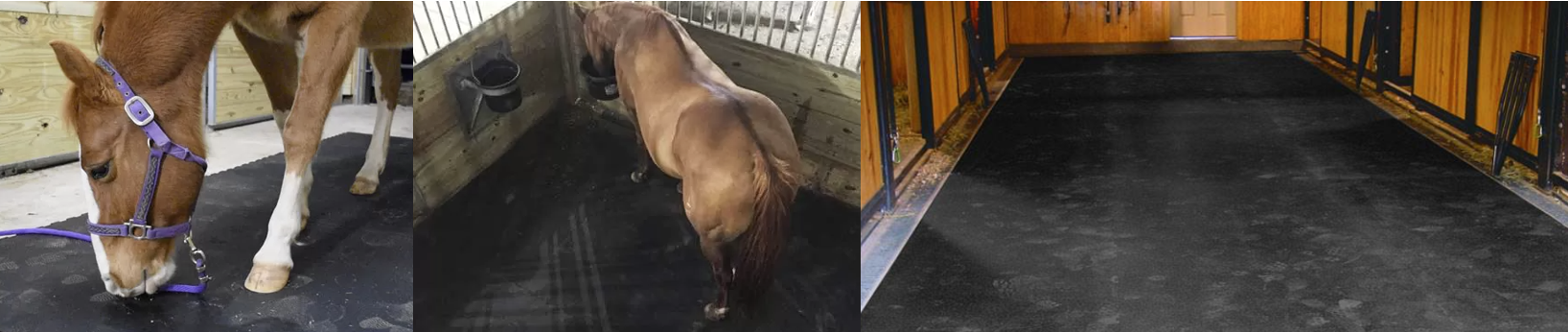
Animat
Animat, a North West Rubber Company, is a leading manufacturer of high-quality rubber flooring solutions designed to meet the needs of various industries, including agriculture, equestrian, and industrial applications. With decades of experience, Animat specializes in creating durable, eco-friendly products like rubber pavers, mats, and flooring systems that offer superior traction, comfort, and safety.
Animat's commitment to innovation and sustainability ensures that their products are made from recycled materials without compromising on performance. Whether you need rubber flooring for barns, stables, or industrial settings, Animat provides solutions that are built to last and withstand heavy traffic and harsh conditions.
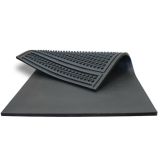 Horse Stall Mattress$335.00The Horse Stall Mattress is the most comfortable footing you can give a horse in a stall. It's a cushioned mattress system, not a single flat mat — a soft core under a tough top cover. The cushioning takes pressure off legs and joints during the long hours a
...
The Horse Stall Mattress is the most comfortable footing you can give a horse in a stall. It's a...
The Horse Stall Mattress is the most comfortable footing you can give a horse in a stall. It's a cushioned mattress system, not a single flat mat — a soft core under a tough top cover. The cushioning takes pressure off legs and joints during the long hours a horse spends standing. For stalls where rest matters most, this is the top of the line.
The system works in two layers. A cushioned foam core gives the soft support. A sealed rubber top cover takes the wear, resists tearing, and keeps urine and moisture out of the core below. Together they stay comfortable for years, where a cheap foam pad would pack down flat in a season. The cover also protects the stall floor underneath, the same job a standard rubber mat does.
This is the right choice when a horse spends long hours on its feet or lying down — foaling stalls, rehab and recovery stalls, older horses, and performance horses resting between work. Standing that long puts steady load on legs and joints, and the cushioned core is built to absorb it. Penn State Extension points to joint-impact reduction as one of the biggest factors in how stall flooring performs over the long run.
For everyday working stalls where horses are turned out most of the day, a standard rubber mat is usually enough; the mattress earns its place when time in the stall is high. It comes as a single 48-by-72-inch mattress or as a full-stall kit — 10 by 10, 12 by 12, or 12 by 16 feet, with custom sizes available. Within the stall mats for horses range, it's the comfort tier — above the standard rubber and drainage mats. Installed over a flat, prepared base and cleaned on a normal routine, it holds its support and its shape over years of use.
Construction Two-layer mattress — cushioned foam core under a sealed, non-slip top cover Thickness 1-1/4" Surface Textured, non-slip Single mattress 48" x 72" (4' x 6') Full-stall kits 10' x 10', 12' x 12', or 12' x 16' (custom sizes available) Moisture Sealed cover keeps liquid out of the foam core Frequently Asked Questions
Will the mattress flatten out over time?
Answered by Dustin Thompson, Owner & CEO
Not if it's built right. The comfort comes from a real cushioned core, not soft foam that packs down in a season. The sealed top cover keeps moisture out of that core, which is what lets it hold its support for years. Put it over a flat, prepared base and clean it on a normal routine, and it keeps its shape. The fastest way to wear one out early is an uneven floor or trapped moisture underneath.
How is it installed and cleaned?
Answered by Dustin Thompson, Owner & CEO
It lays into the stall over a level, prepared base — the flatter the base, the better the mattress sits and lasts. Clean the top cover the way you'd clean any stall mat: sweep, rinse, and let it dry. Because the cover is sealed, liquid stays on top instead of soaking in, so it cleans up fast. Lift it now and then to clean and dry the floor underneath.
Which horses really need a stall mattress?
Answered by Jinna Hopson, Vice President of Marketing
Horses that spend a lot of time standing or lying down. Broodmares near foaling, horses on stall rest for rehab, older horses with sore joints, and performance horses resting hard between sessions all feel the difference. A softer surface means less strain on legs and joints and better rest. If your horses are out in the field most of the day, you don't need this — a standard mat is fine.
Should we put mattresses in every stall or just some?
Answered by Jinna Hopson, Vice President of Marketing
Just the ones that need them. Most barns put mattresses in their special stalls — foaling, rehab, and the stalls for their most valuable horses — and use standard rubber everywhere else. That puts the comfort where it counts without putting the premium spec where it isn't needed. If you're outfitting several premium or foaling stalls, using the same mattress across them keeps things simple. Send the stall sizes and we'll help you plan it.
By Jinna Hopson, Vice President of Marketing, Mats Inc.
↑
The Horse Stall Mattress is the most comfortable footing you can give a horse in a stall. It's a cushioned mattress system, not a single flat mat — a soft core under a tough top cover. The cushioning takes pressure off legs and joints during the long hours a horse spends standing. For stalls where rest matters most, this is the top of the line.
The system works in two layers. A cushioned foam core gives the soft support. A sealed rubber top cover takes the wear, resists tearing, and keeps urine and moisture out of the core below. Together they stay comfortable for years, where a cheap foam pad would pack down flat in a season. The cover also protects the stall floor underneath, the same job a standard rubber mat does.
This is the right choice when a horse spends long hours on its feet or lying down — foaling stalls, rehab and recovery stalls, older horses, and performance horses resting between work. Standing that long puts steady load on legs and joints, and the cushioned core is built to absorb it. Penn State Extension points to joint-impact reduction as one of the biggest factors in how stall flooring performs over the long run.
For everyday working stalls where horses are turned out most of the day, a standard rubber mat is usually enough; the mattress earns its place when time in the stall is high. It comes as a single 48-by-72-inch mattress or as a full-stall kit — 10 by 10, 12 by 12, or 12 by 16 feet, with custom sizes available. Within the stall mats for horses range, it's the comfort tier — above the standard rubber and drainage mats. Installed over a flat, prepared base and cleaned on a normal routine, it holds its support and its shape over years of use.
Construction Two-layer mattress — cushioned foam core under a sealed, non-slip top cover Thickness 1-1/4" Surface Textured, non-slip Single mattress 48" x 72" (4' x 6') Full-stall kits 10' x 10', 12' x 12', or 12' x 16' (custom sizes available) Moisture Sealed cover keeps liquid out of the foam core Frequently Asked Questions
Will the mattress flatten out over time?
Answered by Dustin Thompson, Owner & CEO
Not if it's built right. The comfort comes from a real cushioned core, not soft foam that packs down in a season. The sealed top cover keeps moisture out of that core, which is what lets it hold its support for years. Put it over a flat, prepared base and clean it on a normal routine, and it keeps its shape. The fastest way to wear one out early is an uneven floor or trapped moisture underneath.
How is it installed and cleaned?
Answered by Dustin Thompson, Owner & CEO
It lays into the stall over a level, prepared base — the flatter the base, the better the mattress sits and lasts. Clean the top cover the way you'd clean any stall mat: sweep, rinse, and let it dry. Because the cover is sealed, liquid stays on top instead of soaking in, so it cleans up fast. Lift it now and then to clean and dry the floor underneath.
Which horses really need a stall mattress?
Answered by Jinna Hopson, Vice President of Marketing
Horses that spend a lot of time standing or lying down. Broodmares near foaling, horses on stall rest for rehab, older horses with sore joints, and performance horses resting hard between sessions all feel the difference. A softer surface means less strain on legs and joints and better rest. If your horses are out in the field most of the day, you don't need this — a standard mat is fine.
Should we put mattresses in every stall or just some?
Answered by Jinna Hopson, Vice President of Marketing
Just the ones that need them. Most barns put mattresses in their special stalls — foaling, rehab, and the stalls for their most valuable horses — and use standard rubber everywhere else. That puts the comfort where it counts without putting the premium spec where it isn't needed. If you're outfitting several premium or foaling stalls, using the same mattress across them keeps things simple. Send the stall sizes and we'll help you plan it.
By Jinna Hopson, Vice President of Marketing, Mats Inc.
↑
View Details
View Details
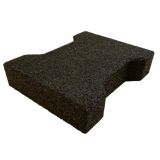 Rubber Pavers for Horse BarnsRubber pavers solve a problem that concrete and gravel both handle badly: a surface that has to be firm underfoot, kind to hooves, and able to move a little when the ground beneath it does. These are molded from 100% recycled rubber in a dog-bone profile that locks piece to
...
Rubber pavers solve a problem that concrete and gravel both handle badly: a surface that has to be firm underfoot,...
Rubber pavers solve a problem that concrete and gravel both handle badly: a surface that has to be firm underfoot, kind to hooves, and able to move a little when the ground beneath it does. These are molded from 100% recycled rubber in a dog-bone profile that locks piece to piece, so a walkway, wash bay, or patio goes down as one connected field rather than a set of loose blocks.
What Rubber Pavers Do Before the Path Turns to Mud
High-traffic ground around a barn takes a beating that nobody plans for. The route from the aisle to the wash bay, the ring at the tie post, the strip outside the tack room door — these wear down to bare dirt, then to mud, then to something that holds standing water every time it rains. Once that starts, the surface stops draining and the footing gets worse each season.
Interlocking rubber pavers put a stable, high-traction surface over that ground and keep it there. Because the pieces lock together, foot and hoof traffic pushes against the field as a whole instead of shifting individual pavers out of place. The recycled rubber gives underfoot rather than staying rigid, which is what makes a horse willing to walk on it confidently.
The same behavior matters for people. The material provides real foot cushioning and anti-fatigue properties, which is noticeable in the places where you stand still for long stretches: saddling areas, wash bays, and the spot beside the trailer where tacking up actually happens.
Why Re-Vulcanized Recycled Rubber, and Why the Dog-Bone Profile
The rubber here is re-vulcanized, meaning it has been chemically treated to form stronger bonds within the material itself. The result is denser and more durable than untreated recycled rubber, and the practical payoff is that these pavers stay flat instead of curling at the corners under stress and sun. Curling edges are how most outdoor rubber products eventually fail.
Being 100% recycled rubber is what makes the material appropriate for outdoor exposure in the first place. It does not rot, does not need sealing, and holds up to weather cycling year after year. Available in 1-3/4" and 7/8" thicknesses and in black, green, grey, and red.
The dog-bone shape is doing more work than it appears to. Each piece keys into its neighbors on multiple faces, so the field resists spreading in every direction rather than just along one axis. It also means layouts are not locked to a grid: the same pavers combine into different patterns, widths, and shapes depending on how you run them.
Every piece can be cut, shaped, and saw-cut on site, which is what lets a path curve around a post, meet a doorway squarely, or finish against an existing slab without an awkward gap. That flexibility is why the product fits alongside the stalls and aisles in Horse Stall Mats rather than competing with them.
Where They Belong, and What They Are Not
Around a barn, these earn their place in the transition zones: aisle ways, saddling and grooming areas, wash bays, service roads, and the paths connecting buildings. They work indoors as well as out, so a run can carry through from a barn aisle to an exterior walkway without changing surface material partway.
Outside the equine setting, the same pavers make garden pathways, patios, yard walkways, and any exterior route where anti-slip protection matters more than a decorative finish. Buyers looking at rubber patio pavers or rubber landscape tiles are generally solving the same problem in a different location.
What they are not: playground safety surfacing. Fall protection for play equipment is qualified against a tested critical fall height, and that rating is a separate specification these pavers do not carry. If you are surfacing under swings or a climbing structure, that is a different product and the rating is not optional.
They also are not a substitute for a stall floor. Stalls have their own requirements around seamlessness, drainage, and bedding retention, and dedicated stall matting handles those better than a paver field will.
Three Things to Check Before You Spec It
First, sort out the base before you order a single paver. The manufacturer is direct about this: an appropriate sub-floor is what keeps the installation on even ground. Pavers laid over soft, rutted, or uneven dirt will follow that contour and telegraph every low spot. Compacted screenings or an existing slab both work; unprepared soil generally does not.
Second, confirm whether your configuration needs adhesive. Certain sizes are glued down rather than dry-laid, and which ones applies to your order is worth pinning down at quote rather than discovering on install day. It changes both your material list and how permanent the installation is.
Third, decide the layout before the count. Because the dog-bone profile supports multiple patterns and the pieces saw-cut to shape, the same square footage can be run several ways, and edges and curves change how many pieces you actually need. Sketch the run, including where it meets doorways and existing hardscape, then work out quantity from that.
Why Mats Inc.
Paver layouts are where a project either looks intentional or looks improvised, and the difference is usually decided before anything is ordered. We have been in commercial and equine matting since 1964, and on this product that mostly means walking through your run with you — where it curves, where it transitions, which color reads best against your existing surfaces — so the field goes down once and looks right.
Specifications
Material 100% recycled rubber, re-vulcanized Profile Dog-bone interlocking shape; multi-directional keying Thickness 1-3/4" and 7/8" Colors Black, green, grey, red Surface High-traction; foot cushioning with anti-fatigue properties Use Interior and exterior Installation Interlocking over a prepared sub-floor; certain sizes require adhesive Install Time Typically within a day Modification Cut, shaped, and saw-cut on site Cleaning Pressure-washable; leaf blower for surface debris Paver Dimensions Confirmed at order — contact us with your layout Warranty 1-year limited (Mats Inc.) Frequently Asked Questions
What does re-vulcanized mean, and why does it matter outdoors?
Vulcanizing is a chemical treatment that forms stronger bonds inside the rubber itself. Re-vulcanizing recycled rubber puts the material through that process again, which produces a denser, more durable product than recycled crumb simply pressed and bound together. The visible payoff outdoors is that the pavers stay flat. Recycled rubber that has not been treated this way tends to curl at the corners under heat cycling and sustained load, and once a corner lifts it becomes a trip point and catches a boot or a hoof. A denser body also means the surface holds up under stress rather than compressing permanently where traffic concentrates. — Dustin Thompson
How do they hold up to weather and cleaning over time?
They are built for outdoor exposure, so rain, sun, and freeze-thaw cycling are expected conditions rather than things that shorten their life. Rubber does not rot, absorb water the way wood does, or need periodic sealing the way some hardscape materials do. For cleaning, the pavers are strong enough to be pressure-washed when you want a deep clean, which matters in wash bays and anywhere manure and bedding accumulate. Day to day, a leaf blower clears surface debris in a couple of minutes. That combination is why they hold up in spots where a decorative surface would need constant attention. — Dustin Thompson
Can these go directly on dirt, or do they need a base?
They need a prepared base, and this is the single most important thing to get right. The manufacturer is clear that an appropriate sub-floor is required to keep the installation on even ground. Rubber pavers are flexible by design, which means they conform to whatever is under them — lay them over rutted or soft soil and every dip transfers straight through to the walking surface. Compacted screenings or crushed stone works well, and an existing concrete slab works too. If you are converting a worn dirt path, budget the time to grade and compact it first, because that prep determines whether the finished surface stays level. — Dustin Thompson
How do I figure out how many I need?
Start with a sketch of the actual run rather than a square footage number. Because the dog-bone shape supports several layout patterns and every piece can be cut to fit, the same area can be covered different ways, and the edges are where the count shifts. Curves, doorway thresholds, and the line where the pavers meet an existing slab all involve cut pieces. Individual paver dimensions are confirmed at order, so send us the length and width of the run, where it turns, and what it butts up against, and we will work the quantity with you rather than having you estimate and come up short. — Jinna Hopson
What colors are available, and how do they weather?
Black, green, grey, and red. Black is the most common choice around barns because it reads as a working surface and hides the dirt that inevitably ends up on it, while grey tends to suit patios and garden paths where you want the surface to recede rather than announce itself. Green and red are the ones people use to define a zone deliberately — marking a wash bay or a walkway edge so it is visually distinct from what surrounds it. The color runs through the material rather than sitting on top as a coating, so scuffing does not expose a different color underneath. — Jinna Hopson
Can I use these under playground equipment?
No, and this is worth being direct about. Surfacing under swings, slides, and climbing structures has to be tested and rated to a specific critical fall height, and that certification is what makes it playground safety surfacing rather than just a soft surface. These pavers are not rated for fall protection. They are an excellent walkway, patio, and barn surface, and they will feel cushioned underfoot, but cushioned is not the same as tested. If you are surfacing a play area, ask us about products carrying an actual fall-height rating and we will point you to the right ones. — Jinna Hopson
Written by Jinna Hopson, Vice President of Marketing, Mats Inc.
↑
Rubber pavers solve a problem that concrete and gravel both handle badly: a surface that has to be firm underfoot, kind to hooves, and able to move a little when the ground beneath it does. These are molded from 100% recycled rubber in a dog-bone profile that locks piece to piece, so a walkway, wash bay, or patio goes down as one connected field rather than a set of loose blocks.
What Rubber Pavers Do Before the Path Turns to Mud
High-traffic ground around a barn takes a beating that nobody plans for. The route from the aisle to the wash bay, the ring at the tie post, the strip outside the tack room door — these wear down to bare dirt, then to mud, then to something that holds standing water every time it rains. Once that starts, the surface stops draining and the footing gets worse each season.
Interlocking rubber pavers put a stable, high-traction surface over that ground and keep it there. Because the pieces lock together, foot and hoof traffic pushes against the field as a whole instead of shifting individual pavers out of place. The recycled rubber gives underfoot rather than staying rigid, which is what makes a horse willing to walk on it confidently.
The same behavior matters for people. The material provides real foot cushioning and anti-fatigue properties, which is noticeable in the places where you stand still for long stretches: saddling areas, wash bays, and the spot beside the trailer where tacking up actually happens.
Why Re-Vulcanized Recycled Rubber, and Why the Dog-Bone Profile
The rubber here is re-vulcanized, meaning it has been chemically treated to form stronger bonds within the material itself. The result is denser and more durable than untreated recycled rubber, and the practical payoff is that these pavers stay flat instead of curling at the corners under stress and sun. Curling edges are how most outdoor rubber products eventually fail.
Being 100% recycled rubber is what makes the material appropriate for outdoor exposure in the first place. It does not rot, does not need sealing, and holds up to weather cycling year after year. Available in 1-3/4" and 7/8" thicknesses and in black, green, grey, and red.
The dog-bone shape is doing more work than it appears to. Each piece keys into its neighbors on multiple faces, so the field resists spreading in every direction rather than just along one axis. It also means layouts are not locked to a grid: the same pavers combine into different patterns, widths, and shapes depending on how you run them.
Every piece can be cut, shaped, and saw-cut on site, which is what lets a path curve around a post, meet a doorway squarely, or finish against an existing slab without an awkward gap. That flexibility is why the product fits alongside the stalls and aisles in Horse Stall Mats rather than competing with them.
Where They Belong, and What They Are Not
Around a barn, these earn their place in the transition zones: aisle ways, saddling and grooming areas, wash bays, service roads, and the paths connecting buildings. They work indoors as well as out, so a run can carry through from a barn aisle to an exterior walkway without changing surface material partway.
Outside the equine setting, the same pavers make garden pathways, patios, yard walkways, and any exterior route where anti-slip protection matters more than a decorative finish. Buyers looking at rubber patio pavers or rubber landscape tiles are generally solving the same problem in a different location.
What they are not: playground safety surfacing. Fall protection for play equipment is qualified against a tested critical fall height, and that rating is a separate specification these pavers do not carry. If you are surfacing under swings or a climbing structure, that is a different product and the rating is not optional.
They also are not a substitute for a stall floor. Stalls have their own requirements around seamlessness, drainage, and bedding retention, and dedicated stall matting handles those better than a paver field will.
Three Things to Check Before You Spec It
First, sort out the base before you order a single paver. The manufacturer is direct about this: an appropriate sub-floor is what keeps the installation on even ground. Pavers laid over soft, rutted, or uneven dirt will follow that contour and telegraph every low spot. Compacted screenings or an existing slab both work; unprepared soil generally does not.
Second, confirm whether your configuration needs adhesive. Certain sizes are glued down rather than dry-laid, and which ones applies to your order is worth pinning down at quote rather than discovering on install day. It changes both your material list and how permanent the installation is.
Third, decide the layout before the count. Because the dog-bone profile supports multiple patterns and the pieces saw-cut to shape, the same square footage can be run several ways, and edges and curves change how many pieces you actually need. Sketch the run, including where it meets doorways and existing hardscape, then work out quantity from that.
Why Mats Inc.
Paver layouts are where a project either looks intentional or looks improvised, and the difference is usually decided before anything is ordered. We have been in commercial and equine matting since 1964, and on this product that mostly means walking through your run with you — where it curves, where it transitions, which color reads best against your existing surfaces — so the field goes down once and looks right.
Specifications
Material 100% recycled rubber, re-vulcanized Profile Dog-bone interlocking shape; multi-directional keying Thickness 1-3/4" and 7/8" Colors Black, green, grey, red Surface High-traction; foot cushioning with anti-fatigue properties Use Interior and exterior Installation Interlocking over a prepared sub-floor; certain sizes require adhesive Install Time Typically within a day Modification Cut, shaped, and saw-cut on site Cleaning Pressure-washable; leaf blower for surface debris Paver Dimensions Confirmed at order — contact us with your layout Warranty 1-year limited (Mats Inc.) Frequently Asked Questions
What does re-vulcanized mean, and why does it matter outdoors?
Vulcanizing is a chemical treatment that forms stronger bonds inside the rubber itself. Re-vulcanizing recycled rubber puts the material through that process again, which produces a denser, more durable product than recycled crumb simply pressed and bound together. The visible payoff outdoors is that the pavers stay flat. Recycled rubber that has not been treated this way tends to curl at the corners under heat cycling and sustained load, and once a corner lifts it becomes a trip point and catches a boot or a hoof. A denser body also means the surface holds up under stress rather than compressing permanently where traffic concentrates. — Dustin Thompson
How do they hold up to weather and cleaning over time?
They are built for outdoor exposure, so rain, sun, and freeze-thaw cycling are expected conditions rather than things that shorten their life. Rubber does not rot, absorb water the way wood does, or need periodic sealing the way some hardscape materials do. For cleaning, the pavers are strong enough to be pressure-washed when you want a deep clean, which matters in wash bays and anywhere manure and bedding accumulate. Day to day, a leaf blower clears surface debris in a couple of minutes. That combination is why they hold up in spots where a decorative surface would need constant attention. — Dustin Thompson
Can these go directly on dirt, or do they need a base?
They need a prepared base, and this is the single most important thing to get right. The manufacturer is clear that an appropriate sub-floor is required to keep the installation on even ground. Rubber pavers are flexible by design, which means they conform to whatever is under them — lay them over rutted or soft soil and every dip transfers straight through to the walking surface. Compacted screenings or crushed stone works well, and an existing concrete slab works too. If you are converting a worn dirt path, budget the time to grade and compact it first, because that prep determines whether the finished surface stays level. — Dustin Thompson
How do I figure out how many I need?
Start with a sketch of the actual run rather than a square footage number. Because the dog-bone shape supports several layout patterns and every piece can be cut to fit, the same area can be covered different ways, and the edges are where the count shifts. Curves, doorway thresholds, and the line where the pavers meet an existing slab all involve cut pieces. Individual paver dimensions are confirmed at order, so send us the length and width of the run, where it turns, and what it butts up against, and we will work the quantity with you rather than having you estimate and come up short. — Jinna Hopson
What colors are available, and how do they weather?
Black, green, grey, and red. Black is the most common choice around barns because it reads as a working surface and hides the dirt that inevitably ends up on it, while grey tends to suit patios and garden paths where you want the surface to recede rather than announce itself. Green and red are the ones people use to define a zone deliberately — marking a wash bay or a walkway edge so it is visually distinct from what surrounds it. The color runs through the material rather than sitting on top as a coating, so scuffing does not expose a different color underneath. — Jinna Hopson
Can I use these under playground equipment?
No, and this is worth being direct about. Surfacing under swings, slides, and climbing structures has to be tested and rated to a specific critical fall height, and that certification is what makes it playground safety surfacing rather than just a soft surface. These pavers are not rated for fall protection. They are an excellent walkway, patio, and barn surface, and they will feel cushioned underfoot, but cushioned is not the same as tested. If you are surfacing a play area, ask us about products carrying an actual fall-height rating and we will point you to the right ones. — Jinna Hopson
Written by Jinna Hopson, Vice President of Marketing, Mats Inc.
↑
View Details
View Details
 Horse Stall Kits
Starting at $1,100.00
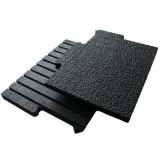
Horse Stall Kits take the measuring, cutting, and guesswork out of matting a stall. Each kit is built from 3/4-inch pebble-top rubber mats, custom-cut and interlocked to fit your stall and lock together into one tight floor. Instead of buying loose mats and trimming them yourself, you get a...
Horse Stall Kits take the measuring, cutting, and guesswork out of matting a stall. Each kit is built from...
Horse Stall Kits take the measuring, cutting, and guesswork out of matting a stall. Each kit is built from 3/4-inch pebble-top rubber mats, custom-cut and interlocked to fit your stall and lock together into one tight floor. Instead of buying loose mats and trimming them yourself, you get a set sized to the space — the mats drop in, interlock, and stay put.
The top is a low-profile pebble surface that gives the horse footing instead of a slick floor and sheds manure rather than packing it into a deep tread. The mats are durable vulcanized rubber with an anti-abrasion compound, so they stand up to continuous hoof traffic and protect the stall floor underneath. It's a surface built for grip and wear at the same time.
Underneath, a grooved profile lets liquid flow away instead of pooling against the subfloor, which keeps the standing surface drier and slows the moisture buildup that drives odor. The interlocking edges are what set a kit apart from loose mats: cut to lock each piece to the next, the floor moves as one and won't shift or gap, and the tight seams keep urine and bedding from working down between the mats. Within the stall mats for horses range, the kit is the turnkey way to floor a full stall.
Because each kit is a custom order — the mats cut and interlocked to your stall's dimensions — it sits square against the walls without a pile of trimming on site. Laid over a level base of concrete, asphalt, or compacted stone, the kit holds up for years — what shortens any stall floor is an uneven base or trapped moisture, not the rubber. The pebble surface sweeps clean and rinses off with a hose or pressure washer.
Thickness 3/4" (19 mm) Material Vulcanized rubber with an anti-abrasion compound Top surface Low-profile pebble, non-slip Underside Grooved — channels liquid away to prevent pooling Weight 4.3 lb per square foot Format Custom order — cut and interlocked to fit the stall Care Sweep, hose, or pressure-wash Installation Over a level prepared base (concrete, asphalt, or compacted stone) Frequently Asked Questions
What does the pebble top do, and how durable is it?
Answered by Dustin Thompson, Owner & CEO
The low-profile pebble surface gives the horse traction instead of a slick floor, and it sheds manure rather than packing it into a deep tread. The mats are vulcanized rubber with an anti-abrasion compound built to take continuous hoof traffic, so laid over a level base a kit holds up for years. As with any stall floor, what shortens its life is an uneven base or trapped moisture underneath — not the rubber itself.
How does the grooved underside handle moisture?
Answered by Dustin Thompson, Owner & CEO
The grooves on the underside give liquid a path to flow away instead of pooling against the subfloor, which keeps the standing surface drier and slows the odor buildup that comes with trapped moisture. For that to work, the kit needs a base that drains — graded concrete, asphalt, or well-compacted stone. On a sealed slab with nowhere for water to go, it would just collect underneath, so tell us what's under the stall and we'll confirm the base is right.
Why buy a kit instead of loose mats?
Answered by Jinna Hopson, Vice President of Marketing
A kit takes the measuring and cutting off your plate. The mats are custom-cut and interlocked to fit your stall, so instead of buying loose mats and trimming them yourself, you drop in a set sized to the space. The interlocking edges keep the floor from shifting and stop bedding and urine from working down between the mats — the problem that makes loose mats curl, gap, and need re-laying. It's the simplest way to floor a whole stall at once.
Will it fit my stall, even if it's not a standard size?
Answered by Jinna Hopson, Vice President of Marketing
Yes — because the mats are cut and interlocked to fit, the kit can be made for common stall sizes or for a non-standard space with posts or openings to work around. The edges sit square against the walls so there's minimal fitting on site. Send your stall dimensions and anything to work around, and we'll lay out the right kit before you order.
By Jinna Hopson, Vice President of Marketing, Mats Inc.
↑
Horse Stall Kits take the measuring, cutting, and guesswork out of matting a stall. Each kit is built from 3/4-inch pebble-top rubber mats, custom-cut and interlocked to fit your stall and lock together into one tight floor. Instead of buying loose mats and trimming them yourself, you get a set sized to the space — the mats drop in, interlock, and stay put.
The top is a low-profile pebble surface that gives the horse footing instead of a slick floor and sheds manure rather than packing it into a deep tread. The mats are durable vulcanized rubber with an anti-abrasion compound, so they stand up to continuous hoof traffic and protect the stall floor underneath. It's a surface built for grip and wear at the same time.
Underneath, a grooved profile lets liquid flow away instead of pooling against the subfloor, which keeps the standing surface drier and slows the moisture buildup that drives odor. The interlocking edges are what set a kit apart from loose mats: cut to lock each piece to the next, the floor moves as one and won't shift or gap, and the tight seams keep urine and bedding from working down between the mats. Within the stall mats for horses range, the kit is the turnkey way to floor a full stall.
Because each kit is a custom order — the mats cut and interlocked to your stall's dimensions — it sits square against the walls without a pile of trimming on site. Laid over a level base of concrete, asphalt, or compacted stone, the kit holds up for years — what shortens any stall floor is an uneven base or trapped moisture, not the rubber. The pebble surface sweeps clean and rinses off with a hose or pressure washer.
Thickness 3/4" (19 mm) Material Vulcanized rubber with an anti-abrasion compound Top surface Low-profile pebble, non-slip Underside Grooved — channels liquid away to prevent pooling Weight 4.3 lb per square foot Format Custom order — cut and interlocked to fit the stall Care Sweep, hose, or pressure-wash Installation Over a level prepared base (concrete, asphalt, or compacted stone) Frequently Asked Questions
What does the pebble top do, and how durable is it?
Answered by Dustin Thompson, Owner & CEO
The low-profile pebble surface gives the horse traction instead of a slick floor, and it sheds manure rather than packing it into a deep tread. The mats are vulcanized rubber with an anti-abrasion compound built to take continuous hoof traffic, so laid over a level base a kit holds up for years. As with any stall floor, what shortens its life is an uneven base or trapped moisture underneath — not the rubber itself.
How does the grooved underside handle moisture?
Answered by Dustin Thompson, Owner & CEO
The grooves on the underside give liquid a path to flow away instead of pooling against the subfloor, which keeps the standing surface drier and slows the odor buildup that comes with trapped moisture. For that to work, the kit needs a base that drains — graded concrete, asphalt, or well-compacted stone. On a sealed slab with nowhere for water to go, it would just collect underneath, so tell us what's under the stall and we'll confirm the base is right.
Why buy a kit instead of loose mats?
Answered by Jinna Hopson, Vice President of Marketing
A kit takes the measuring and cutting off your plate. The mats are custom-cut and interlocked to fit your stall, so instead of buying loose mats and trimming them yourself, you drop in a set sized to the space. The interlocking edges keep the floor from shifting and stop bedding and urine from working down between the mats — the problem that makes loose mats curl, gap, and need re-laying. It's the simplest way to floor a whole stall at once.
Will it fit my stall, even if it's not a standard size?
Answered by Jinna Hopson, Vice President of Marketing
Yes — because the mats are cut and interlocked to fit, the kit can be made for common stall sizes or for a non-standard space with posts or openings to work around. The edges sit square against the walls so there's minimal fitting on site. Send your stall dimensions and anything to work around, and we'll lay out the right kit before you order.
By Jinna Hopson, Vice President of Marketing, Mats Inc.
↑
View Details
View Details
Why Choose Animat?
- Durable & Slip-Resistant: Animat products provide excellent traction and long-lasting durability in both wet and dry environments.
- Eco-Friendly Solutions: Made from recycled rubber, Animat’s products are designed with environmental sustainability in mind.
- Easy Maintenance: Our rubber flooring is easy to clean and maintain, perfect for high-traffic areas.
- Versatile Applications: Animat (North West Rubber) flooring solutions are ideal for agricultural, equestrian, and industrial uses.
With a focus on quality and innovation, Animat is your trusted partner for rubber flooring solutions that offer safety, comfort, and durability in any setting.