




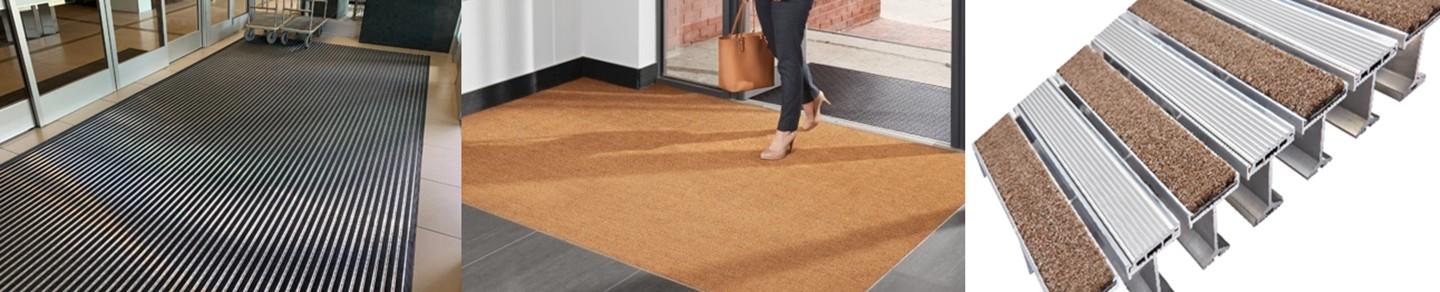

Recessed Entrance Mats & Walk-Off Grate Systems
Mats Inc. has supplied recessed entrance mats and walk-off systems for commercial buildings since 1964. Two product families cover the different installation scenarios at a recessed threshold — Recessed Grate Systems, hinged aluminum or rubber rail walk-off constructions that handle the heaviest commercial entry traffic, and Recessed Mat Inserts, flat walk-off matting that drops into the well and sits flush with the surrounding floor. The right pick depends on traffic volume at the entrance, what the threshold needs to look like as part of the space, and how the system is going to be cleaned over its service life.

Recessed Entrance Systems for Commercial Buildings
Mats Inc. has supplied recessed entrance systems for commercial buildings since 1964. Two product families cover the different installation scenarios at a recessed threshold — Recessed Grate Systems for hinged aluminum or rubber rail constructions that handle the heaviest commercial entry traffic, and Recessed Mat Inserts for flat matting that drops into the well and sits flush with the surrounding floor.
The right pick depends on traffic volume at the entrance, what the threshold needs to look like as part of the space, and how the system is going to be cleaned over its service life.
What a Recessed Entrance System Does Differently
A recessed entrance system sits below the surrounding floor surface so the threshold stays flush with the lobby flooring rather than presenting a raised edge at the door. That flush profile matters operationally for three reasons.
Wheeled traffic — luggage, carts, wheelchairs, hand trucks — crosses the threshold without catching on a mat edge. Architectural intent stays intact: the floor reads as one continuous plane rather than a building floor with a mat sitting on top of it. And the entry stays planted — a recessed system can't migrate or curl the way a surface-mounted mat eventually does under continuous foot traffic.
Both grate systems and insert matting deliver this flush installation; the difference between them is how the matting handles dirt and moisture once foot traffic reaches it.
The Mistake That Burns Recessed-Entry Buyers
The most common mistake at a recessed installation is treating the well as the project and the matting as an afterthought. The well gets specified during construction or renovation — depth, dimensions, frame system, drainage — and the matting choice gets deferred until the space is nearly finished. By then, the options have been narrowed by the well's depth tolerance, and buyers default to whichever option the contractor knows.
The matting decision drives the entrance performance more than the well does. ISSA field research shows commercial entrances see 70 to 80% of indoor dirt arriving on shoes, with the six-to-eight footstep rule indicating about 15 feet of walk-off matting from the door inward to clean a shoe properly.
A well too short for the traffic, or the wrong matting type inside the right-sized well, undercuts the entire entrance performance. Specifying both together is what separates a recessed system that works for a decade from one that gets replaced piecemeal within three years.
The Two Product Families
Two distinct construction families handle recessed entrance scenarios, each suited to different combinations of traffic, moisture, and aesthetic intent.
Recessed Grate Systems
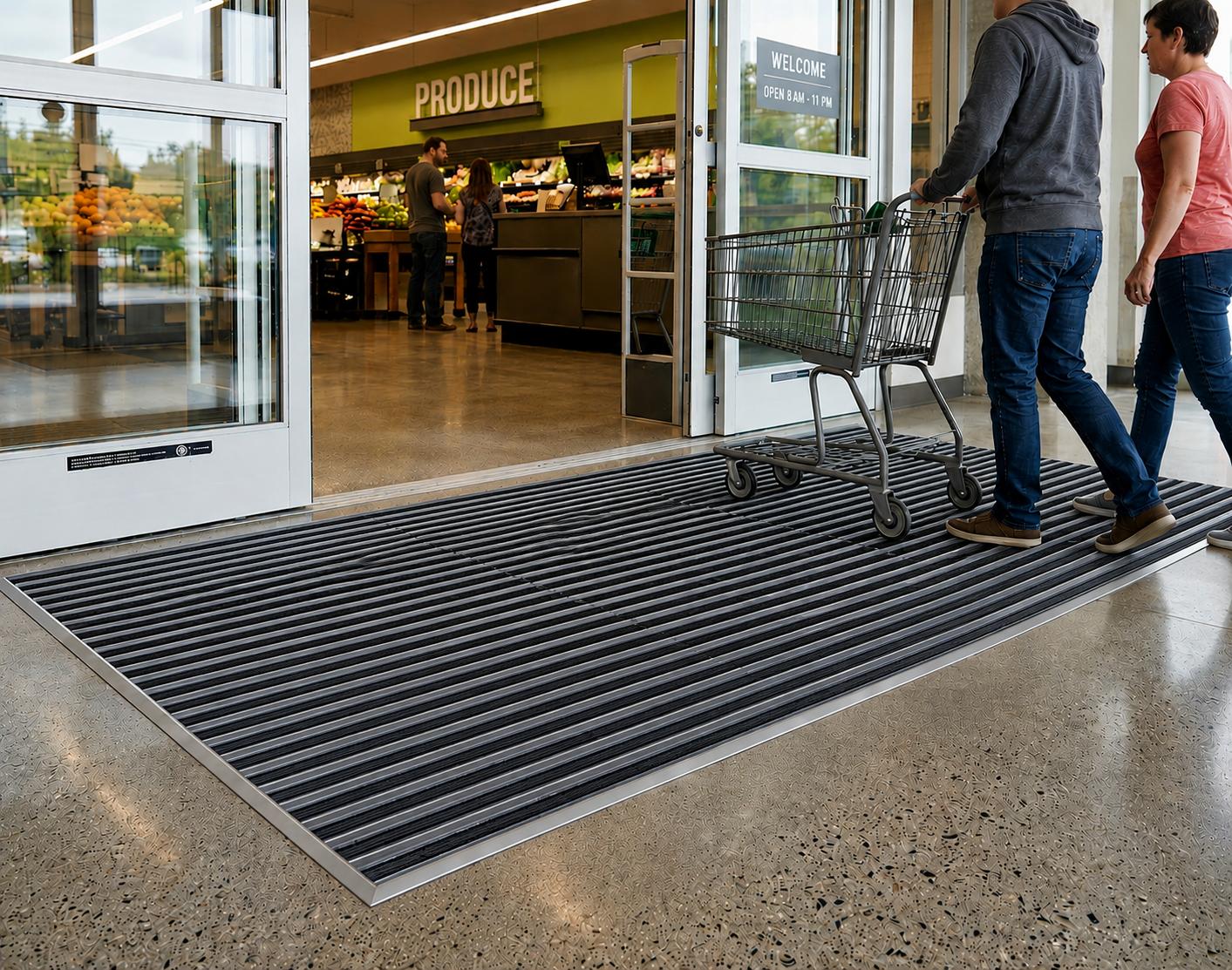
Engineered rigid grate systems built around hinged aluminum or rubber rails with replaceable textile or scraping inserts. The rails channel dirt and moisture below the walking surface into the well underneath, keeping the surface presentable while the well absorbs what's been scraped off. The whole system rolls up for cleaning, which is the practical answer to maintaining a high-traffic recessed entrance without specialty equipment.
Right fit for the heaviest commercial entries where traffic volume is at the top of the range and the threshold appearance has to hold up over the full service life. The aluminum housing frame is included in this family for installations that need the mounting structure specified alongside the matting.
Recessed Mat Inserts
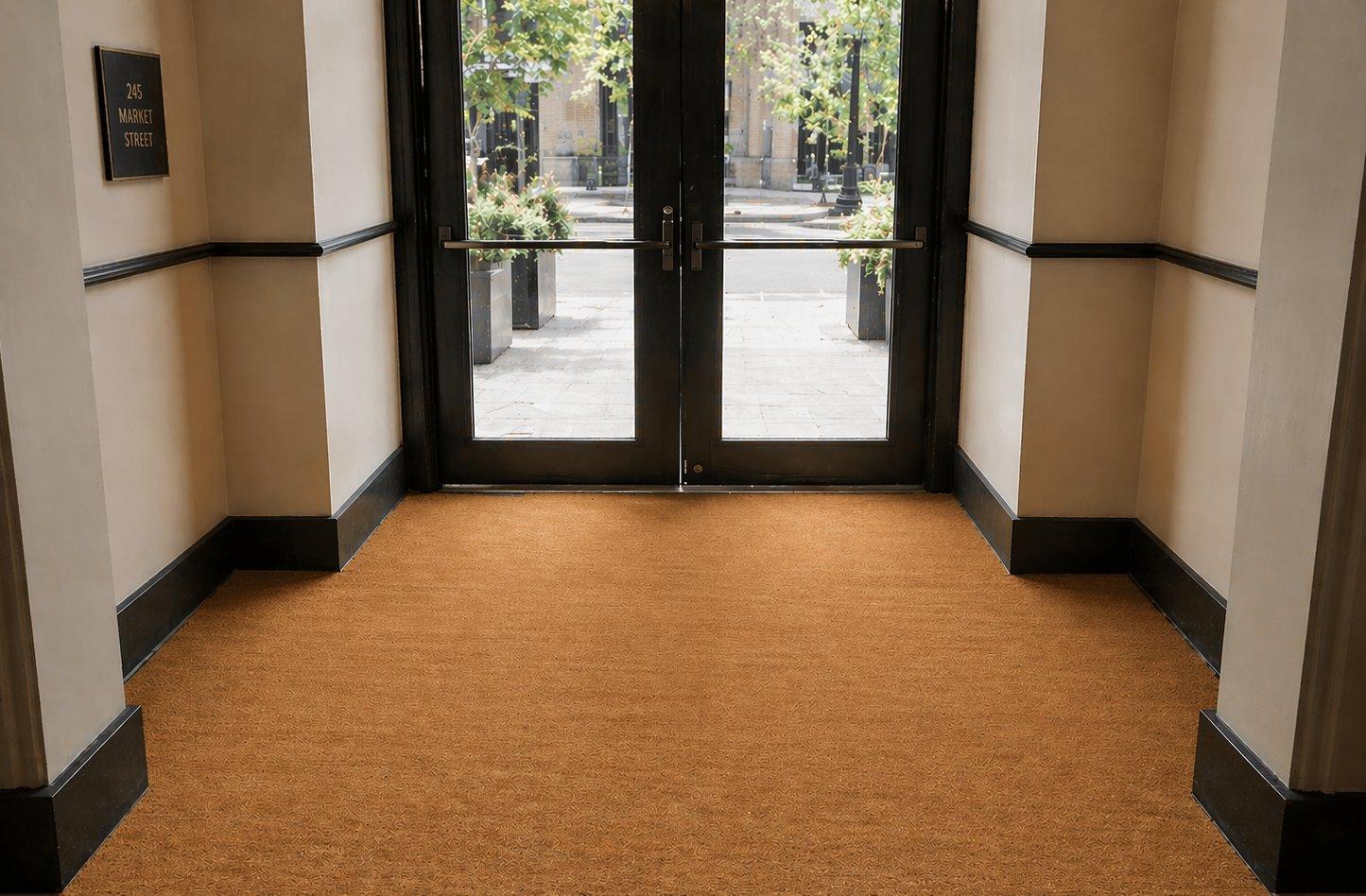
Flat matting designed to drop into a recessed well and sit flush with the surrounding floor. Different fiber and material constructions handle different scenarios — carpet-faced matting for general entry performance, vinyl link for industrial-leaning or wet entries, natural coir for covered architectural entries where the natural-fiber aesthetic fits the space. Cut-to-size options accommodate non-standard well dimensions.
Right pick when the recessed well is shallower than what grate systems require, when the aesthetic calls for a textile-feel threshold, or when the entrance use case fits a simpler matting solution.
Three Things to Get Right Before Specifying
First, the well depth. Grate systems require deeper wells than insert matting — typically 5/8-inch to 1-inch minimum depending on the specific construction. Insert matting works in shallower wells, sometimes as little as 3/8-inch. If the well is already built, the depth often determines which family you can use. If the well is still in the spec stage, decide the matting type first and design the well to fit.
Second, what the entrance is actually fighting and how it's going to be maintained. Continuous wet conditions, heavy debris traffic, branded threshold requirements, and architectural aesthetic constraints all push the decision toward one family or the other. Grate systems handle the heaviest combinations of traffic and moisture; insert matting handles spaces where the matting needs to look textile-soft or feel residential at the threshold.
Third, the surrounding floor finish. Recessed installations should sit flush with what's around them — a recessed mat in a tiled floor needs the depth and edge profile that matches the tile course; a recessed door mat in carpet needs different framing than one in stone or hardwood. The frame system, edge treatment, and matting depth get specified together, not in isolation.
Why Mats Inc.
Mats Inc. has been supplying commercial entrance matting since 1964 — six decades of watching how recessed constructions actually perform at commercial thresholds. The product families above are the ones that have earned their place in the catalog over that time, including systems from Durable and Reese.
Specification consultation is part of how we work: send the well dimensions, the entrance traffic profile, and the surrounding floor finish, and we'll spec the matting family and individual construction that fits.
Frequently Asked Questions
When does a building need a recessed entrance system instead of a surface-mounted mat?
Answered by Dustin Thompson, Owner & CEO
A recessed system makes operational sense when the threshold needs to stay flush with the surrounding floor for either functional or architectural reasons. Wheeled traffic — luggage carts at hotels, bed transports at hospitals, hand trucks at loading-adjacent entries — pushes the decision toward recessed because a surface mat creates a tripping or catching edge under wheels.
Architectural specifications at corporate lobbies, museums, and high-end hospitality usually call for recessed because the design intent doesn't accommodate a mat sitting on top of the finished floor.
Surface-mounted matting works fine at most commercial entrances; recessed systems become the right call when flush installation is either required by the use case or specified by the design.
How do recessed grate systems compare to recessed insert matting on durability?
Answered by Dustin Thompson, Owner & CEO
Grate systems have the longer service life when both are used at the right placement. The rigid aluminum or rubber rail construction is built to handle heavy traffic indefinitely; the textile or scraping inserts inside the system are the wear component, and they're designed to be replaced when they degrade without replacing the whole system.
Practical service life on the housing and rail construction can run 15 to 20 years at moderate-traffic installations, with insert replacement every three to seven years depending on traffic. Recessed insert matting typically runs three to five years at moderate-traffic placements and one to three years at the busiest entrances before the whole product is replaced.
The trade-off is upfront involvement — grate systems require more specification and construction; insert matting is a simpler spec and replacement cycle.
What spec information do I need to provide for a recessed installation?
Answered by Dustin Thompson, Owner & CEO
Five pieces of information cover most recessed specifications. First, well dimensions — length, width, and depth of the existing or planned recess. Second, the surrounding floor finish — tile, stone, hardwood, carpet — which affects edge profile and frame selection. Third, the entrance traffic profile — daily volume, moisture exposure, debris characteristics.
Fourth, any architectural or aesthetic requirements — branded threshold, specific color palette, design intent. Fifth, any procurement specifications — LEED requirements, recycled-content specs, branded-product requirements. Send those and we can return a recessed matting spec that fits the actual installation rather than a generic recommendation.
What does each option look like in the space — is one more visually refined than the other?
Answered by Jinna Hopson, Vice President of Marketing
The aesthetic distinction is real and worth deciding on early in the specification process. Grate systems present as architectural — visible rail structures with textile or scraping insert strips between them, reading as part of the building's floor design rather than as a separate mat. Strong fit for spaces where the entrance is meant to be an intentional architectural moment: high-end corporate lobbies, hospitality grand entrances, museum thresholds, government building front doors.
Insert matting presents as textile — the entrance reads as a flush carpet or matting panel within the surrounding floor, softer and quieter visually. Strong fit for spaces where the entrance should feel welcoming and residential-quality rather than industrial or architectural: hotel lobbies with traditional design language, healthcare entries focused on patient comfort, educational facilities.
Neither is more refined than the other; they're different aesthetic vocabularies.
Can a recessed system be customized for our brand or specific design intent?
Answered by Jinna Hopson, Vice President of Marketing
Yes, with options across both product families. Insert matting accepts custom branding most directly — carpet-face constructions weave the logo into the carpet pile, integrating the brand mark into the threshold itself. Grate systems accept custom color combinations on the insert strips, allowing brand color palettes to appear in the threshold without a traditional logo presentation.
Both families support custom dimensions to fit non-standard well sizes. For specific design intent — color matching to brand standards, logo positioning, multi-color insert configurations — send the brand guidelines and well dimensions and we'll scope what's manufacturable. Custom orders typically take two to four weeks depending on complexity.
How do multi-location facility programs handle recessed entrance consistency?
Answered by Jinna Hopson, Vice President of Marketing
Multi-location programs benefit from specifying recessed matting at the program level rather than the property level. Most multi-location operations end up standardizing on one product family across the portfolio — either grate systems at all primary entrances for operational consistency and visual continuity, or insert matting with a consistent brand-color palette across locations.
The choice depends on whether brand presence at the threshold is core to the customer experience or whether operational consistency is the priority. Either approach is workable; the deciding factor is usually whether the brand strategy treats the threshold as a brand touchpoint or as a building utility. Both decisions are easier to execute consistently across locations when specified centrally rather than per-property.
By Dustin Thompson, Owner & CEO, Mats Inc.