




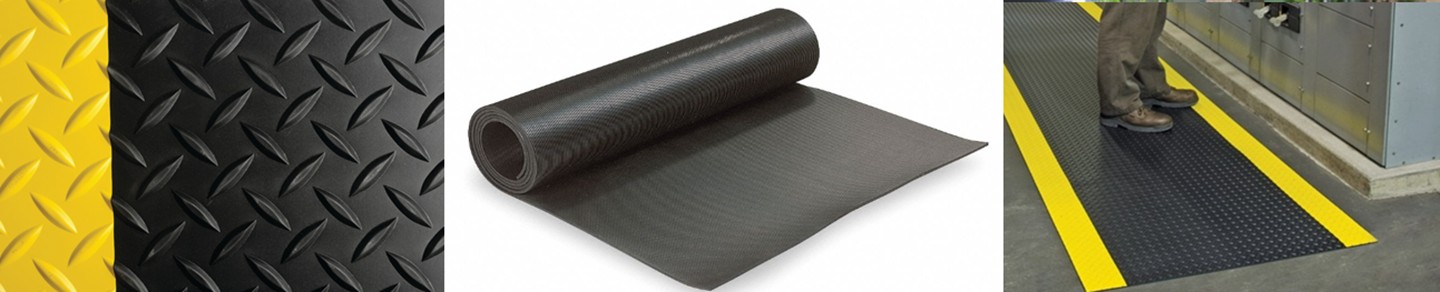
Electrical Switchboard Matting
Every mat on this page does one job: it stops the floor from being part of a circuit. Where they differ is voltage rating, standard, and surface — and those three choices are what decide whether the mat in front of your panel is actually protecting anyone.
Eight products sit here across two standards. Read the class before you read anything else. Two mats that look identical on a dock can be rated for wildly different equipment.
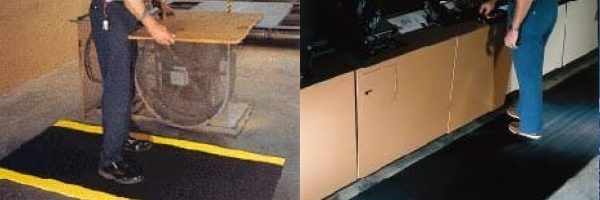
 Corrugated Rubber Switchboard Matting (ASTM)$1,606.00This is ASTM D178 Type I switchboard matting in a corrugated finish — an insulating rubber barrier for people working on or near energized electrical equipment. It's available in Class 2, Class 3, and Class 4, and the class you choose is the specification. Every roll is proof tested at
...
This is ASTM D178 Type I switchboard matting in a corrugated finish — an insulating rubber barrier for people working...
This is ASTM D178 Type I switchboard matting in a corrugated finish — an insulating rubber barrier for people working on or near energized electrical equipment. It's available in Class 2, Class 3, and Class 4, and the class you choose is the specification. Every roll is proof tested at the voltage specified for its class, across the entire surface.
What Switchboard Matting Does Before Current Finds a Path Through a Worker
Electricity needs a complete circuit. A worker standing on a concrete floor in front of an energized panel is a potential half of one — if their hand contacts something live, current travels through the body, down through the legs, and into the ground. The floor is what completes the path.
Switchboard matting interrupts that path. It's an insulating barrier between the worker and the floor, engineered so current cannot pass through it to reach ground. The person can still be exposed to a live conductor, but the circuit has nowhere to complete, and that difference is the entire point of the product.
This is worth stating plainly because it runs opposite to another kind of matting people confuse it with. Anti-static and ESD matting is deliberately conductive — it drains charge to ground on purpose. Dielectric matting blocks that path completely. Substituting one for the other, or grounding a mat that must never be grounded, removes the protection entirely.
The consequences here aren't measured in downtime or floor wear. Electrical incidents at switchgear and distribution equipment are the kind that end careers and lives. Insulating matting is one layer in an electrical safety program that also includes de-energizing where possible, proper protective equipment, and trained procedure. It is not a substitute for any of those.
Why Type I Rubber Construction, and Why Class Matters More Than Anything Else
ASTM D178 governs insulating matting for electrical work, and it sorts product two ways. Type identifies the compound the matting is made from. Class sets the voltage the material is tested and rated for. Both belong on a specification, and both have to match the job.
This is Type I — a vulcanized rubber compound. Rubber gives you a well-understood insulating material with the flexibility to lie flat, roll up, and stay workable across normal temperature ranges. It's the baseline construction in the standard, and for most indoor electrical rooms it's exactly what's called for.
Class is where your attention belongs. Class 2, Class 3, and Class 4 are three different products wearing the same name, and each carries its own proof test voltage and its own maximum recommended use voltage. Thickness increases with class, because insulating capacity comes from material. Picking a class because it was in stock rather than because it matched your equipment is the failure mode this whole category exists to prevent.
The testing detail that matters most: every roll is proof tested at its class voltage over the entire surface, not sampled. A dielectric barrier is only as good as its weakest square inch, and a spot check across a 75-foot roll would leave most of that surface unverified. Full-surface testing is the difference between a rated product and a plausible one.
Rolls are guaranteed single piece. That sounds like a shipping detail and isn't. A splice is a discontinuity in the insulating barrier, and discontinuities are where protection fails. A single-piece roll means the material in front of your panel is continuous end to end.
The corrugated surface runs as ridges across the mat, giving traction where workers stand for long periods and where the floor may pick up oil or moisture. Each piece is permanently marked at regular intervals with the manufacturer, the standard, the type, and the class — so what arrives on your dock can be verified on sight rather than taken on trust.
Where It Belongs, and Where It Doesn't
The applications are specific and they're all electrical: distribution boards, switchgear, sub-stations, transformers, generators, and electrical workbenches. The common factor is a person working at or near energized equipment who needs the floor beneath them to stop being a conductor.
Coverage is usually what people get wrong. The matting should extend across the full working area in front of the equipment, far enough that a worker can move, step back, or reach without ever having a foot off the mat. A strip narrower than the panel is a strip somebody will step past. It sits alongside the rest of our electrical and switchboard matting, which covers the other type and class combinations.
What it is not: an ESD or anti-static mat. It will not dissipate static charge, protect sensitive electronics, or work as a bench mat for soldering and component handling. Those products are conductive by design and belong to a completely different specification. If static control is what you need, this is the wrong product and it will not do that job.
It's also not an anti-fatigue mat, an entrance mat, or general floor protection — despite the corrugated surface offering traction. Specifying it for comfort or coverage means paying for dielectric performance where it isn't needed, and it can leave people assuming a work area is protected when the mat was never placed for that reason.
And it is not primary protection. Electrical safety work starts with de-energizing and verifying, then protective equipment and procedure. Insulating matting is a supplementary layer beneath all of that, not a reason to skip any of it.
Three Things to Check Before You Spec It
First, match the class to your actual working voltage. Find the real voltage at the equipment rather than assuming, then select the class rated at or above it with margin to spare. Class 2, 3, and 4 are all available here, and moving up a class costs far less than discovering mid-project that the mat under someone's feet was never rated for the panel in front of them.
Second, build inspection into your routine. Dielectric failure is invisible. A cut, a puncture, embedded metal debris, or chemical and oil contamination can compromise the insulating barrier while the mat still looks perfectly serviceable. Inspect regularly, replace anything damaged rather than working around it, and follow your facility's retest interval. A mat people trust and shouldn't is worse than no mat.
Third, size the coverage to the work, not to the equipment. Measure the area a worker actually occupies and moves through while working the panel, then choose a width that keeps them fully on the mat throughout. Cutting a roll into panel-length sections is normal practice. When it's a close call between two widths, take the wider one — the extra material is minimal across a full roll and it removes the most common coverage mistake.
Why Mats Inc.
We've been supplying industrial and commercial matting since 1964, and safety-rated electrical products are where getting the specification right matters more than anything else we sell. We'll ask what voltage you're working at and what the equipment is before we quote, because type and class aren't preferences — they're the whole product. If your application needs a class we don't have in front of you, we'd rather route you to it than sell you what's convenient.
Product Type Insulating (dielectric) switchboard matting Standard ANSI/ASTM D178, Type I Classes Available Class 2, Class 3, Class 4 Material High-quality vulcanized rubber compound Surface Corrugated Color Black Class 2 Sizes 24 inch, 36 inch, and 48 inch widths in 75 ft. rolls Class 3 Sizes 36 inch width in 75 ft. rolls Class 4 Sizes 36 inch and 48 inch widths in 30 ft. rolls Class 2 Proof Test 20,000 volts A.C., tested over the entire surface Class 2 Max Use Voltage 17,000 volts A.C. Class 2 Dielectric Strength 30,000 volts A.C. Roll Guarantee Single piece, full rolls only Marking Permanently marked with manufacturer, ASTM D178, type, and class Recommended For Distribution boards, switchgear, sub-stations, transformers, generators, electrical workbenches Static Control None — this is an insulator, not an ESD or anti-static product Warranty 1-year limited (Mats Inc.) Frequently Asked Questions
What do Type and Class mean on switchboard matting?
They're the two halves of the specification, and a quote that names only one isn't complete. Type identifies the compound the matting is manufactured from — this product is Type I, a vulcanized rubber compound. Class sets the voltage the material is tested and rated to handle.
Class is the one that changes what you're buying. This product is offered in Class 2, Class 3, and Class 4, and each has its own proof test voltage and its own maximum recommended use voltage, with thickness increasing as the class goes up. Two rolls that look identical on a dock can be rated for very different equipment. Always confirm the class against the voltage you're actually working at, not against what's convenient to order. — Dustin Thompson, Owner & CEO, Mats Inc.
How is it tested, and how do I know it's still protecting anyone a year from now?
Testing is the strongest thing about this product. Every roll is proof tested at the voltage specified for its class over the entire surface rather than sampled at intervals. A dielectric barrier is only as good as its weakest point, so full-surface testing is what separates a rated mat from one that's probably fine. Rolls are also guaranteed single piece, meaning no splice sits in the middle of your barrier. Class 2 material is proof tested at 20,000 volts A.C. with a maximum recommended use voltage of 17,000.
Ongoing, the honest answer is that you have to inspect it. Dielectric failure doesn't announce itself — a cut, a puncture, metal debris pressed into the surface, or oil and chemical contamination can compromise the insulation while the mat looks completely normal. Build inspection into your routine, follow your facility's retest interval, and replace damaged material instead of working around it. A mat people trust that no longer performs is more dangerous than bare floor, because bare floor doesn't create false confidence. — Dustin Thompson, Owner & CEO, Mats Inc.
Where should it be placed, and how much area does it need to cover?
It goes wherever people work at or near energized equipment — in front of distribution boards, switchgear, sub-stations, transformers, generators, and electrical workbenches. The mat's job is to break the path to ground beneath the worker, so it has to be under them the entire time they're exposed.
That's why coverage deserves real thought. Extend the matting across the full working area in front of the equipment, with enough margin that someone can shift their stance, step back, or reach sideways without a foot landing on bare floor. A strip narrower than the panel is a strip somebody will eventually step past, usually at the worst moment. And to be direct: this is supplementary protection. It sits underneath de-energizing, verification, protective equipment, and trained procedure — never in place of them. — Dustin Thompson, Owner & CEO, Mats Inc.
What sizes are available, and how do I work out what to order?
It depends on the class. Class 2 comes in 24, 36, and 48 inch widths in 75-foot rolls. Class 3 comes in 36 inch width in 75-foot rolls. Class 4 comes in 36 and 48 inch widths in 30-foot rolls — shorter because the material is thicker and heavier at that rating.
To work out quantity, go equipment by equipment. Measure the width of each panel or bench, then add margin on both sides so a worker never runs out of mat when they move. Total those lengths, and choose your width based on how far people stand back while working. Cutting a roll into panel-length sections is normal, so one roll usually serves several pieces of equipment. Send us your equipment list and the voltages, and we'll work through both the class and the quantity with you. — Jinna Hopson, Vice President of Marketing, Mats Inc.
What does it look like, and what's involved in handling it?
It's black with a corrugated surface — ridges running across the mat that give traction where people stand for long stretches or where the floor picks up oil and moisture. The look is straightforwardly industrial, which is right for the setting. Nobody is specifying switchboard matting for a lobby.
Handling is the practical thing to plan for. These rolls are heavy, and they get heavier as the class goes up, since higher classes mean thicker material. A full-width roll is genuinely a two-person job with equipment, so think about where it lands on the dock, how it gets to the electrical room, and where you'll cut it. Let it lie flat and relax before final placement, and cut with a sharp blade and a straightedge for clean, safe edges. — Jinna Hopson, Vice President of Marketing, Mats Inc.
Is this the same as an anti-static or ESD mat?
No, and this is the single most important thing to be clear about, because the two get confused constantly and the mistake runs in a dangerous direction. Anti-static and ESD matting is conductive or dissipative on purpose — it exists to give static charge a controlled path to ground so it doesn't damage sensitive electronics. It's designed to conduct.
Switchboard matting is the opposite. It's an insulator, engineered so electricity cannot pass through it to reach ground, which is exactly what protects a worker at a live panel. It offers no static control whatsoever and won't protect components on a bench. More seriously, treating it like an ESD product — grounding it, or swapping one in for the other — removes the protection it exists to provide. If you need static control, we carry proper ESD products and we'll point you at them. If you need shock protection at electrical equipment, this is the right category. They are not interchangeable. — Jinna Hopson, Vice President of Marketing, Mats Inc.
Written by Dustin Thompson, Owner & CEO, Mats Inc.
↑
This is ASTM D178 Type I switchboard matting in a corrugated finish — an insulating rubber barrier for people working on or near energized electrical equipment. It's available in Class 2, Class 3, and Class 4, and the class you choose is the specification. Every roll is proof tested at the voltage specified for its class, across the entire surface.
What Switchboard Matting Does Before Current Finds a Path Through a Worker
Electricity needs a complete circuit. A worker standing on a concrete floor in front of an energized panel is a potential half of one — if their hand contacts something live, current travels through the body, down through the legs, and into the ground. The floor is what completes the path.
Switchboard matting interrupts that path. It's an insulating barrier between the worker and the floor, engineered so current cannot pass through it to reach ground. The person can still be exposed to a live conductor, but the circuit has nowhere to complete, and that difference is the entire point of the product.
This is worth stating plainly because it runs opposite to another kind of matting people confuse it with. Anti-static and ESD matting is deliberately conductive — it drains charge to ground on purpose. Dielectric matting blocks that path completely. Substituting one for the other, or grounding a mat that must never be grounded, removes the protection entirely.
The consequences here aren't measured in downtime or floor wear. Electrical incidents at switchgear and distribution equipment are the kind that end careers and lives. Insulating matting is one layer in an electrical safety program that also includes de-energizing where possible, proper protective equipment, and trained procedure. It is not a substitute for any of those.
Why Type I Rubber Construction, and Why Class Matters More Than Anything Else
ASTM D178 governs insulating matting for electrical work, and it sorts product two ways. Type identifies the compound the matting is made from. Class sets the voltage the material is tested and rated for. Both belong on a specification, and both have to match the job.
This is Type I — a vulcanized rubber compound. Rubber gives you a well-understood insulating material with the flexibility to lie flat, roll up, and stay workable across normal temperature ranges. It's the baseline construction in the standard, and for most indoor electrical rooms it's exactly what's called for.
Class is where your attention belongs. Class 2, Class 3, and Class 4 are three different products wearing the same name, and each carries its own proof test voltage and its own maximum recommended use voltage. Thickness increases with class, because insulating capacity comes from material. Picking a class because it was in stock rather than because it matched your equipment is the failure mode this whole category exists to prevent.
The testing detail that matters most: every roll is proof tested at its class voltage over the entire surface, not sampled. A dielectric barrier is only as good as its weakest square inch, and a spot check across a 75-foot roll would leave most of that surface unverified. Full-surface testing is the difference between a rated product and a plausible one.
Rolls are guaranteed single piece. That sounds like a shipping detail and isn't. A splice is a discontinuity in the insulating barrier, and discontinuities are where protection fails. A single-piece roll means the material in front of your panel is continuous end to end.
The corrugated surface runs as ridges across the mat, giving traction where workers stand for long periods and where the floor may pick up oil or moisture. Each piece is permanently marked at regular intervals with the manufacturer, the standard, the type, and the class — so what arrives on your dock can be verified on sight rather than taken on trust.
Where It Belongs, and Where It Doesn't
The applications are specific and they're all electrical: distribution boards, switchgear, sub-stations, transformers, generators, and electrical workbenches. The common factor is a person working at or near energized equipment who needs the floor beneath them to stop being a conductor.
Coverage is usually what people get wrong. The matting should extend across the full working area in front of the equipment, far enough that a worker can move, step back, or reach without ever having a foot off the mat. A strip narrower than the panel is a strip somebody will step past. It sits alongside the rest of our electrical and switchboard matting, which covers the other type and class combinations.
What it is not: an ESD or anti-static mat. It will not dissipate static charge, protect sensitive electronics, or work as a bench mat for soldering and component handling. Those products are conductive by design and belong to a completely different specification. If static control is what you need, this is the wrong product and it will not do that job.
It's also not an anti-fatigue mat, an entrance mat, or general floor protection — despite the corrugated surface offering traction. Specifying it for comfort or coverage means paying for dielectric performance where it isn't needed, and it can leave people assuming a work area is protected when the mat was never placed for that reason.
And it is not primary protection. Electrical safety work starts with de-energizing and verifying, then protective equipment and procedure. Insulating matting is a supplementary layer beneath all of that, not a reason to skip any of it.
Three Things to Check Before You Spec It
First, match the class to your actual working voltage. Find the real voltage at the equipment rather than assuming, then select the class rated at or above it with margin to spare. Class 2, 3, and 4 are all available here, and moving up a class costs far less than discovering mid-project that the mat under someone's feet was never rated for the panel in front of them.
Second, build inspection into your routine. Dielectric failure is invisible. A cut, a puncture, embedded metal debris, or chemical and oil contamination can compromise the insulating barrier while the mat still looks perfectly serviceable. Inspect regularly, replace anything damaged rather than working around it, and follow your facility's retest interval. A mat people trust and shouldn't is worse than no mat.
Third, size the coverage to the work, not to the equipment. Measure the area a worker actually occupies and moves through while working the panel, then choose a width that keeps them fully on the mat throughout. Cutting a roll into panel-length sections is normal practice. When it's a close call between two widths, take the wider one — the extra material is minimal across a full roll and it removes the most common coverage mistake.
Why Mats Inc.
We've been supplying industrial and commercial matting since 1964, and safety-rated electrical products are where getting the specification right matters more than anything else we sell. We'll ask what voltage you're working at and what the equipment is before we quote, because type and class aren't preferences — they're the whole product. If your application needs a class we don't have in front of you, we'd rather route you to it than sell you what's convenient.
Product Type Insulating (dielectric) switchboard matting Standard ANSI/ASTM D178, Type I Classes Available Class 2, Class 3, Class 4 Material High-quality vulcanized rubber compound Surface Corrugated Color Black Class 2 Sizes 24 inch, 36 inch, and 48 inch widths in 75 ft. rolls Class 3 Sizes 36 inch width in 75 ft. rolls Class 4 Sizes 36 inch and 48 inch widths in 30 ft. rolls Class 2 Proof Test 20,000 volts A.C., tested over the entire surface Class 2 Max Use Voltage 17,000 volts A.C. Class 2 Dielectric Strength 30,000 volts A.C. Roll Guarantee Single piece, full rolls only Marking Permanently marked with manufacturer, ASTM D178, type, and class Recommended For Distribution boards, switchgear, sub-stations, transformers, generators, electrical workbenches Static Control None — this is an insulator, not an ESD or anti-static product Warranty 1-year limited (Mats Inc.) Frequently Asked Questions
What do Type and Class mean on switchboard matting?
They're the two halves of the specification, and a quote that names only one isn't complete. Type identifies the compound the matting is manufactured from — this product is Type I, a vulcanized rubber compound. Class sets the voltage the material is tested and rated to handle.
Class is the one that changes what you're buying. This product is offered in Class 2, Class 3, and Class 4, and each has its own proof test voltage and its own maximum recommended use voltage, with thickness increasing as the class goes up. Two rolls that look identical on a dock can be rated for very different equipment. Always confirm the class against the voltage you're actually working at, not against what's convenient to order. — Dustin Thompson, Owner & CEO, Mats Inc.
How is it tested, and how do I know it's still protecting anyone a year from now?
Testing is the strongest thing about this product. Every roll is proof tested at the voltage specified for its class over the entire surface rather than sampled at intervals. A dielectric barrier is only as good as its weakest point, so full-surface testing is what separates a rated mat from one that's probably fine. Rolls are also guaranteed single piece, meaning no splice sits in the middle of your barrier. Class 2 material is proof tested at 20,000 volts A.C. with a maximum recommended use voltage of 17,000.
Ongoing, the honest answer is that you have to inspect it. Dielectric failure doesn't announce itself — a cut, a puncture, metal debris pressed into the surface, or oil and chemical contamination can compromise the insulation while the mat looks completely normal. Build inspection into your routine, follow your facility's retest interval, and replace damaged material instead of working around it. A mat people trust that no longer performs is more dangerous than bare floor, because bare floor doesn't create false confidence. — Dustin Thompson, Owner & CEO, Mats Inc.
Where should it be placed, and how much area does it need to cover?
It goes wherever people work at or near energized equipment — in front of distribution boards, switchgear, sub-stations, transformers, generators, and electrical workbenches. The mat's job is to break the path to ground beneath the worker, so it has to be under them the entire time they're exposed.
That's why coverage deserves real thought. Extend the matting across the full working area in front of the equipment, with enough margin that someone can shift their stance, step back, or reach sideways without a foot landing on bare floor. A strip narrower than the panel is a strip somebody will eventually step past, usually at the worst moment. And to be direct: this is supplementary protection. It sits underneath de-energizing, verification, protective equipment, and trained procedure — never in place of them. — Dustin Thompson, Owner & CEO, Mats Inc.
What sizes are available, and how do I work out what to order?
It depends on the class. Class 2 comes in 24, 36, and 48 inch widths in 75-foot rolls. Class 3 comes in 36 inch width in 75-foot rolls. Class 4 comes in 36 and 48 inch widths in 30-foot rolls — shorter because the material is thicker and heavier at that rating.
To work out quantity, go equipment by equipment. Measure the width of each panel or bench, then add margin on both sides so a worker never runs out of mat when they move. Total those lengths, and choose your width based on how far people stand back while working. Cutting a roll into panel-length sections is normal, so one roll usually serves several pieces of equipment. Send us your equipment list and the voltages, and we'll work through both the class and the quantity with you. — Jinna Hopson, Vice President of Marketing, Mats Inc.
What does it look like, and what's involved in handling it?
It's black with a corrugated surface — ridges running across the mat that give traction where people stand for long stretches or where the floor picks up oil and moisture. The look is straightforwardly industrial, which is right for the setting. Nobody is specifying switchboard matting for a lobby.
Handling is the practical thing to plan for. These rolls are heavy, and they get heavier as the class goes up, since higher classes mean thicker material. A full-width roll is genuinely a two-person job with equipment, so think about where it lands on the dock, how it gets to the electrical room, and where you'll cut it. Let it lie flat and relax before final placement, and cut with a sharp blade and a straightedge for clean, safe edges. — Jinna Hopson, Vice President of Marketing, Mats Inc.
Is this the same as an anti-static or ESD mat?
No, and this is the single most important thing to be clear about, because the two get confused constantly and the mistake runs in a dangerous direction. Anti-static and ESD matting is conductive or dissipative on purpose — it exists to give static charge a controlled path to ground so it doesn't damage sensitive electronics. It's designed to conduct.
Switchboard matting is the opposite. It's an insulator, engineered so electricity cannot pass through it to reach ground, which is exactly what protects a worker at a live panel. It offers no static control whatsoever and won't protect components on a bench. More seriously, treating it like an ESD product — grounding it, or swapping one in for the other — removes the protection it exists to provide. If you need static control, we carry proper ESD products and we'll point you at them. If you need shock protection at electrical equipment, this is the right category. They are not interchangeable. — Jinna Hopson, Vice President of Marketing, Mats Inc.
Written by Dustin Thompson, Owner & CEO, Mats Inc.
↑
View Details
View Details
 Corrugated Vinyl Switchboard Matting (ASTM)$1,202.00This is ASTM D178 Type II switchboard matting in a corrugated finish — a non-conductive vinyl barrier for people working at or near energized electrical equipment. It comes in Class 1, Class 2, and Class 3, each rated for a different working voltage, and every roll is proof tested at
...
This is ASTM D178 Type II switchboard matting in a corrugated finish — a non-conductive vinyl barrier for people working...
This is ASTM D178 Type II switchboard matting in a corrugated finish — a non-conductive vinyl barrier for people working at or near energized electrical equipment. It comes in Class 1, Class 2, and Class 3, each rated for a different working voltage, and every roll is proof tested at its class voltage across the entire surface.
What Non-Conductive Matting Does Before a Routine Job Turns Into an Incident
The mechanism is simple. Electricity needs a complete circuit, and a person standing on a bare floor in front of a live panel is half of one. Insulating matting sits between the worker and the floor so current has nowhere to go. Contact can still happen; the circuit just can't close.
What's less obvious is when that matters most. Serious electrical incidents rarely happen on the unfamiliar job where everyone is careful. They happen on the routine one — the panel somebody has opened four hundred times, on an afternoon when they're thinking about something else and skip a step they've never skipped before.
That's the argument for insulated matting as permanent infrastructure rather than task equipment. It doesn't depend on anyone remembering it. It's already under their feet on the day attention slips, which is the day it earns its keep.
Most facilities also run mixed voltages. A distribution board, a transformer, and a bench aren't the same electrical environment, and matting rated for one isn't automatically right for another. That's why this product is sold by class rather than as a single item — the mat has to match the equipment, not the building.
Why Type II Vinyl, and Why the Class Range Matters Here
Type II designates the compound. This is a vinyl formulation built for electrical insulation, and it also meets fire resistance standards — a meaningful property in electrical rooms, where the equipment being protected against is itself an ignition source.
Vinyl brings some practical advantages in this application. It holds up against the oils, greases, and chemicals that end up on shop and plant floors, wipes down easily so contaminants don't accumulate in the corrugations, and stays dimensionally stable over long runs so a roll lies flat instead of fighting you.
The class range is the real differentiator on this product. Class 1 covers lower-voltage work at 7,500 volts maximum recommended use. Class 2 steps up to 17,000. Class 3 reaches 26,500. One product line covers a wide span of equipment, so a facility with varied voltages can standardize on one type and vary only the class.
Thickness rises with class, because insulating capacity comes from material. Class 1 is 3/16 inch, Class 2 is 1/4 inch, Class 3 is 3/8 inch. That relationship is useful in the field — thickness is a fast visual check that the roll in front of you is the class you ordered.
Testing is what makes any of it meaningful. Every roll is proof tested at its class voltage over the entire surface rather than sampled. A barrier is only as good as its weakest square inch, and spot-checking a 75-foot roll would leave most of it unverified. Rolls are supplied as single pieces, so no splice sits in the middle of the protection.
The corrugated surface runs as ridges across the mat, adding traction where people stand for long stretches and where floors pick up oil or moisture. In an electrical room, a mat that doubles as a slip hazard would be solving one problem by creating another.
Where It Belongs, and Where It Doesn't
Distribution boards, switchgear, sub-stations, transformers, generators, and electrical workbenches. Anywhere someone works at or near energized equipment and the floor under them needs to stop conducting. It sits with the rest of our electrical and switchboard matting, which covers the other type and class combinations.
Coverage is where specifications usually fall short. The mat needs to span the full area a worker occupies — enough that they can shift stance, step back, or reach sideways without a foot landing on bare floor. A mat narrower than the panel is a mat somebody steps off, and they won't notice when they do.
What it is not: an ESD or anti-static mat. Those are conductive by design, built to drain static charge to ground and protect sensitive electronics. This does the opposite — it blocks the path to ground entirely. The two are not interchangeable in either direction, and treating this one as an ESD product would remove the protection it exists to provide.
It's also not an anti-fatigue mat or general floor protection. The corrugated surface gives traction, but comfort isn't what you're buying, and putting insulating matting where it isn't needed can leave people assuming an area is protected when the mat was placed for another reason entirely.
And it is not primary protection. De-energizing, verification, protective equipment, and trained procedure come first. This is the layer underneath all of that — the one still working when something else doesn't.
Three Things to Check Before You Spec It
First, inventory your equipment before you pick a class. Walk the rooms and write down the actual working voltage at each panel, bench, and transformer. Facilities that buy one class for everything usually end up over-specified in some rooms and under-specified in others. With three classes available, you can match each area properly rather than averaging across the building.
Second, think about thickness in the space it's going. Class 3 material at 3/8 inch is noticeably thicker than Class 1 at 3/16, and that shows up in door clearance, in the transition at the mat edge, and in how much the roll weighs when your crew moves it. Check the swing of any door opening over the mat before the order goes in, not after it lands.
Third, set the inspection routine on day one. Dielectric failure is invisible — a cut, a puncture, metal debris pressed into the surface, or chemical contamination can compromise the barrier while the mat looks fine. Decide now who checks it, how often, and what triggers replacement. A mat people trust that no longer performs is worse than no mat, because bare floor at least doesn't create confidence.
Why Mats Inc.
Since 1964 we've built a matting line broad enough that we don't have to push you toward whatever's on the shelf. On electrical work that matters more than usual, because the right answer depends entirely on your voltage and your equipment. We'll ask what you're working on before we quote, and if the honest answer is a different class or a different type than this one, that's what we'll tell you. Getting a switchboard mat wrong isn't a returns problem.
Product Type Insulating (non-conductive) switchboard matting Standard ANSI/ASTM D178, Type II Material High-quality vinyl compound; meets fire resistance standards Surface Corrugated Color Black Classes Available Class 1, Class 2, Class 3 Testing Every roll proof tested at its class voltage over the entire surface Roll Supply Full rolls only, single piece Recommended For Distribution boards, switchgear, sub-stations, transformers, generators, electrical workbenches Static Control None — this is an insulator, not an ESD or anti-static product Warranty 1-year limited (Mats Inc.) Sizes by Class
Class Thickness Widths Roll Length Roll Weight Class 1 3/16 inch 36 inch 75 ft. 295 lb. Class 2 1/4 inch 24, 36, and 48 inch 75 ft. Confirm by width Class 3 3/8 inch 36 inch 75 ft. Confirm Frequently Asked Questions
What's the difference between Type I and Type II, and does vinyl insulate as well as rubber?
Type designates the compound the matting is manufactured from. Type I is a rubber compound; Type II, this product, is a vinyl compound. Both are insulating matting made to the same ASTM D178 standard, and both are proof tested to the same class voltages. Vinyl doesn't insulate less — insulating performance is defined by class, and a Type II Class 2 mat is tested at the same voltage as a Type I Class 2 mat.
Where they differ is in secondary properties. This vinyl formulation also meets fire resistance standards and stands up well to oils, greases, and chemicals. In a plant or shop where the floor around the panel isn't pristine, that resistance matters over the life of the mat. Choose type on those environmental factors, and choose class on voltage. Class is the safety decision; type is the fit decision. — Dustin Thompson, Owner & CEO, Mats Inc.
Which class do I need?
Start from the actual working voltage at the equipment — measured or taken off the equipment documentation, not estimated. Class 1 carries a recommended maximum use voltage of 7,500 volts, Class 2 goes to 17,000, and Class 3 reaches 26,500. Match the class to the voltage with room to spare rather than landing right on the limit.
Notice that each class is proof tested well above its recommended use voltage — Class 2, for example, is proof tested at 20,000 volts but rated for use at 17,000. That gap is deliberate margin, and it's there for real-world conditions, not as a reserve you're meant to spend. Treat the recommended maximum use voltage as the ceiling and the proof test figure as evidence the material has margin behind it. If your equipment sits near a class boundary, move up. — Dustin Thompson, Owner & CEO, Mats Inc.
Does it need to be grounded, bonded, or fastened to the floor?
No grounding, and this is important enough to be blunt about. Grounding an insulating mat defeats its entire purpose — the whole point is that there's no path from the worker through the floor to ground. If anyone on your team is used to installing ESD matting, they may reach for a ground cord out of habit. On this product that habit is dangerous.
On fastening: it's designed to lie loose so it can be lifted, inspected underneath, repositioned, and replaced without demolition. Adhesives and mechanical fasteners can also puncture or contaminate the barrier. Let it lie flat and relax after unrolling, trim it clean so edges sit tight, and if it's slipping in a busy area, ask us before adding anything to hold it down. — Dustin Thompson, Owner & CEO, Mats Inc.
What sizes are available, and how do I work out how much to order?
Class 2 is the most flexible — 24, 36, and 48 inch widths in 75-foot rolls. Class 1 and Class 3 come in 36 inch width, also in 75-foot rolls. It's sold in full rolls, and one roll typically covers several pieces of equipment once it's cut to length.
To estimate, work equipment by equipment rather than room by room. Measure the width of each panel or bench, add margin on both sides so a worker never runs out of mat when they shift or step back, and total those lengths. Choose width based on how far people stand back while working — for anything they need to open, reach into, and step away from, the wider option is usually the right call. Send us your equipment list with voltages and we'll size both the class and the quantity with you. — Jinna Hopson, Vice President of Marketing, Mats Inc.
What's it like to install and live with day to day?
It's black with a corrugated ridged surface — plainly industrial, which is exactly right for an electrical room. Plan for the weight: material runs from 1.25 pounds per square foot at Class 1 up to 2.51 at Class 3, so a full roll of the thicker material is a two-person job with equipment. Think through where it lands on the dock and how it gets to the room before it arrives.
Let it lie flat for a while after unrolling so it relaxes and stops holding the curl. Cut with a sharp blade against a straightedge for clean edges that sit tight and don't catch a boot. Day to day it's easy — the vinyl surface wipes down, and it resists the oils and greases that collect on plant floors, so the corrugations don't turn into a trap for grime. — Jinna Hopson, Vice President of Marketing, Mats Inc.
Can I just buy one class and use it everywhere?
You can, and plenty of facilities do, but it's worth understanding the trade before you commit. Buying the highest class for the whole building means you're covered everywhere, but you're also putting 3/8 inch material in rooms that never needed it — thicker underfoot, heavier to handle, and more of a step at the edge in low-traffic areas.
Buying a single lower class is the mistake that actually matters. If one transformer room runs above what that class is rated for, the mat there isn't protecting anyone and nothing about it looks different from the rolls that are. Standardizing on one type across the facility is genuinely sensible — it keeps purchasing simple and the material consistent. Varying the class by room is what keeps it correct. Walk the equipment once, write down the voltages, and you'll only ever have to do it properly one time. — Jinna Hopson, Vice President of Marketing, Mats Inc.
Written by Dustin Thompson, Owner & CEO, Mats Inc.
↑
This is ASTM D178 Type II switchboard matting in a corrugated finish — a non-conductive vinyl barrier for people working at or near energized electrical equipment. It comes in Class 1, Class 2, and Class 3, each rated for a different working voltage, and every roll is proof tested at its class voltage across the entire surface.
What Non-Conductive Matting Does Before a Routine Job Turns Into an Incident
The mechanism is simple. Electricity needs a complete circuit, and a person standing on a bare floor in front of a live panel is half of one. Insulating matting sits between the worker and the floor so current has nowhere to go. Contact can still happen; the circuit just can't close.
What's less obvious is when that matters most. Serious electrical incidents rarely happen on the unfamiliar job where everyone is careful. They happen on the routine one — the panel somebody has opened four hundred times, on an afternoon when they're thinking about something else and skip a step they've never skipped before.
That's the argument for insulated matting as permanent infrastructure rather than task equipment. It doesn't depend on anyone remembering it. It's already under their feet on the day attention slips, which is the day it earns its keep.
Most facilities also run mixed voltages. A distribution board, a transformer, and a bench aren't the same electrical environment, and matting rated for one isn't automatically right for another. That's why this product is sold by class rather than as a single item — the mat has to match the equipment, not the building.
Why Type II Vinyl, and Why the Class Range Matters Here
Type II designates the compound. This is a vinyl formulation built for electrical insulation, and it also meets fire resistance standards — a meaningful property in electrical rooms, where the equipment being protected against is itself an ignition source.
Vinyl brings some practical advantages in this application. It holds up against the oils, greases, and chemicals that end up on shop and plant floors, wipes down easily so contaminants don't accumulate in the corrugations, and stays dimensionally stable over long runs so a roll lies flat instead of fighting you.
The class range is the real differentiator on this product. Class 1 covers lower-voltage work at 7,500 volts maximum recommended use. Class 2 steps up to 17,000. Class 3 reaches 26,500. One product line covers a wide span of equipment, so a facility with varied voltages can standardize on one type and vary only the class.
Thickness rises with class, because insulating capacity comes from material. Class 1 is 3/16 inch, Class 2 is 1/4 inch, Class 3 is 3/8 inch. That relationship is useful in the field — thickness is a fast visual check that the roll in front of you is the class you ordered.
Testing is what makes any of it meaningful. Every roll is proof tested at its class voltage over the entire surface rather than sampled. A barrier is only as good as its weakest square inch, and spot-checking a 75-foot roll would leave most of it unverified. Rolls are supplied as single pieces, so no splice sits in the middle of the protection.
The corrugated surface runs as ridges across the mat, adding traction where people stand for long stretches and where floors pick up oil or moisture. In an electrical room, a mat that doubles as a slip hazard would be solving one problem by creating another.
Where It Belongs, and Where It Doesn't
Distribution boards, switchgear, sub-stations, transformers, generators, and electrical workbenches. Anywhere someone works at or near energized equipment and the floor under them needs to stop conducting. It sits with the rest of our electrical and switchboard matting, which covers the other type and class combinations.
Coverage is where specifications usually fall short. The mat needs to span the full area a worker occupies — enough that they can shift stance, step back, or reach sideways without a foot landing on bare floor. A mat narrower than the panel is a mat somebody steps off, and they won't notice when they do.
What it is not: an ESD or anti-static mat. Those are conductive by design, built to drain static charge to ground and protect sensitive electronics. This does the opposite — it blocks the path to ground entirely. The two are not interchangeable in either direction, and treating this one as an ESD product would remove the protection it exists to provide.
It's also not an anti-fatigue mat or general floor protection. The corrugated surface gives traction, but comfort isn't what you're buying, and putting insulating matting where it isn't needed can leave people assuming an area is protected when the mat was placed for another reason entirely.
And it is not primary protection. De-energizing, verification, protective equipment, and trained procedure come first. This is the layer underneath all of that — the one still working when something else doesn't.
Three Things to Check Before You Spec It
First, inventory your equipment before you pick a class. Walk the rooms and write down the actual working voltage at each panel, bench, and transformer. Facilities that buy one class for everything usually end up over-specified in some rooms and under-specified in others. With three classes available, you can match each area properly rather than averaging across the building.
Second, think about thickness in the space it's going. Class 3 material at 3/8 inch is noticeably thicker than Class 1 at 3/16, and that shows up in door clearance, in the transition at the mat edge, and in how much the roll weighs when your crew moves it. Check the swing of any door opening over the mat before the order goes in, not after it lands.
Third, set the inspection routine on day one. Dielectric failure is invisible — a cut, a puncture, metal debris pressed into the surface, or chemical contamination can compromise the barrier while the mat looks fine. Decide now who checks it, how often, and what triggers replacement. A mat people trust that no longer performs is worse than no mat, because bare floor at least doesn't create confidence.
Why Mats Inc.
Since 1964 we've built a matting line broad enough that we don't have to push you toward whatever's on the shelf. On electrical work that matters more than usual, because the right answer depends entirely on your voltage and your equipment. We'll ask what you're working on before we quote, and if the honest answer is a different class or a different type than this one, that's what we'll tell you. Getting a switchboard mat wrong isn't a returns problem.
Product Type Insulating (non-conductive) switchboard matting Standard ANSI/ASTM D178, Type II Material High-quality vinyl compound; meets fire resistance standards Surface Corrugated Color Black Classes Available Class 1, Class 2, Class 3 Testing Every roll proof tested at its class voltage over the entire surface Roll Supply Full rolls only, single piece Recommended For Distribution boards, switchgear, sub-stations, transformers, generators, electrical workbenches Static Control None — this is an insulator, not an ESD or anti-static product Warranty 1-year limited (Mats Inc.) Sizes by Class
Class Thickness Widths Roll Length Roll Weight Class 1 3/16 inch 36 inch 75 ft. 295 lb. Class 2 1/4 inch 24, 36, and 48 inch 75 ft. Confirm by width Class 3 3/8 inch 36 inch 75 ft. Confirm Frequently Asked Questions
What's the difference between Type I and Type II, and does vinyl insulate as well as rubber?
Type designates the compound the matting is manufactured from. Type I is a rubber compound; Type II, this product, is a vinyl compound. Both are insulating matting made to the same ASTM D178 standard, and both are proof tested to the same class voltages. Vinyl doesn't insulate less — insulating performance is defined by class, and a Type II Class 2 mat is tested at the same voltage as a Type I Class 2 mat.
Where they differ is in secondary properties. This vinyl formulation also meets fire resistance standards and stands up well to oils, greases, and chemicals. In a plant or shop where the floor around the panel isn't pristine, that resistance matters over the life of the mat. Choose type on those environmental factors, and choose class on voltage. Class is the safety decision; type is the fit decision. — Dustin Thompson, Owner & CEO, Mats Inc.
Which class do I need?
Start from the actual working voltage at the equipment — measured or taken off the equipment documentation, not estimated. Class 1 carries a recommended maximum use voltage of 7,500 volts, Class 2 goes to 17,000, and Class 3 reaches 26,500. Match the class to the voltage with room to spare rather than landing right on the limit.
Notice that each class is proof tested well above its recommended use voltage — Class 2, for example, is proof tested at 20,000 volts but rated for use at 17,000. That gap is deliberate margin, and it's there for real-world conditions, not as a reserve you're meant to spend. Treat the recommended maximum use voltage as the ceiling and the proof test figure as evidence the material has margin behind it. If your equipment sits near a class boundary, move up. — Dustin Thompson, Owner & CEO, Mats Inc.
Does it need to be grounded, bonded, or fastened to the floor?
No grounding, and this is important enough to be blunt about. Grounding an insulating mat defeats its entire purpose — the whole point is that there's no path from the worker through the floor to ground. If anyone on your team is used to installing ESD matting, they may reach for a ground cord out of habit. On this product that habit is dangerous.
On fastening: it's designed to lie loose so it can be lifted, inspected underneath, repositioned, and replaced without demolition. Adhesives and mechanical fasteners can also puncture or contaminate the barrier. Let it lie flat and relax after unrolling, trim it clean so edges sit tight, and if it's slipping in a busy area, ask us before adding anything to hold it down. — Dustin Thompson, Owner & CEO, Mats Inc.
What sizes are available, and how do I work out how much to order?
Class 2 is the most flexible — 24, 36, and 48 inch widths in 75-foot rolls. Class 1 and Class 3 come in 36 inch width, also in 75-foot rolls. It's sold in full rolls, and one roll typically covers several pieces of equipment once it's cut to length.
To estimate, work equipment by equipment rather than room by room. Measure the width of each panel or bench, add margin on both sides so a worker never runs out of mat when they shift or step back, and total those lengths. Choose width based on how far people stand back while working — for anything they need to open, reach into, and step away from, the wider option is usually the right call. Send us your equipment list with voltages and we'll size both the class and the quantity with you. — Jinna Hopson, Vice President of Marketing, Mats Inc.
What's it like to install and live with day to day?
It's black with a corrugated ridged surface — plainly industrial, which is exactly right for an electrical room. Plan for the weight: material runs from 1.25 pounds per square foot at Class 1 up to 2.51 at Class 3, so a full roll of the thicker material is a two-person job with equipment. Think through where it lands on the dock and how it gets to the room before it arrives.
Let it lie flat for a while after unrolling so it relaxes and stops holding the curl. Cut with a sharp blade against a straightedge for clean edges that sit tight and don't catch a boot. Day to day it's easy — the vinyl surface wipes down, and it resists the oils and greases that collect on plant floors, so the corrugations don't turn into a trap for grime. — Jinna Hopson, Vice President of Marketing, Mats Inc.
Can I just buy one class and use it everywhere?
You can, and plenty of facilities do, but it's worth understanding the trade before you commit. Buying the highest class for the whole building means you're covered everywhere, but you're also putting 3/8 inch material in rooms that never needed it — thicker underfoot, heavier to handle, and more of a step at the edge in low-traffic areas.
Buying a single lower class is the mistake that actually matters. If one transformer room runs above what that class is rated for, the mat there isn't protecting anyone and nothing about it looks different from the rolls that are. Standardizing on one type across the facility is genuinely sensible — it keeps purchasing simple and the material consistent. Varying the class by room is what keeps it correct. Walk the equipment once, write down the voltages, and you'll only ever have to do it properly one time. — Jinna Hopson, Vice President of Marketing, Mats Inc.
Written by Dustin Thompson, Owner & CEO, Mats Inc.
↑
View Details
View Details
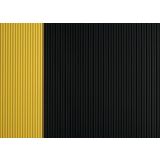 Corrugated Vinyl Switchboard Matting With Black and Yellow Safety Border (ASTM)$1,528.00This is ASTM D178 Type II, Class 2 switchboard matting with a high-visibility yellow safety border along the edge. The black field is the insulating surface. The yellow tells everyone in the room exactly where it ends. It runs 36 inches wide by 75 feet at 1/4 inch thick, proof
...
This is ASTM D178 Type II, Class 2 switchboard matting with a high-visibility yellow safety border along the edge. The...
This is ASTM D178 Type II, Class 2 switchboard matting with a high-visibility yellow safety border along the edge. The black field is the insulating surface. The yellow tells everyone in the room exactly where it ends. It runs 36 inches wide by 75 feet at 1/4 inch thick, proof tested at 20,000 volts A.C. across the entire roll.
What a Safety Border Does That the Mat Alone Cannot
Insulating matting works by breaking the path between a worker and the ground. Stand on it while working a live panel and the circuit has nowhere to complete. That protection is real, and it's also entirely conditional on one thing: both feet actually being on the mat.
That condition fails more often than people expect, and it fails quietly. A technician shifts their weight to reach a terminal on the far side of a cabinet. Somebody steps back to let a colleague past. A heel lands two inches off the edge on a dark floor where black matting and grey concrete look nearly identical under overhead light.
Nobody notices, because there's nothing to notice. The mat gives no feedback when you leave it. A yellow border changes that — it puts a visible line at the edge of the protected zone, so the boundary registers in peripheral vision instead of requiring somebody to look down and check.
The same marking works on everyone else in the room. A yellow-bordered mat reads as a designated zone from across a plant floor, which keeps foot traffic clear while work is in progress. It also stops the mat from getting treated as ordinary flooring by people who don't know what it's for.
Why Type II Vinyl With a Bonded Border, and Why Class 2
Type II designates the compound. This is a vinyl formulation built for electrical insulation, and it carries two properties that matter on a working floor: it's oil resistant and flame resistant. In an electrical room, the equipment you're protecting people from is itself a potential ignition source, which makes flame resistance more than a checkbox.
Oil resistance matters for a different reason. Shop and plant floors accumulate oils and greases, and contaminants that soak into a mat can compromise the insulating barrier over time. A compound that resists absorption keeps the barrier intact and lets the corrugations be wiped out rather than slowly loading up.
Class 2 sets the electrical rating. Dielectric strength is 30,000 volts A.C., every roll is proof tested at 20,000 volts A.C., and the recommended maximum use voltage is 17,000. That gap between the proof test and the use rating is deliberate margin — treat 17,000 as your ceiling, not 20,000.
The proof test detail is worth understanding. Testing runs across the entire surface of every roll rather than sampling sections. An insulating barrier is only as good as its weakest square inch, and spot-checking a 75-foot roll would leave most of that material unverified.
The corrugated surface adds traction underfoot, which matters where people stand for long stretches and where floors pick up moisture or oil. A mat that solved an electrical hazard by creating a slip hazard wouldn't be much of a trade.
Where It Belongs, and Where It Doesn't
Distribution boards, switchgear, sub-stations, transformers, generators, and electrical workbenches — anywhere someone works at or near energized equipment. It sits with the rest of our electrical and switchboard matting, which covers the other type and class combinations.
The bordered version earns its place in specific conditions. Dimly lit electrical rooms and mechanical spaces, where a plain black mat disappears against a dark floor. Shared or high-traffic areas where people who aren't doing the work walk past. Sites with contractors and visitors who won't recognize an unmarked mat for what it is. And anywhere your safety program already uses yellow to mark zones, so the floor speaks a language people have been trained on.
What it is not: an ESD or anti-static mat. Those are conductive by design, built to drain static charge to ground and protect sensitive electronics. This does the opposite — it blocks the path to ground entirely. Grounding it would defeat the entire purpose, and the two are not interchangeable in either direction.
It's also not general-purpose safety marking. If you want to delineate a walkway or a storage area, floor tape does that job at a fraction of the cost. The border here is a feature of an insulating mat, not a reason to put insulating matting somewhere it isn't needed.
And it is not primary protection. De-energizing, verification, protective equipment, and trained procedure all come first. This is the layer underneath, and the border is what keeps that layer working when attention drifts.
Three Things to Check Before You Spec It
First, confirm Class 2 matches your equipment. The recommended maximum use voltage is 17,000 volts A.C. Check the actual working voltage at each panel rather than assuming, and if anything sits near that ceiling, step up to a higher class instead. The border is a visibility feature — it does nothing to change the electrical rating.
Second, look at the room in its real lighting. The border is worth most where the floor is dark, the lighting is poor, or people move through while work is happening. Stand in the space at the hour the work actually gets done. If a plain black mat would read clearly against that floor, you may not need the border. In most electrical rooms, it will not.
Third, plan the coverage and the orientation together. This comes 36 inches wide, so work out whether one run gives a worker enough room to shift, step back, and reach without leaving the mat. Then decide which way the border faces — it should sit on the side people are most likely to step off, which is usually the open side away from the equipment.
Why Mats Inc.
Since 1964 we've learned that the safety products people actually use are the ones that work without anybody thinking about them. That's the argument for the bordered version — the insulation is identical to the plain mat, but the yellow edge keeps working on the afternoon when someone is tired and reaching sideways without looking down. We'll ask about your voltage and your lighting before we quote, because one of those determines the class and the other determines whether the border is worth it.
Product Type Insulating (non-conductive) switchboard matting with safety border Standard ANSI/ASTM D178, Type II, Class 2 Dielectric Strength 30,000 volts A.C. Proof Test 20,000 volts A.C., tested over the entire surface of every roll Recommended Max Use Voltage 17,000 volts A.C. Material High-quality vinyl compound, oil resistant and flame resistant Surface Corrugated Color Black with yellow safety border Border Yellow safety border along one long edge Size 36 inch width x 75 ft. length x 1/4 inch thickness Roll Weight 350 lb. Roll Supply Full rolls only, single piece Recommended For Distribution boards, switchgear, sub-stations, transformers, generators, electrical workbenches Static Control None — this is an insulator, not an ESD or anti-static product Warranty 1-year limited (Mats Inc.) Frequently Asked Questions
Does the yellow border change the electrical protection in any way?
No. The insulating performance comes from the vinyl compound and its thickness, and both are identical to the unbordered version of this mat. Same Type II compound, same Class 2 rating, same 1/4 inch thickness, same full-surface proof test at 20,000 volts A.C. on every roll.
The border is a visibility feature layered onto a mat that already meets the standard. Think of it as solving a different problem than the insulation does. The vinyl handles the electrical hazard; the yellow handles the human one, which is that people step off mats without realizing it. Neither substitutes for the other, and you're not trading any electrical performance to get the marking. — Dustin Thompson, Owner & CEO, Mats Inc.
What are the ratings, and what does oil and flame resistance actually get me?
Class 2 gives you 30,000 volts A.C. dielectric strength, a 20,000 volt A.C. proof test across the entire surface of every roll, and a recommended maximum use voltage of 17,000. Work to the 17,000 figure. The gap above it is engineered margin for real conditions, not headroom to spend.
The oil and flame resistance matter over the mat's life rather than on day one. Flame resistance is straightforward in a room where the equipment is itself an ignition risk. Oil resistance is the quieter one: floors around panels and benches collect oils and greases, and a compound that absorbs them can have its insulating barrier degraded from within while the surface still looks fine. Resisting absorption is what keeps the mat performing in year four the way it did in year one. — Dustin Thompson, Owner & CEO, Mats Inc.
Which way should the border face, and does the mat need to be grounded or fastened down?
Orient the border toward the side people are most likely to step off — usually the open side facing away from the equipment, since that's where somebody backs up to let a colleague past or turns to reach a tool. Walk the space and watch how people actually move around that panel before you cut and place it. The border runs along one long edge, so decide before you unroll which side faces the open floor.
On grounding: absolutely not, and this one is worth saying plainly. Grounding an insulating mat destroys its purpose, because the entire mechanism is that no path exists from the worker through the floor to ground. Anyone accustomed to installing ESD matting may reach for a ground cord from habit, and on this product that habit is dangerous. On fastening, it's meant to lie loose so it can be lifted, inspected underneath, and replaced without demolition — and adhesives or fasteners can puncture or contaminate the barrier. — Dustin Thompson, Owner & CEO, Mats Inc.
What size does it come in, and how do I work out how much I need?
One size: 36 inches wide by 75 feet long at 1/4 inch thick, sold as a full single-piece roll. That 75 feet usually covers several pieces of equipment once it's cut to length, so most facilities buy one roll and section it.
Work equipment by equipment rather than room by room. Measure the width of each panel or bench, then add margin on both sides so a worker never runs out of mat when they shift their stance or step back. Total those lengths and you have your run. Cut with a sharp blade against a straightedge so the edges sit tight and don't catch a boot. A full roll runs 350 pounds, so plan on two people and equipment to move it. Send us your equipment list and we'll size it with you. — Jinna Hopson, Vice President of Marketing, Mats Inc.
How visible is the border in a real electrical room?
Very, and that's the whole design intent. Yellow against black is one of the highest-contrast pairings available to the human eye, which is why it shows up on stair nosings, machine guarding, and hazard marking everywhere. It reads at a distance, at an angle, and in the kind of mediocre overhead lighting most electrical rooms actually have.
What matters more than absolute brightness is that it works peripherally. Somebody focused on a terminal block isn't looking at the floor, but a strong contrast line still registers at the edge of vision when a foot approaches it. That's the difference between a boundary you have to check for and one that simply tells you it's there. It also signals the zone to everyone else in the room, which keeps traffic clear while work is underway. — Jinna Hopson, Vice President of Marketing, Mats Inc.
Should I buy the bordered version or the plain one?
Go plain when the mat sits in a well-lit, dedicated electrical room with a light floor, used only by trained people who know exactly what's underfoot. In that setting the border is buying visibility you already have.
Go bordered in the situations where the edge genuinely disappears or the audience is wider — dim mechanical spaces, dark or grey floors where black-on-grey blends together, shared areas where non-electrical staff walk past, and any site with contractors or visitors who won't recognize an unmarked mat for what it is. It's also the right call if your safety program already uses yellow for zone marking, since the floor then matches training people have already had. When it's a close call, we'd lean bordered — the insulation is identical either way, and visibility is the thing you can't add later. — Jinna Hopson, Vice President of Marketing, Mats Inc.
Written by Jinna Hopson, Vice President of Marketing, Mats Inc.
↑
This is ASTM D178 Type II, Class 2 switchboard matting with a high-visibility yellow safety border along the edge. The black field is the insulating surface. The yellow tells everyone in the room exactly where it ends. It runs 36 inches wide by 75 feet at 1/4 inch thick, proof tested at 20,000 volts A.C. across the entire roll.
What a Safety Border Does That the Mat Alone Cannot
Insulating matting works by breaking the path between a worker and the ground. Stand on it while working a live panel and the circuit has nowhere to complete. That protection is real, and it's also entirely conditional on one thing: both feet actually being on the mat.
That condition fails more often than people expect, and it fails quietly. A technician shifts their weight to reach a terminal on the far side of a cabinet. Somebody steps back to let a colleague past. A heel lands two inches off the edge on a dark floor where black matting and grey concrete look nearly identical under overhead light.
Nobody notices, because there's nothing to notice. The mat gives no feedback when you leave it. A yellow border changes that — it puts a visible line at the edge of the protected zone, so the boundary registers in peripheral vision instead of requiring somebody to look down and check.
The same marking works on everyone else in the room. A yellow-bordered mat reads as a designated zone from across a plant floor, which keeps foot traffic clear while work is in progress. It also stops the mat from getting treated as ordinary flooring by people who don't know what it's for.
Why Type II Vinyl With a Bonded Border, and Why Class 2
Type II designates the compound. This is a vinyl formulation built for electrical insulation, and it carries two properties that matter on a working floor: it's oil resistant and flame resistant. In an electrical room, the equipment you're protecting people from is itself a potential ignition source, which makes flame resistance more than a checkbox.
Oil resistance matters for a different reason. Shop and plant floors accumulate oils and greases, and contaminants that soak into a mat can compromise the insulating barrier over time. A compound that resists absorption keeps the barrier intact and lets the corrugations be wiped out rather than slowly loading up.
Class 2 sets the electrical rating. Dielectric strength is 30,000 volts A.C., every roll is proof tested at 20,000 volts A.C., and the recommended maximum use voltage is 17,000. That gap between the proof test and the use rating is deliberate margin — treat 17,000 as your ceiling, not 20,000.
The proof test detail is worth understanding. Testing runs across the entire surface of every roll rather than sampling sections. An insulating barrier is only as good as its weakest square inch, and spot-checking a 75-foot roll would leave most of that material unverified.
The corrugated surface adds traction underfoot, which matters where people stand for long stretches and where floors pick up moisture or oil. A mat that solved an electrical hazard by creating a slip hazard wouldn't be much of a trade.
Where It Belongs, and Where It Doesn't
Distribution boards, switchgear, sub-stations, transformers, generators, and electrical workbenches — anywhere someone works at or near energized equipment. It sits with the rest of our electrical and switchboard matting, which covers the other type and class combinations.
The bordered version earns its place in specific conditions. Dimly lit electrical rooms and mechanical spaces, where a plain black mat disappears against a dark floor. Shared or high-traffic areas where people who aren't doing the work walk past. Sites with contractors and visitors who won't recognize an unmarked mat for what it is. And anywhere your safety program already uses yellow to mark zones, so the floor speaks a language people have been trained on.
What it is not: an ESD or anti-static mat. Those are conductive by design, built to drain static charge to ground and protect sensitive electronics. This does the opposite — it blocks the path to ground entirely. Grounding it would defeat the entire purpose, and the two are not interchangeable in either direction.
It's also not general-purpose safety marking. If you want to delineate a walkway or a storage area, floor tape does that job at a fraction of the cost. The border here is a feature of an insulating mat, not a reason to put insulating matting somewhere it isn't needed.
And it is not primary protection. De-energizing, verification, protective equipment, and trained procedure all come first. This is the layer underneath, and the border is what keeps that layer working when attention drifts.
Three Things to Check Before You Spec It
First, confirm Class 2 matches your equipment. The recommended maximum use voltage is 17,000 volts A.C. Check the actual working voltage at each panel rather than assuming, and if anything sits near that ceiling, step up to a higher class instead. The border is a visibility feature — it does nothing to change the electrical rating.
Second, look at the room in its real lighting. The border is worth most where the floor is dark, the lighting is poor, or people move through while work is happening. Stand in the space at the hour the work actually gets done. If a plain black mat would read clearly against that floor, you may not need the border. In most electrical rooms, it will not.
Third, plan the coverage and the orientation together. This comes 36 inches wide, so work out whether one run gives a worker enough room to shift, step back, and reach without leaving the mat. Then decide which way the border faces — it should sit on the side people are most likely to step off, which is usually the open side away from the equipment.
Why Mats Inc.
Since 1964 we've learned that the safety products people actually use are the ones that work without anybody thinking about them. That's the argument for the bordered version — the insulation is identical to the plain mat, but the yellow edge keeps working on the afternoon when someone is tired and reaching sideways without looking down. We'll ask about your voltage and your lighting before we quote, because one of those determines the class and the other determines whether the border is worth it.
Product Type Insulating (non-conductive) switchboard matting with safety border Standard ANSI/ASTM D178, Type II, Class 2 Dielectric Strength 30,000 volts A.C. Proof Test 20,000 volts A.C., tested over the entire surface of every roll Recommended Max Use Voltage 17,000 volts A.C. Material High-quality vinyl compound, oil resistant and flame resistant Surface Corrugated Color Black with yellow safety border Border Yellow safety border along one long edge Size 36 inch width x 75 ft. length x 1/4 inch thickness Roll Weight 350 lb. Roll Supply Full rolls only, single piece Recommended For Distribution boards, switchgear, sub-stations, transformers, generators, electrical workbenches Static Control None — this is an insulator, not an ESD or anti-static product Warranty 1-year limited (Mats Inc.) Frequently Asked Questions
Does the yellow border change the electrical protection in any way?
No. The insulating performance comes from the vinyl compound and its thickness, and both are identical to the unbordered version of this mat. Same Type II compound, same Class 2 rating, same 1/4 inch thickness, same full-surface proof test at 20,000 volts A.C. on every roll.
The border is a visibility feature layered onto a mat that already meets the standard. Think of it as solving a different problem than the insulation does. The vinyl handles the electrical hazard; the yellow handles the human one, which is that people step off mats without realizing it. Neither substitutes for the other, and you're not trading any electrical performance to get the marking. — Dustin Thompson, Owner & CEO, Mats Inc.
What are the ratings, and what does oil and flame resistance actually get me?
Class 2 gives you 30,000 volts A.C. dielectric strength, a 20,000 volt A.C. proof test across the entire surface of every roll, and a recommended maximum use voltage of 17,000. Work to the 17,000 figure. The gap above it is engineered margin for real conditions, not headroom to spend.
The oil and flame resistance matter over the mat's life rather than on day one. Flame resistance is straightforward in a room where the equipment is itself an ignition risk. Oil resistance is the quieter one: floors around panels and benches collect oils and greases, and a compound that absorbs them can have its insulating barrier degraded from within while the surface still looks fine. Resisting absorption is what keeps the mat performing in year four the way it did in year one. — Dustin Thompson, Owner & CEO, Mats Inc.
Which way should the border face, and does the mat need to be grounded or fastened down?
Orient the border toward the side people are most likely to step off — usually the open side facing away from the equipment, since that's where somebody backs up to let a colleague past or turns to reach a tool. Walk the space and watch how people actually move around that panel before you cut and place it. The border runs along one long edge, so decide before you unroll which side faces the open floor.
On grounding: absolutely not, and this one is worth saying plainly. Grounding an insulating mat destroys its purpose, because the entire mechanism is that no path exists from the worker through the floor to ground. Anyone accustomed to installing ESD matting may reach for a ground cord from habit, and on this product that habit is dangerous. On fastening, it's meant to lie loose so it can be lifted, inspected underneath, and replaced without demolition — and adhesives or fasteners can puncture or contaminate the barrier. — Dustin Thompson, Owner & CEO, Mats Inc.
What size does it come in, and how do I work out how much I need?
One size: 36 inches wide by 75 feet long at 1/4 inch thick, sold as a full single-piece roll. That 75 feet usually covers several pieces of equipment once it's cut to length, so most facilities buy one roll and section it.
Work equipment by equipment rather than room by room. Measure the width of each panel or bench, then add margin on both sides so a worker never runs out of mat when they shift their stance or step back. Total those lengths and you have your run. Cut with a sharp blade against a straightedge so the edges sit tight and don't catch a boot. A full roll runs 350 pounds, so plan on two people and equipment to move it. Send us your equipment list and we'll size it with you. — Jinna Hopson, Vice President of Marketing, Mats Inc.
How visible is the border in a real electrical room?
Very, and that's the whole design intent. Yellow against black is one of the highest-contrast pairings available to the human eye, which is why it shows up on stair nosings, machine guarding, and hazard marking everywhere. It reads at a distance, at an angle, and in the kind of mediocre overhead lighting most electrical rooms actually have.
What matters more than absolute brightness is that it works peripherally. Somebody focused on a terminal block isn't looking at the floor, but a strong contrast line still registers at the edge of vision when a foot approaches it. That's the difference between a boundary you have to check for and one that simply tells you it's there. It also signals the zone to everyone else in the room, which keeps traffic clear while work is underway. — Jinna Hopson, Vice President of Marketing, Mats Inc.
Should I buy the bordered version or the plain one?
Go plain when the mat sits in a well-lit, dedicated electrical room with a light floor, used only by trained people who know exactly what's underfoot. In that setting the border is buying visibility you already have.
Go bordered in the situations where the edge genuinely disappears or the audience is wider — dim mechanical spaces, dark or grey floors where black-on-grey blends together, shared areas where non-electrical staff walk past, and any site with contractors or visitors who won't recognize an unmarked mat for what it is. It's also the right call if your safety program already uses yellow for zone marking, since the floor then matches training people have already had. When it's a close call, we'd lean bordered — the insulation is identical either way, and visibility is the thing you can't add later. — Jinna Hopson, Vice President of Marketing, Mats Inc.
Written by Jinna Hopson, Vice President of Marketing, Mats Inc.
↑
View Details
View Details
 Diamond Plate Vinyl Switchboard Matting (ASTM)$1,115.00This is ASTM D178 Type II, Class 2 switchboard matting in a diamond plate finish — an insulating vinyl barrier for people working at or near energized equipment. It's rated to a maximum recommended use voltage of 17,000 volts A.C., proof tested at 20,000 across the entire surface of every
...
This is ASTM D178 Type II, Class 2 switchboard matting in a diamond plate finish — an insulating vinyl barrier...
This is ASTM D178 Type II, Class 2 switchboard matting in a diamond plate finish — an insulating vinyl barrier for people working at or near energized equipment. It's rated to a maximum recommended use voltage of 17,000 volts A.C., proof tested at 20,000 across the entire surface of every roll, and available in three widths at 1/4 inch thick.
What Insulating Matting Does Before a Bad Second Becomes a Bad Outcome
Current has to complete a circuit to hurt anyone. A worker standing on bare concrete in front of an energized panel is already half of one — hand on something live, feet on something grounded, and the path runs straight through them. Insulating matting removes the second half.
Stand on it and the floor stops being a conductor. Contact with a live part is still contact, but the current has nowhere to go, and what would have been an incident becomes a moment somebody talks about later.
The failure this prevents is rarely dramatic beforehand. It's a routine job on familiar equipment, a hand placed slightly wrong, a step taken without looking. Nobody plans for the second it happens, which is exactly why the protection has to already be underfoot rather than something anyone remembers to deploy.
That's the case for treating insulating matting as permanent infrastructure. It doesn't depend on training holding up on a bad day, and it doesn't ask anyone to make a decision. It's simply there, working, on the day everything else slips.
Why a Diamond Plate Surface, and What It Changes
The insulating performance here is identical to the corrugated version of this mat — same Type II vinyl compound, same Class 2 rating, same 1/4 inch thickness, same full-surface proof test. What changes is the top surface, and the difference is worth understanding before you choose.
Corrugations run in parallel ridges, so they grip well across the ridge line and less so along it. A diamond plate pattern is raised in a repeating multidirectional layout, which means traction works the same regardless of which way someone approaches, turns, or plants a foot.
That matters where movement isn't linear. A technician working a panel pivots, sidesteps, and backs up. Around switchgear and open cabinet doors, people move in every direction, and a surface with no preferred grip direction fits that better than one with ridges running a single way.
The pattern also handles debris differently. Corrugation channels can collect grit and shavings along their length; a diamond pattern breaks the surface into discrete raised sections with nowhere continuous for material to travel. In a shop or plant environment, that keeps the surface working with less attention.
The electrical specification is the part that doesn't vary. Dielectric strength is 30,000 volts A.C., Class 2 sets a maximum recommended use voltage of 17,000, and every roll is proof tested at 20,000 across its full surface — not sampled at intervals, because an insulating barrier is only as good as its weakest square inch. Rolls are supplied single piece, so no splice sits in the middle of the protection.
The vinyl compound is oil resistant and flame resistant. Flame resistance is the obvious one in a room where the equipment is itself an ignition source. Oil resistance matters over the longer run, because a compound that absorbs oils and greases can have its barrier degraded from the inside while the surface still looks perfectly fine.
Where It Belongs, and Where It Doesn't
Distribution boards, switchgear, sub-stations, transformers, generators, and electrical workbenches. It sits with the rest of our electrical and switchboard matting, which covers the other type, class, and surface combinations.
The diamond plate surface earns its place where people move in multiple directions in a confined area — walking the front of a switchgear lineup, working between open cabinet doors, or moving between adjacent panels. It also suits environments where the floor picks up debris, since the pattern doesn't channel material the way corrugations can.
Where corrugated is the better pick: long straight runs along a bench or a wall of panels, where traffic moves in one predictable direction and the ridges align across the path of travel. Neither is a safety difference. It's a fit decision about how people actually use the space.
What it is not: an ESD or anti-static mat. Those are conductive by design, built to give static charge a path to ground and protect sensitive electronics. This blocks that path entirely. Grounding it would defeat its purpose, and the two are not interchangeable in either direction.
It's also not an anti-fatigue mat or general floor protection. The raised pattern gives traction, but comfort isn't what you're buying, and putting insulating matting where it isn't needed can leave people assuming an area is protected when the mat was placed for another reason entirely.
And it is not primary protection. De-energizing, verification, protective equipment, and trained procedure come first. This is the layer beneath all of that — the one still working when something else doesn't.
Three Things to Check Before You Spec It
First, confirm Class 2 covers your equipment. The maximum recommended use voltage is 17,000 volts A.C. Find the actual working voltage at each panel rather than assuming, and if anything sits close to that ceiling, move up a class rather than working to the edge of the rating. The surface pattern has no bearing on the electrical rating.
Second, choose your width by how people move, not by how wide the panel is. Widths run 24, 36, and 48 inches. Watch someone work the equipment: how far back do they step, how far sideways do they reach? The mat needs to stay under them through all of it. When it's close between two widths, take the wider one.
Third, set the inspection routine on day one. Dielectric failure is invisible — a cut, a puncture, metal debris pressed into the surface, or chemical contamination can compromise the barrier while the mat looks fine. Decide now who checks it, how often, and what triggers replacement. A mat people trust that no longer performs is worse than bare floor, because bare floor doesn't create confidence.
Why Mats Inc.
Since 1964 we've carried a line broad enough that we don't have to steer anyone toward whatever's in stock. On this product that shows up in a specific way: corrugated and diamond plate are electrically identical, so the honest recommendation depends entirely on how people move around your equipment. We'll ask about that, and about your voltage, before we quote — and if the answer is the other surface or a different class, that's what we'll tell you.
Product Type Insulating (non-conductive) switchboard matting Standard ANSI/ASTM D178, Type II, Class 2 Dielectric Strength 30,000 volts A.C. Proof Test 20,000 volts A.C., tested over the entire surface of every roll Recommended Max Use Voltage 17,000 volts A.C. Material High-quality vinyl compound, oil resistant and flame resistant Surface Diamond plate Color Black Thickness 1/4 inch Available Widths 24 inch, 36 inch, 48 inch Roll Length 75 ft., single piece guaranteed Roll Weight 24 inch — 240 lb.; 36 inch — 350 lb.; 48 inch — 470 lb. Recommended For Distribution boards, switchgear, sub-stations, transformers, generators, electrical workbenches Static Control None — this is an insulator, not an ESD or anti-static product Warranty 1-year limited (Mats Inc.) Frequently Asked Questions
Is diamond plate as protective as the corrugated version?
Exactly as protective. Both are Type II vinyl at Class 2, both are 1/4 inch thick, and both are proof tested at 20,000 volts A.C. over the entire surface of every roll with a maximum recommended use voltage of 17,000. The pattern is on top of the mat; the insulation is the mat.
So this isn't a performance decision. Pick the surface that suits how people move in the space and how much debris the floor sees, and know that whichever you choose, the electrical protection is the same. If someone tells you one pattern insulates better than the other, they're describing traction, not dielectric performance. — Dustin Thompson, Owner & CEO, Mats Inc.
What are the ratings, and how is it tested?
Class 2 gives you 30,000 volts A.C. dielectric strength, a maximum recommended use voltage of 17,000 volts A.C., and a proof test at 20,000 on every roll. Work to the 17,000 figure — the gap above it is engineered margin for real conditions, not headroom to spend.
The testing method is the part worth knowing. Proof testing runs across the entire surface of every roll rather than sampling sections, because a barrier is only as good as its weakest square inch and a spot check on 75 feet would leave most of it unverified. Rolls are also supplied single piece, so there's no splice sitting mid-run where the protection changes. Beyond the electrical rating, the compound is oil and flame resistant, which is what keeps it performing in year four rather than just on the day it's installed. — Dustin Thompson, Owner & CEO, Mats Inc.
Does it need grounding, and should it be fastened down?
No grounding, and this is worth being blunt about. Grounding an insulating mat destroys the thing it exists to do, because the entire mechanism is that no path runs from the worker through the floor to ground. Anyone used to installing ESD matting may reach for a ground cord out of habit. On this product, that habit is dangerous.
On fastening: it's designed to lie loose. That lets you lift it, inspect underneath, reposition it, and replace it without demolition — and adhesives or mechanical fasteners can puncture or contaminate the barrier. Let it lie flat and relax after unrolling so it stops holding the curl, then cut with a sharp blade against a straightedge so the edges sit tight and don't catch a boot. If it's shifting in a busy area, talk to us before adding anything to hold it down. — Dustin Thompson, Owner & CEO, Mats Inc.
What sizes are available, and how much should I order?
It comes in 24, 36, and 48 inch widths, all in 75-foot single-piece rolls at 1/4 inch thick. Rolls are heavy — 240 pounds at 24 inch, 350 at 36 inch, and 470 at 48 inch — so plan on two people and equipment to move one, and think about where it lands on the dock and how it gets to the room.
For quantity, work equipment by equipment rather than room by room. Measure the width of each panel or bench, add margin on both sides so a worker never runs out of mat when they shift or step back, and total those lengths. Seventy-five feet usually covers several pieces of equipment once it's cut to length. Send us your equipment list with the voltages and we'll size the width and the quantity with you. — Jinna Hopson, Vice President of Marketing, Mats Inc.
What does the diamond plate surface look and feel like?
It's black with a raised diamond pattern — the same visual language as the steel plate you'd see on a stair tread or a truck bed, which is exactly why it reads as industrial equipment rather than as flooring. In an electrical room, that's the right signal for the surface to send.
Underfoot it's a low, broad pattern rather than anything aggressive, so it gives grip without feeling like standing on texture. Because the raised sections point in multiple directions, it grips the same regardless of which way you plant a foot, which is noticeable when you're pivoting between adjacent panels rather than walking a straight line. It also stays presentable — debris doesn't have a continuous channel to collect in, so a sweep or a wipe keeps it looking maintained. — Jinna Hopson, Vice President of Marketing, Mats Inc.
Should I choose diamond plate or corrugated?
Choose diamond plate when people move in more than one direction in a confined space — walking the front of a switchgear lineup, working between open cabinet doors, or stepping between adjacent panels. The multidirectional pattern grips consistently no matter how a foot lands, and it handles debris well because there's no continuous channel for grit to travel along.
Choose corrugated for long straight runs along a bench or a wall of panels, where traffic moves in one predictable direction and the ridges sit across the path of travel. It's also the surface to pick if you want the black and yellow bordered version, which marks the edge of the protected zone in low light. Neither choice is a safety trade — they carry the same rating — so decide it on the space, not the spec sheet. Describe the room to us and we'll tell you which one we'd put in it. — Jinna Hopson, Vice President of Marketing, Mats Inc.
Written by Dustin Thompson, Owner & CEO, Mats Inc.
↑
This is ASTM D178 Type II, Class 2 switchboard matting in a diamond plate finish — an insulating vinyl barrier for people working at or near energized equipment. It's rated to a maximum recommended use voltage of 17,000 volts A.C., proof tested at 20,000 across the entire surface of every roll, and available in three widths at 1/4 inch thick.
What Insulating Matting Does Before a Bad Second Becomes a Bad Outcome
Current has to complete a circuit to hurt anyone. A worker standing on bare concrete in front of an energized panel is already half of one — hand on something live, feet on something grounded, and the path runs straight through them. Insulating matting removes the second half.
Stand on it and the floor stops being a conductor. Contact with a live part is still contact, but the current has nowhere to go, and what would have been an incident becomes a moment somebody talks about later.
The failure this prevents is rarely dramatic beforehand. It's a routine job on familiar equipment, a hand placed slightly wrong, a step taken without looking. Nobody plans for the second it happens, which is exactly why the protection has to already be underfoot rather than something anyone remembers to deploy.
That's the case for treating insulating matting as permanent infrastructure. It doesn't depend on training holding up on a bad day, and it doesn't ask anyone to make a decision. It's simply there, working, on the day everything else slips.
Why a Diamond Plate Surface, and What It Changes
The insulating performance here is identical to the corrugated version of this mat — same Type II vinyl compound, same Class 2 rating, same 1/4 inch thickness, same full-surface proof test. What changes is the top surface, and the difference is worth understanding before you choose.
Corrugations run in parallel ridges, so they grip well across the ridge line and less so along it. A diamond plate pattern is raised in a repeating multidirectional layout, which means traction works the same regardless of which way someone approaches, turns, or plants a foot.
That matters where movement isn't linear. A technician working a panel pivots, sidesteps, and backs up. Around switchgear and open cabinet doors, people move in every direction, and a surface with no preferred grip direction fits that better than one with ridges running a single way.
The pattern also handles debris differently. Corrugation channels can collect grit and shavings along their length; a diamond pattern breaks the surface into discrete raised sections with nowhere continuous for material to travel. In a shop or plant environment, that keeps the surface working with less attention.
The electrical specification is the part that doesn't vary. Dielectric strength is 30,000 volts A.C., Class 2 sets a maximum recommended use voltage of 17,000, and every roll is proof tested at 20,000 across its full surface — not sampled at intervals, because an insulating barrier is only as good as its weakest square inch. Rolls are supplied single piece, so no splice sits in the middle of the protection.
The vinyl compound is oil resistant and flame resistant. Flame resistance is the obvious one in a room where the equipment is itself an ignition source. Oil resistance matters over the longer run, because a compound that absorbs oils and greases can have its barrier degraded from the inside while the surface still looks perfectly fine.
Where It Belongs, and Where It Doesn't
Distribution boards, switchgear, sub-stations, transformers, generators, and electrical workbenches. It sits with the rest of our electrical and switchboard matting, which covers the other type, class, and surface combinations.
The diamond plate surface earns its place where people move in multiple directions in a confined area — walking the front of a switchgear lineup, working between open cabinet doors, or moving between adjacent panels. It also suits environments where the floor picks up debris, since the pattern doesn't channel material the way corrugations can.
Where corrugated is the better pick: long straight runs along a bench or a wall of panels, where traffic moves in one predictable direction and the ridges align across the path of travel. Neither is a safety difference. It's a fit decision about how people actually use the space.
What it is not: an ESD or anti-static mat. Those are conductive by design, built to give static charge a path to ground and protect sensitive electronics. This blocks that path entirely. Grounding it would defeat its purpose, and the two are not interchangeable in either direction.
It's also not an anti-fatigue mat or general floor protection. The raised pattern gives traction, but comfort isn't what you're buying, and putting insulating matting where it isn't needed can leave people assuming an area is protected when the mat was placed for another reason entirely.
And it is not primary protection. De-energizing, verification, protective equipment, and trained procedure come first. This is the layer beneath all of that — the one still working when something else doesn't.
Three Things to Check Before You Spec It
First, confirm Class 2 covers your equipment. The maximum recommended use voltage is 17,000 volts A.C. Find the actual working voltage at each panel rather than assuming, and if anything sits close to that ceiling, move up a class rather than working to the edge of the rating. The surface pattern has no bearing on the electrical rating.
Second, choose your width by how people move, not by how wide the panel is. Widths run 24, 36, and 48 inches. Watch someone work the equipment: how far back do they step, how far sideways do they reach? The mat needs to stay under them through all of it. When it's close between two widths, take the wider one.
Third, set the inspection routine on day one. Dielectric failure is invisible — a cut, a puncture, metal debris pressed into the surface, or chemical contamination can compromise the barrier while the mat looks fine. Decide now who checks it, how often, and what triggers replacement. A mat people trust that no longer performs is worse than bare floor, because bare floor doesn't create confidence.
Why Mats Inc.
Since 1964 we've carried a line broad enough that we don't have to steer anyone toward whatever's in stock. On this product that shows up in a specific way: corrugated and diamond plate are electrically identical, so the honest recommendation depends entirely on how people move around your equipment. We'll ask about that, and about your voltage, before we quote — and if the answer is the other surface or a different class, that's what we'll tell you.
Product Type Insulating (non-conductive) switchboard matting Standard ANSI/ASTM D178, Type II, Class 2 Dielectric Strength 30,000 volts A.C. Proof Test 20,000 volts A.C., tested over the entire surface of every roll Recommended Max Use Voltage 17,000 volts A.C. Material High-quality vinyl compound, oil resistant and flame resistant Surface Diamond plate Color Black Thickness 1/4 inch Available Widths 24 inch, 36 inch, 48 inch Roll Length 75 ft., single piece guaranteed Roll Weight 24 inch — 240 lb.; 36 inch — 350 lb.; 48 inch — 470 lb. Recommended For Distribution boards, switchgear, sub-stations, transformers, generators, electrical workbenches Static Control None — this is an insulator, not an ESD or anti-static product Warranty 1-year limited (Mats Inc.) Frequently Asked Questions
Is diamond plate as protective as the corrugated version?
Exactly as protective. Both are Type II vinyl at Class 2, both are 1/4 inch thick, and both are proof tested at 20,000 volts A.C. over the entire surface of every roll with a maximum recommended use voltage of 17,000. The pattern is on top of the mat; the insulation is the mat.
So this isn't a performance decision. Pick the surface that suits how people move in the space and how much debris the floor sees, and know that whichever you choose, the electrical protection is the same. If someone tells you one pattern insulates better than the other, they're describing traction, not dielectric performance. — Dustin Thompson, Owner & CEO, Mats Inc.
What are the ratings, and how is it tested?
Class 2 gives you 30,000 volts A.C. dielectric strength, a maximum recommended use voltage of 17,000 volts A.C., and a proof test at 20,000 on every roll. Work to the 17,000 figure — the gap above it is engineered margin for real conditions, not headroom to spend.
The testing method is the part worth knowing. Proof testing runs across the entire surface of every roll rather than sampling sections, because a barrier is only as good as its weakest square inch and a spot check on 75 feet would leave most of it unverified. Rolls are also supplied single piece, so there's no splice sitting mid-run where the protection changes. Beyond the electrical rating, the compound is oil and flame resistant, which is what keeps it performing in year four rather than just on the day it's installed. — Dustin Thompson, Owner & CEO, Mats Inc.
Does it need grounding, and should it be fastened down?
No grounding, and this is worth being blunt about. Grounding an insulating mat destroys the thing it exists to do, because the entire mechanism is that no path runs from the worker through the floor to ground. Anyone used to installing ESD matting may reach for a ground cord out of habit. On this product, that habit is dangerous.
On fastening: it's designed to lie loose. That lets you lift it, inspect underneath, reposition it, and replace it without demolition — and adhesives or mechanical fasteners can puncture or contaminate the barrier. Let it lie flat and relax after unrolling so it stops holding the curl, then cut with a sharp blade against a straightedge so the edges sit tight and don't catch a boot. If it's shifting in a busy area, talk to us before adding anything to hold it down. — Dustin Thompson, Owner & CEO, Mats Inc.
What sizes are available, and how much should I order?
It comes in 24, 36, and 48 inch widths, all in 75-foot single-piece rolls at 1/4 inch thick. Rolls are heavy — 240 pounds at 24 inch, 350 at 36 inch, and 470 at 48 inch — so plan on two people and equipment to move one, and think about where it lands on the dock and how it gets to the room.
For quantity, work equipment by equipment rather than room by room. Measure the width of each panel or bench, add margin on both sides so a worker never runs out of mat when they shift or step back, and total those lengths. Seventy-five feet usually covers several pieces of equipment once it's cut to length. Send us your equipment list with the voltages and we'll size the width and the quantity with you. — Jinna Hopson, Vice President of Marketing, Mats Inc.
What does the diamond plate surface look and feel like?
It's black with a raised diamond pattern — the same visual language as the steel plate you'd see on a stair tread or a truck bed, which is exactly why it reads as industrial equipment rather than as flooring. In an electrical room, that's the right signal for the surface to send.
Underfoot it's a low, broad pattern rather than anything aggressive, so it gives grip without feeling like standing on texture. Because the raised sections point in multiple directions, it grips the same regardless of which way you plant a foot, which is noticeable when you're pivoting between adjacent panels rather than walking a straight line. It also stays presentable — debris doesn't have a continuous channel to collect in, so a sweep or a wipe keeps it looking maintained. — Jinna Hopson, Vice President of Marketing, Mats Inc.
Should I choose diamond plate or corrugated?
Choose diamond plate when people move in more than one direction in a confined space — walking the front of a switchgear lineup, working between open cabinet doors, or stepping between adjacent panels. The multidirectional pattern grips consistently no matter how a foot lands, and it handles debris well because there's no continuous channel for grit to travel along.
Choose corrugated for long straight runs along a bench or a wall of panels, where traffic moves in one predictable direction and the ridges sit across the path of travel. It's also the surface to pick if you want the black and yellow bordered version, which marks the edge of the protected zone in low light. Neither choice is a safety trade — they carry the same rating — so decide it on the space, not the spec sheet. Describe the room to us and we'll tell you which one we'd put in it. — Jinna Hopson, Vice President of Marketing, Mats Inc.
Written by Dustin Thompson, Owner & CEO, Mats Inc.
↑
View Details
View Details
 Diamond Plate Vinyl Switchboard Matting With Black and Yellow Safety Border (ASTM)$1,528.00This is ASTM D178 Type II, Class 2 switchboard matting in a diamond plate finish with a high-visibility yellow safety border. The raised pattern grips in every direction. The yellow edge marks where the protected zone ends. It runs 36 inches wide by 75 feet at 1/4 inch thick, proof
...
This is ASTM D178 Type II, Class 2 switchboard matting in a diamond plate finish with a high-visibility yellow safety...
This is ASTM D178 Type II, Class 2 switchboard matting in a diamond plate finish with a high-visibility yellow safety border. The raised pattern grips in every direction. The yellow edge marks where the protected zone ends. It runs 36 inches wide by 75 feet at 1/4 inch thick, proof tested at 20,000 volts A.C. across the entire roll.
What This Mat Does About the Two Ways Protection Quietly Fails
An insulating mat works by breaking the path between a worker and ground. Stand on it at a live panel and the circuit can't complete. That's the whole mechanism, and it's reliable — as long as two conditions hold that nobody thinks about while they're working.
The first is footing. Around switchgear people don't walk in straight lines. They pivot to reach a terminal, sidestep past an open cabinet door, plant a foot at an angle they didn't plan. A surface that grips in only one direction is a surface that grips less well in most of those moments.
The second is staying on it. The mat gives no feedback when somebody steps off the edge — a heel lands two inches past it on a dark floor and nothing announces the protection just ended. On black matting against grey concrete under mediocre overhead light, that boundary is genuinely hard to see.
This version addresses both. The diamond pattern is raised in a multidirectional layout, so traction holds no matter how a foot lands. The yellow border puts a visible line at the zone edge, where it registers in peripheral vision without anyone having to look down and check.
Neither of those changes the electrical rating. What they change is how reliably the rating actually applies to the person standing there on an ordinary afternoon.
Why Diamond Plate Plus a Border, and Why Class 2
Start with what doesn't vary. Dielectric strength is 30,000 volts A.C., every roll is proof tested at 20,000 across its full surface, and the maximum recommended use voltage is 17,000. Those figures are identical across every Class 2 mat we carry, whatever the surface or the marking.
The proof test detail is the one worth understanding. Testing runs over the entire surface of every roll rather than sampling sections, because an insulating barrier is only as good as its weakest square inch. Rolls ship single piece, so no splice sits mid-run where the protection changes character.
The vinyl compound is oil resistant and flame resistant. Flame resistance speaks for itself in a room where the equipment is the ignition source. Oil resistance is the quieter one — a compound that absorbs oils and greases can have its barrier degraded from within while the surface still looks perfectly serviceable.
The diamond plate surface is a discrete raised pattern rather than continuous ridges. That gives it two properties corrugation doesn't have: grip that's consistent regardless of approach angle, and no continuous channel for grit and shavings to travel along. On a plant floor that collects debris, the second one matters more than people expect.
The border is a manufacturing feature of the mat, not something applied afterward. It runs along one long edge in yellow against black — one of the highest-contrast pairings the human eye processes, which is why it appears on stair nosings and machine guarding everywhere.
Where It Belongs, and Where It Doesn't
Distribution boards, switchgear, sub-stations, transformers, generators, and electrical workbenches. It sits with the rest of our electrical and switchboard matting, which covers the other type, class, and surface combinations.
This particular combination fits a specific room: one where people move in several directions in a confined space, and where the mat edge would otherwise disappear. Switchgear lineups in dim mechanical spaces. Panel rooms with dark floors. Areas where contractors and other trades pass through and won't recognize an unmarked mat for what it is.
If your space doesn't have both problems, there's a simpler answer. Well-lit dedicated electrical rooms with light floors don't need the border. Long straight benches where traffic runs one direction do fine on corrugated. Buy this version when the room genuinely presents both conditions.
What it is not: an ESD or anti-static mat. Those are conductive by design, built to drain static charge to ground and protect sensitive electronics. This blocks that path entirely. Grounding it would defeat its purpose, and the two are not interchangeable in either direction.
It's also not general-purpose zone marking. Floor tape delineates a walkway for a fraction of the cost. The border here is a feature of an insulating mat, not a reason to put insulating matting where it isn't needed.
And it is not primary protection. De-energizing, verification, protective equipment, and trained procedure come first. This is the layer beneath all of that — the one still working when something else doesn't.
Three Things to Check Before You Spec It
First, confirm Class 2 covers your equipment. The maximum recommended use voltage is 17,000 volts A.C. Find the actual working voltage at each panel rather than assuming, and if anything sits near that ceiling, move up a class instead of working to the edge. Neither the surface pattern nor the border affects the electrical rating in any way.
Second, decide the border orientation before you unroll. The yellow runs along one long edge, so you get one marked side. It belongs facing the open floor — the direction somebody backs into when they step away from the panel or let a colleague past. Walk the space and watch how people actually move before you cut.
Third, plan for a single width. The bordered version comes 36 inches wide. Check that one run gives a worker room to shift, step back, and reach without leaving the mat. If 36 inches isn't enough coverage for your equipment, the unbordered diamond plate goes up to 48 inches — worth weighing which matters more in that particular room.
Why Mats Inc.
Since 1964 we've sold enough of these to know that the mat somebody actually stays on is worth more than the mat with the better spec sheet. This version costs a little more than plain diamond plate and the insulation is identical — what you're buying is a marked edge in a room where the edge would otherwise be invisible. We'll ask about your lighting and your floor color before we quote, because if you don't need the border we'd rather tell you.
Product Type Insulating (non-conductive) switchboard matting with safety border Standard ANSI/ASTM D178, Type II, Class 2 Dielectric Strength 30,000 volts A.C. Proof Test 20,000 volts A.C., tested over the entire surface of every roll Recommended Max Use Voltage 17,000 volts A.C. Material High-quality vinyl compound, oil resistant and flame resistant Surface Textured diamond plate Color Black with yellow safety border Border Yellow safety border along one long edge Size 36 inch width x 75 ft. length x 1/4 inch thickness Roll Weight 350 lb. Roll Supply Full rolls only, single piece Recommended For Distribution boards, switchgear, sub-stations, transformers, generators, electrical workbenches Static Control None — this is an insulator, not an ESD or anti-static product Warranty 1-year limited (Mats Inc.) Frequently Asked Questions
Does the border or the diamond pattern change the electrical protection?
Neither one does. Dielectric strength is 30,000 volts A.C., proof testing runs at 20,000 across the entire surface of every roll, and the maximum recommended use voltage is 17,000 — the same figures as every other Class 2 mat, whatever the surface or the marking.
Both features solve human problems rather than electrical ones. The diamond pattern addresses footing, so grip holds no matter which direction someone plants a foot. The border addresses awareness, so people know where the protected zone ends. The insulation is the vinyl compound and its thickness, and that's identical across the range. Choose on the room; the rating comes along regardless. — Dustin Thompson, Owner & CEO, Mats Inc.
What are the ratings, and what do oil and flame resistance get me?
Class 2 gives you 30,000 volts A.C. dielectric strength, a 20,000 volt A.C. proof test on every roll, and a maximum recommended use voltage of 17,000. Work to 17,000. The margin above it is engineered for real conditions, not headroom you're meant to spend.
The proof test method matters as much as the number: testing covers the entire surface of every roll rather than sampling sections, because a barrier is only as good as its weakest square inch. On the compound, flame resistance is straightforward in a room where the equipment itself is an ignition risk. Oil resistance is the one people underrate — floors around panels collect oils and greases, and a material that absorbs them can degrade from the inside while the surface still looks fine. That's what keeps it performing in year four rather than only on day one. — Dustin Thompson, Owner & CEO, Mats Inc.
Which way should the border face, and does it need grounding or fastening?
The yellow runs along one long edge, so you get a single marked side and one chance to place it correctly. Face it toward the open floor — the direction people step when they back away from a panel or move aside for someone. Watch how the space is actually used before you cut and lay it.
On grounding: no, and this one deserves bluntness. Grounding an insulating mat destroys its entire function, because the mechanism is that no path runs from the worker through the floor to ground. Anyone accustomed to ESD matting may reach for a ground cord from habit, and here that habit is dangerous. On fastening, it's meant to lie loose so you can lift it, inspect underneath, and replace it without demolition — and adhesives or fasteners can puncture or contaminate the barrier. Let it relax flat after unrolling, then cut with a sharp blade against a straightedge. — Dustin Thompson, Owner & CEO, Mats Inc.
What size does it come in, and how much do I need?
One size for the bordered version: 36 inches wide by 75 feet long at 1/4 inch thick, sold as a full single-piece roll. It weighs 350 pounds, so plan on two people and equipment to move it, and think about where it lands on the dock and how it reaches the room.
For quantity, work equipment by equipment rather than room by room. Measure the width of each panel or bench, add margin on both sides so a worker never runs out of mat when they shift or step back, and total those lengths. Seventy-five feet usually covers several pieces of equipment once it's cut. One thing to weigh: if 36 inches doesn't give enough depth for how far people step back at your equipment, the unbordered diamond plate goes to 48 inches. Send us the layout and we'll help you decide. — Jinna Hopson, Vice President of Marketing, Mats Inc.
What does it look like installed?
Black with a raised diamond pattern and a yellow stripe down one long edge. The diamond plate reads as industrial equipment — the same visual language as a stair tread or a truck bed — which is the right register for an electrical room. Underfoot it's low and broad rather than aggressive, so it grips without feeling like standing on texture.
The border is what changes the room. From across a floor, a yellow-edged mat reads immediately as a designated zone rather than as a piece of dark flooring, which keeps foot traffic clear while work is underway and stops people treating it as ordinary matting. Up close it works peripherally — somebody focused on a terminal block isn't looking down, but a strong contrast line still registers at the edge of vision when a foot approaches it. — Jinna Hopson, Vice President of Marketing, Mats Inc.
How do I choose between the four Class 2 options?
All four carry identical electrical protection, so this is entirely a fit decision. Two questions settle it. First, do people move in multiple directions around the equipment, or along a single line? Multidirectional movement points to diamond plate; long straight runs along a bench or wall suit corrugated, where the ridges sit across the path of travel.
Second, would the mat edge be visible in that room's real lighting? Stand in the space at the hour the work happens. Against a dark floor in a dim mechanical room, a plain black mat edge disappears and the border earns its place. In a bright, dedicated electrical room with a light floor and only trained staff, it doesn't. This product is the answer when both conditions point the same way — multidirectional movement and a hard-to-see edge. Describe the room to us and we'll tell you which of the four we'd put in it. — Jinna Hopson, Vice President of Marketing, Mats Inc.
Written by Jinna Hopson, Vice President of Marketing, Mats Inc.
↑
This is ASTM D178 Type II, Class 2 switchboard matting in a diamond plate finish with a high-visibility yellow safety border. The raised pattern grips in every direction. The yellow edge marks where the protected zone ends. It runs 36 inches wide by 75 feet at 1/4 inch thick, proof tested at 20,000 volts A.C. across the entire roll.
What This Mat Does About the Two Ways Protection Quietly Fails
An insulating mat works by breaking the path between a worker and ground. Stand on it at a live panel and the circuit can't complete. That's the whole mechanism, and it's reliable — as long as two conditions hold that nobody thinks about while they're working.
The first is footing. Around switchgear people don't walk in straight lines. They pivot to reach a terminal, sidestep past an open cabinet door, plant a foot at an angle they didn't plan. A surface that grips in only one direction is a surface that grips less well in most of those moments.
The second is staying on it. The mat gives no feedback when somebody steps off the edge — a heel lands two inches past it on a dark floor and nothing announces the protection just ended. On black matting against grey concrete under mediocre overhead light, that boundary is genuinely hard to see.
This version addresses both. The diamond pattern is raised in a multidirectional layout, so traction holds no matter how a foot lands. The yellow border puts a visible line at the zone edge, where it registers in peripheral vision without anyone having to look down and check.
Neither of those changes the electrical rating. What they change is how reliably the rating actually applies to the person standing there on an ordinary afternoon.
Why Diamond Plate Plus a Border, and Why Class 2
Start with what doesn't vary. Dielectric strength is 30,000 volts A.C., every roll is proof tested at 20,000 across its full surface, and the maximum recommended use voltage is 17,000. Those figures are identical across every Class 2 mat we carry, whatever the surface or the marking.
The proof test detail is the one worth understanding. Testing runs over the entire surface of every roll rather than sampling sections, because an insulating barrier is only as good as its weakest square inch. Rolls ship single piece, so no splice sits mid-run where the protection changes character.
The vinyl compound is oil resistant and flame resistant. Flame resistance speaks for itself in a room where the equipment is the ignition source. Oil resistance is the quieter one — a compound that absorbs oils and greases can have its barrier degraded from within while the surface still looks perfectly serviceable.
The diamond plate surface is a discrete raised pattern rather than continuous ridges. That gives it two properties corrugation doesn't have: grip that's consistent regardless of approach angle, and no continuous channel for grit and shavings to travel along. On a plant floor that collects debris, the second one matters more than people expect.
The border is a manufacturing feature of the mat, not something applied afterward. It runs along one long edge in yellow against black — one of the highest-contrast pairings the human eye processes, which is why it appears on stair nosings and machine guarding everywhere.
Where It Belongs, and Where It Doesn't
Distribution boards, switchgear, sub-stations, transformers, generators, and electrical workbenches. It sits with the rest of our electrical and switchboard matting, which covers the other type, class, and surface combinations.
This particular combination fits a specific room: one where people move in several directions in a confined space, and where the mat edge would otherwise disappear. Switchgear lineups in dim mechanical spaces. Panel rooms with dark floors. Areas where contractors and other trades pass through and won't recognize an unmarked mat for what it is.
If your space doesn't have both problems, there's a simpler answer. Well-lit dedicated electrical rooms with light floors don't need the border. Long straight benches where traffic runs one direction do fine on corrugated. Buy this version when the room genuinely presents both conditions.
What it is not: an ESD or anti-static mat. Those are conductive by design, built to drain static charge to ground and protect sensitive electronics. This blocks that path entirely. Grounding it would defeat its purpose, and the two are not interchangeable in either direction.
It's also not general-purpose zone marking. Floor tape delineates a walkway for a fraction of the cost. The border here is a feature of an insulating mat, not a reason to put insulating matting where it isn't needed.
And it is not primary protection. De-energizing, verification, protective equipment, and trained procedure come first. This is the layer beneath all of that — the one still working when something else doesn't.
Three Things to Check Before You Spec It
First, confirm Class 2 covers your equipment. The maximum recommended use voltage is 17,000 volts A.C. Find the actual working voltage at each panel rather than assuming, and if anything sits near that ceiling, move up a class instead of working to the edge. Neither the surface pattern nor the border affects the electrical rating in any way.
Second, decide the border orientation before you unroll. The yellow runs along one long edge, so you get one marked side. It belongs facing the open floor — the direction somebody backs into when they step away from the panel or let a colleague past. Walk the space and watch how people actually move before you cut.
Third, plan for a single width. The bordered version comes 36 inches wide. Check that one run gives a worker room to shift, step back, and reach without leaving the mat. If 36 inches isn't enough coverage for your equipment, the unbordered diamond plate goes up to 48 inches — worth weighing which matters more in that particular room.
Why Mats Inc.
Since 1964 we've sold enough of these to know that the mat somebody actually stays on is worth more than the mat with the better spec sheet. This version costs a little more than plain diamond plate and the insulation is identical — what you're buying is a marked edge in a room where the edge would otherwise be invisible. We'll ask about your lighting and your floor color before we quote, because if you don't need the border we'd rather tell you.
Product Type Insulating (non-conductive) switchboard matting with safety border Standard ANSI/ASTM D178, Type II, Class 2 Dielectric Strength 30,000 volts A.C. Proof Test 20,000 volts A.C., tested over the entire surface of every roll Recommended Max Use Voltage 17,000 volts A.C. Material High-quality vinyl compound, oil resistant and flame resistant Surface Textured diamond plate Color Black with yellow safety border Border Yellow safety border along one long edge Size 36 inch width x 75 ft. length x 1/4 inch thickness Roll Weight 350 lb. Roll Supply Full rolls only, single piece Recommended For Distribution boards, switchgear, sub-stations, transformers, generators, electrical workbenches Static Control None — this is an insulator, not an ESD or anti-static product Warranty 1-year limited (Mats Inc.) Frequently Asked Questions
Does the border or the diamond pattern change the electrical protection?
Neither one does. Dielectric strength is 30,000 volts A.C., proof testing runs at 20,000 across the entire surface of every roll, and the maximum recommended use voltage is 17,000 — the same figures as every other Class 2 mat, whatever the surface or the marking.
Both features solve human problems rather than electrical ones. The diamond pattern addresses footing, so grip holds no matter which direction someone plants a foot. The border addresses awareness, so people know where the protected zone ends. The insulation is the vinyl compound and its thickness, and that's identical across the range. Choose on the room; the rating comes along regardless. — Dustin Thompson, Owner & CEO, Mats Inc.
What are the ratings, and what do oil and flame resistance get me?
Class 2 gives you 30,000 volts A.C. dielectric strength, a 20,000 volt A.C. proof test on every roll, and a maximum recommended use voltage of 17,000. Work to 17,000. The margin above it is engineered for real conditions, not headroom you're meant to spend.
The proof test method matters as much as the number: testing covers the entire surface of every roll rather than sampling sections, because a barrier is only as good as its weakest square inch. On the compound, flame resistance is straightforward in a room where the equipment itself is an ignition risk. Oil resistance is the one people underrate — floors around panels collect oils and greases, and a material that absorbs them can degrade from the inside while the surface still looks fine. That's what keeps it performing in year four rather than only on day one. — Dustin Thompson, Owner & CEO, Mats Inc.
Which way should the border face, and does it need grounding or fastening?
The yellow runs along one long edge, so you get a single marked side and one chance to place it correctly. Face it toward the open floor — the direction people step when they back away from a panel or move aside for someone. Watch how the space is actually used before you cut and lay it.
On grounding: no, and this one deserves bluntness. Grounding an insulating mat destroys its entire function, because the mechanism is that no path runs from the worker through the floor to ground. Anyone accustomed to ESD matting may reach for a ground cord from habit, and here that habit is dangerous. On fastening, it's meant to lie loose so you can lift it, inspect underneath, and replace it without demolition — and adhesives or fasteners can puncture or contaminate the barrier. Let it relax flat after unrolling, then cut with a sharp blade against a straightedge. — Dustin Thompson, Owner & CEO, Mats Inc.
What size does it come in, and how much do I need?
One size for the bordered version: 36 inches wide by 75 feet long at 1/4 inch thick, sold as a full single-piece roll. It weighs 350 pounds, so plan on two people and equipment to move it, and think about where it lands on the dock and how it reaches the room.
For quantity, work equipment by equipment rather than room by room. Measure the width of each panel or bench, add margin on both sides so a worker never runs out of mat when they shift or step back, and total those lengths. Seventy-five feet usually covers several pieces of equipment once it's cut. One thing to weigh: if 36 inches doesn't give enough depth for how far people step back at your equipment, the unbordered diamond plate goes to 48 inches. Send us the layout and we'll help you decide. — Jinna Hopson, Vice President of Marketing, Mats Inc.
What does it look like installed?
Black with a raised diamond pattern and a yellow stripe down one long edge. The diamond plate reads as industrial equipment — the same visual language as a stair tread or a truck bed — which is the right register for an electrical room. Underfoot it's low and broad rather than aggressive, so it grips without feeling like standing on texture.
The border is what changes the room. From across a floor, a yellow-edged mat reads immediately as a designated zone rather than as a piece of dark flooring, which keeps foot traffic clear while work is underway and stops people treating it as ordinary matting. Up close it works peripherally — somebody focused on a terminal block isn't looking down, but a strong contrast line still registers at the edge of vision when a foot approaches it. — Jinna Hopson, Vice President of Marketing, Mats Inc.
How do I choose between the four Class 2 options?
All four carry identical electrical protection, so this is entirely a fit decision. Two questions settle it. First, do people move in multiple directions around the equipment, or along a single line? Multidirectional movement points to diamond plate; long straight runs along a bench or wall suit corrugated, where the ridges sit across the path of travel.
Second, would the mat edge be visible in that room's real lighting? Stand in the space at the hour the work happens. Against a dark floor in a dim mechanical room, a plain black mat edge disappears and the border earns its place. In a bright, dedicated electrical room with a light floor and only trained staff, it doesn't. This product is the answer when both conditions point the same way — multidirectional movement and a hard-to-see edge. Describe the room to us and we'll tell you which of the four we'd put in it. — Jinna Hopson, Vice President of Marketing, Mats Inc.
Written by Jinna Hopson, Vice President of Marketing, Mats Inc.
↑
View Details
View Details
 Diamond Plate Vinyl Switchboard Matting (Mil Spec)$1,099.00This is diamond plate vinyl switchboard matting built to MIL-DTL-15562G, Type III — the military specification for electrical insulating matting. It carries a dielectric test voltage of 30,000 VAC, is proof tested across its entire surface at 15,000 VAC, and has a recommended maximum use voltage of 3,000 VAC. It
...
This is diamond plate vinyl switchboard matting built to MIL-DTL-15562G, Type III — the military specification for electrical insulating matting....
This is diamond plate vinyl switchboard matting built to MIL-DTL-15562G, Type III — the military specification for electrical insulating matting. It carries a dielectric test voltage of 30,000 VAC, is proof tested across its entire surface at 15,000 VAC, and has a recommended maximum use voltage of 3,000 VAC. It ships in 36 inch by 75 foot rolls at 3/16 inch thick.
What This Matting Does, and the Assumption That Gets It Specified Wrong
The mechanism is the same as any insulating mat. Current needs a complete circuit, and a worker standing on bare floor in front of live equipment is half of one. Put an insulating barrier underfoot and the circuit has nowhere to close, so contact with an energized part stops being a path through a person.
Here's where this product needs a plain warning. "Military specification" sounds like a higher rating, and people reach for it on that basis. The recommended maximum use voltage on this mat is 3,000 VAC. Commercial ASTM D178 Class 2 matting is rated to 17,000. The military spec is not the higher-rated product.
That gap trips up buyers who reasonably assume defense standards outrank commercial ones. What MIL-DTL-15562G actually does is apply a much wider safety margin between what the material survives in testing and what it's cleared for in service. It's a more conservative philosophy, not a more capable material.
So the specification decision is straightforward once you know it. Buy this when a contract, drawing, or facility standard names MIL-DTL-15562G. If you're selecting on voltage alone, check the number against your equipment before anything else, because the name on the standard tells you nothing useful about the rating.
Why MIL-DTL-15562G Type III, and What the Numbers Mean
MIL-DTL-15562G is the current designation for the military detail specification covering electrical insulating matting. It replaced MIL-M-15562F, and older drawings still reference that earlier number — worth knowing when you're reading a legacy spec package and trying to work out whether it's been superseded.
Type III is a classification within the military spec, and it has no relationship to ASTM's Type I and Type II. Same word, entirely different numbering system. A drawing calling for Type III under MIL-DTL-15562G is not asking for anything ASTM Type designations describe.
The three voltage figures do different jobs. Dielectric test voltage of 30,000 VAC is the level the material is proven to withstand under laboratory conditions. Proof testing at 15,000 VAC runs across the entire surface of every roll — not sampled sections, because a barrier is only as good as its weakest square inch.
Recommended maximum use voltage of 3,000 VAC is the only one that governs where the mat goes. The distance between 15,000 and 3,000 is the margin the military specification builds in deliberately, and it isn't reserve capacity you're meant to draw on.
Construction is vinyl at 3/16 inch with a diamond plate surface. The raised pattern is multidirectional, so traction holds regardless of which way somebody plants a foot — useful around equipment where people pivot and sidestep rather than walking a straight line. It also gives debris no continuous channel to travel along.
Where It Belongs, and Where It Doesn't
This belongs wherever MIL-DTL-15562G is called out by name: military installations, shipboard and naval facilities, defense contractor floors, and any site working to federal specification packages. It also fits industrial work at lower voltages where the diamond plate surface and the insulation both matter. It sits with the rest of our electrical and switchboard matting, which covers the ASTM types and classes.
The practical boundary is the 3,000 VAC rating. Control cabinets, distribution panels, and workbench areas operating within that limit are a good fit. Medium and high voltage switchgear are not, and no amount of military-specification pedigree changes that.
If your requirement is voltage rather than compliance, look at the commercial standard instead. ASTM D178 offers classes rated well above this one, and there's no advantage in specifying a military standard for equipment it wasn't rated to cover.
What it is not: an ESD or anti-static mat. Those are conductive by design, built to drain static charge to ground and protect sensitive electronics. This blocks that path entirely. Grounding it would defeat its purpose, and the two are not interchangeable in either direction.
It's also not an anti-fatigue mat or general floor protection, and it is not primary protection. De-energizing, verification, protective equipment, and trained procedure come first. This is the layer beneath all of that — the one still working when something else doesn't.
Three Things to Check Before You Spec It
First, confirm the standard is what your job actually requires. If a contract or drawing names MIL-DTL-15562G, or references the older MIL-M-15562F, this is the product. If nothing names it, ask why you're buying to a military specification — the commercial standard covers a wider voltage range and may fit your equipment better.
Second, check 3,000 VAC against your equipment before anything else. Find the actual working voltage at each panel or cabinet rather than assuming. This is the single most common error on this product, because the specification name suggests capability the rating doesn't support. If your voltage exceeds 3,000, you need a different product regardless of what the drawing says.
Third, plan coverage around movement. This comes 36 inches wide. Watch how people work the equipment — how far they step back, how far they reach sideways — and confirm one run keeps them on the mat throughout. Cutting a 75-foot roll into sections is normal, so a single roll usually serves several positions.
Why Mats Inc.
Since 1964 we've handled enough specification packages to know that the hardest part is often reading what the drawing actually asks for. On this product we'll ask two questions before quoting: does your paperwork name the military standard, and what voltage are you working at. Those answers point to different products often enough that we'd rather ask than assume, and we'd rather send you to the commercial line than sell you a mat your equipment outranks.
Product Type Insulating (non-conductive) switchboard matting Standard MIL-DTL-15562G (formerly MIL-M-15562F), Type III Dielectric Test Voltage 30,000 VAC Proof Test 15,000 VAC, tested over the entire surface Recommended Max Use Voltage 3,000 VAC Material Vinyl Surface Diamond plate Thickness 3/16 inch Size 36 inch width x 75 ft. length Recommended For Military and defense facilities, industrial electrical work within the rated voltage Static Control None — this is an insulator, not an ESD or anti-static product Warranty 1-year limited (Mats Inc.) Frequently Asked Questions
What does MIL-DTL-15562G Type III mean, and is Type III the same as ASTM Type I or II?
MIL-DTL-15562G is the military detail specification for electrical insulating matting. It supersedes MIL-M-15562F, which still shows up on older drawings — so if you're reading a legacy package that cites the F revision, this is the current product answering it.
On the second question: no, and it's a genuine trap. Type III belongs to the military specification's own classification system and has no connection to ASTM D178's Type I and Type II. The word is identical, the numbering systems are unrelated, and the two standards sit side by side in most catalogs. A drawing calling for Type III under MIL-DTL-15562G is not asking for anything an ASTM Type designation describes, and vice versa. Read which standard is named before you read the type number. — Dustin Thompson, Owner & CEO, Mats Inc.
Why is the maximum use voltage only 3,000 when it's tested at 15,000?
Because the military specification builds in a much wider safety margin than the commercial one does. The 30,000 VAC dielectric figure is what the material withstands in laboratory testing. The 15,000 VAC proof test is applied across the entire surface of every roll, not sampled sections. The 3,000 VAC recommended maximum use voltage is what governs where you can actually put it.
That margin is deliberate and it is not reserve capacity to draw on. It's also why this product needs care in specification: people see "military grade" and assume a higher rating, when commercial ASTM D178 Class 2 matting is rated to 17,000 volts — more than five times this one. Neither product is better. They're written to different philosophies, and the only thing that matters is whether the published use voltage covers your equipment. — Dustin Thompson, Owner & CEO, Mats Inc.
Where should it go, and does it need grounding or fastening?
Put it in front of equipment operating within 3,000 VAC — control cabinets, distribution panels, and workbench areas — and anywhere a contract or facility standard names the military specification. It should cover the full area a worker occupies, with enough margin that they can shift, step back, or reach sideways without a foot landing on bare floor.
No grounding, and this deserves bluntness. Grounding an insulating mat destroys its entire function, because the mechanism is that no path runs from the worker through the floor to ground. Anyone used to ESD matting may reach for a ground cord from habit, and here that habit is dangerous. On fastening, it's meant to lie loose so it can be lifted, inspected underneath, and replaced without demolition — adhesives and mechanical fasteners can puncture or contaminate the barrier. Let it relax flat after unrolling, then cut with a sharp blade against a straightedge. — Dustin Thompson, Owner & CEO, Mats Inc.
What size does it come in, and how much should I order?
One configuration: 36 inches wide by 75 feet long at 3/16 inch thick, sold as a full roll. At 3/16 inch it's thinner than the 1/4 inch commercial mats, which makes it a bit easier to handle and means less of a step at the edge — worth knowing if door clearance or a transition is tight.
For quantity, work position by position rather than room by room. Measure the width of each panel, cabinet, or bench, add margin on both sides so a worker never runs out of mat when they move, and total those lengths. Seventy-five feet usually covers several positions once it's cut to length. Send us your equipment list with the voltages and the specification your drawing calls for, and we'll size it with you. — Jinna Hopson, Vice President of Marketing, Mats Inc.
What does it look like and what's it like to work with?
Black with a raised diamond pattern — the same visual language as a steel stair tread or a truck bed, which reads correctly as equipment rather than as flooring. Underfoot it's a low, broad pattern that grips without feeling like standing on texture.
The practical advantage of the pattern is that it works in every direction. Corrugated ridges grip best across their line and less well along it; a diamond layout doesn't care which way you plant a foot, which matters when someone is pivoting between adjacent cabinets rather than walking a straight path. It also stays presentable, because there's no continuous channel for grit and shavings to collect in — a sweep keeps it looking maintained. — Jinna Hopson, Vice President of Marketing, Mats Inc.
Do I need the military spec version or the commercial one?
Let your paperwork decide it. If a contract, drawing, or facility standard names MIL-DTL-15562G or the older MIL-M-15562F, buy this one — a commercial mat won't satisfy that call-out no matter how it's rated. Defense work, shipboard installations, and federal facilities often specify it directly.
If nothing names the military standard, the commercial line is usually the better fit. ASTM D178 covers a much wider voltage range, with Class 2 rated to 17,000 volts and higher classes above that, so it can serve equipment this product can't. And if your paperwork names the military spec but your equipment runs above 3,000 volts, that's a conflict to raise with whoever wrote the drawing rather than a decision to make on the floor. Send us the call-out and the voltage and we'll help you sort out which one you actually need. — Jinna Hopson, Vice President of Marketing, Mats Inc.
Written by Dustin Thompson, Owner & CEO, Mats Inc.
↑
This is diamond plate vinyl switchboard matting built to MIL-DTL-15562G, Type III — the military specification for electrical insulating matting. It carries a dielectric test voltage of 30,000 VAC, is proof tested across its entire surface at 15,000 VAC, and has a recommended maximum use voltage of 3,000 VAC. It ships in 36 inch by 75 foot rolls at 3/16 inch thick.
What This Matting Does, and the Assumption That Gets It Specified Wrong
The mechanism is the same as any insulating mat. Current needs a complete circuit, and a worker standing on bare floor in front of live equipment is half of one. Put an insulating barrier underfoot and the circuit has nowhere to close, so contact with an energized part stops being a path through a person.
Here's where this product needs a plain warning. "Military specification" sounds like a higher rating, and people reach for it on that basis. The recommended maximum use voltage on this mat is 3,000 VAC. Commercial ASTM D178 Class 2 matting is rated to 17,000. The military spec is not the higher-rated product.
That gap trips up buyers who reasonably assume defense standards outrank commercial ones. What MIL-DTL-15562G actually does is apply a much wider safety margin between what the material survives in testing and what it's cleared for in service. It's a more conservative philosophy, not a more capable material.
So the specification decision is straightforward once you know it. Buy this when a contract, drawing, or facility standard names MIL-DTL-15562G. If you're selecting on voltage alone, check the number against your equipment before anything else, because the name on the standard tells you nothing useful about the rating.
Why MIL-DTL-15562G Type III, and What the Numbers Mean
MIL-DTL-15562G is the current designation for the military detail specification covering electrical insulating matting. It replaced MIL-M-15562F, and older drawings still reference that earlier number — worth knowing when you're reading a legacy spec package and trying to work out whether it's been superseded.
Type III is a classification within the military spec, and it has no relationship to ASTM's Type I and Type II. Same word, entirely different numbering system. A drawing calling for Type III under MIL-DTL-15562G is not asking for anything ASTM Type designations describe.
The three voltage figures do different jobs. Dielectric test voltage of 30,000 VAC is the level the material is proven to withstand under laboratory conditions. Proof testing at 15,000 VAC runs across the entire surface of every roll — not sampled sections, because a barrier is only as good as its weakest square inch.
Recommended maximum use voltage of 3,000 VAC is the only one that governs where the mat goes. The distance between 15,000 and 3,000 is the margin the military specification builds in deliberately, and it isn't reserve capacity you're meant to draw on.
Construction is vinyl at 3/16 inch with a diamond plate surface. The raised pattern is multidirectional, so traction holds regardless of which way somebody plants a foot — useful around equipment where people pivot and sidestep rather than walking a straight line. It also gives debris no continuous channel to travel along.
Where It Belongs, and Where It Doesn't
This belongs wherever MIL-DTL-15562G is called out by name: military installations, shipboard and naval facilities, defense contractor floors, and any site working to federal specification packages. It also fits industrial work at lower voltages where the diamond plate surface and the insulation both matter. It sits with the rest of our electrical and switchboard matting, which covers the ASTM types and classes.
The practical boundary is the 3,000 VAC rating. Control cabinets, distribution panels, and workbench areas operating within that limit are a good fit. Medium and high voltage switchgear are not, and no amount of military-specification pedigree changes that.
If your requirement is voltage rather than compliance, look at the commercial standard instead. ASTM D178 offers classes rated well above this one, and there's no advantage in specifying a military standard for equipment it wasn't rated to cover.
What it is not: an ESD or anti-static mat. Those are conductive by design, built to drain static charge to ground and protect sensitive electronics. This blocks that path entirely. Grounding it would defeat its purpose, and the two are not interchangeable in either direction.
It's also not an anti-fatigue mat or general floor protection, and it is not primary protection. De-energizing, verification, protective equipment, and trained procedure come first. This is the layer beneath all of that — the one still working when something else doesn't.
Three Things to Check Before You Spec It
First, confirm the standard is what your job actually requires. If a contract or drawing names MIL-DTL-15562G, or references the older MIL-M-15562F, this is the product. If nothing names it, ask why you're buying to a military specification — the commercial standard covers a wider voltage range and may fit your equipment better.
Second, check 3,000 VAC against your equipment before anything else. Find the actual working voltage at each panel or cabinet rather than assuming. This is the single most common error on this product, because the specification name suggests capability the rating doesn't support. If your voltage exceeds 3,000, you need a different product regardless of what the drawing says.
Third, plan coverage around movement. This comes 36 inches wide. Watch how people work the equipment — how far they step back, how far they reach sideways — and confirm one run keeps them on the mat throughout. Cutting a 75-foot roll into sections is normal, so a single roll usually serves several positions.
Why Mats Inc.
Since 1964 we've handled enough specification packages to know that the hardest part is often reading what the drawing actually asks for. On this product we'll ask two questions before quoting: does your paperwork name the military standard, and what voltage are you working at. Those answers point to different products often enough that we'd rather ask than assume, and we'd rather send you to the commercial line than sell you a mat your equipment outranks.
Product Type Insulating (non-conductive) switchboard matting Standard MIL-DTL-15562G (formerly MIL-M-15562F), Type III Dielectric Test Voltage 30,000 VAC Proof Test 15,000 VAC, tested over the entire surface Recommended Max Use Voltage 3,000 VAC Material Vinyl Surface Diamond plate Thickness 3/16 inch Size 36 inch width x 75 ft. length Recommended For Military and defense facilities, industrial electrical work within the rated voltage Static Control None — this is an insulator, not an ESD or anti-static product Warranty 1-year limited (Mats Inc.) Frequently Asked Questions
What does MIL-DTL-15562G Type III mean, and is Type III the same as ASTM Type I or II?
MIL-DTL-15562G is the military detail specification for electrical insulating matting. It supersedes MIL-M-15562F, which still shows up on older drawings — so if you're reading a legacy package that cites the F revision, this is the current product answering it.
On the second question: no, and it's a genuine trap. Type III belongs to the military specification's own classification system and has no connection to ASTM D178's Type I and Type II. The word is identical, the numbering systems are unrelated, and the two standards sit side by side in most catalogs. A drawing calling for Type III under MIL-DTL-15562G is not asking for anything an ASTM Type designation describes, and vice versa. Read which standard is named before you read the type number. — Dustin Thompson, Owner & CEO, Mats Inc.
Why is the maximum use voltage only 3,000 when it's tested at 15,000?
Because the military specification builds in a much wider safety margin than the commercial one does. The 30,000 VAC dielectric figure is what the material withstands in laboratory testing. The 15,000 VAC proof test is applied across the entire surface of every roll, not sampled sections. The 3,000 VAC recommended maximum use voltage is what governs where you can actually put it.
That margin is deliberate and it is not reserve capacity to draw on. It's also why this product needs care in specification: people see "military grade" and assume a higher rating, when commercial ASTM D178 Class 2 matting is rated to 17,000 volts — more than five times this one. Neither product is better. They're written to different philosophies, and the only thing that matters is whether the published use voltage covers your equipment. — Dustin Thompson, Owner & CEO, Mats Inc.
Where should it go, and does it need grounding or fastening?
Put it in front of equipment operating within 3,000 VAC — control cabinets, distribution panels, and workbench areas — and anywhere a contract or facility standard names the military specification. It should cover the full area a worker occupies, with enough margin that they can shift, step back, or reach sideways without a foot landing on bare floor.
No grounding, and this deserves bluntness. Grounding an insulating mat destroys its entire function, because the mechanism is that no path runs from the worker through the floor to ground. Anyone used to ESD matting may reach for a ground cord from habit, and here that habit is dangerous. On fastening, it's meant to lie loose so it can be lifted, inspected underneath, and replaced without demolition — adhesives and mechanical fasteners can puncture or contaminate the barrier. Let it relax flat after unrolling, then cut with a sharp blade against a straightedge. — Dustin Thompson, Owner & CEO, Mats Inc.
What size does it come in, and how much should I order?
One configuration: 36 inches wide by 75 feet long at 3/16 inch thick, sold as a full roll. At 3/16 inch it's thinner than the 1/4 inch commercial mats, which makes it a bit easier to handle and means less of a step at the edge — worth knowing if door clearance or a transition is tight.
For quantity, work position by position rather than room by room. Measure the width of each panel, cabinet, or bench, add margin on both sides so a worker never runs out of mat when they move, and total those lengths. Seventy-five feet usually covers several positions once it's cut to length. Send us your equipment list with the voltages and the specification your drawing calls for, and we'll size it with you. — Jinna Hopson, Vice President of Marketing, Mats Inc.
What does it look like and what's it like to work with?
Black with a raised diamond pattern — the same visual language as a steel stair tread or a truck bed, which reads correctly as equipment rather than as flooring. Underfoot it's a low, broad pattern that grips without feeling like standing on texture.
The practical advantage of the pattern is that it works in every direction. Corrugated ridges grip best across their line and less well along it; a diamond layout doesn't care which way you plant a foot, which matters when someone is pivoting between adjacent cabinets rather than walking a straight path. It also stays presentable, because there's no continuous channel for grit and shavings to collect in — a sweep keeps it looking maintained. — Jinna Hopson, Vice President of Marketing, Mats Inc.
Do I need the military spec version or the commercial one?
Let your paperwork decide it. If a contract, drawing, or facility standard names MIL-DTL-15562G or the older MIL-M-15562F, buy this one — a commercial mat won't satisfy that call-out no matter how it's rated. Defense work, shipboard installations, and federal facilities often specify it directly.
If nothing names the military standard, the commercial line is usually the better fit. ASTM D178 covers a much wider voltage range, with Class 2 rated to 17,000 volts and higher classes above that, so it can serve equipment this product can't. And if your paperwork names the military spec but your equipment runs above 3,000 volts, that's a conflict to raise with whoever wrote the drawing rather than a decision to make on the floor. Send us the call-out and the voltage and we'll help you sort out which one you actually need. — Jinna Hopson, Vice President of Marketing, Mats Inc.
Written by Dustin Thompson, Owner & CEO, Mats Inc.
↑
View Details
View Details
 Smooth Vinyl Switchboard Matting (Mil Spec)$969.00This is smooth-surface vinyl switchboard matting built to MIL-DTL-15562G, Type II — a fire-retardant insulating runner for use in front of equipment and on workbenches. It's proof tested across its entire surface at 15,000 VAC with a recommended maximum use voltage of 3,000 VAC, and it comes in black, blue,
...
This is smooth-surface vinyl switchboard matting built to MIL-DTL-15562G, Type II — a fire-retardant insulating runner for use in front...
This is smooth-surface vinyl switchboard matting built to MIL-DTL-15562G, Type II — a fire-retardant insulating runner for use in front of equipment and on workbenches. It's proof tested across its entire surface at 15,000 VAC with a recommended maximum use voltage of 3,000 VAC, and it comes in black, blue, or green at 1/8 inch thick.
What a Smooth Insulating Runner Does That a Textured Mat Can't
The insulating job is the same as any mat in this family. Current needs a complete circuit, and a worker standing on bare floor in front of live equipment is half of one. Put a non-conductive barrier underfoot and the circuit has nowhere to close.
What's different here is the surface, and it's a deliberate trade rather than a lesser version. Textured mats grip better. Smooth mats clean better, sit lower, and lie flat on a bench — and there are places where those matter more than traction does.
On a workbench, traction is irrelevant; nobody is standing on it. What matters is that the surface doesn't trap solder splash, metal filings, or flux residue in a pattern you can't get clean. A smooth face wipes down completely, which is why bench-top insulating matting is smooth almost everywhere you find it.
The thinness works the same way. At 1/8 inch this is the slimmest mat in the switchboard family, so it slides under a door swing, sits flat against a bench edge, and creates almost no step where somebody transitions onto it. In tight equipment rooms that's often the deciding factor.
The trade is real and worth stating plainly. On a floor that gets wet, oily, or greasy, a smooth surface offers no traction help. In those areas, a textured mat is the correct choice and this one isn't.
Why MIL-DTL-15562G Type II, and What Gets Tested
MIL-DTL-15562G is the military detail specification for insulating switchboard matting and sheet floor covering. It's approved for use by the Department of the Navy and available across all departments and agencies of the Department of Defense. It supersedes MIL-M-15562F, which still turns up on older drawings.
Type II within that specification means the smooth surface. It has no relationship to ASTM D178's Type II — same words, unrelated numbering systems, and both standards sit side by side in this catalog. Read which standard a drawing names before you read the type number.
The voltage figures are identical across all three MIL types, because the type describes surface and construction rather than rating. Dielectric test voltage is 30,000 VAC. Proof testing runs at 15,000 VAC over the entire surface of every roll, not sampled sections. Recommended maximum use voltage is 3,000 VAC.
That last number is the one that governs placement, and it's worth reading carefully. Military specification does not mean higher rated — commercial ASTM D178 Class 2 matting is cleared to 17,000 volts, well above this. The military standard applies a much wider margin between test and service, which is a different philosophy, not a better material.
Where this specification does go further is aging and chemical durability. The material meets additional property requirements for oxygen bomb aging, sulfuric acid exposure, and ultraviolet light exposure. Those test how the compound holds up over time and against conditions that degrade vinyl, which is exactly what matters on a mat that stays in place for years.
The surface is also fire-retardant, and each roll is certified to the specification. It's manufactured in black, blue, and green — the only mat in our switchboard line offering a color choice.
Where It Belongs, and Where It Doesn't
Electrical workbenches first. The smooth face cleans completely, the 1/8 inch profile sits flat without lifting tools or fixtures, and the insulation is there if something energized touches down. It also works as a portable runner in front of equipment where a mat needs to be rolled out, used, and moved. It sits with the rest of our electrical and switchboard matting, which covers the other types and the commercial standards.
The color options open up something the rest of the line can't do. Facilities commonly color-code by voltage class, by zone, or by department, and three colors in an identical specification lets you build that system without mixing products. Blue for one bench area, green for another, black everywhere else — same rating, same certification, immediate visual distinction.
The voltage boundary is 3,000 VAC. Control cabinets, benches, and low-voltage panels fit. Medium and high voltage switchgear do not, and the specification name doesn't change that.
Where it's the wrong choice: any floor that sees water, oil, or grease. Smooth vinyl gives no traction assistance, and putting it in a wet area trades an electrical hazard for a slip hazard. Diamond plate or corrugated belongs there instead.
What it is not: an ESD or anti-static mat. Those are conductive by design, built to drain static charge to ground and protect sensitive electronics — which matters here, because bench mats are exactly where people expect ESD function. This is an insulator. It blocks the path to ground, offers no static control, and must never be grounded.
And it is not primary protection. De-energizing, verification, protective equipment, and trained procedure come first. This is the layer beneath all of that.
Three Things to Check Before You Spec It
First, confirm 3,000 VAC covers your equipment. Find the actual working voltage rather than assuming, because the military designation suggests capability the rating doesn't support. If your equipment runs higher, you need a different product — and if a drawing names the military spec but the voltage exceeds 3,000, that's a conflict to raise with whoever wrote it.
Second, be honest about the floor. Smooth is right on a bench, in a dry equipment room, or as a portable runner. It is wrong anywhere water, oil, or coolant reaches the floor. Walk the space and look at what's actually on the ground before you choose surface over texture.
Third, decide whether color earns its place. Black is the default and disappears into most spaces. Blue and green let you build a visual system — marking voltage classes, separating zones, or distinguishing departments. If you're outfitting more than one area, deciding the color scheme up front costs nothing and saves relabeling later.
Why Mats Inc.
Since 1964 we've noticed that the smooth version gets overlooked because it looks like the plain option. It isn't — it's the one that belongs on a bench, where texture would trap debris and thickness would get in the way. We'll ask whether the mat is going on a bench or a floor, and whether that floor stays dry, because those two answers decide this more reliably than any spec sheet does.
Product Type Insulating (non-conductive) switchboard matting and sheet floor covering Standard MIL-DTL-15562G (formerly MIL-M-15562F), Type II Approvals Approved for use by the Department of the Navy; available to all Department of Defense departments and agencies Dielectric Test Voltage 30,000 VAC Proof Test 15,000 VAC, tested over the entire surface Recommended Max Use Voltage 3,000 VAC Additional Testing Oxygen bomb aging, sulfuric acid, ultraviolet light exposure Material Vinyl, fire-retardant Surface Smooth Colors Black, blue, or green Thickness 1/8 inch Size 36 inch width x 75 ft. length Roll Weight 220 lb. Certification Every roll certified to MIL-DTL-15562G Recommended For Electrical workbenches, portable runners in front of equipment, dry electrical rooms Static Control None — this is an insulator, not an ESD or anti-static product Warranty 1-year limited (Mats Inc.) Frequently Asked Questions
Why choose a smooth surface instead of a textured one?
Because smooth solves different problems. On a workbench, nobody is standing on the mat, so traction is irrelevant — what matters is that solder splash, metal filings, and flux residue wipe off completely rather than lodging in a pattern. A smooth face cleans in one pass. Textured surfaces don't.
The 1/8 inch thickness works the same way. It's the thinnest mat in the switchboard family, so it lies flat against a bench without lifting fixtures, slides under a door swing, and creates almost no step where someone transitions onto it. The trade is genuine and worth naming: on a floor that gets wet, oily, or greasy, smooth vinyl offers no traction assistance at all. That's where diamond plate or corrugated belongs, and this one doesn't. — Dustin Thompson, Owner & CEO, Mats Inc.
What are the ratings, and what does the extra testing cover?
Dielectric test voltage is 30,000 VAC, proof testing runs at 15,000 VAC across the entire surface of every roll, and the recommended maximum use voltage is 3,000 VAC. Work to 3,000 — that's the number that governs where the mat can go, and the margin above it is deliberate rather than headroom to spend.
Beyond the electrical testing, this specification requires performance against oxygen bomb aging, sulfuric acid, and ultraviolet light exposure. Those aren't voltage tests — they're durability tests, checking how the compound holds up as it ages and against conditions that break vinyl down. On a mat that stays in service for years, that's what determines whether it's still performing in year six or just still present. The material is also fire-retardant, and every roll is certified to the specification. — Dustin Thompson, Owner & CEO, Mats Inc.
Can I use this as a bench mat for electronics work, and does it need grounding?
You can use it as a bench mat, but be clear about what it does. This is an insulator — it blocks the path to ground. An ESD bench mat is conductive, built to drain static charge away from sensitive components. If you're handling circuit boards and worried about static damage, this is not that product and won't protect them.
And no, it must never be grounded. Grounding an insulating mat destroys its entire function, because the mechanism is that no path exists from the worker through the mat to ground. That confusion is especially live on a bench, where people are used to seeing a ground cord attached. If your bench needs both shock protection and static control, those are two separate products and we'll walk you through how they coexist. On fastening, it's meant to lie loose so it can be lifted, inspected underneath, and replaced. — Dustin Thompson, Owner & CEO, Mats Inc.
What size does it come in, and how much should I order?
It ships in 36 inch by 75 foot rolls at 1/8 inch thick, and each roll weighs 220 pounds — the lightest in the switchboard line, though still a two-person job with equipment.
For bench work, measure each bench top and add a little margin at the edges. For floor runs, go position by position: measure the width of each panel or cabinet, add margin on both sides so a worker never runs out of mat when they shift or step back, and total those lengths. Seventy-five feet usually covers several positions once cut, so one roll often does a whole area. If you're ordering more than one color, tell us how you want to split the run and we'll sort it out with you. — Jinna Hopson, Vice President of Marketing, Mats Inc.
What do the three colors look like, and why would I use them?
Black, blue, and green — all identical in specification, thickness, certification, and rating. Black is the default and recedes into most industrial spaces. Blue and green read clearly as deliberate choices rather than as generic flooring, which is precisely their usefulness.
Color-coding is standard practice in electrical facilities, and this is the only mat in our switchboard line that supports it. You might mark voltage classes so nobody has to read a label to know what zone they're in, separate departments sharing a floor, or distinguish training benches from production ones. The advantage over tape or paint is that the coding lives on the equipment itself and moves with it. If you're outfitting several areas, work out the scheme before you order — it costs nothing to plan and it's awkward to retrofit. — Jinna Hopson, Vice President of Marketing, Mats Inc.
Do I need this or one of the commercial ASTM mats?
Two questions decide it. First, does your paperwork name the standard? If a contract, drawing, or facility standard calls for MIL-DTL-15562G or the older MIL-M-15562F, buy this — a commercial mat won't satisfy that call-out however it's rated. Navy and Department of Defense work often specifies it directly.
Second, what's the voltage and where is the mat going? This is rated to 3,000 VAC, while commercial ASTM D178 Class 2 reaches 17,000 and higher classes go further, so equipment above 3,000 volts needs the commercial line regardless. And for a bench or a dry equipment room where you want a thin, easily cleaned surface — or where color-coding helps — this is the better product even without a military call-out. Tell us the specification, the voltage, and whether it's a bench or a floor, and the answer usually resolves itself. — Jinna Hopson, Vice President of Marketing, Mats Inc.
Written by Jinna Hopson, Vice President of Marketing, Mats Inc.
↑
This is smooth-surface vinyl switchboard matting built to MIL-DTL-15562G, Type II — a fire-retardant insulating runner for use in front of equipment and on workbenches. It's proof tested across its entire surface at 15,000 VAC with a recommended maximum use voltage of 3,000 VAC, and it comes in black, blue, or green at 1/8 inch thick.
What a Smooth Insulating Runner Does That a Textured Mat Can't
The insulating job is the same as any mat in this family. Current needs a complete circuit, and a worker standing on bare floor in front of live equipment is half of one. Put a non-conductive barrier underfoot and the circuit has nowhere to close.
What's different here is the surface, and it's a deliberate trade rather than a lesser version. Textured mats grip better. Smooth mats clean better, sit lower, and lie flat on a bench — and there are places where those matter more than traction does.
On a workbench, traction is irrelevant; nobody is standing on it. What matters is that the surface doesn't trap solder splash, metal filings, or flux residue in a pattern you can't get clean. A smooth face wipes down completely, which is why bench-top insulating matting is smooth almost everywhere you find it.
The thinness works the same way. At 1/8 inch this is the slimmest mat in the switchboard family, so it slides under a door swing, sits flat against a bench edge, and creates almost no step where somebody transitions onto it. In tight equipment rooms that's often the deciding factor.
The trade is real and worth stating plainly. On a floor that gets wet, oily, or greasy, a smooth surface offers no traction help. In those areas, a textured mat is the correct choice and this one isn't.
Why MIL-DTL-15562G Type II, and What Gets Tested
MIL-DTL-15562G is the military detail specification for insulating switchboard matting and sheet floor covering. It's approved for use by the Department of the Navy and available across all departments and agencies of the Department of Defense. It supersedes MIL-M-15562F, which still turns up on older drawings.
Type II within that specification means the smooth surface. It has no relationship to ASTM D178's Type II — same words, unrelated numbering systems, and both standards sit side by side in this catalog. Read which standard a drawing names before you read the type number.
The voltage figures are identical across all three MIL types, because the type describes surface and construction rather than rating. Dielectric test voltage is 30,000 VAC. Proof testing runs at 15,000 VAC over the entire surface of every roll, not sampled sections. Recommended maximum use voltage is 3,000 VAC.
That last number is the one that governs placement, and it's worth reading carefully. Military specification does not mean higher rated — commercial ASTM D178 Class 2 matting is cleared to 17,000 volts, well above this. The military standard applies a much wider margin between test and service, which is a different philosophy, not a better material.
Where this specification does go further is aging and chemical durability. The material meets additional property requirements for oxygen bomb aging, sulfuric acid exposure, and ultraviolet light exposure. Those test how the compound holds up over time and against conditions that degrade vinyl, which is exactly what matters on a mat that stays in place for years.
The surface is also fire-retardant, and each roll is certified to the specification. It's manufactured in black, blue, and green — the only mat in our switchboard line offering a color choice.
Where It Belongs, and Where It Doesn't
Electrical workbenches first. The smooth face cleans completely, the 1/8 inch profile sits flat without lifting tools or fixtures, and the insulation is there if something energized touches down. It also works as a portable runner in front of equipment where a mat needs to be rolled out, used, and moved. It sits with the rest of our electrical and switchboard matting, which covers the other types and the commercial standards.
The color options open up something the rest of the line can't do. Facilities commonly color-code by voltage class, by zone, or by department, and three colors in an identical specification lets you build that system without mixing products. Blue for one bench area, green for another, black everywhere else — same rating, same certification, immediate visual distinction.
The voltage boundary is 3,000 VAC. Control cabinets, benches, and low-voltage panels fit. Medium and high voltage switchgear do not, and the specification name doesn't change that.
Where it's the wrong choice: any floor that sees water, oil, or grease. Smooth vinyl gives no traction assistance, and putting it in a wet area trades an electrical hazard for a slip hazard. Diamond plate or corrugated belongs there instead.
What it is not: an ESD or anti-static mat. Those are conductive by design, built to drain static charge to ground and protect sensitive electronics — which matters here, because bench mats are exactly where people expect ESD function. This is an insulator. It blocks the path to ground, offers no static control, and must never be grounded.
And it is not primary protection. De-energizing, verification, protective equipment, and trained procedure come first. This is the layer beneath all of that.
Three Things to Check Before You Spec It
First, confirm 3,000 VAC covers your equipment. Find the actual working voltage rather than assuming, because the military designation suggests capability the rating doesn't support. If your equipment runs higher, you need a different product — and if a drawing names the military spec but the voltage exceeds 3,000, that's a conflict to raise with whoever wrote it.
Second, be honest about the floor. Smooth is right on a bench, in a dry equipment room, or as a portable runner. It is wrong anywhere water, oil, or coolant reaches the floor. Walk the space and look at what's actually on the ground before you choose surface over texture.
Third, decide whether color earns its place. Black is the default and disappears into most spaces. Blue and green let you build a visual system — marking voltage classes, separating zones, or distinguishing departments. If you're outfitting more than one area, deciding the color scheme up front costs nothing and saves relabeling later.
Why Mats Inc.
Since 1964 we've noticed that the smooth version gets overlooked because it looks like the plain option. It isn't — it's the one that belongs on a bench, where texture would trap debris and thickness would get in the way. We'll ask whether the mat is going on a bench or a floor, and whether that floor stays dry, because those two answers decide this more reliably than any spec sheet does.
Product Type Insulating (non-conductive) switchboard matting and sheet floor covering Standard MIL-DTL-15562G (formerly MIL-M-15562F), Type II Approvals Approved for use by the Department of the Navy; available to all Department of Defense departments and agencies Dielectric Test Voltage 30,000 VAC Proof Test 15,000 VAC, tested over the entire surface Recommended Max Use Voltage 3,000 VAC Additional Testing Oxygen bomb aging, sulfuric acid, ultraviolet light exposure Material Vinyl, fire-retardant Surface Smooth Colors Black, blue, or green Thickness 1/8 inch Size 36 inch width x 75 ft. length Roll Weight 220 lb. Certification Every roll certified to MIL-DTL-15562G Recommended For Electrical workbenches, portable runners in front of equipment, dry electrical rooms Static Control None — this is an insulator, not an ESD or anti-static product Warranty 1-year limited (Mats Inc.) Frequently Asked Questions
Why choose a smooth surface instead of a textured one?
Because smooth solves different problems. On a workbench, nobody is standing on the mat, so traction is irrelevant — what matters is that solder splash, metal filings, and flux residue wipe off completely rather than lodging in a pattern. A smooth face cleans in one pass. Textured surfaces don't.
The 1/8 inch thickness works the same way. It's the thinnest mat in the switchboard family, so it lies flat against a bench without lifting fixtures, slides under a door swing, and creates almost no step where someone transitions onto it. The trade is genuine and worth naming: on a floor that gets wet, oily, or greasy, smooth vinyl offers no traction assistance at all. That's where diamond plate or corrugated belongs, and this one doesn't. — Dustin Thompson, Owner & CEO, Mats Inc.
What are the ratings, and what does the extra testing cover?
Dielectric test voltage is 30,000 VAC, proof testing runs at 15,000 VAC across the entire surface of every roll, and the recommended maximum use voltage is 3,000 VAC. Work to 3,000 — that's the number that governs where the mat can go, and the margin above it is deliberate rather than headroom to spend.
Beyond the electrical testing, this specification requires performance against oxygen bomb aging, sulfuric acid, and ultraviolet light exposure. Those aren't voltage tests — they're durability tests, checking how the compound holds up as it ages and against conditions that break vinyl down. On a mat that stays in service for years, that's what determines whether it's still performing in year six or just still present. The material is also fire-retardant, and every roll is certified to the specification. — Dustin Thompson, Owner & CEO, Mats Inc.
Can I use this as a bench mat for electronics work, and does it need grounding?
You can use it as a bench mat, but be clear about what it does. This is an insulator — it blocks the path to ground. An ESD bench mat is conductive, built to drain static charge away from sensitive components. If you're handling circuit boards and worried about static damage, this is not that product and won't protect them.
And no, it must never be grounded. Grounding an insulating mat destroys its entire function, because the mechanism is that no path exists from the worker through the mat to ground. That confusion is especially live on a bench, where people are used to seeing a ground cord attached. If your bench needs both shock protection and static control, those are two separate products and we'll walk you through how they coexist. On fastening, it's meant to lie loose so it can be lifted, inspected underneath, and replaced. — Dustin Thompson, Owner & CEO, Mats Inc.
What size does it come in, and how much should I order?
It ships in 36 inch by 75 foot rolls at 1/8 inch thick, and each roll weighs 220 pounds — the lightest in the switchboard line, though still a two-person job with equipment.
For bench work, measure each bench top and add a little margin at the edges. For floor runs, go position by position: measure the width of each panel or cabinet, add margin on both sides so a worker never runs out of mat when they shift or step back, and total those lengths. Seventy-five feet usually covers several positions once cut, so one roll often does a whole area. If you're ordering more than one color, tell us how you want to split the run and we'll sort it out with you. — Jinna Hopson, Vice President of Marketing, Mats Inc.
What do the three colors look like, and why would I use them?
Black, blue, and green — all identical in specification, thickness, certification, and rating. Black is the default and recedes into most industrial spaces. Blue and green read clearly as deliberate choices rather than as generic flooring, which is precisely their usefulness.
Color-coding is standard practice in electrical facilities, and this is the only mat in our switchboard line that supports it. You might mark voltage classes so nobody has to read a label to know what zone they're in, separate departments sharing a floor, or distinguish training benches from production ones. The advantage over tape or paint is that the coding lives on the equipment itself and moves with it. If you're outfitting several areas, work out the scheme before you order — it costs nothing to plan and it's awkward to retrofit. — Jinna Hopson, Vice President of Marketing, Mats Inc.
Do I need this or one of the commercial ASTM mats?
Two questions decide it. First, does your paperwork name the standard? If a contract, drawing, or facility standard calls for MIL-DTL-15562G or the older MIL-M-15562F, buy this — a commercial mat won't satisfy that call-out however it's rated. Navy and Department of Defense work often specifies it directly.
Second, what's the voltage and where is the mat going? This is rated to 3,000 VAC, while commercial ASTM D178 Class 2 reaches 17,000 and higher classes go further, so equipment above 3,000 volts needs the commercial line regardless. And for a bench or a dry equipment room where you want a thin, easily cleaned surface — or where color-coding helps — this is the better product even without a military call-out. Tell us the specification, the voltage, and whether it's a bench or a floor, and the answer usually resolves itself. — Jinna Hopson, Vice President of Marketing, Mats Inc.
Written by Jinna Hopson, Vice President of Marketing, Mats Inc.
↑
View Details
View Details
 Smooth Marbleized Vinyl Switchboard Matting (Mil Spec)$1,249.00This is marbleized vinyl insulating sheet flooring built to MIL-DTL-15562G, Type I — the version installed in naval vessels in high-voltage compartments. Unlike a portable runner, it's laid as continuous flooring with heat-welded seams that give the finished surface water-tight integrity. It comes in blue standard or blue high gloss
...
This is marbleized vinyl insulating sheet flooring built to MIL-DTL-15562G, Type I — the version installed in naval vessels in...
This is marbleized vinyl insulating sheet flooring built to MIL-DTL-15562G, Type I — the version installed in naval vessels in high-voltage compartments. Unlike a portable runner, it's laid as continuous flooring with heat-welded seams that give the finished surface water-tight integrity. It comes in blue standard or blue high gloss at 1/8 inch thick.
What a Welded Insulating Floor Does That a Portable Mat Cannot
The insulating principle is the same across every product in this family. Current needs a complete circuit, and a person standing on bare deck in front of energized equipment is half of one. A non-conductive surface underfoot means the circuit has nowhere to close.
What changes here is coverage. A portable mat protects the footprint it occupies, and it has edges — places where the protection stops and somebody can step off without noticing. Sheet flooring with welded seams protects the whole compartment. There is no edge to step past because the floor itself is the barrier.
That distinction matters most in spaces where people work all around energized equipment rather than standing at one panel. In a shipboard high-voltage compartment, there isn't a single spot to place a mat. The protection has to be the deck.
The welded seams do a second job. Heat-welding the joints with matching thread produces a water-tight surface, so moisture can't get beneath the flooring and sit between the covering and the deck. On a vessel that matters for corrosion as much as for insulation, and it's the reason this product is installed rather than laid down.
The trade is permanence. This isn't something you roll out, use, and move. It's installed, and it stays. If you need coverage you can reposition, a portable runner is the right product and this one isn't.
Why Type I Marbleized, and What Gets Certified
MIL-DTL-15562G is the military detail specification for insulating switchboard matting and sheet floor covering. It's approved for use by the Department of the Navy and available across all departments and agencies of the Department of Defense. It supersedes MIL-M-15562F, which still appears on older drawings.
Type I within that specification is the marbleized sheeting. It has no connection to ASTM D178's Type I — same words, unrelated numbering systems, and both standards appear side by side in this catalog. Check which standard a drawing names before reading the type number.
The voltage figures are identical across all three MIL types, because the type describes surface and installation method rather than electrical rating. Dielectric test voltage is 30,000 VAC. Proof testing runs at 15,000 VAC across the entire surface of every roll. Recommended maximum use voltage is 3,000 VAC.
Read that last figure carefully. Military specification does not mean higher rated — commercial ASTM D178 Class 2 matting is cleared to 17,000 volts, well above this. The military standard applies a much wider margin between test voltage and service voltage. Different philosophy, not a different capability.
Where the military specification does go further is durability. The material meets additional property requirements for oxygen bomb aging, sulfuric acid exposure, and ultraviolet light exposure. Those test how the compound survives over years rather than what it withstands in a single dielectric test — which is the right emphasis for flooring that gets installed permanently.
The surface is fire-retardant, every roll is certified to the specification, and it's manufactured in blue standard or blue high gloss finish. Matching color welding thread is available for the seams.
Where It Belongs, and Where It Doesn't
Naval vessels first — high-voltage compartments are the application this was designed around. Beyond that, it suits any permanently occupied electrical space where a continuous insulating floor makes more sense than placed mats: control rooms, equipment compartments, and dedicated electrical spaces operating within the rated voltage. It sits with the rest of our electrical and switchboard matting, which covers the portable types and the commercial standards.
The finish choice follows the room. Blue standard is the workhorse and hides marks better in a working compartment. Blue high gloss reflects more light, which brightens a windowless space and reads as a more finished installation — worth considering where the compartment gets visitors or inspections.
The voltage boundary is 3,000 VAC. Equipment above that needs a different product regardless of what the specification package says, and that conflict belongs with whoever wrote the drawing rather than resolved on the deck.
Where it's the wrong choice: any application needing portability. If the requirement is a mat in front of one panel, or coverage that moves with the work, Type II smooth and Type III diamond plate exist for exactly that and install in minutes rather than requiring a flooring crew.
What it is not: an ESD or anti-static floor. Those are conductive by design, built to drain static charge to ground and protect sensitive electronics. This is an insulator — it blocks the path to ground entirely, offers no static control, and must never be grounded.
And it is not primary protection. De-energizing, verification, protective equipment, and trained procedure come first. This is the layer beneath all of that.
Three Things to Check Before You Spec It
First, confirm you want installed flooring rather than a mat. This is bonded down and welded at the seams, which means a proper installation and a permanent result. That's the right answer for a compartment and the wrong answer for a single panel. If the coverage needs to move, buy a runner instead.
Second, plan the seams before you measure. Rolls are 36 inches wide, so any space wider than that has seams, and every seam has to be heat-welded with matching thread for the water-tight integrity to hold. Lay out the seam positions with the installer, and order the welding thread with the material rather than after it.
Third, check 3,000 VAC against your equipment. Find the real working voltage rather than assuming, because the military designation implies capability the rating doesn't support. This is the most common error on MIL spec products, and permanent flooring is an expensive place to discover it.
Why Mats Inc.
Since 1964 we've learned to ask one question early on this product: is this a mat or a floor? People arrive asking for switchboard matting and describe a compartment, which is a flooring job with welded seams and an installer. Others describe a panel, which is a runner they can roll out this afternoon. We'll ask which one you actually have, along with your voltage and your specification call-out, before we quote anything.
Product Type Insulating (non-conductive) switchboard matting and sheet floor covering Standard MIL-DTL-15562G (formerly MIL-M-15562F), Type I Approvals Approved for use by the Department of the Navy; available to all Department of Defense departments and agencies Dielectric Test Voltage 30,000 VAC Proof Test 15,000 VAC, tested over the entire surface Recommended Max Use Voltage 3,000 VAC Additional Testing Oxygen bomb aging, sulfuric acid, ultraviolet light exposure Material Vinyl, fire-retardant Surface Marbleized Finishes Blue standard or blue high gloss Seaming Heat-welded seams for water-tight integrity; matching color welding thread available Thickness 1/8 inch Size 36 inch width x 75 ft. length Roll Weight 225 lb. Certification Every roll certified to MIL-DTL-15562G Recommended For Naval vessel high-voltage compartments, permanently installed electrical spaces Static Control None — this is an insulator, not an ESD or anti-static product Warranty 1-year limited (Mats Inc.) Frequently Asked Questions
What makes Type I different from the other military spec options?
Installation method, and it's a bigger difference than it sounds. Type I is sheet floor covering — bonded down and joined with heat-welded seams so the finished surface is continuous and water-tight. Type II smooth and Type III diamond plate are portable runners you roll out in front of equipment or across a bench.
The electrical performance is identical across all three: 30,000 VAC dielectric test, 15,000 VAC proof test over the entire surface, 3,000 VAC recommended maximum use. What you're choosing between is coverage and permanence. A runner protects where it sits and has edges somebody can step past. Welded sheet flooring protects the whole compartment with no edge at all, which is why it's what goes into naval high-voltage spaces. — Dustin Thompson, Owner & CEO, Mats Inc.
What are the ratings, and what does the additional testing cover?
Dielectric test voltage is 30,000 VAC, proof testing runs at 15,000 VAC across the entire surface of every roll rather than sampled sections, and the recommended maximum use voltage is 3,000 VAC. That last number governs placement. The margin above it is deliberate rather than capacity to draw on.
The additional requirements are what set this specification apart from a pure voltage standard. The material has to perform against oxygen bomb aging, sulfuric acid exposure, and ultraviolet light. Those test how the vinyl survives over years and against conditions that degrade it — which matters far more on permanently installed flooring than on a mat you can replace in an afternoon. The surface is also fire-retardant, and every roll is certified to the specification. — Dustin Thompson, Owner & CEO, Mats Inc.
How does it install, and does it need grounding?
It's bonded to the existing deck or floor and the seams are heat-welded with matching color thread. That welding is what delivers the water-tight integrity, so it isn't optional finishing — it's what makes the installation perform as specified. This is work for someone experienced with welded vinyl flooring, not a roll-and-trim job.
No grounding, and that deserves emphasis on a permanent installation. Grounding an insulating floor destroys its entire function, because the mechanism is that no path runs from a person through the covering to ground. Anyone used to conductive or ESD flooring may expect a ground connection as part of the install. On this product that expectation is dangerous, and it's much harder to undo once the floor is down and welded. — Dustin Thompson, Owner & CEO, Mats Inc.
What size does it come in, and how do I estimate a compartment?
It ships in 36 inch by 75 foot rolls at 1/8 inch thick, and each roll weighs 225 pounds — plan on two people and equipment to move it.
For estimating, measure the length and width of each space and calculate square footage, then think in strips rather than area. At 36 inches wide, work out how many runs the room takes and where the seams land, adding a few inches of overlap at each joint for trimming and welding. Add margin for cuts around equipment bases, hatches, and fixtures. Order the matching welding thread at the same time — you'll need it, and it's frustrating to have the flooring on site without it. Send us the room dimensions and we'll work the strip layout with you. — Jinna Hopson, Vice President of Marketing, Mats Inc.
What's the difference between blue standard and blue high gloss?
Both are the same marbleized blue with identical specification, thickness, certification, and rating. The difference is the finish, and it changes how a compartment reads more than you'd expect.
Blue standard has a lower sheen that diffuses light and forgives scuffs, marks, and foot traffic — the practical choice for a working space that sees daily use. Blue high gloss reflects considerably more light, which genuinely brightens a windowless compartment where lighting is limited, and it presents as a finished, maintained installation. That makes it worth considering in spaces that get inspections, tours, or visitors. The trade is that gloss shows wear and scuffing sooner, so it asks for more upkeep to keep looking the way it did on day one. — Jinna Hopson, Vice President of Marketing, Mats Inc.
Do I need this, a portable runner, or a commercial mat?
Three questions sort it out. Does your paperwork name MIL-DTL-15562G or the older MIL-M-15562F? If so, you're in the military line, and a commercial mat won't satisfy that call-out however it's rated. Is the equipment within 3,000 volts? Above that, you need the commercial ASTM line, where Class 2 reaches 17,000 and higher classes go further.
Then the question that actually separates this product from its siblings: are you covering a compartment or protecting a position? A whole space with people working all around energized equipment wants continuous welded flooring with no edges to step past. A single panel or a bench wants a portable runner — Type II smooth for benches and clean-down, Type III diamond plate where traction matters. Describe the space and the specification to us and we'll tell you which of the three fits. — Jinna Hopson, Vice President of Marketing, Mats Inc.
Written by Jinna Hopson, Vice President of Marketing, Mats Inc.
↑
This is marbleized vinyl insulating sheet flooring built to MIL-DTL-15562G, Type I — the version installed in naval vessels in high-voltage compartments. Unlike a portable runner, it's laid as continuous flooring with heat-welded seams that give the finished surface water-tight integrity. It comes in blue standard or blue high gloss at 1/8 inch thick.
What a Welded Insulating Floor Does That a Portable Mat Cannot
The insulating principle is the same across every product in this family. Current needs a complete circuit, and a person standing on bare deck in front of energized equipment is half of one. A non-conductive surface underfoot means the circuit has nowhere to close.
What changes here is coverage. A portable mat protects the footprint it occupies, and it has edges — places where the protection stops and somebody can step off without noticing. Sheet flooring with welded seams protects the whole compartment. There is no edge to step past because the floor itself is the barrier.
That distinction matters most in spaces where people work all around energized equipment rather than standing at one panel. In a shipboard high-voltage compartment, there isn't a single spot to place a mat. The protection has to be the deck.
The welded seams do a second job. Heat-welding the joints with matching thread produces a water-tight surface, so moisture can't get beneath the flooring and sit between the covering and the deck. On a vessel that matters for corrosion as much as for insulation, and it's the reason this product is installed rather than laid down.
The trade is permanence. This isn't something you roll out, use, and move. It's installed, and it stays. If you need coverage you can reposition, a portable runner is the right product and this one isn't.
Why Type I Marbleized, and What Gets Certified
MIL-DTL-15562G is the military detail specification for insulating switchboard matting and sheet floor covering. It's approved for use by the Department of the Navy and available across all departments and agencies of the Department of Defense. It supersedes MIL-M-15562F, which still appears on older drawings.
Type I within that specification is the marbleized sheeting. It has no connection to ASTM D178's Type I — same words, unrelated numbering systems, and both standards appear side by side in this catalog. Check which standard a drawing names before reading the type number.
The voltage figures are identical across all three MIL types, because the type describes surface and installation method rather than electrical rating. Dielectric test voltage is 30,000 VAC. Proof testing runs at 15,000 VAC across the entire surface of every roll. Recommended maximum use voltage is 3,000 VAC.
Read that last figure carefully. Military specification does not mean higher rated — commercial ASTM D178 Class 2 matting is cleared to 17,000 volts, well above this. The military standard applies a much wider margin between test voltage and service voltage. Different philosophy, not a different capability.
Where the military specification does go further is durability. The material meets additional property requirements for oxygen bomb aging, sulfuric acid exposure, and ultraviolet light exposure. Those test how the compound survives over years rather than what it withstands in a single dielectric test — which is the right emphasis for flooring that gets installed permanently.
The surface is fire-retardant, every roll is certified to the specification, and it's manufactured in blue standard or blue high gloss finish. Matching color welding thread is available for the seams.
Where It Belongs, and Where It Doesn't
Naval vessels first — high-voltage compartments are the application this was designed around. Beyond that, it suits any permanently occupied electrical space where a continuous insulating floor makes more sense than placed mats: control rooms, equipment compartments, and dedicated electrical spaces operating within the rated voltage. It sits with the rest of our electrical and switchboard matting, which covers the portable types and the commercial standards.
The finish choice follows the room. Blue standard is the workhorse and hides marks better in a working compartment. Blue high gloss reflects more light, which brightens a windowless space and reads as a more finished installation — worth considering where the compartment gets visitors or inspections.
The voltage boundary is 3,000 VAC. Equipment above that needs a different product regardless of what the specification package says, and that conflict belongs with whoever wrote the drawing rather than resolved on the deck.
Where it's the wrong choice: any application needing portability. If the requirement is a mat in front of one panel, or coverage that moves with the work, Type II smooth and Type III diamond plate exist for exactly that and install in minutes rather than requiring a flooring crew.
What it is not: an ESD or anti-static floor. Those are conductive by design, built to drain static charge to ground and protect sensitive electronics. This is an insulator — it blocks the path to ground entirely, offers no static control, and must never be grounded.
And it is not primary protection. De-energizing, verification, protective equipment, and trained procedure come first. This is the layer beneath all of that.
Three Things to Check Before You Spec It
First, confirm you want installed flooring rather than a mat. This is bonded down and welded at the seams, which means a proper installation and a permanent result. That's the right answer for a compartment and the wrong answer for a single panel. If the coverage needs to move, buy a runner instead.
Second, plan the seams before you measure. Rolls are 36 inches wide, so any space wider than that has seams, and every seam has to be heat-welded with matching thread for the water-tight integrity to hold. Lay out the seam positions with the installer, and order the welding thread with the material rather than after it.
Third, check 3,000 VAC against your equipment. Find the real working voltage rather than assuming, because the military designation implies capability the rating doesn't support. This is the most common error on MIL spec products, and permanent flooring is an expensive place to discover it.
Why Mats Inc.
Since 1964 we've learned to ask one question early on this product: is this a mat or a floor? People arrive asking for switchboard matting and describe a compartment, which is a flooring job with welded seams and an installer. Others describe a panel, which is a runner they can roll out this afternoon. We'll ask which one you actually have, along with your voltage and your specification call-out, before we quote anything.
Product Type Insulating (non-conductive) switchboard matting and sheet floor covering Standard MIL-DTL-15562G (formerly MIL-M-15562F), Type I Approvals Approved for use by the Department of the Navy; available to all Department of Defense departments and agencies Dielectric Test Voltage 30,000 VAC Proof Test 15,000 VAC, tested over the entire surface Recommended Max Use Voltage 3,000 VAC Additional Testing Oxygen bomb aging, sulfuric acid, ultraviolet light exposure Material Vinyl, fire-retardant Surface Marbleized Finishes Blue standard or blue high gloss Seaming Heat-welded seams for water-tight integrity; matching color welding thread available Thickness 1/8 inch Size 36 inch width x 75 ft. length Roll Weight 225 lb. Certification Every roll certified to MIL-DTL-15562G Recommended For Naval vessel high-voltage compartments, permanently installed electrical spaces Static Control None — this is an insulator, not an ESD or anti-static product Warranty 1-year limited (Mats Inc.) Frequently Asked Questions
What makes Type I different from the other military spec options?
Installation method, and it's a bigger difference than it sounds. Type I is sheet floor covering — bonded down and joined with heat-welded seams so the finished surface is continuous and water-tight. Type II smooth and Type III diamond plate are portable runners you roll out in front of equipment or across a bench.
The electrical performance is identical across all three: 30,000 VAC dielectric test, 15,000 VAC proof test over the entire surface, 3,000 VAC recommended maximum use. What you're choosing between is coverage and permanence. A runner protects where it sits and has edges somebody can step past. Welded sheet flooring protects the whole compartment with no edge at all, which is why it's what goes into naval high-voltage spaces. — Dustin Thompson, Owner & CEO, Mats Inc.
What are the ratings, and what does the additional testing cover?
Dielectric test voltage is 30,000 VAC, proof testing runs at 15,000 VAC across the entire surface of every roll rather than sampled sections, and the recommended maximum use voltage is 3,000 VAC. That last number governs placement. The margin above it is deliberate rather than capacity to draw on.
The additional requirements are what set this specification apart from a pure voltage standard. The material has to perform against oxygen bomb aging, sulfuric acid exposure, and ultraviolet light. Those test how the vinyl survives over years and against conditions that degrade it — which matters far more on permanently installed flooring than on a mat you can replace in an afternoon. The surface is also fire-retardant, and every roll is certified to the specification. — Dustin Thompson, Owner & CEO, Mats Inc.
How does it install, and does it need grounding?
It's bonded to the existing deck or floor and the seams are heat-welded with matching color thread. That welding is what delivers the water-tight integrity, so it isn't optional finishing — it's what makes the installation perform as specified. This is work for someone experienced with welded vinyl flooring, not a roll-and-trim job.
No grounding, and that deserves emphasis on a permanent installation. Grounding an insulating floor destroys its entire function, because the mechanism is that no path runs from a person through the covering to ground. Anyone used to conductive or ESD flooring may expect a ground connection as part of the install. On this product that expectation is dangerous, and it's much harder to undo once the floor is down and welded. — Dustin Thompson, Owner & CEO, Mats Inc.
What size does it come in, and how do I estimate a compartment?
It ships in 36 inch by 75 foot rolls at 1/8 inch thick, and each roll weighs 225 pounds — plan on two people and equipment to move it.
For estimating, measure the length and width of each space and calculate square footage, then think in strips rather than area. At 36 inches wide, work out how many runs the room takes and where the seams land, adding a few inches of overlap at each joint for trimming and welding. Add margin for cuts around equipment bases, hatches, and fixtures. Order the matching welding thread at the same time — you'll need it, and it's frustrating to have the flooring on site without it. Send us the room dimensions and we'll work the strip layout with you. — Jinna Hopson, Vice President of Marketing, Mats Inc.
What's the difference between blue standard and blue high gloss?
Both are the same marbleized blue with identical specification, thickness, certification, and rating. The difference is the finish, and it changes how a compartment reads more than you'd expect.
Blue standard has a lower sheen that diffuses light and forgives scuffs, marks, and foot traffic — the practical choice for a working space that sees daily use. Blue high gloss reflects considerably more light, which genuinely brightens a windowless compartment where lighting is limited, and it presents as a finished, maintained installation. That makes it worth considering in spaces that get inspections, tours, or visitors. The trade is that gloss shows wear and scuffing sooner, so it asks for more upkeep to keep looking the way it did on day one. — Jinna Hopson, Vice President of Marketing, Mats Inc.
Do I need this, a portable runner, or a commercial mat?
Three questions sort it out. Does your paperwork name MIL-DTL-15562G or the older MIL-M-15562F? If so, you're in the military line, and a commercial mat won't satisfy that call-out however it's rated. Is the equipment within 3,000 volts? Above that, you need the commercial ASTM line, where Class 2 reaches 17,000 and higher classes go further.
Then the question that actually separates this product from its siblings: are you covering a compartment or protecting a position? A whole space with people working all around energized equipment wants continuous welded flooring with no edges to step past. A single panel or a bench wants a portable runner — Type II smooth for benches and clean-down, Type III diamond plate where traction matters. Describe the space and the specification to us and we'll tell you which of the three fits. — Jinna Hopson, Vice President of Marketing, Mats Inc.
Written by Jinna Hopson, Vice President of Marketing, Mats Inc.
↑
View Details
View Details
What Insulating Matting Does, and Why It Isn't Anti-Static Matting
Current needs a complete circuit. A worker standing on bare concrete in front of energized equipment is half of one — hand on something live, feet on something grounded, path straight through the body. Insulating matting removes the second half by making the floor non-conductive.
This is the opposite of ESD and anti-static matting, and the confusion between them is the most dangerous mistake in this category. ESD matting is deliberately conductive; it drains static charge to ground to protect sensitive electronics. Switchboard matting blocks that path completely, which is what protects a person.
Two consequences follow. An ESD mat at a switchgear panel provides no shock protection. And grounding a switchboard mat — attaching a ground cord out of habit — destroys the only thing standing between a worker and the equipment. Neither product substitutes for the other in either direction.
None of these mats is primary protection either. De-energizing, verification, protective equipment, and trained procedure come first. Insulating matting is the layer underneath, working on the day something else doesn't.
The Mistake That Burns Buyers: Choosing by Surface Instead of by Class
People shop this category by what the mat looks like. Corrugated, diamond plate, smooth. Then they check the voltage. That order is backwards, and it produces under-rated installations that nobody catches until an inspection.
The numbers make it concrete. Under ASTM D178, Class 1 carries a maximum recommended use voltage of 7,500 volts. Class 2 reaches 17,000. Class 3 reaches 26,500. Three mats, same standard, same surface options — and a Class 1 mat at 13,800-volt switchgear is not protecting the person standing on it.
The second version of this mistake involves the Mil Spec products. "Military grade" reads as higher rated, and here it is emphatically not. MIL-DTL-15562G matting carries a recommended maximum use voltage of 3,000 volts. That is well below every ASTM class on this page. The military standard applies a wider safety margin between test voltage and service voltage — a different philosophy, not a stronger material.
There's a third trap worth naming. Both standards use the word "Type," and the numbering systems are unrelated. ASTM Type II is a vinyl compound with special properties. MIL Type II is a smooth surface. A drawing calling for Type II tells you nothing until you know which standard it cites.
So the order is: what standard does your paperwork name, what voltage does your equipment run, then what surface fits the room. Get the first two right and the third is a comfort decision.
How the Eight Products Compare
Corrugated Rubber Switchboard Matting (ASTM) is the only rubber product here, built to ASTM D178 Type I and available in Class 2, 3, and 4. That range reaches the highest voltages on this page. Class 2 is proof tested at 20,000 volts with a 17,000-volt maximum use rating and 30,000-volt dielectric strength, in 24, 36, and 48 inch widths. Rubber stays flexible across temperature ranges and lies flat readily. Strongest fit for utilities, power generation, and industrial plants working medium-voltage switchgear where the class needs to go above 17,000.
Corrugated Vinyl Switchboard Matting (ASTM) spans the widest class range in vinyl — Class 1 at 7,500 volts in 3/16 inch, Class 2 at 17,000 in 1/4 inch, and Class 3 at 26,500 in 3/8 inch. Vinyl adds oil and flame resistance, which matters where floors collect grease and where the equipment is itself an ignition source. Class 2 comes in 24, 36, and 48 inch widths; the others in 36 inch. Strongest fit for manufacturing plants and mixed-voltage facilities that want one product family across rooms with different ratings.
Corrugated Vinyl Switchboard Matting With Black and Yellow Safety Border (ASTM) is the same Class 2 vinyl with a yellow border running down one long edge. The insulation is identical — 30,000-volt dielectric, 20,000-volt proof test, 17,000-volt maximum use — but the border marks where the protected zone ends, so nobody steps off it without noticing. Comes in 36 inch by 75 feet. Strongest fit for dim mechanical spaces, dark floors, and shared areas where contractors and other trades walk past equipment they don't work on.
Diamond Plate Vinyl Switchboard Matting (ASTM) carries the same Class 2 ratings in a raised multidirectional pattern. Corrugated ridges grip best across their line; a diamond layout grips the same regardless of how a foot lands, and it gives debris no continuous channel to travel along. Available in 24, 36, and 48 inch widths at 1/4 inch. Strongest fit for switchgear lineups and equipment rooms where people pivot between adjacent cabinets rather than walking a straight path.
Diamond Plate Vinyl Switchboard Matting With Black and Yellow Safety Border (ASTM) combines both: multidirectional traction and a marked zone edge, at Class 2 in 36 inch by 75 feet. It's the answer when a room presents both problems at once — people moving in several directions, and a mat edge that would otherwise disappear against a dark floor. Strongest fit for shipboard spaces, plant electrical rooms, and any confined area that sees traffic from outside the electrical trade.
Diamond Plate Vinyl Switchboard Matting (Mil Spec) is built to MIL-DTL-15562G Type III at 3/16 inch, proof tested at 15,000 volts with a 3,000-volt maximum use rating. Beyond the electrical testing, the specification requires performance against oxygen bomb aging, sulfuric acid, and ultraviolet exposure. It's a portable runner in 36 inch by 75 feet. Strongest fit for defense contractors, federal facilities, and shipboard work where a drawing names the military standard and the equipment runs within the rating.
Smooth Vinyl Switchboard Matting (Mil Spec) is MIL-DTL-15562G Type II at 1/8 inch — the thinnest product here, fire-retardant, and the only one offering black, blue, or green. A smooth face wipes clean completely, which is why bench-top insulating matting is smooth almost everywhere. The color choice supports coding by zone or voltage class. Strongest fit for electrical workbenches, dry equipment rooms, and facilities running a color-coded safety system.
Smooth Marbleized Vinyl Switchboard Matting (Mil Spec) is the outlier — MIL-DTL-15562G Type I sheet floor covering rather than a mat. It's bonded down and joined with heat-welded seams for water-tight integrity, in blue standard or blue high gloss at 1/8 inch. It's what goes into naval vessel high-voltage compartments, where there's no single spot to place a mat and the protection has to be the deck itself. Strongest fit for shipboard compartments and permanently occupied electrical spaces needing continuous coverage with no edges to step past.
Three Things to Check Before You Pick
First, find the actual working voltage and match it to a class. Not an estimate — the real figure at the equipment. If it's above 17,000 volts, you're looking at Corrugated Rubber in Class 3 or 4, or Corrugated Vinyl in Class 3. If it's under 3,000 and a drawing names the military standard, the Mil Spec products apply. Everything between is Class 2 territory, which is most of this page.
Second, decide whether you're covering a position or a space. Seven of these products are mats and runners — laid in front of a panel, cut to length, moved when needed. Smooth Marbleized is installed flooring with welded seams. If people work all around energized equipment rather than standing at one panel, the mat approach leaves edges somebody will step past, and continuous flooring is the honest answer.
Third, look at the floor and the lighting before choosing a surface. Wet, oily, or debris-strewn floors want texture, which points to the diamond plate or corrugated products. Benches and dry controlled rooms are better served by Smooth Vinyl, where a wipe-clean surface beats traction nobody needs. And if the mat edge would disappear against a dark floor in that room's real lighting, one of the bordered versions earns its price.
Why Mats Inc.
We've been supplying industrial matting since 1964, and electrical products are where we ask the most questions before quoting. Two of them decide almost everything: what voltage is at the equipment, and does your paperwork name a standard. Those answers regularly point somewhere other than what a customer first asked for, and we would rather redirect you than ship a mat your equipment outranks. Every product here arrives with its type, class, and standard identified so an inspector can verify what you installed.
Frequently Asked Questions
How do I know which class I need?
Start with the working voltage at the equipment, taken from the equipment documentation or measured rather than estimated. Then pick a class rated at or above it with margin to spare. Class 1 covers up to 7,500 volts, Class 2 to 17,000, Class 3 to 26,500, and Class 4 higher still.
One thing to understand about those numbers: each class is proof tested well above its use rating. Class 2 is tested at 20,000 volts but rated for use at 17,000. That gap is engineered margin for real-world conditions — damage, contamination, humidity — not reserve capacity you're meant to spend. Treat the maximum use voltage as a hard ceiling, and if your equipment sits near a class boundary, move up rather than working to the edge. — Dustin Thompson, Owner & CEO, Mats Inc.
Where should switchboard matting be placed, and how much area does it need to cover?
In front of distribution boards, switchgear, sub-stations, transformers, generators, and electrical workbenches — anywhere someone works at or near energized equipment. The mat's job is to break the path to ground beneath a worker, so it has to be under them the entire time they're exposed.
Coverage is where most specifications fall short. Watch someone actually work the panel: they shift stance, step back to let a colleague past, reach sideways for a tool. The matting needs to span all of that with margin, not just the width of the cabinet. A strip narrower than the equipment is a strip somebody will step off, and they won't notice when they do. Where that's a persistent risk, the bordered products put a visible line at the edge. — Dustin Thompson, Owner & CEO, Mats Inc.
Does switchboard matting need to be grounded or fastened down?
Never grounded. Grounding an insulating mat destroys its entire function, because the mechanism is that no path runs from the worker through the floor to ground. This matters because anyone experienced with ESD matting is used to attaching a ground cord as part of installation, and that habit applied here removes the protection completely.
On fastening, seven of these products are designed to lie loose so they can be lifted, inspected underneath, repositioned, and replaced without demolition — and adhesives or mechanical fasteners can puncture or contaminate the barrier. The exception is Smooth Marbleized, which is bonded down and welded at the seams by design. Let loose-laid material relax flat after unrolling, then cut with a sharp blade against a straightedge so edges sit tight. — Dustin Thompson, Owner & CEO, Mats Inc.
How long does it last, and how do I know when to replace it?
There's no service life in years, because what ends a mat's life is damage rather than age. A cut, a puncture, embedded metal debris, or oil and chemical contamination can compromise the insulating barrier while the mat still looks completely serviceable. Dielectric failure gives no visible warning.
So the answer is inspection rather than a replacement schedule. Check regularly for cuts, embedded material, and contamination, follow your facility's retest interval, and replace anything damaged instead of working around it. Two things extend service life meaningfully: the vinyl products resist oils and greases that degrade a compound from within, and the Mil Spec material is additionally tested against oxygen bomb aging, sulfuric acid, and ultraviolet exposure. But no material specification substitutes for looking at it. — Dustin Thompson, Owner & CEO, Mats Inc.
What do these look like, and do the colors mean anything?
Most are black, which recedes into an industrial space and shows the least. Diamond plate reads like a steel stair tread or truck bed; corrugated shows parallel ridges; smooth is flat and unadorned. All of them look like equipment rather than flooring, which is the right register for an electrical room.
Colors do appear in two places and both are useful. Smooth Vinyl Mil Spec comes in black, blue, or green with identical specification across all three, so you can build a color-coded system — marking voltage classes, separating departments, or distinguishing training benches from production. Smooth Marbleized comes in blue standard or blue high gloss, where the gloss brightens a windowless compartment noticeably but shows wear sooner. And the yellow borders aren't decorative: yellow on black is one of the highest-contrast pairings the eye processes. — Jinna Hopson, Vice President of Marketing, Mats Inc.
Can these be cut to size, and do you offer custom configurations?
All of them ship as full rolls, 75 feet in most cases, and cutting to length is normal practice — one roll typically covers several pieces of equipment. Cut with a sharp blade against a straightedge for clean edges that sit tight and don't catch a boot. What you can't do is alter the width or thickness, because both are tied to the class rating.
Widths are where the real flexibility sits. Corrugated Rubber, Corrugated Vinyl at Class 2, and Diamond Plate all come in 24, 36, and 48 inch options, so you can match coverage to how far people step back at each position. The bordered products and the Mil Spec range come in 36 inch only. Send us your equipment list with the voltages and we'll work out the widths and quantities with you before anything ships. — Jinna Hopson, Vice President of Marketing, Mats Inc.
Written by Dustin Thompson, Owner & CEO, Mats Inc.