




More Information
| Manufacturer | Dimex |
|---|
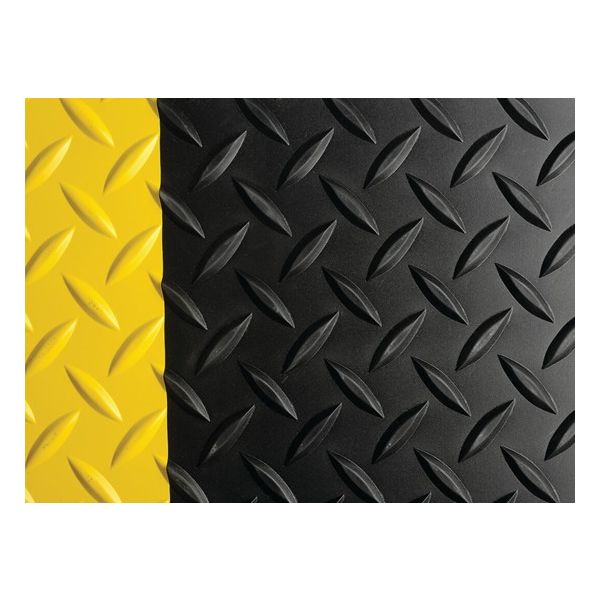
Diamond Plate Vinyl Switchboard Matting With Black and Yellow Safety Border (ASTM)
Product Number:
#0213VDY
$1,528.00

Have a question? We're here to help!
Description
This is ASTM D178 Type II, Class 2 switchboard matting in a diamond plate finish with a high-visibility yellow safety border. The raised pattern grips in every direction. The yellow edge marks where the protected zone ends. It runs 36 inches wide by 75 feet at 1/4 inch thick, proof tested at 20,000 volts A.C. across the entire roll.
What This Mat Does About the Two Ways Protection Quietly Fails
An insulating mat works by breaking the path between a worker and ground. Stand on it at a live panel and the circuit can't complete. That's the whole mechanism, and it's reliable — as long as two conditions hold that nobody thinks about while they're working.
The first is footing. Around switchgear people don't walk in straight lines. They pivot to reach a terminal, sidestep past an open cabinet door, plant a foot at an angle they didn't plan. A surface that grips in only one direction is a surface that grips less well in most of those moments.
The second is staying on it. The mat gives no feedback when somebody steps off the edge — a heel lands two inches past it on a dark floor and nothing announces the protection just ended. On black matting against grey concrete under mediocre overhead light, that boundary is genuinely hard to see.
This version addresses both. The diamond pattern is raised in a multidirectional layout, so traction holds no matter how a foot lands. The yellow border puts a visible line at the zone edge, where it registers in peripheral vision without anyone having to look down and check.
Neither of those changes the electrical rating. What they change is how reliably the rating actually applies to the person standing there on an ordinary afternoon.
Why Diamond Plate Plus a Border, and Why Class 2
Start with what doesn't vary. Dielectric strength is 30,000 volts A.C., every roll is proof tested at 20,000 across its full surface, and the maximum recommended use voltage is 17,000. Those figures are identical across every Class 2 mat we carry, whatever the surface or the marking.
The proof test detail is the one worth understanding. Testing runs over the entire surface of every roll rather than sampling sections, because an insulating barrier is only as good as its weakest square inch. Rolls ship single piece, so no splice sits mid-run where the protection changes character.
The vinyl compound is oil resistant and flame resistant. Flame resistance speaks for itself in a room where the equipment is the ignition source. Oil resistance is the quieter one — a compound that absorbs oils and greases can have its barrier degraded from within while the surface still looks perfectly serviceable.
The diamond plate surface is a discrete raised pattern rather than continuous ridges. That gives it two properties corrugation doesn't have: grip that's consistent regardless of approach angle, and no continuous channel for grit and shavings to travel along. On a plant floor that collects debris, the second one matters more than people expect.
The border is a manufacturing feature of the mat, not something applied afterward. It runs along one long edge in yellow against black — one of the highest-contrast pairings the human eye processes, which is why it appears on stair nosings and machine guarding everywhere.
Where It Belongs, and Where It Doesn't
Distribution boards, switchgear, sub-stations, transformers, generators, and electrical workbenches. It sits with the rest of our electrical and switchboard matting, which covers the other type, class, and surface combinations.
This particular combination fits a specific room: one where people move in several directions in a confined space, and where the mat edge would otherwise disappear. Switchgear lineups in dim mechanical spaces. Panel rooms with dark floors. Areas where contractors and other trades pass through and won't recognize an unmarked mat for what it is.
If your space doesn't have both problems, there's a simpler answer. Well-lit dedicated electrical rooms with light floors don't need the border. Long straight benches where traffic runs one direction do fine on corrugated. Buy this version when the room genuinely presents both conditions.
What it is not: an ESD or anti-static mat. Those are conductive by design, built to drain static charge to ground and protect sensitive electronics. This blocks that path entirely. Grounding it would defeat its purpose, and the two are not interchangeable in either direction.
It's also not general-purpose zone marking. Floor tape delineates a walkway for a fraction of the cost. The border here is a feature of an insulating mat, not a reason to put insulating matting where it isn't needed.
And it is not primary protection. De-energizing, verification, protective equipment, and trained procedure come first. This is the layer beneath all of that — the one still working when something else doesn't.
Three Things to Check Before You Spec It
First, confirm Class 2 covers your equipment. The maximum recommended use voltage is 17,000 volts A.C. Find the actual working voltage at each panel rather than assuming, and if anything sits near that ceiling, move up a class instead of working to the edge. Neither the surface pattern nor the border affects the electrical rating in any way.
Second, decide the border orientation before you unroll. The yellow runs along one long edge, so you get one marked side. It belongs facing the open floor — the direction somebody backs into when they step away from the panel or let a colleague past. Walk the space and watch how people actually move before you cut.
Third, plan for a single width. The bordered version comes 36 inches wide. Check that one run gives a worker room to shift, step back, and reach without leaving the mat. If 36 inches isn't enough coverage for your equipment, the unbordered diamond plate goes up to 48 inches — worth weighing which matters more in that particular room.
Why Mats Inc.
Since 1964 we've sold enough of these to know that the mat somebody actually stays on is worth more than the mat with the better spec sheet. This version costs a little more than plain diamond plate and the insulation is identical — what you're buying is a marked edge in a room where the edge would otherwise be invisible. We'll ask about your lighting and your floor color before we quote, because if you don't need the border we'd rather tell you.
| Product Type | Insulating (non-conductive) switchboard matting with safety border |
| Standard | ANSI/ASTM D178, Type II, Class 2 |
| Dielectric Strength | 30,000 volts A.C. |
| Proof Test | 20,000 volts A.C., tested over the entire surface of every roll |
| Recommended Max Use Voltage | 17,000 volts A.C. |
| Material | High-quality vinyl compound, oil resistant and flame resistant |
| Surface | Textured diamond plate |
| Color | Black with yellow safety border |
| Border | Yellow safety border along one long edge |
| Size | 36 inch width x 75 ft. length x 1/4 inch thickness |
| Roll Weight | 350 lb. |
| Roll Supply | Full rolls only, single piece |
| Recommended For | Distribution boards, switchgear, sub-stations, transformers, generators, electrical workbenches |
| Static Control | None — this is an insulator, not an ESD or anti-static product |
| Warranty | 1-year limited (Mats Inc.) |
Frequently Asked Questions
Does the border or the diamond pattern change the electrical protection?
Neither one does. Dielectric strength is 30,000 volts A.C., proof testing runs at 20,000 across the entire surface of every roll, and the maximum recommended use voltage is 17,000 — the same figures as every other Class 2 mat, whatever the surface or the marking.
Both features solve human problems rather than electrical ones. The diamond pattern addresses footing, so grip holds no matter which direction someone plants a foot. The border addresses awareness, so people know where the protected zone ends. The insulation is the vinyl compound and its thickness, and that's identical across the range. Choose on the room; the rating comes along regardless. — Dustin Thompson, Owner & CEO, Mats Inc.
What are the ratings, and what do oil and flame resistance get me?
Class 2 gives you 30,000 volts A.C. dielectric strength, a 20,000 volt A.C. proof test on every roll, and a maximum recommended use voltage of 17,000. Work to 17,000. The margin above it is engineered for real conditions, not headroom you're meant to spend.
The proof test method matters as much as the number: testing covers the entire surface of every roll rather than sampling sections, because a barrier is only as good as its weakest square inch. On the compound, flame resistance is straightforward in a room where the equipment itself is an ignition risk. Oil resistance is the one people underrate — floors around panels collect oils and greases, and a material that absorbs them can degrade from the inside while the surface still looks fine. That's what keeps it performing in year four rather than only on day one. — Dustin Thompson, Owner & CEO, Mats Inc.
Which way should the border face, and does it need grounding or fastening?
The yellow runs along one long edge, so you get a single marked side and one chance to place it correctly. Face it toward the open floor — the direction people step when they back away from a panel or move aside for someone. Watch how the space is actually used before you cut and lay it.
On grounding: no, and this one deserves bluntness. Grounding an insulating mat destroys its entire function, because the mechanism is that no path runs from the worker through the floor to ground. Anyone accustomed to ESD matting may reach for a ground cord from habit, and here that habit is dangerous. On fastening, it's meant to lie loose so you can lift it, inspect underneath, and replace it without demolition — and adhesives or fasteners can puncture or contaminate the barrier. Let it relax flat after unrolling, then cut with a sharp blade against a straightedge. — Dustin Thompson, Owner & CEO, Mats Inc.
What size does it come in, and how much do I need?
One size for the bordered version: 36 inches wide by 75 feet long at 1/4 inch thick, sold as a full single-piece roll. It weighs 350 pounds, so plan on two people and equipment to move it, and think about where it lands on the dock and how it reaches the room.
For quantity, work equipment by equipment rather than room by room. Measure the width of each panel or bench, add margin on both sides so a worker never runs out of mat when they shift or step back, and total those lengths. Seventy-five feet usually covers several pieces of equipment once it's cut. One thing to weigh: if 36 inches doesn't give enough depth for how far people step back at your equipment, the unbordered diamond plate goes to 48 inches. Send us the layout and we'll help you decide. — Jinna Hopson, Vice President of Marketing, Mats Inc.
What does it look like installed?
Black with a raised diamond pattern and a yellow stripe down one long edge. The diamond plate reads as industrial equipment — the same visual language as a stair tread or a truck bed — which is the right register for an electrical room. Underfoot it's low and broad rather than aggressive, so it grips without feeling like standing on texture.
The border is what changes the room. From across a floor, a yellow-edged mat reads immediately as a designated zone rather than as a piece of dark flooring, which keeps foot traffic clear while work is underway and stops people treating it as ordinary matting. Up close it works peripherally — somebody focused on a terminal block isn't looking down, but a strong contrast line still registers at the edge of vision when a foot approaches it. — Jinna Hopson, Vice President of Marketing, Mats Inc.
How do I choose between the four Class 2 options?
All four carry identical electrical protection, so this is entirely a fit decision. Two questions settle it. First, do people move in multiple directions around the equipment, or along a single line? Multidirectional movement points to diamond plate; long straight runs along a bench or wall suit corrugated, where the ridges sit across the path of travel.
Second, would the mat edge be visible in that room's real lighting? Stand in the space at the hour the work happens. Against a dark floor in a dim mechanical room, a plain black mat edge disappears and the border earns its place. In a bright, dedicated electrical room with a light floor and only trained staff, it doesn't. This product is the answer when both conditions point the same way — multidirectional movement and a hard-to-see edge. Describe the room to us and we'll tell you which of the four we'd put in it. — Jinna Hopson, Vice President of Marketing, Mats Inc.
Written by Jinna Hopson, Vice President of Marketing, Mats Inc.
Reviews
Write Your Own Review
Related Products
Super Scrape Rubber Mats
Safety Track Non-Skid Tape - Coarse

Smooth Marbleized Vinyl Switchboard Matting (Mil Spec)
Super Scrape Rubber Logo Mats

Strip Doors
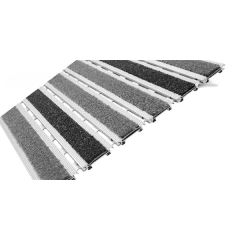
Perfec Clean 3/8" Rollup Mats - Aluminum Hinge
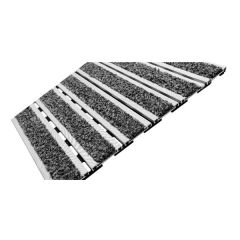
Perfec Clean 3/8" Rollup Mats - Rubber Hinge
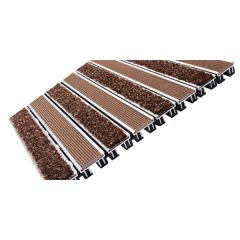
Perfec Clean 3/4" Rollup Grate - Rubber Hinge
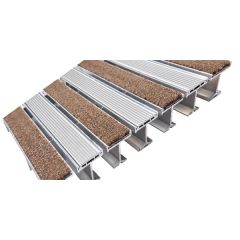
Perfec Clean 1-5/8" Grate

WP-70 Non-Skid Epoxy Coating