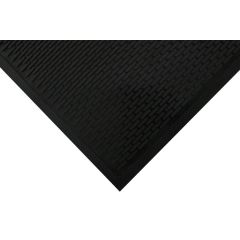
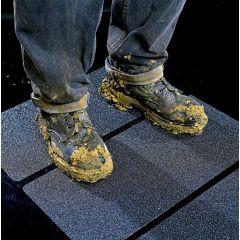
TredLok is an interlocking PVC floor tile with a three-bar checker-plate face — the same surface language as the steel plate on a truck bed or a stair landing. It looks like a working floor because it is one.
Tiles are 18" x 18" and 9/16" thick. They lock together at the edges, lie loose over concrete with no adhesive, and cut to fit with a utility knife. When a section takes damage, that tile lifts out and a new one drops in.
Built for Floors That Get Worked On
A shop floor collects marks. Scuffs from boots, drag marks from equipment, dropped tools, tire tracks where something got wheeled in. On a smooth floor every one of those shows. Six months in, a surface that looked sharp on day one looks tired.
The three-bar checker-plate pattern breaks that up. The raised bars run in alternating groups across the face, so the surface already has visual texture and marks disappear into it rather than sitting on top of it. A floor that gets used hard stays presentable considerably longer.
That pattern is doing mechanical work too. The raised bars give grip underfoot, and the surface is hard-wearing and slip resistant — useful on a floor that sees spills, wet boots, and traffic in both directions.
What the Tile Protects Underneath
Concrete absorbs what lands on it. Oil, brake fluid, solvents, and road salt all soak into a porous slab and stay there. Stains do not come out, and salt working into the surface causes spalling and dust. Sealing slows it down but has to be redone, which means emptying the room.
The tile is non-porous flexible PVC — not a coating over an absorbent core, but the same material all the way through. There is no surface layer to wear off and expose something underneath. It resists most oils and acids, and it takes extreme temperatures without going brittle or soft.
A spill sits on top until someone mops it. The slab stays clean, which matters in a leased bay you eventually hand back, and it matters in any space where a stained floor is a problem for the people who use it.
How It Goes Down and How It Comes Up
The edges are a jigsaw profile that locks tile to tile without adhesive or fasteners. Nothing bonds to the slab, so the floor covers large areas quickly and one or two people can lay a room without specialist tools.
Matching ramped edging finishes the perimeter, supplied in male and female profiles in 1'8" lengths, in black or yellow. That ramp removes the trip point at an open floor line and gives wheeled traffic a clean transition onto the floor. Yellow edging doubles as a visible boundary marking an aisle or a work zone.
Because nothing is glued, individual tiles lift for cleaning underneath, and the whole floor can be taken up and relaid somewhere else. That makes it a real option for temporary floor protection — cover a space for a job or a season, then lift it and move on.
The tile is also fully compatible with wheelchairs, strollers, and shopping carts, which matters anywhere the public crosses the floor.
Where It Belongs, and What It Is Not
Workshops, service and repair bays, tool rooms, equipment stores, work stations, storage areas, locker rooms, and gym and fitness spaces. It is one of the interlocking options in our garage flooring range, and the same tile works unchanged in a locker room or a weight room.
The reason shifts by room. In a workshop it is chemical resistance and the lift-out repair. In a gym it is shock absorption and reduced noise transfer to spaces below or next door. In a locker room it is the non-porous surface and the fact that a damp mop is the whole maintenance routine.
What it is not: a lifting platform. It absorbs impact, but loaded barbells dropped from height need a purpose-built platform in that spot, with the tile handling the rest of the room. It is not an outdoor product either — the recycled black tile carries no rated UV stability, so a sun-exposed installation is a conversation to have before ordering.
And if the actual problem is one leaking vehicle or one person standing in one place all shift, a containment mat or an anti-fatigue mat solves it for less. Tiling a room to fix a single spot is overbuying.
Three Things to Check Before You Spec It
First, look at the slab. The tiles lie loose and follow the floor underneath, bridging small imperfections but not correcting a badly humped or dished surface. Grind or level anything significant before you start, and make sure the concrete is clean and dry on the day.
Second, decide where color goes before you order. Rubber tires can permanently stain light-colored vinyl — a reaction between the antioxidant in some tire compounds and the plasticizer in the tile — and it does not clean off. Black and gray are unaffected. Put those anywhere vehicles park and use color for walkways, work zones, and borders.
Third, order the whole floor at once. Color is matched within a single production batch, and a run ordered later is not guaranteed to match what is already down. Work out your full square footage, add roughly ten percent for cuts and spares, and order it together. Those spares are your repair stock, and they are why a damaged tile is a five-minute job.
Why Mats Inc.
We have specified commercial flooring since 1964, and what we bring to a job like this is knowing where it goes wrong. Batch matching, the tire staining rule, the spreader plate that belongs under a jack stand — none of it is printed on a spec sheet, and all of it decides whether the floor still looks right in two years.
We will also tell you when this is not the product you need. A mat at one station often beats a tiled room, and getting the job sized right matters more to us than the square footage on the order.
| Material | Flexible polyvinyl chloride (PVC), non-porous |
| Surface pattern | Three-bar checker plate |
| Thickness | 9/16" (14mm), tolerance ± 0.5" |
| Tile size | 18" x 18" nominal, tolerance ± 1/2" |
| Weight | 1.4 lb per sq ft |
| Colors | Black and gray stock; other colors to order |
| Edging | Ramped male and female strips, 1/2" x 2" x 1'8", black or yellow |
| Chemical resistance | Resistant to most oils and acids |
| Acoustic | Sound absorbing; reduces noise transfer |
| Recycled content | Black made from 100% recycled material; fully recyclable |
| Installation | Loose lay, interlocking; no adhesive or special tools |
| Warranty | 1-year limited (Mats Inc.) |
Frequently Asked Questions
What is the checker-plate surface actually made of?
Answered by Dustin Thompson, Owner and CEO
Flexible PVC, and the pattern is molded into the tile rather than applied to it. The material is non-porous throughout, so there is no top layer that can wear away and expose an absorbent core underneath. That is what makes the chemical resistance hold up over years rather than months.
Black tiles are made entirely from recycled material that would have gone to landfill, and every color is recyclable again at end of life. The performance is the same across colors — the recycled content is specific to black.
How long does a floor like this last, and what shortens it?
Answered by Dustin Thompson, Owner and CEO
We will not put a number of years on it, because the tile is rarely what fails. What ends these floors early is point-load damage where a jack stand or a heavy leg sits without a spreader plate, permanent tire staining on lighter colors, and sun exposure in an open bay, since the recycled black tile has no rated UV stability.
The structural advantage is that damage stays in one tile. A room with spare tiles on a shelf keeps running indefinitely, because every failure is a swap rather than a replacement floor.
Does it need adhesive, and can it be taken up later?
Answered by Dustin Thompson, Owner and CEO
No adhesive, no fasteners, no special tools. The tiles interlock and lie loose on the slab, which means a room goes down fast and comes back up just as easily. Trimming at walls, posts, and thresholds is done with a sharp utility knife and a straightedge as you lay.
Because nothing bonds to the concrete, the floor is genuinely portable. Individual tiles lift for cleaning underneath, and the whole installation can be taken up and relaid in another space — which is why it works for temporary protection as well as permanent floors.
How do I work out how many tiles I need?
Answered by Jinna Hopson, Vice President of Marketing
Each tile covers 18" x 18", so four tiles make up about nine square feet. Take your room's length and width, get the square footage, and divide by 2.25 for a tile count.
Add roughly ten percent on top. That absorbs the waste from cutting around walls and obstacles and leaves you holding spares. Buy those spares in the same order rather than later — colors are matched within one production batch, and a later batch may not match the floor you already have down.
What does checker plate look like in a finished space?
Answered by Jinna Hopson, Vice President of Marketing
Industrial, and deliberately so. It borrows the look of steel plate, so a room reads as a working space rather than a showroom. In a workshop, a service bay, or a gym that is the point — the floor matches what happens on it instead of looking too precious for the job.
The practical bonus is that the busy pattern hides wear. Scuffs and marks that would stand out on a smooth surface get absorbed into the texture, so the floor holds its appearance in a space that takes daily use. If you want something that reads cleaner and more finished, the coin pattern is the alternative — same tile underneath, different face.
Can I use more than one color, or mark out zones on the floor?
Answered by Jinna Hopson, Vice President of Marketing
Yes, and you can do a lot with the two stock colors before ordering anything custom. Blocks of black against gray mark a walkway apart from a parking bay, or set a workbench area off from the rest of the room. Other colors are available to order — call us for a quote on anything beyond black and gray.
The yellow ramped edging is the most useful zoning tool here. It frames an aisle or a work area as a clear visible boundary while solving the trip point at the same time. Just keep the staining rule in mind: darker tiles wherever vehicles park, color where people walk.
By Jinna Hopson, Vice President of Marketing, Mats Inc.