




- Home
- Products
- Stair Treads, Risers, Landing Tiles & Adhesives
- Exterior Treads
Outdoor Non-Slip Stair Treads
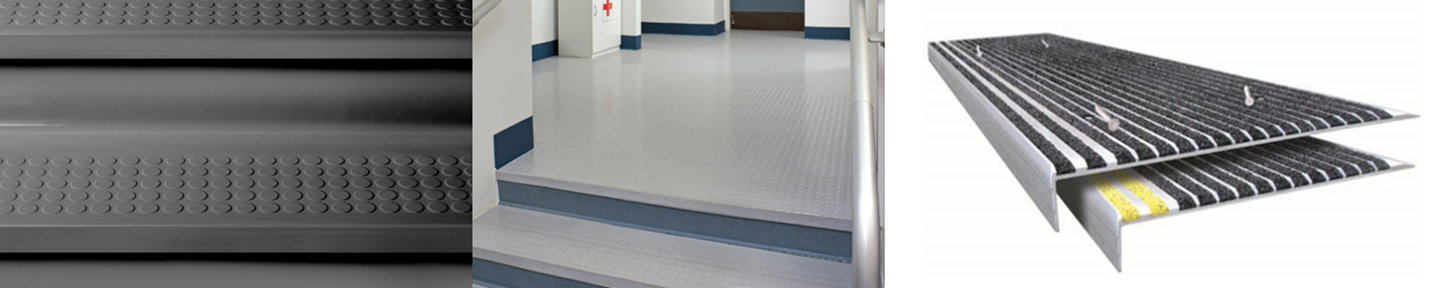
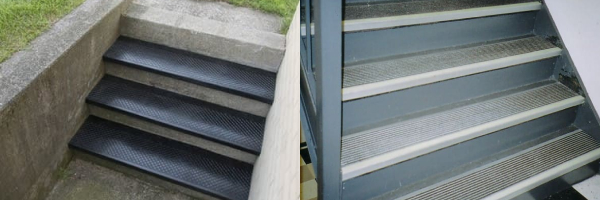
Outdoor non-slip stair treads have a harder job than anything on an indoor stair. Rain, ice, salt, and mud hit them every season, and the step underneath is usually concrete that has already started to wear. This range covers the main answers: Renovation Stair Treads for worn concrete steps, the Rubber Outdoor Stair Tread for busy entrances and arenas, and Ladder Rung Covers for the fixed ladders that sit beside so many exterior stairs.
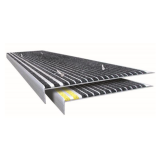 Renovation Stair Treads
Starting at $168.00
What a non-slip stair tread does before a worn step becomes an incident Stairs do not fail all at once. The nose rounds off, the walking surface polishes smooth under thousands of footfalls, and a step that once had grip turns into a slick edge people trust without looking. Non...
What a non-slip stair tread does before a worn step becomes an incident Stairs do not fail all at once....
What a non-slip stair tread does before a worn step becomes an incident
Stairs do not fail all at once. The nose rounds off, the walking surface polishes smooth under thousands of footfalls, and a step that once had grip turns into a slick edge people trust without looking. Non slip stair treads cover that surface with a hard abrasive face, putting traction back exactly where a foot lands and body weight shifts forward.
These are stair tread covers, not replacement steps. The tread fastens down over the step already in place. The abrasive face does the gripping, and the aluminum body underneath carries traffic and shields the nose from further wear. Nothing structural comes out, and the stairway stays in service through the work.
The descent is where the risk concentrates. A person going down a flight commits weight to the front third of each step, and that is the first area to wear smooth and the last area anyone inspects. A tread with a formed nose puts the grip surface over the edge itself rather than stopping short of it.
Traction is a measurable property, not an impression. The National Floor Safety Institute maintains ANSI/NFSI B101.1, the standard method for measuring wet traction on walking surfaces, which is the framework facility teams use when they audit a stairway rather than guess at it.
Why extruded aluminum with abrasive filler, and why this profile
The base is 6063-T5 extruded aluminum, heat treated and corrosion resistant. Extrusion matters here because it produces a consistent cross section along the full length of the tread, so the nose geometry and the filler channels are identical from one end of an 8-foot run to the other. There are no welds and no fasteners fighting a rolled or stamped shape.
The anti-slip surface is not a coating sitting on top of the metal. It is a filler packed into channels in the extrusion, and the specification calls for no less than 65% virgin grain aluminum oxide and silicon carbide abrasive. That is a mineral hardness argument: the grit outlasts the shoe leather and grit tracked across it rather than polishing under it.
Color runs uniformly through the filler instead of sitting on the surface as paint. Practically, that means the center of the stair, where every person walks, does not turn into a faded stripe against untouched edges after a season of traffic. Eleven standard colors are available, and black is supplied when no color is specified on the order.
The profile is what separates this tread from a flat plate. It measures 11 inches deep and 9/32 of an inch thick, with a 1-1/8 inch nose on the underside and a beveled back edge. The nose wraps the leading edge of the existing step. The beveled back lets the tread sit down against the step without creating a lip that catches a toe on the way up.
The assembly is noncombustible, tested under Federal Test Method Standard No. 501a, Method 6411 — a specification line that matters in stairwells serving as means of egress, where combustibility of applied finishes gets asked about during review.
Where it belongs, and where it is not the answer
This tread is built for renovation. It goes over stairs that already exist and have worn out, polished up, or were never slip resistant to begin with: concrete stairs in a parking structure, terrazzo in a school building, steel pan stairs in a plant, tile landings in a lobby, wood stairs in an older building.
It works interior and exterior. Outdoors, the corrosion-resistant aluminum handles weather and the abrasive face keeps working when the surface is wet — which is why it reads as a strong fit among exterior stair treads on loading docks, entry steps, and stairs exposed to freeze-thaw cycling. A special tread sealer is available for wood substrates and saltwater exposure.
Where it is not the answer: this is not a decorative finish tread and it is not carpet. It is also not the right call on a step whose structure is failing. If the concrete is spalling or a wood stringer is soft, the tread will fasten to a substrate that cannot hold an anchor, and the repair belongs before the tread, not under it.
It is also not a landing solution on its own. An 11-inch depth covers a stair tread, not a landing surface, so landings usually need a tile or a wider covering handled separately. The tread's job is the step; think of it as one component of the stairway package rather than the whole of it.
Three Things to Check Before You Spec It
First, confirm exposure and traffic. Interior and exterior are both in scope, but exterior stairs and stairs seeing constant traffic are where the abrasive content earns its keep. If the stair is exposed to saltwater or is being installed over wood, ask about the tread sealer at the time of order rather than after installation, because it is applied as part of the job.
Second, measure the step, not the stairway. You need the depth of the existing tread and the run length of each step, because lengths are made to order. Maximum length is 8 feet in a single section, and anything longer is supplied in equal sections. Decide up front whether treads run the full width less 1/8 inch of clearance, or terminate 4 inches short of each end — the short termination leaves a channel that is easier to clean out.
Third, settle the substrate and the anchor. Anchor type has to be specified on the order: Tapcons, wood screws, machine screws, or screws with expansion shields, depending on whether you are fastening into concrete, wood, or steel. Dished or worn steps need leveling compound troweled to a feather edge first, and smooth surfaces such as marble, terrazzo, or tile have to be roughed up so adhesive grabs. Drilled and countersunk holes come standard.
Why Mats Inc.
Stair treads get ordered wrong more often than almost anything else we sell, because the person measuring is rarely the person specifying the anchor. We take the step dimensions, the substrate, and the exposure together, and we confirm the length breakdown before anything gets cut, so a stairwell does not end up with a run of treads that are 3 inches short at the top landing. Sixty years of shipping into commercial and industrial jobs is most of what that judgment is built on.
Renovation Stair Treads — Specifications Base material 6063-T5 extruded aluminum, heat treated and corrosion resistant Anti-slip surface Abrasive filler, not less than 65% virgin grain aluminum oxide / silicon carbide Tread depth 11" Thickness 9/32" Nose 1-1/8" underside, beveled back End treatment Beveled or square ends Lengths Made to order; 8'0" maximum in one section (longer runs supplied in equal sections) Color 11 standard colors; color extends uniformly through the filler; black supplied if none specified Two-tone option Contrasting color available on the first two ribs Fire performance Noncombustible per Federal Test Method Standard No. 501a, Method 6411 Anchoring Drilled and countersunk holes standard; Tapcons, wood screws, machine screws, or screws with expansion shields (anchor type specified at order) Installation Construction adhesive plus mechanical fasteners over prepared, level substrate Application Interior and exterior stair renovation Warranty 1-year limited (Mats Inc.) Frequently Asked Questions
What are these stair treads actually made of?
Answered by Dustin Thompson, Owner & CEO, Mats Inc.
The body is 6063-T5 extruded aluminum, heat treated and corrosion resistant. The gripping surface is a separate abrasive filler packed into channels formed into that extrusion, specified at no less than 65% virgin grain aluminum oxide and silicon carbide. Those two minerals sit near the top of the hardness scale, which is the whole point — grit tracked in on boots does not polish them down.
The distinction that matters is filler versus coating. A painted or sprayed anti-slip surface wears through and exposes bare substrate. Here the abrasive is a body of material with real depth to it, held in a metal channel. When people ask why the tread is 9/32 of an inch thick rather than a thin plate, that thickness is what makes room for the abrasive to have somewhere to go.
How well do they hold up under constant foot traffic?
Answered by Dustin Thompson, Owner & CEO, Mats Inc.
Durability here comes from three specific things rather than a general claim. The abrasive content is a minimum of 65% virgin grain aluminum oxide and silicon carbide. The base is heat-treated 6063-T5 aluminum, so it does not deform under point loads the way a soft metal would. And the color is carried through the filler, so wear does not show up first as a bleached path down the middle of the stairway.
The failure mode we see on these is almost never the tread surface. It is the fastening. A tread installed with adhesive and mechanical anchors into a properly leveled step stays put. A tread set on a dished step without leveling compound rocks under traffic, works the anchors loose, and gets blamed on the product. Our warranty is 1-year limited.
Can these go on outdoor concrete steps, or are they indoor only?
Answered by Dustin Thompson, Owner & CEO, Mats Inc.
They are specified for both interior and exterior stair renovation, and outdoor concrete is one of the most common applications we ship into. The aluminum is corrosion resistant, the abrasive face keeps working wet, and there is nothing in the assembly that absorbs water and freezes. Parking garage stairs, dock steps, and exterior entry stairs are all in scope.
Two things to raise before you order for an outdoor job. If the stair is near saltwater, ask for the tread sealer — it is applied at installation, not after. And if the concrete is spalling or the nose has broken away, that gets patched and leveled first. The tread needs a sound step to anchor into; it restores the walking surface, it does not rebuild the step.
How do I measure my stairs and order the right lengths?
Answered by Jinna Hopson, Vice President of Marketing, Mats Inc.
Two measurements per stairway: the depth of the existing tread front to back, and the width of the step from stringer to stringer. Depth tells us whether the 11-inch profile fits your step. Width sets the cut length, and lengths are made to order rather than pulled from stock sizes, so you are not forced into a standard that leaves a gap.
Maximum length is 8 feet in one continuous section. Anything wider than that comes in equal sections rather than one long piece and one stub, which looks deliberate instead of patched. You will also want to decide whether treads run the full width of the step less 1/8 inch of clearance, or stop 4 inches short of each end. The short termination is the easier one to keep clean in a stairwell that gets mopped.
Will the color fade or wear off where people walk?
Answered by Jinna Hopson, Vice President of Marketing, Mats Inc.
No, and that is a deliberate design choice rather than a coating quality. The color extends uniformly through the abrasive filler, so as the surface wears the exposed material is the same color as what was there originally. A stairway does not end up with a pale traffic lane down the middle and saturated color at the untouched edges, which is exactly how a painted or coated stair ages.
There are eleven standard colors, and if no color is specified on the order, black is what ships. For property managers matching an existing palette across a building, that range is usually enough to land close on a stairwell without a custom run.
Can I get a contrasting nose so the step edge stands out?
Answered by Jinna Hopson, Vice President of Marketing, Mats Inc.
Yes. A two-tone tread with a contrasting color on the first two ribs is available, and it is worth asking about on almost any public stairway. A high-contrast leading edge makes the boundary between one step and the next legible to someone descending quickly, in low light, or with reduced vision. Safety yellow against a dark body is the combination most people picture, but the contrast can be built from any of the standard colors.
It also gives you a design lever in a lobby or an entry stair where a stripe of tape would look like a temporary fix. Because the contrast comes from filler color rather than an applied marking, it wears at the same rate as the rest of the tread and does not peel at the nose. Specify the two-tone at the time of order — it is not something added after the treads are made.
Written by Dustin Thompson, Owner & CEO, Mats Inc.
↑
What a non-slip stair tread does before a worn step becomes an incident
Stairs do not fail all at once. The nose rounds off, the walking surface polishes smooth under thousands of footfalls, and a step that once had grip turns into a slick edge people trust without looking. Non slip stair treads cover that surface with a hard abrasive face, putting traction back exactly where a foot lands and body weight shifts forward.
These are stair tread covers, not replacement steps. The tread fastens down over the step already in place. The abrasive face does the gripping, and the aluminum body underneath carries traffic and shields the nose from further wear. Nothing structural comes out, and the stairway stays in service through the work.
The descent is where the risk concentrates. A person going down a flight commits weight to the front third of each step, and that is the first area to wear smooth and the last area anyone inspects. A tread with a formed nose puts the grip surface over the edge itself rather than stopping short of it.
Traction is a measurable property, not an impression. The National Floor Safety Institute maintains ANSI/NFSI B101.1, the standard method for measuring wet traction on walking surfaces, which is the framework facility teams use when they audit a stairway rather than guess at it.
Why extruded aluminum with abrasive filler, and why this profile
The base is 6063-T5 extruded aluminum, heat treated and corrosion resistant. Extrusion matters here because it produces a consistent cross section along the full length of the tread, so the nose geometry and the filler channels are identical from one end of an 8-foot run to the other. There are no welds and no fasteners fighting a rolled or stamped shape.
The anti-slip surface is not a coating sitting on top of the metal. It is a filler packed into channels in the extrusion, and the specification calls for no less than 65% virgin grain aluminum oxide and silicon carbide abrasive. That is a mineral hardness argument: the grit outlasts the shoe leather and grit tracked across it rather than polishing under it.
Color runs uniformly through the filler instead of sitting on the surface as paint. Practically, that means the center of the stair, where every person walks, does not turn into a faded stripe against untouched edges after a season of traffic. Eleven standard colors are available, and black is supplied when no color is specified on the order.
The profile is what separates this tread from a flat plate. It measures 11 inches deep and 9/32 of an inch thick, with a 1-1/8 inch nose on the underside and a beveled back edge. The nose wraps the leading edge of the existing step. The beveled back lets the tread sit down against the step without creating a lip that catches a toe on the way up.
The assembly is noncombustible, tested under Federal Test Method Standard No. 501a, Method 6411 — a specification line that matters in stairwells serving as means of egress, where combustibility of applied finishes gets asked about during review.
Where it belongs, and where it is not the answer
This tread is built for renovation. It goes over stairs that already exist and have worn out, polished up, or were never slip resistant to begin with: concrete stairs in a parking structure, terrazzo in a school building, steel pan stairs in a plant, tile landings in a lobby, wood stairs in an older building.
It works interior and exterior. Outdoors, the corrosion-resistant aluminum handles weather and the abrasive face keeps working when the surface is wet — which is why it reads as a strong fit among exterior stair treads on loading docks, entry steps, and stairs exposed to freeze-thaw cycling. A special tread sealer is available for wood substrates and saltwater exposure.
Where it is not the answer: this is not a decorative finish tread and it is not carpet. It is also not the right call on a step whose structure is failing. If the concrete is spalling or a wood stringer is soft, the tread will fasten to a substrate that cannot hold an anchor, and the repair belongs before the tread, not under it.
It is also not a landing solution on its own. An 11-inch depth covers a stair tread, not a landing surface, so landings usually need a tile or a wider covering handled separately. The tread's job is the step; think of it as one component of the stairway package rather than the whole of it.
Three Things to Check Before You Spec It
First, confirm exposure and traffic. Interior and exterior are both in scope, but exterior stairs and stairs seeing constant traffic are where the abrasive content earns its keep. If the stair is exposed to saltwater or is being installed over wood, ask about the tread sealer at the time of order rather than after installation, because it is applied as part of the job.
Second, measure the step, not the stairway. You need the depth of the existing tread and the run length of each step, because lengths are made to order. Maximum length is 8 feet in a single section, and anything longer is supplied in equal sections. Decide up front whether treads run the full width less 1/8 inch of clearance, or terminate 4 inches short of each end — the short termination leaves a channel that is easier to clean out.
Third, settle the substrate and the anchor. Anchor type has to be specified on the order: Tapcons, wood screws, machine screws, or screws with expansion shields, depending on whether you are fastening into concrete, wood, or steel. Dished or worn steps need leveling compound troweled to a feather edge first, and smooth surfaces such as marble, terrazzo, or tile have to be roughed up so adhesive grabs. Drilled and countersunk holes come standard.
Why Mats Inc.
Stair treads get ordered wrong more often than almost anything else we sell, because the person measuring is rarely the person specifying the anchor. We take the step dimensions, the substrate, and the exposure together, and we confirm the length breakdown before anything gets cut, so a stairwell does not end up with a run of treads that are 3 inches short at the top landing. Sixty years of shipping into commercial and industrial jobs is most of what that judgment is built on.
Renovation Stair Treads — Specifications Base material 6063-T5 extruded aluminum, heat treated and corrosion resistant Anti-slip surface Abrasive filler, not less than 65% virgin grain aluminum oxide / silicon carbide Tread depth 11" Thickness 9/32" Nose 1-1/8" underside, beveled back End treatment Beveled or square ends Lengths Made to order; 8'0" maximum in one section (longer runs supplied in equal sections) Color 11 standard colors; color extends uniformly through the filler; black supplied if none specified Two-tone option Contrasting color available on the first two ribs Fire performance Noncombustible per Federal Test Method Standard No. 501a, Method 6411 Anchoring Drilled and countersunk holes standard; Tapcons, wood screws, machine screws, or screws with expansion shields (anchor type specified at order) Installation Construction adhesive plus mechanical fasteners over prepared, level substrate Application Interior and exterior stair renovation Warranty 1-year limited (Mats Inc.) Frequently Asked Questions
What are these stair treads actually made of?
Answered by Dustin Thompson, Owner & CEO, Mats Inc.
The body is 6063-T5 extruded aluminum, heat treated and corrosion resistant. The gripping surface is a separate abrasive filler packed into channels formed into that extrusion, specified at no less than 65% virgin grain aluminum oxide and silicon carbide. Those two minerals sit near the top of the hardness scale, which is the whole point — grit tracked in on boots does not polish them down.
The distinction that matters is filler versus coating. A painted or sprayed anti-slip surface wears through and exposes bare substrate. Here the abrasive is a body of material with real depth to it, held in a metal channel. When people ask why the tread is 9/32 of an inch thick rather than a thin plate, that thickness is what makes room for the abrasive to have somewhere to go.
How well do they hold up under constant foot traffic?
Answered by Dustin Thompson, Owner & CEO, Mats Inc.
Durability here comes from three specific things rather than a general claim. The abrasive content is a minimum of 65% virgin grain aluminum oxide and silicon carbide. The base is heat-treated 6063-T5 aluminum, so it does not deform under point loads the way a soft metal would. And the color is carried through the filler, so wear does not show up first as a bleached path down the middle of the stairway.
The failure mode we see on these is almost never the tread surface. It is the fastening. A tread installed with adhesive and mechanical anchors into a properly leveled step stays put. A tread set on a dished step without leveling compound rocks under traffic, works the anchors loose, and gets blamed on the product. Our warranty is 1-year limited.
Can these go on outdoor concrete steps, or are they indoor only?
Answered by Dustin Thompson, Owner & CEO, Mats Inc.
They are specified for both interior and exterior stair renovation, and outdoor concrete is one of the most common applications we ship into. The aluminum is corrosion resistant, the abrasive face keeps working wet, and there is nothing in the assembly that absorbs water and freezes. Parking garage stairs, dock steps, and exterior entry stairs are all in scope.
Two things to raise before you order for an outdoor job. If the stair is near saltwater, ask for the tread sealer — it is applied at installation, not after. And if the concrete is spalling or the nose has broken away, that gets patched and leveled first. The tread needs a sound step to anchor into; it restores the walking surface, it does not rebuild the step.
How do I measure my stairs and order the right lengths?
Answered by Jinna Hopson, Vice President of Marketing, Mats Inc.
Two measurements per stairway: the depth of the existing tread front to back, and the width of the step from stringer to stringer. Depth tells us whether the 11-inch profile fits your step. Width sets the cut length, and lengths are made to order rather than pulled from stock sizes, so you are not forced into a standard that leaves a gap.
Maximum length is 8 feet in one continuous section. Anything wider than that comes in equal sections rather than one long piece and one stub, which looks deliberate instead of patched. You will also want to decide whether treads run the full width of the step less 1/8 inch of clearance, or stop 4 inches short of each end. The short termination is the easier one to keep clean in a stairwell that gets mopped.
Will the color fade or wear off where people walk?
Answered by Jinna Hopson, Vice President of Marketing, Mats Inc.
No, and that is a deliberate design choice rather than a coating quality. The color extends uniformly through the abrasive filler, so as the surface wears the exposed material is the same color as what was there originally. A stairway does not end up with a pale traffic lane down the middle and saturated color at the untouched edges, which is exactly how a painted or coated stair ages.
There are eleven standard colors, and if no color is specified on the order, black is what ships. For property managers matching an existing palette across a building, that range is usually enough to land close on a stairwell without a custom run.
Can I get a contrasting nose so the step edge stands out?
Answered by Jinna Hopson, Vice President of Marketing, Mats Inc.
Yes. A two-tone tread with a contrasting color on the first two ribs is available, and it is worth asking about on almost any public stairway. A high-contrast leading edge makes the boundary between one step and the next legible to someone descending quickly, in low light, or with reduced vision. Safety yellow against a dark body is the combination most people picture, but the contrast can be built from any of the standard colors.
It also gives you a design lever in a lobby or an entry stair where a stripe of tape would look like a temporary fix. Because the contrast comes from filler color rather than an applied marking, it wears at the same rate as the rest of the tread and does not peel at the nose. Specify the two-tone at the time of order — it is not something added after the treads are made.
Written by Dustin Thompson, Owner & CEO, Mats Inc.
↑
View Details
View Details
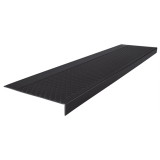 Rubber Outdoor Stair Tread$77.00What an outdoor rubber stair tread does before an exterior step turns slick Outdoor steps fail on a weather cycle, not a traffic cycle. Rain sits on a smooth surface and turns it into a slide. Freeze-thaw works into the concrete and rounds the leading edge. By the time a
...
What an outdoor rubber stair tread does before an exterior step turns slick Outdoor steps fail on a weather cycle,...
What an outdoor rubber stair tread does before an exterior step turns slick
Outdoor steps fail on a weather cycle, not a traffic cycle. Rain sits on a smooth surface and turns it into a slide. Freeze-thaw works into the concrete and rounds the leading edge. By the time a step reads as worn, it has usually been slick in bad weather for a season or two already.
Rubber outdoor stair treads cover that surface with a raised diamond pattern. The pattern is doing real work: the raised diamonds carry the load while the channels between them give water somewhere to go, so a shoe contacts high points instead of floating on a film. That is the mechanism behind traction on a wet exterior step.
The square nose wraps the leading edge and drops 1-9/16 inches down the riser face. That matters more outdoors than in, because the nose is where ice forms first, where a foot lands on the way down, and where a concrete step chips and crumbles. Covering it protects the edge and puts grip exactly where the descent commits weight.
The back three inches of the tread are molded smooth rather than patterned. Debris does not pack into a pattern that is not there, so leaves, sand, and ice melt sweep off the back border instead of building up against the riser where they hold moisture.
Why an exterior rubber compound, and why this profile
Most rubber stair treads are built for interior service. Put one outside and the compound is the part that gives up first: it hardens in cold, chalks under sun, and loses its bond when water works under the edge. This tread is molded from a compound formulated specifically for exterior use, which is the whole reason it exists as a separate product.
Thickness runs 3/16 of an inch at the front and tapers to 1/8 inch toward the back. The taper is deliberate. Material sits where impact lands and where a nose takes abuse, and thins out toward the back edge so the tread feathers into the step rather than creating a lip that catches a toe or peels up under a snow shovel.
The tread weighs 2 pounds per linear foot. On a 60-inch step that is roughly 10 pounds of material sitting on a single tread, which is part of why it stays put under freeze-thaw movement instead of curling at the corners the way a thin mat does.
A trim mark is molded into the smooth back border. It gives an installer a reference line to cut against in the field, so a tread can be brought down to a non-standard depth on site without guessing where to run the blade. Standard lengths run 36, 42, 48, 54, 60, and 72 inches, square nose only.
One thing is not optional: this tread bonds with #775 epoxy adhesive. The contact and water-based adhesives used on interior treads are not rated for the moisture and temperature swing an exterior step sees, and substituting one is the most common reason an outdoor tread lifts within a year.
Where it belongs, and where it is not the answer
This is a heavy-traffic exterior tread. The applications it was built around are ice rinks, sports arenas, and high-traffic entryways — places where footwear arrives wet, cold, and often cleated or studded, and where the volume of people through a stairway is high enough that a general-purpose covering does not last.
Beyond that, it earns its place on any stairway where weather and traffic stack up together: building entrances, loading dock steps, stadium and bleacher stairs, exterior egress stairs on parking structures, and concrete steps at service entrances. It fits well alongside other exterior stair treads where the substrate is sound concrete, steel, or wood.
Where it is not the answer: this is not an interior product. Indoors, the color range and adhesive options on interior-rated rubber treads are wider, and there is no reason to give those up. It also comes in black only, so if a design requires a specific stairway color, this is not the tread that delivers it.
It is also not a fix for a failing step. Epoxy needs a sound, clean surface to bond to. Spalling concrete, a crumbled nose, or a soft wood stringer all have to be repaired and leveled first — otherwise the tread bonds to material that is already on its way off the step.
Three Things to Check Before You Spec It
First, confirm the step depth against 12-1/16 inches. That is the depth from the inside of the nose back. If your steps run shallower, the trim mark in the smooth back border is your cut line and the tread comes down cleanly. If your steps run deeper than that, you will have an exposed strip at the back of every step, and the answer is usually a landing tile or riser treatment rather than forcing the tread.
Second, measure step width and map it to the standard lengths. Standard runs are 36, 42, 48, 54, 60, and 72 inches. A tread cut down from the next size up looks intentional; a tread that lands short of the stringer does not, and it leaves an exposed edge where water gets underneath. Work out the length per step before ordering, not per stairway, because exterior stairs are less consistent step to step than interior ones.
Third, plan the substrate prep and the epoxy. The surface has to be clean, sound, and dry when the epoxy goes down, which on an exterior job means watching the forecast and the surface temperature, not just the calendar. Smooth concrete, terrazzo, and steel all need to be roughed up so the epoxy has something to key into. Order the #775 epoxy with the treads so nothing gets substituted on site.
Why Mats Inc.
The mistake we catch most often on exterior stair jobs is an interior tread ordered for an outdoor step, usually because the specs looked close enough on paper. They are not close: different compound, different adhesive, different service life outdoors. We ask where the stair is and what hits it before we quote, and if the answer is weather, we route you to a tread rated for it. Sixty years of shipping into commercial and industrial work is mostly what that habit is built from.
Rubber Outdoor Stair Tread — Specifications Material Rubber, compound formulated for exterior use Surface Raised diamond pattern with 3" smooth back border Depth 12-1/16" nominal from inside of nose Thickness 3/16" tapering to 1/8" Nose Square, 1-9/16" drop, 1/8" thick Standard lengths 36", 42", 48", 54", 60", 72" Weight 2 lbs. per linear foot Color Black Field trimming Trim mark molded into the smooth back border Adhesive #775 epoxy adhesive (required) Application Exterior Warranty 1-year limited (Mats Inc.) Frequently Asked Questions
What makes this different from a standard rubber stair tread?
Answered by Dustin Thompson, Owner & CEO, Mats Inc.
The compound. Interior rubber treads and this one can look similar on a spec sheet, but the rubber itself is mixed for different service. This one is formulated for outdoor exposure, which is why it is the tread we point people to for exterior stairs and why we do not treat an interior tread as a substitute when the price looks close.
The profile is built around the same idea. A raised diamond surface with channels between the diamonds gives water a path off the tread rather than a film to sit on. The back three inches are molded smooth so debris sweeps off instead of packing in. Every one of those choices is answering weather, not foot traffic.
How does it hold up to constant traffic and weather?
Answered by Dustin Thompson, Owner & CEO, Mats Inc.
The material is where it starts. Thickness is 3/16 of an inch at the front, tapering to 1/8 inch at the back, and the tread runs 2 pounds per linear foot. That mass and thickness are concentrated at the nose and the walking area, which is exactly where an exterior step takes impact and abrasion. Ice rinks and arenas are named applications for a reason — that is footwear designed to chew up a surface.
The failure we actually see is almost never the rubber. It is the bond. An exterior tread put down with an interior adhesive lifts at the corners in the first freeze-thaw season, water gets underneath, and it goes downhill from there. Use the #775 epoxy on a clean, dry, sound surface and this stays where you put it. Our warranty is 1-year limited.
What surfaces can it be installed on outdoors?
Answered by Dustin Thompson, Owner & CEO, Mats Inc.
Concrete, steel, and wood all work, provided they are sound and prepared. Smooth surfaces such as troweled concrete, terrazzo, or painted steel need to be roughed up so the epoxy has something to grab. Anything dirty, oily, or damp gets cleaned and dried first — epoxy is unforgiving about what it is asked to stick to.
What it cannot do is compensate for a step that is coming apart. If the concrete is spalling or the nose has broken away, patch and level before the tread goes down. I would also flag surface temperature on exterior work: crews plan around rain but forget that a cold slab slows the epoxy cure, and a tread walked on before it has set will move.
My steps are not a standard size — can these be cut to fit?
Answered by Jinna Hopson, Vice President of Marketing, Mats Inc.
Yes, in both directions, and the tread is designed for it. Depth is 12-1/16 inches measured from the inside of the nose, and there is a trim mark molded into the smooth back border that gives your installer a reference line to cut against. That means a shallower step gets a clean, straight cut instead of a freehand one.
Length works by trimming down from the next standard size up. Standard runs are 36, 42, 48, 54, 60, and 72 inches. Measure each step individually rather than assuming a stairway is consistent — exterior stairs settle and get patched over the years, and it is common to find a half-inch of variation between the top and bottom of a flight.
It only comes in black — is that a problem for a visible entrance?
Answered by Jinna Hopson, Vice President of Marketing, Mats Inc.
Black is the only color, and for most exterior stairways it turns out to be the practical choice anyway. Outdoor steps collect road grit, salt residue, and mud, and a lighter tread shows every bit of it between cleanings. Black reads as finished and intentional at a service entrance or a loading dock rather than looking like a patch.
Where it is worth pausing is a formal front entrance with a specific palette, or a stairway where you want a high-contrast leading edge for visibility. Neither is available here. If that is the requirement, tell us before you order and we will look at what else covers exterior duty, because working around a color limitation after installation is not really possible.
Can I match risers and landings to the treads?
Answered by Jinna Hopson, Vice President of Marketing, Mats Inc.
Partly, and it is worth planning up front rather than discovering it mid-install. This tread covers the step surface and the nose, and the 1-9/16 inch nose drop covers the very top of the riser face. Everything below that on the riser, and any landing at the top or bottom of the flight, is a separate item.
On an exterior stairway most facilities handle the risers with paint or a coating rather than a covering, since the riser face does not take foot traffic and a black tread against a painted riser looks deliberate. Landings are the piece people forget, and a landing at the head of an exterior flight is often the wettest surface in the whole assembly. Bring us the full stairway dimensions and we will work out what covers what.
Written by Dustin Thompson, Owner & CEO, Mats Inc.
↑
What an outdoor rubber stair tread does before an exterior step turns slick
Outdoor steps fail on a weather cycle, not a traffic cycle. Rain sits on a smooth surface and turns it into a slide. Freeze-thaw works into the concrete and rounds the leading edge. By the time a step reads as worn, it has usually been slick in bad weather for a season or two already.
Rubber outdoor stair treads cover that surface with a raised diamond pattern. The pattern is doing real work: the raised diamonds carry the load while the channels between them give water somewhere to go, so a shoe contacts high points instead of floating on a film. That is the mechanism behind traction on a wet exterior step.
The square nose wraps the leading edge and drops 1-9/16 inches down the riser face. That matters more outdoors than in, because the nose is where ice forms first, where a foot lands on the way down, and where a concrete step chips and crumbles. Covering it protects the edge and puts grip exactly where the descent commits weight.
The back three inches of the tread are molded smooth rather than patterned. Debris does not pack into a pattern that is not there, so leaves, sand, and ice melt sweep off the back border instead of building up against the riser where they hold moisture.
Why an exterior rubber compound, and why this profile
Most rubber stair treads are built for interior service. Put one outside and the compound is the part that gives up first: it hardens in cold, chalks under sun, and loses its bond when water works under the edge. This tread is molded from a compound formulated specifically for exterior use, which is the whole reason it exists as a separate product.
Thickness runs 3/16 of an inch at the front and tapers to 1/8 inch toward the back. The taper is deliberate. Material sits where impact lands and where a nose takes abuse, and thins out toward the back edge so the tread feathers into the step rather than creating a lip that catches a toe or peels up under a snow shovel.
The tread weighs 2 pounds per linear foot. On a 60-inch step that is roughly 10 pounds of material sitting on a single tread, which is part of why it stays put under freeze-thaw movement instead of curling at the corners the way a thin mat does.
A trim mark is molded into the smooth back border. It gives an installer a reference line to cut against in the field, so a tread can be brought down to a non-standard depth on site without guessing where to run the blade. Standard lengths run 36, 42, 48, 54, 60, and 72 inches, square nose only.
One thing is not optional: this tread bonds with #775 epoxy adhesive. The contact and water-based adhesives used on interior treads are not rated for the moisture and temperature swing an exterior step sees, and substituting one is the most common reason an outdoor tread lifts within a year.
Where it belongs, and where it is not the answer
This is a heavy-traffic exterior tread. The applications it was built around are ice rinks, sports arenas, and high-traffic entryways — places where footwear arrives wet, cold, and often cleated or studded, and where the volume of people through a stairway is high enough that a general-purpose covering does not last.
Beyond that, it earns its place on any stairway where weather and traffic stack up together: building entrances, loading dock steps, stadium and bleacher stairs, exterior egress stairs on parking structures, and concrete steps at service entrances. It fits well alongside other exterior stair treads where the substrate is sound concrete, steel, or wood.
Where it is not the answer: this is not an interior product. Indoors, the color range and adhesive options on interior-rated rubber treads are wider, and there is no reason to give those up. It also comes in black only, so if a design requires a specific stairway color, this is not the tread that delivers it.
It is also not a fix for a failing step. Epoxy needs a sound, clean surface to bond to. Spalling concrete, a crumbled nose, or a soft wood stringer all have to be repaired and leveled first — otherwise the tread bonds to material that is already on its way off the step.
Three Things to Check Before You Spec It
First, confirm the step depth against 12-1/16 inches. That is the depth from the inside of the nose back. If your steps run shallower, the trim mark in the smooth back border is your cut line and the tread comes down cleanly. If your steps run deeper than that, you will have an exposed strip at the back of every step, and the answer is usually a landing tile or riser treatment rather than forcing the tread.
Second, measure step width and map it to the standard lengths. Standard runs are 36, 42, 48, 54, 60, and 72 inches. A tread cut down from the next size up looks intentional; a tread that lands short of the stringer does not, and it leaves an exposed edge where water gets underneath. Work out the length per step before ordering, not per stairway, because exterior stairs are less consistent step to step than interior ones.
Third, plan the substrate prep and the epoxy. The surface has to be clean, sound, and dry when the epoxy goes down, which on an exterior job means watching the forecast and the surface temperature, not just the calendar. Smooth concrete, terrazzo, and steel all need to be roughed up so the epoxy has something to key into. Order the #775 epoxy with the treads so nothing gets substituted on site.
Why Mats Inc.
The mistake we catch most often on exterior stair jobs is an interior tread ordered for an outdoor step, usually because the specs looked close enough on paper. They are not close: different compound, different adhesive, different service life outdoors. We ask where the stair is and what hits it before we quote, and if the answer is weather, we route you to a tread rated for it. Sixty years of shipping into commercial and industrial work is mostly what that habit is built from.
Rubber Outdoor Stair Tread — Specifications Material Rubber, compound formulated for exterior use Surface Raised diamond pattern with 3" smooth back border Depth 12-1/16" nominal from inside of nose Thickness 3/16" tapering to 1/8" Nose Square, 1-9/16" drop, 1/8" thick Standard lengths 36", 42", 48", 54", 60", 72" Weight 2 lbs. per linear foot Color Black Field trimming Trim mark molded into the smooth back border Adhesive #775 epoxy adhesive (required) Application Exterior Warranty 1-year limited (Mats Inc.) Frequently Asked Questions
What makes this different from a standard rubber stair tread?
Answered by Dustin Thompson, Owner & CEO, Mats Inc.
The compound. Interior rubber treads and this one can look similar on a spec sheet, but the rubber itself is mixed for different service. This one is formulated for outdoor exposure, which is why it is the tread we point people to for exterior stairs and why we do not treat an interior tread as a substitute when the price looks close.
The profile is built around the same idea. A raised diamond surface with channels between the diamonds gives water a path off the tread rather than a film to sit on. The back three inches are molded smooth so debris sweeps off instead of packing in. Every one of those choices is answering weather, not foot traffic.
How does it hold up to constant traffic and weather?
Answered by Dustin Thompson, Owner & CEO, Mats Inc.
The material is where it starts. Thickness is 3/16 of an inch at the front, tapering to 1/8 inch at the back, and the tread runs 2 pounds per linear foot. That mass and thickness are concentrated at the nose and the walking area, which is exactly where an exterior step takes impact and abrasion. Ice rinks and arenas are named applications for a reason — that is footwear designed to chew up a surface.
The failure we actually see is almost never the rubber. It is the bond. An exterior tread put down with an interior adhesive lifts at the corners in the first freeze-thaw season, water gets underneath, and it goes downhill from there. Use the #775 epoxy on a clean, dry, sound surface and this stays where you put it. Our warranty is 1-year limited.
What surfaces can it be installed on outdoors?
Answered by Dustin Thompson, Owner & CEO, Mats Inc.
Concrete, steel, and wood all work, provided they are sound and prepared. Smooth surfaces such as troweled concrete, terrazzo, or painted steel need to be roughed up so the epoxy has something to grab. Anything dirty, oily, or damp gets cleaned and dried first — epoxy is unforgiving about what it is asked to stick to.
What it cannot do is compensate for a step that is coming apart. If the concrete is spalling or the nose has broken away, patch and level before the tread goes down. I would also flag surface temperature on exterior work: crews plan around rain but forget that a cold slab slows the epoxy cure, and a tread walked on before it has set will move.
My steps are not a standard size — can these be cut to fit?
Answered by Jinna Hopson, Vice President of Marketing, Mats Inc.
Yes, in both directions, and the tread is designed for it. Depth is 12-1/16 inches measured from the inside of the nose, and there is a trim mark molded into the smooth back border that gives your installer a reference line to cut against. That means a shallower step gets a clean, straight cut instead of a freehand one.
Length works by trimming down from the next standard size up. Standard runs are 36, 42, 48, 54, 60, and 72 inches. Measure each step individually rather than assuming a stairway is consistent — exterior stairs settle and get patched over the years, and it is common to find a half-inch of variation between the top and bottom of a flight.
It only comes in black — is that a problem for a visible entrance?
Answered by Jinna Hopson, Vice President of Marketing, Mats Inc.
Black is the only color, and for most exterior stairways it turns out to be the practical choice anyway. Outdoor steps collect road grit, salt residue, and mud, and a lighter tread shows every bit of it between cleanings. Black reads as finished and intentional at a service entrance or a loading dock rather than looking like a patch.
Where it is worth pausing is a formal front entrance with a specific palette, or a stairway where you want a high-contrast leading edge for visibility. Neither is available here. If that is the requirement, tell us before you order and we will look at what else covers exterior duty, because working around a color limitation after installation is not really possible.
Can I match risers and landings to the treads?
Answered by Jinna Hopson, Vice President of Marketing, Mats Inc.
Partly, and it is worth planning up front rather than discovering it mid-install. This tread covers the step surface and the nose, and the 1-9/16 inch nose drop covers the very top of the riser face. Everything below that on the riser, and any landing at the top or bottom of the flight, is a separate item.
On an exterior stairway most facilities handle the risers with paint or a coating rather than a covering, since the riser face does not take foot traffic and a black tread against a painted riser looks deliberate. Landings are the piece people forget, and a landing at the head of an exterior flight is often the wettest surface in the whole assembly. Bring us the full stairway dimensions and we will work out what covers what.
Written by Dustin Thompson, Owner & CEO, Mats Inc.
↑
View Details
View Details
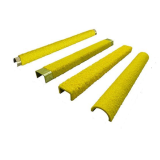 Ladder Rung CoversWhat ladder rung covers do before a wet rung costs someone their footing A ladder rung gives a boot less contact area than almost anything else a person stands on. It is narrow, usually round, and often the only thing between a worker and a fall. Add rain, oil, mud,
...
What ladder rung covers do before a wet rung costs someone their footing A ladder rung gives a boot less...
What ladder rung covers do before a wet rung costs someone their footing
A ladder rung gives a boot less contact area than almost anything else a person stands on. It is narrow, usually round, and often the only thing between a worker and a fall. Add rain, oil, mud, or ice and that small round surface stops being a foothold. The foot rolls off the side before the hand can catch up.
Anti-slip ladder rung covers fit over the rung that is already there. Each cover carries a gritted surface that gives the sole something to bite into, turning a slick round bar into a textured foothold. The rung underneath does not change; what changes is what the boot lands on.
The point of failure is usually the descent. Climbing, a person is pulling into the ladder and can feel a foot slip before committing weight to it. Coming down, weight goes onto the foot before the eye confirms placement, and a rung slick with condensation gives no warning at all.
One thing to be clear about from the start: these covers are not load-bearing. They are installed over an existing rung and rely on it for strength. They add traction to a sound ladder. They do not repair or replace a rung that has corroded or bent.
Why a bonded alumina surface, and why this construction
The gripping surface is an engineered mix of epoxy, resin, and fused alumina aggregate, bonded to a formed base. That matters because of what fused alumina is: it measures 9.4 on the Mohs hardness scale. Diamond is 10. Ordinary silica sand and quartz, the grit that gets tracked onto a ladder from a job site, sit around 6 to 7.
In practice that means the abrasive on the cover is harder than the material trying to wear it down. A wear test run to 30,000 cycles at 400 pounds measured roughly 0.013 of an inch difference between the worn and unworn sections. That is the difference between a surface that polishes smooth and one that keeps its texture.
This is also the argument against anti-slip tape on rungs. Tape is a consumable — it lifts at the edges, fills with grime, and comes back onto the maintenance schedule. A formed cover is fastened or bonded in place as a permanent part of the ladder, and nobody has to scrape a rung clean to reapply it.
Three base materials are available: 1/8-inch pultruded fiberglass at 0.125 inch thick, G90 galvanized steel at 18 gauge, and #316 stainless steel at 18 gauge. Fiberglass is light and impact-resistant and takes no interest in corrosion. Galvanized steel handles rough industrial duty. Stainless is the choice for washdown, marine, and chemically aggressive settings.
Grit comes in five grades, from extra coarse at #10 mesh through coarse #20, fine #24, extra fine #36, and super fine at #54 mesh. The grade is a real decision, not a preference — coarse grit bites through mud and heavy soil, while finer grit suits cleaner environments and lighter footwear.
Two profiles cover most rungs: channel-shaped and half-round. Round covers fit rungs from 3/4 inch to 2 inches in diameter in fiberglass, and 3/4, 7/8, or 1 inch in steel. Channel covers span 3/4 inch to 2 inches. Maximum length is 48 inches, and covers are made to order rather than pulled from stock.
The independent test results are worth reading before you spec into a hard environment. Tested on the 1/8-inch fiberglass base, the covers came through 20 thermal shock cycles from minus 40°F to 150°F with no cracking or melting, and an impact of roughly 138 joules detached the coating only at the point of strike, with no shattering. Flame spread measured 20 under ASTM E84.
Where it belongs, and what it is not
The core application is fixed access ladders in demanding settings: tank and silo ladders, offshore and marine structures, power generation plants, water treatment, refineries, mining, and transportation fleets. Anywhere a worker climbs in weather, in boots, carrying something, with a slick rung between them and the ground.
Food and beverage processing is a specific case worth knowing about. The stainless steel version carries NSF acceptance as a slip resistance treatment for walking surfaces in and around food processing areas, which is the kind of question that stops a specification cold if the answer is not documented.
Ladders are one line item in a facility's fall exposure, and stairs are usually the bigger one by traffic volume. The same reasoning that puts gritted covers on a tank ladder applies to a set of exterior stair treads at the same site, and it is worth surveying both at once rather than solving one and leaving the other.
What this is not: a structural component, a repair for a damaged rung, or a substitute for the ladder meeting whatever code applies to it. Covers add traction to a compliant, sound ladder. If the ladder itself has a problem, that gets fixed first.
It is also not an off-the-shelf item. Covers are manufactured to the rung being covered, so this is a specify-and-order product rather than something to grab from a shelf mid-shift.
Three Things to Check Before You Spec It
First, identify the rung profile and measure the diameter. Round and channel rungs take different covers, and the diameter determines what will seat properly. Round fiberglass covers span 3/4 inch to 2 inches; round steel covers come in 3/4, 7/8, and 1 inch only. Measure an actual rung rather than working from the ladder's drawings — field-fabricated ladders vary more than paperwork suggests.
Second, measure the rung length and look for obstructions. Maximum cover length is 48 inches, and covers generally run up to 2 inches shorter than the rung itself. If you want full rung coverage, check that nothing interferes with seating — a weld bead where the rung meets the side rail is the usual culprit, and it is easier to find now than with a crew on the ladder.
Third, pick the base material and the fastening method together. Most covers install with a polyurethane construction adhesive. Mechanical fasteners work on large-diameter hollow channel rungs, and steel covers on steel rungs can be tack-welded. Edges can be sealed after installation to keep moisture out of the joint, which matters on any ladder living outdoors. Pre-drilled or slotted holes and fasteners are available if you ask at the time of order.
Why Mats Inc.
This is a made-to-order product, which means the quote is only as good as the questions asked before it. We ask for the rung shape, the measured diameter, the rung length, what the environment throws at it, and what people are wearing on their feet — because grit grade and base material both follow from that, and a cover ordered on assumptions arrives as an expensive piece of the wrong shape. Sixty years of industrial and commercial supply is where that checklist came from.
Ladder Rung Covers — Specifications Anti-slip surface Engineered epoxy, resin, and fused alumina aggregate bonded to the base (fused alumina: Mohs 9.4) Base materials 1/8" pultruded fiberglass (0.125" / 3 mm); G90 galvanized steel, 18 ga (0.05" / 1.2 mm); #316 stainless steel, 18 ga (0.05" / 1.2 mm) Profiles Channel-shaped and half-round Rung diameters Round fiberglass 3/4"–2"; round steel 3/4", 7/8", 1"; channel 3/4"–2" Maximum length 48" (1,200 mm); typically supplied up to 2" shorter than the rung Grit grades #10 (extra coarse), #20 (coarse), #24 (fine), #36 (extra fine), #54 mesh (super fine) Colors 14 standard including safety yellow and three fluorescents; 14 premium; two-tone perimeter configuration; 6 photoluminescent; custom available Installation Adhesive, mechanical fasteners, or tack welding (steel bases); edge sealing available; pre-drilled or slotted holes on request Load rating Not load-bearing — installed over an existing rung Wear test 30,000 cycles at 400 lb; ~0.013" (0.33 mm) difference between worn and unworn sections Impact ~138 joules at 60°F — coating detached at point of impact only, no shattering Thermal shock −40°F to 150°F, 20 cycles — no cracking or melting Fire performance ASTM E84 flame spread 20, smoke developed 400; ASTM E648 average critical radiant flux 1.04 W/cm²; FMVSS 302 passed Food processing Stainless steel version: NSF accepted as a slip resistance treatment (P1) for walking surfaces in and around food processing areas Sizing Made to order; custom sizes and shapes available Warranty 1-year limited (Mats Inc.) Test results shown are for the 1/8" fiberglass base unless otherwise noted.
Frequently Asked Questions
What is the gritted surface actually made of?
Answered by Dustin Thompson, Owner & CEO, Mats Inc.
It is an engineered combination of epoxy, resin, and fused alumina aggregate, bonded onto the base material. Fused alumina is the part that does the gripping, and it measures 9.4 on the Mohs hardness scale — diamond is 10, and the sand and quartz that get tracked onto a ladder are around 6 to 7. So the abrasive is harder than what is trying to wear it away.
The important distinction is bonded versus applied. Anti-slip tape is a film with adhesive behind it, and it has a service life measured in months on a ladder. This surface is part of a formed cover that gets fastened to the rung. Once it is on, nobody is scraping residue off a rung to reapply anything.
How long does it hold up, and is there test data?
Answered by Dustin Thompson, Owner & CEO, Mats Inc.
There is real data, which is more than most anti-slip products offer. A wear simulator ran 30,000 cycles at 400 pounds and measured about 0.013 of an inch of difference between the worn and unworn sections — essentially still there. Thermal shock testing cycled from minus 40°F to 150°F twenty times with no cracking or melting, which covers most North American outdoor service.
Impact testing is the one I point people to for industrial sites. At roughly 138 joules — a 17-pound pendulum — the coating detached only where it was struck, and the cover did not shatter. If a wrench comes off a platform and hits a rung, you lose a patch, not the whole cover. Those figures are for the fiberglass base. Our warranty is 1-year limited.
Will these work in washdown, marine, or chemical environments?
Answered by Dustin Thompson, Owner & CEO, Mats Inc.
That is what the base material choice is for. Fiberglass does not corrode at all and is the default for most wet and outdoor work. Galvanized steel handles general industrial duty. For saltwater, washdown, and chemically aggressive settings, #316 stainless is the one to specify, and the stainless version also carries NSF acceptance as a slip resistance treatment for walking surfaces in and around food processing areas.
One installation detail matters more in those environments than anywhere else: seal the cover edges after installation. Any joint between a cover and a rung will hold moisture if you let it, and on a marine or washdown ladder that is where corrosion starts. Say so when you order and the fasteners and sealing can be planned rather than improvised.
How do I measure my ladder to order the right covers?
Answered by Jinna Hopson, Vice President of Marketing, Mats Inc.
Three measurements and one observation. Measure the rung diameter, measure the rung length, and note whether the rung is round or channel-shaped. Then look at where the rung meets the side rail — if there is a weld bead or bracket there, a full-length cover may not seat flat, and that is much easier to spot now than with someone on the ladder holding a part that will not fit.
On sizing: covers are supplied up to about 2 inches shorter than the rung, and the maximum length is 48 inches. Because everything is made to order, there is no standard size to compromise toward — but that also means the measurements need to be right the first time. Measure an actual rung rather than trusting the ladder drawings, especially on anything field-fabricated or older than a decade.
What colors are available, and do they stay visible?
Answered by Jinna Hopson, Vice President of Marketing, Mats Inc.
Fourteen standard colors including safety yellow and three fluorescents, plus fourteen premium colors and custom matching. Weathering testing showed only small color shifts over exposure, so a safety yellow ladder is still reading as safety yellow after a season outdoors rather than fading to cream.
Two options are worth knowing about. A two-tone configuration puts a contrasting color around the perimeter of each cover, which marks the safe foot placement zone and makes the edge of the rung legible at a glance. And a photoluminescent version glows in the dark to help people find their way out during a power failure — the pigment is built into the anti-slip system rather than painted on, and testing showed full luminescence retention after 158 hours and 90 percent after 200.
Can these be customized, or built into new equipment?
Answered by Jinna Hopson, Vice President of Marketing, Mats Inc.
Both. Because every cover is manufactured to the rung it goes on, custom sizes and shapes are part of the normal process rather than a special request. If you have an unusual rung profile, send the dimensions or a drawing and it can be made to match. Colors can be matched beyond the standard and premium ranges as well.
On the OEM side, these can be specified into equipment being built rather than retrofitted afterward, which is the better path if you are fabricating ladders or access structures. Send drawings and the covers are made as part of the build. For facilities standardizing across a site, picking one color and one grit grade up front makes reordering and future maintenance far simpler than handling each ladder as its own project.
Written by Dustin Thompson, Owner & CEO, Mats Inc.
↑
What ladder rung covers do before a wet rung costs someone their footing
A ladder rung gives a boot less contact area than almost anything else a person stands on. It is narrow, usually round, and often the only thing between a worker and a fall. Add rain, oil, mud, or ice and that small round surface stops being a foothold. The foot rolls off the side before the hand can catch up.
Anti-slip ladder rung covers fit over the rung that is already there. Each cover carries a gritted surface that gives the sole something to bite into, turning a slick round bar into a textured foothold. The rung underneath does not change; what changes is what the boot lands on.
The point of failure is usually the descent. Climbing, a person is pulling into the ladder and can feel a foot slip before committing weight to it. Coming down, weight goes onto the foot before the eye confirms placement, and a rung slick with condensation gives no warning at all.
One thing to be clear about from the start: these covers are not load-bearing. They are installed over an existing rung and rely on it for strength. They add traction to a sound ladder. They do not repair or replace a rung that has corroded or bent.
Why a bonded alumina surface, and why this construction
The gripping surface is an engineered mix of epoxy, resin, and fused alumina aggregate, bonded to a formed base. That matters because of what fused alumina is: it measures 9.4 on the Mohs hardness scale. Diamond is 10. Ordinary silica sand and quartz, the grit that gets tracked onto a ladder from a job site, sit around 6 to 7.
In practice that means the abrasive on the cover is harder than the material trying to wear it down. A wear test run to 30,000 cycles at 400 pounds measured roughly 0.013 of an inch difference between the worn and unworn sections. That is the difference between a surface that polishes smooth and one that keeps its texture.
This is also the argument against anti-slip tape on rungs. Tape is a consumable — it lifts at the edges, fills with grime, and comes back onto the maintenance schedule. A formed cover is fastened or bonded in place as a permanent part of the ladder, and nobody has to scrape a rung clean to reapply it.
Three base materials are available: 1/8-inch pultruded fiberglass at 0.125 inch thick, G90 galvanized steel at 18 gauge, and #316 stainless steel at 18 gauge. Fiberglass is light and impact-resistant and takes no interest in corrosion. Galvanized steel handles rough industrial duty. Stainless is the choice for washdown, marine, and chemically aggressive settings.
Grit comes in five grades, from extra coarse at #10 mesh through coarse #20, fine #24, extra fine #36, and super fine at #54 mesh. The grade is a real decision, not a preference — coarse grit bites through mud and heavy soil, while finer grit suits cleaner environments and lighter footwear.
Two profiles cover most rungs: channel-shaped and half-round. Round covers fit rungs from 3/4 inch to 2 inches in diameter in fiberglass, and 3/4, 7/8, or 1 inch in steel. Channel covers span 3/4 inch to 2 inches. Maximum length is 48 inches, and covers are made to order rather than pulled from stock.
The independent test results are worth reading before you spec into a hard environment. Tested on the 1/8-inch fiberglass base, the covers came through 20 thermal shock cycles from minus 40°F to 150°F with no cracking or melting, and an impact of roughly 138 joules detached the coating only at the point of strike, with no shattering. Flame spread measured 20 under ASTM E84.
Where it belongs, and what it is not
The core application is fixed access ladders in demanding settings: tank and silo ladders, offshore and marine structures, power generation plants, water treatment, refineries, mining, and transportation fleets. Anywhere a worker climbs in weather, in boots, carrying something, with a slick rung between them and the ground.
Food and beverage processing is a specific case worth knowing about. The stainless steel version carries NSF acceptance as a slip resistance treatment for walking surfaces in and around food processing areas, which is the kind of question that stops a specification cold if the answer is not documented.
Ladders are one line item in a facility's fall exposure, and stairs are usually the bigger one by traffic volume. The same reasoning that puts gritted covers on a tank ladder applies to a set of exterior stair treads at the same site, and it is worth surveying both at once rather than solving one and leaving the other.
What this is not: a structural component, a repair for a damaged rung, or a substitute for the ladder meeting whatever code applies to it. Covers add traction to a compliant, sound ladder. If the ladder itself has a problem, that gets fixed first.
It is also not an off-the-shelf item. Covers are manufactured to the rung being covered, so this is a specify-and-order product rather than something to grab from a shelf mid-shift.
Three Things to Check Before You Spec It
First, identify the rung profile and measure the diameter. Round and channel rungs take different covers, and the diameter determines what will seat properly. Round fiberglass covers span 3/4 inch to 2 inches; round steel covers come in 3/4, 7/8, and 1 inch only. Measure an actual rung rather than working from the ladder's drawings — field-fabricated ladders vary more than paperwork suggests.
Second, measure the rung length and look for obstructions. Maximum cover length is 48 inches, and covers generally run up to 2 inches shorter than the rung itself. If you want full rung coverage, check that nothing interferes with seating — a weld bead where the rung meets the side rail is the usual culprit, and it is easier to find now than with a crew on the ladder.
Third, pick the base material and the fastening method together. Most covers install with a polyurethane construction adhesive. Mechanical fasteners work on large-diameter hollow channel rungs, and steel covers on steel rungs can be tack-welded. Edges can be sealed after installation to keep moisture out of the joint, which matters on any ladder living outdoors. Pre-drilled or slotted holes and fasteners are available if you ask at the time of order.
Why Mats Inc.
This is a made-to-order product, which means the quote is only as good as the questions asked before it. We ask for the rung shape, the measured diameter, the rung length, what the environment throws at it, and what people are wearing on their feet — because grit grade and base material both follow from that, and a cover ordered on assumptions arrives as an expensive piece of the wrong shape. Sixty years of industrial and commercial supply is where that checklist came from.
Ladder Rung Covers — Specifications Anti-slip surface Engineered epoxy, resin, and fused alumina aggregate bonded to the base (fused alumina: Mohs 9.4) Base materials 1/8" pultruded fiberglass (0.125" / 3 mm); G90 galvanized steel, 18 ga (0.05" / 1.2 mm); #316 stainless steel, 18 ga (0.05" / 1.2 mm) Profiles Channel-shaped and half-round Rung diameters Round fiberglass 3/4"–2"; round steel 3/4", 7/8", 1"; channel 3/4"–2" Maximum length 48" (1,200 mm); typically supplied up to 2" shorter than the rung Grit grades #10 (extra coarse), #20 (coarse), #24 (fine), #36 (extra fine), #54 mesh (super fine) Colors 14 standard including safety yellow and three fluorescents; 14 premium; two-tone perimeter configuration; 6 photoluminescent; custom available Installation Adhesive, mechanical fasteners, or tack welding (steel bases); edge sealing available; pre-drilled or slotted holes on request Load rating Not load-bearing — installed over an existing rung Wear test 30,000 cycles at 400 lb; ~0.013" (0.33 mm) difference between worn and unworn sections Impact ~138 joules at 60°F — coating detached at point of impact only, no shattering Thermal shock −40°F to 150°F, 20 cycles — no cracking or melting Fire performance ASTM E84 flame spread 20, smoke developed 400; ASTM E648 average critical radiant flux 1.04 W/cm²; FMVSS 302 passed Food processing Stainless steel version: NSF accepted as a slip resistance treatment (P1) for walking surfaces in and around food processing areas Sizing Made to order; custom sizes and shapes available Warranty 1-year limited (Mats Inc.) Test results shown are for the 1/8" fiberglass base unless otherwise noted.
Frequently Asked Questions
What is the gritted surface actually made of?
Answered by Dustin Thompson, Owner & CEO, Mats Inc.
It is an engineered combination of epoxy, resin, and fused alumina aggregate, bonded onto the base material. Fused alumina is the part that does the gripping, and it measures 9.4 on the Mohs hardness scale — diamond is 10, and the sand and quartz that get tracked onto a ladder are around 6 to 7. So the abrasive is harder than what is trying to wear it away.
The important distinction is bonded versus applied. Anti-slip tape is a film with adhesive behind it, and it has a service life measured in months on a ladder. This surface is part of a formed cover that gets fastened to the rung. Once it is on, nobody is scraping residue off a rung to reapply anything.
How long does it hold up, and is there test data?
Answered by Dustin Thompson, Owner & CEO, Mats Inc.
There is real data, which is more than most anti-slip products offer. A wear simulator ran 30,000 cycles at 400 pounds and measured about 0.013 of an inch of difference between the worn and unworn sections — essentially still there. Thermal shock testing cycled from minus 40°F to 150°F twenty times with no cracking or melting, which covers most North American outdoor service.
Impact testing is the one I point people to for industrial sites. At roughly 138 joules — a 17-pound pendulum — the coating detached only where it was struck, and the cover did not shatter. If a wrench comes off a platform and hits a rung, you lose a patch, not the whole cover. Those figures are for the fiberglass base. Our warranty is 1-year limited.
Will these work in washdown, marine, or chemical environments?
Answered by Dustin Thompson, Owner & CEO, Mats Inc.
That is what the base material choice is for. Fiberglass does not corrode at all and is the default for most wet and outdoor work. Galvanized steel handles general industrial duty. For saltwater, washdown, and chemically aggressive settings, #316 stainless is the one to specify, and the stainless version also carries NSF acceptance as a slip resistance treatment for walking surfaces in and around food processing areas.
One installation detail matters more in those environments than anywhere else: seal the cover edges after installation. Any joint between a cover and a rung will hold moisture if you let it, and on a marine or washdown ladder that is where corrosion starts. Say so when you order and the fasteners and sealing can be planned rather than improvised.
How do I measure my ladder to order the right covers?
Answered by Jinna Hopson, Vice President of Marketing, Mats Inc.
Three measurements and one observation. Measure the rung diameter, measure the rung length, and note whether the rung is round or channel-shaped. Then look at where the rung meets the side rail — if there is a weld bead or bracket there, a full-length cover may not seat flat, and that is much easier to spot now than with someone on the ladder holding a part that will not fit.
On sizing: covers are supplied up to about 2 inches shorter than the rung, and the maximum length is 48 inches. Because everything is made to order, there is no standard size to compromise toward — but that also means the measurements need to be right the first time. Measure an actual rung rather than trusting the ladder drawings, especially on anything field-fabricated or older than a decade.
What colors are available, and do they stay visible?
Answered by Jinna Hopson, Vice President of Marketing, Mats Inc.
Fourteen standard colors including safety yellow and three fluorescents, plus fourteen premium colors and custom matching. Weathering testing showed only small color shifts over exposure, so a safety yellow ladder is still reading as safety yellow after a season outdoors rather than fading to cream.
Two options are worth knowing about. A two-tone configuration puts a contrasting color around the perimeter of each cover, which marks the safe foot placement zone and makes the edge of the rung legible at a glance. And a photoluminescent version glows in the dark to help people find their way out during a power failure — the pigment is built into the anti-slip system rather than painted on, and testing showed full luminescence retention after 158 hours and 90 percent after 200.
Can these be customized, or built into new equipment?
Answered by Jinna Hopson, Vice President of Marketing, Mats Inc.
Both. Because every cover is manufactured to the rung it goes on, custom sizes and shapes are part of the normal process rather than a special request. If you have an unusual rung profile, send the dimensions or a drawing and it can be made to match. Colors can be matched beyond the standard and premium ranges as well.
On the OEM side, these can be specified into equipment being built rather than retrofitted afterward, which is the better path if you are fabricating ladders or access structures. Send drawings and the covers are made as part of the build. For facilities standardizing across a site, picking one color and one grit grade up front makes reordering and future maintenance far simpler than handling each ladder as its own project.
Written by Dustin Thompson, Owner & CEO, Mats Inc.
↑
View Details
View Details
What Outdoor Stair Treads Do Before a Wet Step Becomes a Fall
An exterior step loses grip in two ways at once. Foot traffic polishes the surface smooth, and weather lays a film of water, slush, or ice on top. A shoe that holds on a dry step can skate on a wet one. It usually happens at the front edge of the step, because that is where weight lands on the way down.
Exterior stair treads put a textured, weather-rated surface over that edge. Some do it with hard abrasive grit set into metal. Others use a raised rubber pattern that gives water a path off the step. Either way, the goal is the same: the shoe touches something with bite instead of a slick film.
This page covers steps and ladders that live outside. Interior stairs, riser covers, landing tiles, and the adhesives that hold them down are part of our full stair treads, risers, and landing tiles range, where color and profile choices open up because weather is not part of the job.
The Mistake: Picking the Tread Before You Look at the Step
Most outdoor stair tread failures are not a worn-out tread. They are a good tread fastened to a step that could not hold it. Exterior concrete goes through freeze-thaw cycles every winter. Water seeps into small cracks, freezes, expands, and breaks the surface loose. The nose, or front edge of the step, usually goes first.
Put a tread over that and it bonds or anchors to material that is already coming apart. The edge lifts a little. Water runs under it, freezes, and lifts it more. Within a season, the tread that was meant to stop a slip has become a trip hazard, with a raised lip at the worst spot on the stair.
Salt and spray add a second problem. De-icing salt and coastal air attack bare metal and wear on bonds over time. The fix is not a tougher tread. It is checking the step first: patch spalled concrete, rebuild a broken nose, and choose a tread whose way of attaching suits what is left.
How the Outdoor Tread Options Compare
Renovation Stair Treads are extruded aluminum treads with a hard abrasive filler packed into channels across the top. They fit over the existing step and fasten with adhesive plus mechanical anchors, so a worn concrete step gets a new walking surface without being torn out. The grit is mostly aluminum oxide and silicon carbide, which tracked-in sand cannot polish down.
They are 11 inches deep and made to order in length, with the filler color running all the way through so wear never shows a pale lane. Near saltwater, a tread sealer goes on at installation. They are the right pick for parking garage stairs, loading dock steps, exterior exit stairs, and concrete entry steps that have worn smooth.
The Rubber Outdoor Stair Tread is molded from a rubber compound made for exterior service, not an indoor tread moved outside. Raised diamonds carry the foot while the channels between them drain water away. The back three inches are molded smooth, so leaves and grit sweep off instead of packing against the riser.
It bonds to the step with an epoxy adhesive that handles the moisture and temperature swings an outdoor stair sees. It comes in black only, with a square nose and standard lengths from 36 to 72 inches. It is the strongest fit for ice rinks, sports arenas, stadium stairs, and busy building entrances where footwear arrives wet, cold, or cleated.
Ladder Rung Covers solve the same problem on a much smaller surface. A round rung gives a boot very little to stand on, and a wet one gives even less. These gritted covers fit over the existing rung in channel or half-round styles, on fiberglass or on galvanized or stainless steel bases.
They install with adhesive, mechanical fasteners, or welding, and come in a choice of grit grades. They add grip to a sound ladder; they do not repair a bent or rusted rung. They are the right pick for roof-access ladders, tank and silo ladders, dock and pier ladders, and platform ladders at plants and refineries.
Three Things to Check Before You Pick
First, the step itself. Look at what it is made of and what shape it is in. A worn but solid concrete step with a rounded nose is where Renovation Stair Treads earn their place, since they anchor in and put back a crisp, gritty edge. Sound concrete, steel, or wood suits the Rubber Outdoor Stair Tread, as long as the surface can be roughed up for the epoxy. Spalling concrete gets repaired first, whichever tread you choose.
Second, what lands on it. Think about footwear and exposure, not just headcount. Skates, cleats, and heavy crowds point to the rubber tread and its molded diamond surface. Salt spray, dock work, and parking decks point to the aluminum tread, with its hard grit and sealer option. If people are climbing rather than walking, the answer is Ladder Rung Covers, not a stair tread.
Third, size and finish. Measure every step, not just one. Exterior flights settle and get patched, so widths drift from top to bottom. The aluminum tread is 11 inches deep and cut to your length. The rubber tread is 12-1/16 inches deep, comes in set lengths, and has a molded trim line for field cuts. If color matters, the aluminum tread offers it and the rubber tread does not.
Why Mats Inc.
An outdoor stair order is really three things: the tread, what holds it down, and the right length for each step. We check all three before anything ships. If the tread needs epoxy, we make sure the epoxy is on the same order, so a crew is not tempted by an indoor adhesive on the shelf. If it anchors, we confirm the fastener type for your step.
We also work from step-by-step measurements rather than one number for the whole flight, because that is where exterior jobs usually go wrong. Mats Inc. has supplied commercial, industrial, and residential customers since 1964, and we ship heavy duty stair treads across the lower 48 states and Canada.
Frequently Asked Questions
Which outdoor stair tread is right for my stairs?
Answered by Jinna Hopson, Vice President of Marketing
Start with the step and the traffic. Worn concrete steps at a garage, dock, or back entrance usually get the aluminum Renovation Stair Treads, since they anchor into the step and restore a sharp, gritty edge. Busy entrances, arenas, and rink stairs usually get the Rubber Outdoor Stair Tread, which bonds down with epoxy and drains water through its diamond pattern.
If the problem is a ladder rather than a stair, Ladder Rung Covers are the fit. Where a stairway sits right next to a fixed ladder, as on many docks and rooftops, it makes sense to order both at once so the whole route up has the same grip.
How are outdoor stair treads installed on concrete steps?
Answered by Dustin Thompson, Owner & CEO
It depends on the tread. The aluminum treads go down with construction adhesive plus mechanical anchors through pre-drilled, countersunk holes. You choose the anchor type when you order, such as concrete screws or screws with expansion shields. The rubber tread bonds with epoxy adhesive only. Interior contact adhesives are not rated for outdoor moisture and temperature swings.
Either way, the step must be clean, dry, and sound, and smooth concrete needs roughing so the adhesive can grip. Epoxy cures slowly on cold concrete, so plan the job for a mild, dry day and keep people off the stair until it has set.
Can anti-slip covers go on ladder rungs as well as stairs?
Answered by Dustin Thompson, Owner & CEO
Yes. Ladder Rung Covers are built for exactly that. They fit over the existing rung and give the boot a gritted face instead of smooth, round metal or fiberglass. Channel and half-round styles suit different rung shapes, and bases come in fiberglass or in galvanized or stainless steel.
The one rule is that the rung underneath must be sound. The cover adds traction; the rung still carries the load. On a ladder with corrosion or a bent rung, fix or replace the ladder first, then cover it. Note each rung's shape and length before ordering, since the cover has to match what is there.
How long do outdoor stair treads last through winter weather?
Answered by Dustin Thompson, Owner & CEO
We don't quote a single year count, because outdoor life depends more on the step and the install than on the tread. The wearing surfaces are built to last. The aluminum tread's filler is at least 65 percent aluminum oxide and silicon carbide, minerals harder than the sand tracked onto it. The rubber tread is 3/16 inch thick at the front, tapering to 1/8 inch, and weighs 2 pounds per linear foot.
What ends life early is almost always the attachment. Water under a lifted edge freezes and pries it up further. The usual causes are the wrong adhesive, spalled concrete under the tread, and skipped surface prep. Check edges each spring and reseat anything that has started to lift. Coverage is our 1-year limited (Mats Inc.) warranty.
Do outdoor stair treads come in colors other than black?
Answered by Jinna Hopson, Vice President of Marketing
Some do. Renovation Stair Treads come in 11 filler colors, and black ships if you don't choose one. The color runs through the whole abrasive filler rather than sitting on top, so the middle of the stair does not fade to a pale lane while the edges stay dark. A contrasting nose is also available, which helps people see where each step ends.
The Rubber Outdoor Stair Tread is black only. On most exterior stairs that is the practical choice, since black hides road grit, salt residue, and mud between cleanings. If your entrance needs a specific color or a bright leading edge, the aluminum tread is the one to look at.
Can outdoor stair treads be ordered for wide or odd-sized steps?
Answered by Jinna Hopson, Vice President of Marketing
Yes. Renovation Stair Treads are made to order in length, up to 8 feet in one piece. Wider steps get equal sections rather than one long piece and a short stub, which looks planned instead of patched. You can run them the full width of the step or stop them a few inches short of each end.
The Rubber Outdoor Stair Tread comes in set lengths of 36, 42, 48, 54, 60, and 72 inches and is cut down from the next size up. A trim line molded into the smooth back border gives a straight guide for shallower steps. Send us each step's width and depth, and we will work out the order for the whole flight.
By Dustin Thompson, Owner & CEO, Mats Inc.