





Gym Flooring and Athletic Mats
Gym flooring takes more abuse than almost any floor in a building. Dropped dumbbells, loaded barbells, treadmills running for hours, and foot traffic that never really stops. But a weight room is only one kind of training space. A cheer gym, a wrestling room, and a dojo each put very different demands on the floor, and the surface that survives a deadlift platform is not the surface that catches a back tuck.
We group gym flooring into four categories, and choosing between them starts with a single question: is this floor protecting your building, or protecting a body? Rubber flooring protects the building from the equipment. Foam athletic mats protect the athlete from the floor. Nearly everything else follows from that one distinction.


Four Categories, Four Different Jobs
Gym Floor Mats
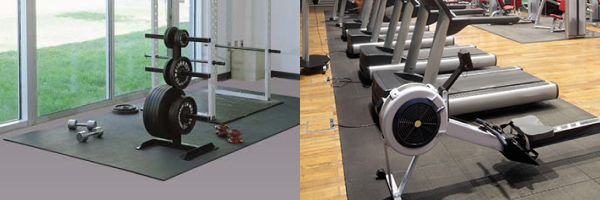
Gym floor mats cover the rubber side of the catalog: rolls for large open floors, interlocking tiles for rooms that change, and heavy-duty mats for the spots where weight gets dropped. Rolls give the fewest seams and suit commercial floors and full garage builds. Tiles go down without adhesive and lift back up when the room needs to become something else.
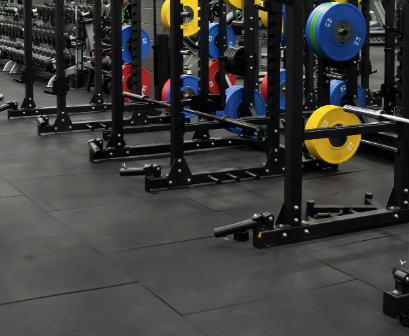
Heavy-duty mats handle deadlift platforms, racks, and free-weight stations. The extra thickness absorbs a dropped barbell instead of passing it into the slab, and it cuts noise and bounce at the same time. Most gyms end up mixing these — rolls or tiles across the open space, heavier mats in the loading zones.
Cheerleading Mats
Cheerleading mats are built for a completely different failure than rubber flooring. Here the concern is a body coming down from height, often after rotation, sometimes off a stunt. The surface has to absorb that landing and give consistent, predictable rebound on the way back up, because an athlete who cannot trust the floor will not commit to the skill.
Two thicknesses cover most programs. The 1-3/8 inch build handles standing tumbling and general practice floors. The 2 inch build carries more margin for running passes and repeated landings, which matters more than people expect — a skill gets built across fifty attempts in a practice, and the floor absorbs every one of them.
Both are foam-cored roll-out surfaces rather than rubber, so they cover full practice floors or tumbling strips and roll up when the space has to serve another purpose. Gymnastics and tumbling programs draw from this same group.
Wrestling Mats
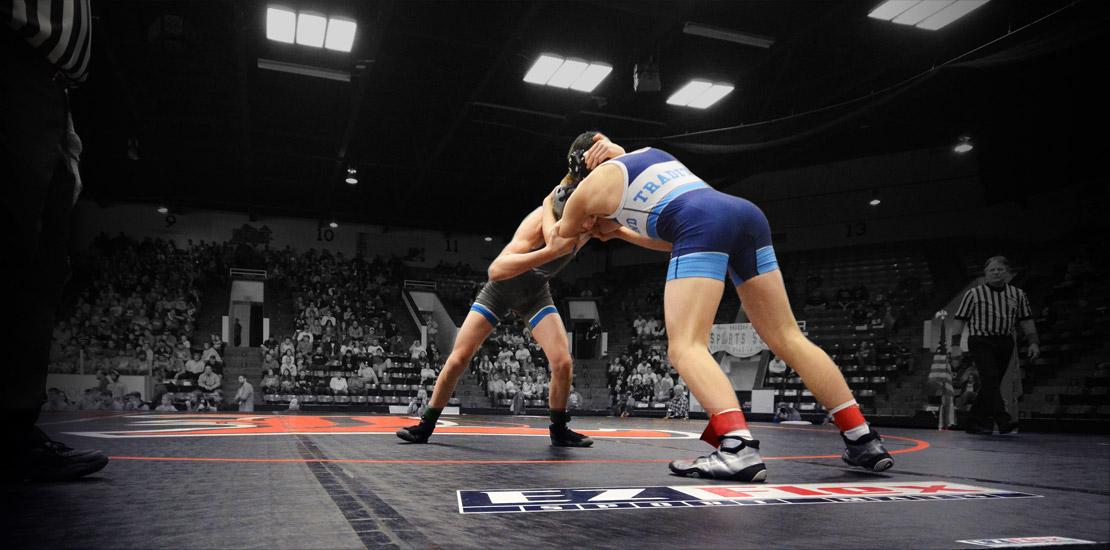
Wrestling mats handle the hardest single impact in this catalog. A takedown puts a wrestler's head and shoulders into the floor at speed with a second body's weight following, and impact protection for these surfaces is governed by ASTM F355 and F1081.
Thickness follows competition level rather than preference. The 1-5/8 inch build is the high school and collegiate spec; 2 inch is the international spec. Both are roll-up construction, so a wrestling room can go back to being a gym or a multipurpose space between seasons.
Martial Arts Mats
Martial arts mats serve MMA, BJJ, judo, karate, and taekwondo, and the spec depends heavily on which of those you actually run. Striking and stand-up styles need less floor than grappling and throwing, and the difference is not a matter of comfort.
Three thicknesses cover the range: 1-1/4 inch for striking and stand-up only, 1-5/8 inch once people are being thrown, and 2 inch for programs that want more margin. If your classes mix disciplines, spec to the grappling side, because that is where the impact lives.
Where Gymnastics and Tumbling Fit
Gymnastics and tumbling do not have their own group here, and that is deliberate. They are applications rather than a separate product family, and they draw from the foam athletic mats already in the cheer, wrestling, and martial arts groups depending on what the skill demands.
Tumbling and floor work sit closest to cheer surfaces, since both involve rotation, landing from height, and needing consistent rebound across a long run. A tumbling strip and a cheer practice floor are often the same construction in a different footprint.
Skills that end on the back or hip rather than the feet move toward the wrestling and martial arts side, where thickness is tuned for absorbing a body rather than returning energy. If your program spans both, tell us what the athletes are actually doing and we will point you at the right group rather than the nearest one.
How to Choose the Right Thickness
Rubber and foam use the same word for two different things, and this is where buyers get caught. Rubber thickness runs a quarter inch to three quarters of an inch and follows the load on top of it. Foam athletic thickness runs one and a quarter inches to two inches and follows how far a body falls onto it. A three-quarter inch rubber mat is thick for rubber and provides no meaningful protection for a throw.
On the rubber side, bodyweight work, cardio equipment, and general fitness are usually covered by 1/4 inch to 3/8 inch. It stays easy to move and clean, and it gives enough cushion for machines and stretching. Once loaded barbells and dropped dumbbells enter the room, step up to 1/2 inch or 3/4 inch so the impact stops at the mat instead of reaching the slab.
On the foam side, thickness follows what the sport does. Striking and stand-up martial arts work on 1-1/4 inch, and cheer and tumbling start at 1-3/8 inch. Grappling, throwing, and wrestling need 1-5/8 inch at minimum, with 2 inch adding margin across every sport here. Going thinner than the sport calls for does not just feel worse — it moves force into necks, shoulders, and ankles that the mat was supposed to absorb.
Why Mats Inc.
Mats Inc. has supplied commercial matting and flooring since 1964, and athletic surfaces are a natural extension of that work. The questions are the same ones we have always asked about traffic, impact, and wear, just moved into a training room. What changes is that here the floor is often protecting a person rather than a building.
We specify rather than install, so our job is matching the surface to how the room actually gets used. That includes telling you when a space needs two different surfaces instead of one, or when the group you were shopping is not the one your program needs. Every surface here is backed by our one-year limited warranty.
Frequently Asked Questions
Which type of gym flooring do I need?
Answered by Dustin Thompson, Owner & CEO
Start with what the floor is protecting. If it is your building — subfloor, slab, downstairs neighbors — from equipment, you want rubber gym floor mats. If it is an athlete from the floor, you want a foam athletic surface from the cheer, wrestling, or martial arts group.
Within rubber, rolls suit large open floors, tiles suit rooms that change layout, and heavy-duty mats go where weight gets dropped. Within foam, the sport picks the group: cheer and tumbling surfaces for rotation and landing from height, wrestling mats for takedowns, martial arts mats scaled to whether people are striking or being thrown. Plenty of facilities run both kinds in different rooms.
How thick should the flooring be?
Answered by Dustin Thompson, Owner & CEO
It depends on which system you are in, and the two are not comparable. Rubber runs 1/4 inch to 3/4 inch and follows the load: 1/4 to 3/8 inch for bodyweight, cardio, and general fitness, then 1/2 or 3/4 inch once loaded barbells and dropped dumbbells are involved.
Foam athletic mats run 1-1/4 inch to 2 inch and follow impact rather than load. Striking and stand-up work sits at 1-1/4 inch, cheer and tumbling at 1-3/8 inch. Grappling, throwing, and wrestling need 1-5/8 inch at minimum, and 2 inch adds margin. Do not read a 3/4 inch rubber mat as thick in this context — it is thick for rubber and thin for a body.
Will rubber flooring protect my subfloor from dropped weights?
Answered by Dustin Thompson, Owner & CEO
That is exactly what the heavier rubber is built to do. A 1/2 inch or 3/4 inch mat spreads and absorbs the force of a dropped weight so it does not crack tile, dent concrete, or telegraph into a wood subfloor below. It also cuts noise and bounce, which matters in a garage over a finished room or anywhere with occupied space underneath.
Thin flooring under a lifting area will not give you that protection regardless of how it looks. The damage tends to show up as a hairline crack or a soft spot months later, well after the mat that caused it has stopped seeming like the cause.
Can I use cheer or tumbling mats for gymnastics at home?
Answered by Jinna Hopson, Vice President of Marketing
Yes, and it is a common setup. Tumbling and gymnastics draw from the same foam surfaces as cheer, so a home tumbling strip in a basement or garage is a smaller version of what a cheer gym runs. Roll-out construction helps here, since the space usually has to become a garage again on Monday.
The thing to be honest about is what skills are being trained. A surface sized for standing tumbling is not the same as one sized for skills that land from real height. Tell us what your athlete is working on and how much ceiling and floor you have, and we will steer you toward the right surface rather than the largest one.
Can I get gym flooring in custom sizes, colors, or with a logo?
Answered by Jinna Hopson, Vice President of Marketing
On the rubber side, rolls cut to length and tiles build almost any footprint around walls, racks, and doorways. Black is the workhorse because it hides scuffs and wears evenly, but color fleck blends are widely available with the color mixed into the rubber rather than coated on top.
Foam athletic surfaces go further. Custom sizes are the norm rather than the exception, and artwork sent in a vector format gets reproduced into the mat itself — logos, competition circles, mascots, program names. For a school or club, that floor ends up in every photo, highlight clip, and recruiting video the program produces.
Will new flooring smell, and is it safe for a home gym?
Answered by Jinna Hopson, Vice President of Marketing
New rubber can carry a noticeable scent for the first few days, especially in a closed room. It fades with airflow — open a door or window and run a fan, and most of it clears within a week. Flooring made from recycled rubber is processed to limit that off-gassing.
Foam athletic mats with a vinyl surface behave differently and tend to be far less noticeable out of the box. Many carry antimicrobial protection built into the material, which matters in sports where skin spends the whole session on the floor. If odor is a real concern in a small enclosed space, ask us before you order.
By Dustin Thompson, Owner & CEO, Mats Inc.