

- Home
- Products
- Gym Flooring
- Cheerleading Mats
Cheerleading Mats
Cheer Mats - 1-3/8" Thick$110.00What Cheer Mats Do Before a Hard Landing Becomes an Injury Every tumbling pass ends the same way: an athlete meeting the floor. What's between them and that floor decides whether the landing is routine or a season-ending problem. Cheerleading mats exist to absorb that impact — practice after practice,...
What Cheer Mats Do Before a Hard Landing Becomes an Injury Every tumbling pass ends the same way: an athlete...
What Cheer Mats Do Before a Hard Landing Becomes an Injury
Every tumbling pass ends the same way: an athlete meeting the floor. What's between them and that floor decides whether the landing is routine or a season-ending problem. Cheerleading mats exist to absorb that impact — practice after practice, pass after pass — so athletes can train full-out without the floor punishing every rep.
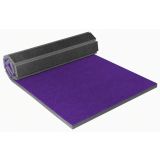
These are roll out cheer mats built from carpet bonded foam: an athletic carpet surface laminated to a shock-absorbing foam core. Sections join side by side to build exactly as much floor as the program needs — a single tumbling strip along one wall, or a full competition-size cheer floor.
And the construction scales down as readily as it scales up. The same carpet-over-foam build that covers an all-star gym comes in home practice sizes, so the surface an athlete drills on in the basement matches the one waiting at practice.
Why Carpet Bonded Foam at 1-3/8 Inch, and Why This One
The build is specific: 26 oz athletic carpet flame-laminated to cross-linked polyethylene foam at a 2.2 lb density. That density is the working number — firm enough to give tumblers a consistent, predictable surface, forgiving enough to take the shock out of landings. Cheap foam does neither for long; it packs down where athletes land most and turns dead spots into rolled ankles.
The 1-3/8 inch thickness is the reason to pick this exact mat: it's the standard used throughout the cheerleading world — the thickness athletes perform on. Training on it means practice conditions match performance conditions, so nothing about the floor changes on the day it counts. It's made in the USA. Programs that want extra cushion for high-repetition drilling can step up to our 2 inch version of the same construction.
The roll system is built for real gyms, where mats go up and down daily. One person can set up or break down a section, no flipping required before or after rolling, and each roll includes a storage strap. Order multiple sections and hook fasteners come included, joining the seams so the floor performs as one surface instead of shifting pieces.
Where It Belongs — and What It Is Not
This surface belongs anywhere athletes tumble and stunt: cheer gyms, school athletic programs, all-star facilities, rec centers, and dance and acro spaces. The smaller 3 x 6 and 5 x 10 sizes bring the same construction home — a basement or garage practice mat for an athlete putting in extra reps. It sits alongside the rest of our gym flooring as the roll-out option among permanent surfaces.
Know what it is not. This is a dead mat — the industry term for foam over a solid floor. It is not a spring floor, and it is not an inflatable air track. That's a feature, not a gap: dead-mat foam is the surface programs train and compete on when they need consistent response, and it stores in a fraction of the space.
Three Things to Check Before You Spec It
Walk through three decisions before you order.
First, confirm the competition match is what you want. This 1-3/8 inch thickness exists to mirror the standard performance surface — that's its job. If your program's priority is instead maximum cushion for drilling new skills or younger athletes, the 2 inch version of this same mat trades exact surface match for extra shock absorption; pick deliberately, not by default.
Second, size to the program. A single 6 x 42 section makes a tumbling strip. Nine sections build the full 42 x 54 competition cheer floor. Home athletes are covered at 3 x 6 and 5 x 10 — and custom sizes fill whatever your space demands, so an odd practice room doesn't force a compromise.
Third, plan the calendar. Home-size mats typically ship in about two weeks by ground carrier; full-size sections and custom floors travel by freight and are quoted at order. If the floor needs to be down for a season opener or a scheduled competition, count backward from that date and order early — a floor that arrives after the first practice helps no one.
Why Mats Inc.
Mats Inc. has covered floors since 1964, and athletic flooring is where getting it right matters most — the consequence of a wrong spec here isn't a worn corner, it's a hurt athlete. We'll help you land the layout, colors, and logo before anything goes into production, and every mat is backed by our 1-year limited warranty.
Construction 26 oz carpet flame-laminated to cross-linked polyethylene foam Foam density 2.2 lb Thickness 1-3/8 inch — industry-standard cheer thickness Standard section 6 ft x 42 ft Full competition floor 42 ft x 54 ft (nine sections) Home / practice sizes 3 ft x 6 ft and 5 ft x 10 ft Section weight About 107 lbs (6 x 42 section) Rolled size 32 inch diameter x 72 inches tall Colors Blue, red, black, purple, teal, light blue, and gray tones; white for inlaid logos only Customization Custom sizes; inlaid carpet logos from vector artwork (max logo width 60 inches) Included Storage strap per roll; hook fasteners with multiple sections Typical lead time About 2 weeks for home sizes; full-size and custom floors quoted at order Origin Made in the USA Warranty 1-year limited (Mats Inc.) Frequently Asked Questions
What's actually inside a carpet bonded foam cheer mat?
Answered by Dustin Thompson, Owner & CEO
Two layers doing two jobs. The top is 26 oz athletic carpet — the traction surface athletes plant, pivot, and land on. Beneath it, flame-laminated so the layers can't peel apart, is cross-linked polyethylene foam at a 2.2 lb density. Cross-linked foam holds its structure under repeated impact, which is why the mat feels the same on the thousandth landing as it did on the first instead of packing down where tumbling passes end.
Why is 1-3/8 inch the thickness most programs choose?
Answered by Dustin Thompson, Owner & CEO
Because it's the thickness the sport performs on. Cheerleading runs on a consistent surface standard, and 1-3/8 inch carpet bonded foam is it — so training at this thickness means an athlete's timing, rebound, and landings transfer directly to performance day. A floor that feels different in practice than in competition makes athletes re-learn their skills at the worst possible moment.
How heavy are the sections, and what does daily setup look like?
Answered by Dustin Thompson, Owner & CEO
A standard 6 x 42 section weighs about 107 pounds, but the roll system is designed so one person can handle setup and breakdown. The mat rolls in either direction with no flipping required, and each roll comes with a hook-and-loop storage strap. Rolled up, a section stands 72 inches tall at a 32 inch diameter — compact enough to stage along a gym wall between practices, and the mats can be cut down with a utility knife if a room demands it.
What sizes are available?
Answered by Jinna Hopson, VP of Marketing
The standard cheer section is 6 x 42 feet, and nine sections joined together make the full 42 x 54 competition cheer floor. For home athletes there are 3 x 6 and 5 x 10 practice mats in the same construction. If none of those match your space, custom sizing is available — tell us the room and we'll spec the floor to it, whether that's a narrow tumbling strip or a full training floor with a logo at center.
Can we get our team colors and logo on the mat?
Answered by Jinna Hopson, VP of Marketing
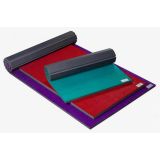
Yes — this is one of the places a mat becomes yours. The carpet comes in a palette that covers most team schemes: blue, red, black, purple, teal, light blue, and gray tones. Logos are done as inlaid carpet, cut into the mat surface itself rather than printed on top, up to 60 inches wide. Artwork needs to be in vector format (.ai, .eps, or .pdf); if you only have a regular image, vector artwork can be produced for you.
Are these practical for home use?
Answered by Jinna Hopson, VP of Marketing
Genuinely, yes — the 3 x 6 and 5 x 10 sizes exist for exactly that. They're the same carpet bonded foam construction as the full gym sections, sized for a basement, garage, or playroom where an athlete drills between practices. They ship by ground carrier rather than freight, typically in about two weeks, and they roll up for storage when the space has to go back to being a garage. Skills stay sharper when the practice surface at home matches the one at the gym.
By Dustin Thompson, Owner & CEO, Mats Inc.
↑
What Cheer Mats Do Before a Hard Landing Becomes an Injury
Every tumbling pass ends the same way: an athlete meeting the floor. What's between them and that floor decides whether the landing is routine or a season-ending problem. Cheerleading mats exist to absorb that impact — practice after practice, pass after pass — so athletes can train full-out without the floor punishing every rep.
These are roll out cheer mats built from carpet bonded foam: an athletic carpet surface laminated to a shock-absorbing foam core. Sections join side by side to build exactly as much floor as the program needs — a single tumbling strip along one wall, or a full competition-size cheer floor.
And the construction scales down as readily as it scales up. The same carpet-over-foam build that covers an all-star gym comes in home practice sizes, so the surface an athlete drills on in the basement matches the one waiting at practice.
Why Carpet Bonded Foam at 1-3/8 Inch, and Why This One
The build is specific: 26 oz athletic carpet flame-laminated to cross-linked polyethylene foam at a 2.2 lb density. That density is the working number — firm enough to give tumblers a consistent, predictable surface, forgiving enough to take the shock out of landings. Cheap foam does neither for long; it packs down where athletes land most and turns dead spots into rolled ankles.
The 1-3/8 inch thickness is the reason to pick this exact mat: it's the standard used throughout the cheerleading world — the thickness athletes perform on. Training on it means practice conditions match performance conditions, so nothing about the floor changes on the day it counts. It's made in the USA. Programs that want extra cushion for high-repetition drilling can step up to our 2 inch version of the same construction.
The roll system is built for real gyms, where mats go up and down daily. One person can set up or break down a section, no flipping required before or after rolling, and each roll includes a storage strap. Order multiple sections and hook fasteners come included, joining the seams so the floor performs as one surface instead of shifting pieces.
Where It Belongs — and What It Is Not
This surface belongs anywhere athletes tumble and stunt: cheer gyms, school athletic programs, all-star facilities, rec centers, and dance and acro spaces. The smaller 3 x 6 and 5 x 10 sizes bring the same construction home — a basement or garage practice mat for an athlete putting in extra reps. It sits alongside the rest of our gym flooring as the roll-out option among permanent surfaces.
Know what it is not. This is a dead mat — the industry term for foam over a solid floor. It is not a spring floor, and it is not an inflatable air track. That's a feature, not a gap: dead-mat foam is the surface programs train and compete on when they need consistent response, and it stores in a fraction of the space.
Three Things to Check Before You Spec It
Walk through three decisions before you order.
First, confirm the competition match is what you want. This 1-3/8 inch thickness exists to mirror the standard performance surface — that's its job. If your program's priority is instead maximum cushion for drilling new skills or younger athletes, the 2 inch version of this same mat trades exact surface match for extra shock absorption; pick deliberately, not by default.
Second, size to the program. A single 6 x 42 section makes a tumbling strip. Nine sections build the full 42 x 54 competition cheer floor. Home athletes are covered at 3 x 6 and 5 x 10 — and custom sizes fill whatever your space demands, so an odd practice room doesn't force a compromise.
Third, plan the calendar. Home-size mats typically ship in about two weeks by ground carrier; full-size sections and custom floors travel by freight and are quoted at order. If the floor needs to be down for a season opener or a scheduled competition, count backward from that date and order early — a floor that arrives after the first practice helps no one.
Why Mats Inc.
Mats Inc. has covered floors since 1964, and athletic flooring is where getting it right matters most — the consequence of a wrong spec here isn't a worn corner, it's a hurt athlete. We'll help you land the layout, colors, and logo before anything goes into production, and every mat is backed by our 1-year limited warranty.
Construction 26 oz carpet flame-laminated to cross-linked polyethylene foam Foam density 2.2 lb Thickness 1-3/8 inch — industry-standard cheer thickness Standard section 6 ft x 42 ft Full competition floor 42 ft x 54 ft (nine sections) Home / practice sizes 3 ft x 6 ft and 5 ft x 10 ft Section weight About 107 lbs (6 x 42 section) Rolled size 32 inch diameter x 72 inches tall Colors Blue, red, black, purple, teal, light blue, and gray tones; white for inlaid logos only Customization Custom sizes; inlaid carpet logos from vector artwork (max logo width 60 inches) Included Storage strap per roll; hook fasteners with multiple sections Typical lead time About 2 weeks for home sizes; full-size and custom floors quoted at order Origin Made in the USA Warranty 1-year limited (Mats Inc.) Frequently Asked Questions
What's actually inside a carpet bonded foam cheer mat?
Answered by Dustin Thompson, Owner & CEO
Two layers doing two jobs. The top is 26 oz athletic carpet — the traction surface athletes plant, pivot, and land on. Beneath it, flame-laminated so the layers can't peel apart, is cross-linked polyethylene foam at a 2.2 lb density. Cross-linked foam holds its structure under repeated impact, which is why the mat feels the same on the thousandth landing as it did on the first instead of packing down where tumbling passes end.
Why is 1-3/8 inch the thickness most programs choose?
Answered by Dustin Thompson, Owner & CEO
Because it's the thickness the sport performs on. Cheerleading runs on a consistent surface standard, and 1-3/8 inch carpet bonded foam is it — so training at this thickness means an athlete's timing, rebound, and landings transfer directly to performance day. A floor that feels different in practice than in competition makes athletes re-learn their skills at the worst possible moment.
How heavy are the sections, and what does daily setup look like?
Answered by Dustin Thompson, Owner & CEO
A standard 6 x 42 section weighs about 107 pounds, but the roll system is designed so one person can handle setup and breakdown. The mat rolls in either direction with no flipping required, and each roll comes with a hook-and-loop storage strap. Rolled up, a section stands 72 inches tall at a 32 inch diameter — compact enough to stage along a gym wall between practices, and the mats can be cut down with a utility knife if a room demands it.
What sizes are available?
Answered by Jinna Hopson, VP of Marketing
The standard cheer section is 6 x 42 feet, and nine sections joined together make the full 42 x 54 competition cheer floor. For home athletes there are 3 x 6 and 5 x 10 practice mats in the same construction. If none of those match your space, custom sizing is available — tell us the room and we'll spec the floor to it, whether that's a narrow tumbling strip or a full training floor with a logo at center.
Can we get our team colors and logo on the mat?
Answered by Jinna Hopson, VP of Marketing
Yes — this is one of the places a mat becomes yours. The carpet comes in a palette that covers most team schemes: blue, red, black, purple, teal, light blue, and gray tones. Logos are done as inlaid carpet, cut into the mat surface itself rather than printed on top, up to 60 inches wide. Artwork needs to be in vector format (.ai, .eps, or .pdf); if you only have a regular image, vector artwork can be produced for you.
Are these practical for home use?
Answered by Jinna Hopson, VP of Marketing
Genuinely, yes — the 3 x 6 and 5 x 10 sizes exist for exactly that. They're the same carpet bonded foam construction as the full gym sections, sized for a basement, garage, or playroom where an athlete drills between practices. They ship by ground carrier rather than freight, typically in about two weeks, and they roll up for storage when the space has to go back to being a garage. Skills stay sharper when the practice surface at home matches the one at the gym.
By Dustin Thompson, Owner & CEO, Mats Inc.
↑
View Details
View Details
Roll Out Cheer Mats - 2" THICK$138.00What 2 Inch Cheer Mats Do Before Repetition Wears Athletes Down Skills aren't built in one attempt. They're built in fifty attempts a practice, and most of those attempts end in a landing that isn't quite right yet. The floor absorbs every one of them — or the athlete does....
What 2 Inch Cheer Mats Do Before Repetition Wears Athletes Down Skills aren't built in one attempt. They're built in...
What 2 Inch Cheer Mats Do Before Repetition Wears Athletes Down
Skills aren't built in one attempt. They're built in fifty attempts a practice, and most of those attempts end in a landing that isn't quite right yet. The floor absorbs every one of them — or the athlete does. That's the problem the 2 inch cheer mat exists to solve: taking the punishment out of volume.
This is the thicker build of roll out carpet bonded foam — the same athletic carpet surface and cross-linked foam core used across cheer flooring, with more than half an inch of additional foam underneath. Sections join side by side into tumbling strips, training floors, or full practice layouts, then roll up when the space is needed for something else.
It's the mat for the work that happens before performance day: new-skill drilling, youth programs, conditioning-heavy practices — anywhere landing count is high and every impact the floor doesn't absorb accumulates in ankles, knees, and backs across a season.
Why the Extra Foam, and Why This One
The construction matches the rest of the line where it counts: 26 oz athletic carpet flame-laminated to 2.2 lb density cross-linked polyethylene foam, made in the USA. What changes is depth. At 2 inches, the foam column under each landing is deeper, which is what the vendor spec calls enhanced shock absorption — more material working before the impact reaches the floor beneath.
Depth matters most when landings are imperfect, and imperfect landings are the definition of learning. An athlete drilling a new pass lands short, over-rotated, off-line — dozens of times before it's clean. On thin or worn-out foam, those misses hurt, and athletes who hurt start holding back. The thicker profile keeps full-effort repetition sustainable.
The roll system carries over unchanged: one person sets up or breaks down a section, no flipping required before or after rolling, a storage strap comes with every roll, and hook fasteners are included with multiple sections so seams stay joined under traffic. Rolled, a section stands 72 inches tall at a 41 inch diameter.
Where It Belongs — and What It Is Not
This thickness belongs where training volume lives: all-star and school practice gyms, tumbling classes, youth and rec programs, and the 3 x 6 home size for an athlete drilling in the basement or garage. It sits within our gym flooring range as the deep-cushion roll-out option.
What it is not: the exact competition-surface match. The thickness cheerleading performs on is 1-3/8 inch, and programs whose priority is replicating performance conditions should train on that version instead. This mat makes the opposite trade on purpose — extra absorption over exact surface match — and it isn't a spring floor or an inflatable air track either. It's a dead mat with more depth.
Three Things to Check Before You Spec It
Three decisions settle the order.
First, be honest about what the floor is for. If it's a drilling and development surface — new skills, young athletes, high-repetition practice — the 2 inch profile is doing exactly its job. If the floor's main purpose is rehearsing routines under performance conditions, the 1-3/8 inch standard thickness is the truer tool, and choosing thickness by "more is better" instead of by purpose is the mistake that burns programs.
Second, size to the space and the work. A 6 x 42 section builds a tumbling strip; multiple sections build out a practice floor; the 3 x 6 home size covers individual training; and custom sizes are available when the room is the constraint. Remember the rolled bulk when planning storage — at 41 inches in diameter per section, a multi-section floor needs real wall space.
Third, plan the calendar. The home-size mat typically ships in about two weeks by ground carrier; full-size sections and custom builds travel by freight and are quoted at order. Back-plan from the season: a development floor delivers the most value when it's down before the heavy skill-building blocks start, not mid-season.
Why Mats Inc.
Mats Inc. has been putting the right surface under hard work since 1964, and this mat is in the line for a coach's reason, not a catalog reason: development floors take more abuse per week than performance floors, and the athletes on them are the ones still learning to fall. We'll help you match thickness to purpose before you order, and every mat carries our 1-year limited warranty.
Construction 26 oz carpet flame-laminated to cross-linked polyethylene foam Foam density 2.2 lb Thickness 2 inch — enhanced shock absorption Standard section 6 ft x 42 ft Home / practice size 3 ft x 6 ft Rolled size 41 inch diameter x 72 inches tall Colors Blue, red, black, purple, teal, light blue, and gray tones; white for inlaid logos only Customization Custom sizes; inlaid carpet logos from vector artwork (max logo width 60 inches) Included Storage strap per roll; hook fasteners with multiple sections Typical lead time About 2 weeks for the home size; full-size and custom floors quoted at order Origin Made in the USA Warranty 1-year limited (Mats Inc.) Frequently Asked Questions
Is the 2 inch mat a different construction than standard cheer mats?
Answered by Dustin Thompson, Owner & CEO
No — same recipe, more of it. It's the identical 26 oz athletic carpet flame-laminated to 2.2 lb density cross-linked polyethylene foam; the difference is the foam runs 2 inches deep instead of 1-3/8. That means traction, surface feel, and durability behave the way athletes expect from carpet bonded foam, while the deeper foam column absorbs more of each landing before it reaches the floor underneath.
What does the extra thickness actually change for athletes?
Answered by Dustin Thompson, Owner & CEO
It changes what a bad landing costs. New skills mean missed landings by definition — short, long, over-rotated — and every miss is an impact the body absorbs. The deeper foam spreads that impact over more material, which is what the enhanced shock absorption rating describes. Over a season of high-repetition practice, that's the difference between athletes who can keep drilling at full effort and athletes nursing sore heels and knees.
How does handling compare, given the bigger roll?
Answered by Dustin Thompson, Owner & CEO
The roll system works the same: one person can set up or break down a section, the mat rolls either direction with no flipping, and each roll includes a storage strap. The difference is bulk — a rolled section measures 41 inches across versus 32 for the thinner version — so plan storage wall space accordingly. Hook fasteners still come included with multiple sections to keep seams tight during practice.
What sizes can I get in the 2 inch thickness?
Answered by Jinna Hopson, VP of Marketing
The standard 6 x 42 section is the building block, joining side by side into strips and practice floors, and there's a 3 x 6 home size for individual training spaces. Beyond those, custom sizing is available — if your practice room is an odd length or you want the floor to run wall to wall, tell us the dimensions and we'll spec it as a custom build rather than forcing stock sections to fit.
Do the same colors and logo options apply?
Answered by Jinna Hopson, VP of Marketing
Yes — thickness doesn't limit the look. The carpet palette runs blue, red, black, purple, teal, light blue, and gray tones, with white reserved for logo inlays. Logos are inlaid carpet cut into the surface, up to 60 inches wide, from vector artwork (.ai, .eps, or .pdf — and vector files can be produced for you if you only have a regular image). A practice floor in team colors does quiet work for program culture every single day.
Should we buy 2 inch or the standard thickness?
Answered by Jinna Hopson, VP of Marketing
Match the mat to the floor's job. If the floor is primarily for rehearsing routines the way they'll be performed, the 1-3/8 inch standard keeps practice identical to performance. If the floor is primarily for building skills — drilling, youth development, high-repetition tumbling — the 2 inch cushion earns its place. Plenty of larger programs eventually run one of each: a development floor and a rehearsal floor doing different jobs.
By Dustin Thompson, Owner & CEO, Mats Inc.
↑
What 2 Inch Cheer Mats Do Before Repetition Wears Athletes Down
Skills aren't built in one attempt. They're built in fifty attempts a practice, and most of those attempts end in a landing that isn't quite right yet. The floor absorbs every one of them — or the athlete does. That's the problem the 2 inch cheer mat exists to solve: taking the punishment out of volume.
This is the thicker build of roll out carpet bonded foam — the same athletic carpet surface and cross-linked foam core used across cheer flooring, with more than half an inch of additional foam underneath. Sections join side by side into tumbling strips, training floors, or full practice layouts, then roll up when the space is needed for something else.
It's the mat for the work that happens before performance day: new-skill drilling, youth programs, conditioning-heavy practices — anywhere landing count is high and every impact the floor doesn't absorb accumulates in ankles, knees, and backs across a season.
Why the Extra Foam, and Why This One
The construction matches the rest of the line where it counts: 26 oz athletic carpet flame-laminated to 2.2 lb density cross-linked polyethylene foam, made in the USA. What changes is depth. At 2 inches, the foam column under each landing is deeper, which is what the vendor spec calls enhanced shock absorption — more material working before the impact reaches the floor beneath.
Depth matters most when landings are imperfect, and imperfect landings are the definition of learning. An athlete drilling a new pass lands short, over-rotated, off-line — dozens of times before it's clean. On thin or worn-out foam, those misses hurt, and athletes who hurt start holding back. The thicker profile keeps full-effort repetition sustainable.
The roll system carries over unchanged: one person sets up or breaks down a section, no flipping required before or after rolling, a storage strap comes with every roll, and hook fasteners are included with multiple sections so seams stay joined under traffic. Rolled, a section stands 72 inches tall at a 41 inch diameter.
Where It Belongs — and What It Is Not
This thickness belongs where training volume lives: all-star and school practice gyms, tumbling classes, youth and rec programs, and the 3 x 6 home size for an athlete drilling in the basement or garage. It sits within our gym flooring range as the deep-cushion roll-out option.
What it is not: the exact competition-surface match. The thickness cheerleading performs on is 1-3/8 inch, and programs whose priority is replicating performance conditions should train on that version instead. This mat makes the opposite trade on purpose — extra absorption over exact surface match — and it isn't a spring floor or an inflatable air track either. It's a dead mat with more depth.
Three Things to Check Before You Spec It
Three decisions settle the order.
First, be honest about what the floor is for. If it's a drilling and development surface — new skills, young athletes, high-repetition practice — the 2 inch profile is doing exactly its job. If the floor's main purpose is rehearsing routines under performance conditions, the 1-3/8 inch standard thickness is the truer tool, and choosing thickness by "more is better" instead of by purpose is the mistake that burns programs.
Second, size to the space and the work. A 6 x 42 section builds a tumbling strip; multiple sections build out a practice floor; the 3 x 6 home size covers individual training; and custom sizes are available when the room is the constraint. Remember the rolled bulk when planning storage — at 41 inches in diameter per section, a multi-section floor needs real wall space.
Third, plan the calendar. The home-size mat typically ships in about two weeks by ground carrier; full-size sections and custom builds travel by freight and are quoted at order. Back-plan from the season: a development floor delivers the most value when it's down before the heavy skill-building blocks start, not mid-season.
Why Mats Inc.
Mats Inc. has been putting the right surface under hard work since 1964, and this mat is in the line for a coach's reason, not a catalog reason: development floors take more abuse per week than performance floors, and the athletes on them are the ones still learning to fall. We'll help you match thickness to purpose before you order, and every mat carries our 1-year limited warranty.
Construction 26 oz carpet flame-laminated to cross-linked polyethylene foam Foam density 2.2 lb Thickness 2 inch — enhanced shock absorption Standard section 6 ft x 42 ft Home / practice size 3 ft x 6 ft Rolled size 41 inch diameter x 72 inches tall Colors Blue, red, black, purple, teal, light blue, and gray tones; white for inlaid logos only Customization Custom sizes; inlaid carpet logos from vector artwork (max logo width 60 inches) Included Storage strap per roll; hook fasteners with multiple sections Typical lead time About 2 weeks for the home size; full-size and custom floors quoted at order Origin Made in the USA Warranty 1-year limited (Mats Inc.) Frequently Asked Questions
Is the 2 inch mat a different construction than standard cheer mats?
Answered by Dustin Thompson, Owner & CEO
No — same recipe, more of it. It's the identical 26 oz athletic carpet flame-laminated to 2.2 lb density cross-linked polyethylene foam; the difference is the foam runs 2 inches deep instead of 1-3/8. That means traction, surface feel, and durability behave the way athletes expect from carpet bonded foam, while the deeper foam column absorbs more of each landing before it reaches the floor underneath.
What does the extra thickness actually change for athletes?
Answered by Dustin Thompson, Owner & CEO
It changes what a bad landing costs. New skills mean missed landings by definition — short, long, over-rotated — and every miss is an impact the body absorbs. The deeper foam spreads that impact over more material, which is what the enhanced shock absorption rating describes. Over a season of high-repetition practice, that's the difference between athletes who can keep drilling at full effort and athletes nursing sore heels and knees.
How does handling compare, given the bigger roll?
Answered by Dustin Thompson, Owner & CEO
The roll system works the same: one person can set up or break down a section, the mat rolls either direction with no flipping, and each roll includes a storage strap. The difference is bulk — a rolled section measures 41 inches across versus 32 for the thinner version — so plan storage wall space accordingly. Hook fasteners still come included with multiple sections to keep seams tight during practice.
What sizes can I get in the 2 inch thickness?
Answered by Jinna Hopson, VP of Marketing
The standard 6 x 42 section is the building block, joining side by side into strips and practice floors, and there's a 3 x 6 home size for individual training spaces. Beyond those, custom sizing is available — if your practice room is an odd length or you want the floor to run wall to wall, tell us the dimensions and we'll spec it as a custom build rather than forcing stock sections to fit.
Do the same colors and logo options apply?
Answered by Jinna Hopson, VP of Marketing
Yes — thickness doesn't limit the look. The carpet palette runs blue, red, black, purple, teal, light blue, and gray tones, with white reserved for logo inlays. Logos are inlaid carpet cut into the surface, up to 60 inches wide, from vector artwork (.ai, .eps, or .pdf — and vector files can be produced for you if you only have a regular image). A practice floor in team colors does quiet work for program culture every single day.
Should we buy 2 inch or the standard thickness?
Answered by Jinna Hopson, VP of Marketing
Match the mat to the floor's job. If the floor is primarily for rehearsing routines the way they'll be performed, the 1-3/8 inch standard keeps practice identical to performance. If the floor is primarily for building skills — drilling, youth development, high-repetition tumbling — the 2 inch cushion earns its place. Plenty of larger programs eventually run one of each: a development floor and a rehearsal floor doing different jobs.
By Dustin Thompson, Owner & CEO, Mats Inc.
↑
View Details
View Details