




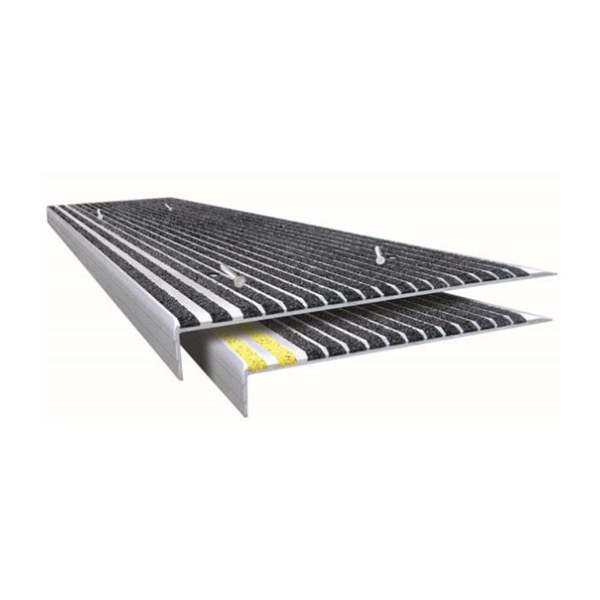
Description
What a non-slip stair tread does before a worn step becomes an incident
Stairs do not fail all at once. The nose rounds off, the walking surface polishes smooth under thousands of footfalls, and a step that once had grip turns into a slick edge people trust without looking. Non slip stair treads cover that surface with a hard abrasive face, putting traction back exactly where a foot lands and body weight shifts forward.
These are stair tread covers, not replacement steps. The tread fastens down over the step already in place. The abrasive face does the gripping, and the aluminum body underneath carries traffic and shields the nose from further wear. Nothing structural comes out, and the stairway stays in service through the work.
The descent is where the risk concentrates. A person going down a flight commits weight to the front third of each step, and that is the first area to wear smooth and the last area anyone inspects. A tread with a formed nose puts the grip surface over the edge itself rather than stopping short of it.
Traction is a measurable property, not an impression. The National Floor Safety Institute maintains ANSI/NFSI B101.1, the standard method for measuring wet traction on walking surfaces, which is the framework facility teams use when they audit a stairway rather than guess at it.
Why extruded aluminum with abrasive filler, and why this profile
The base is 6063-T5 extruded aluminum, heat treated and corrosion resistant. Extrusion matters here because it produces a consistent cross section along the full length of the tread, so the nose geometry and the filler channels are identical from one end of an 8-foot run to the other. There are no welds and no fasteners fighting a rolled or stamped shape.
The anti-slip surface is not a coating sitting on top of the metal. It is a filler packed into channels in the extrusion, and the specification calls for no less than 65% virgin grain aluminum oxide and silicon carbide abrasive. That is a mineral hardness argument: the grit outlasts the shoe leather and grit tracked across it rather than polishing under it.
Color runs uniformly through the filler instead of sitting on the surface as paint. Practically, that means the center of the stair, where every person walks, does not turn into a faded stripe against untouched edges after a season of traffic. Eleven standard colors are available, and black is supplied when no color is specified on the order.
The profile is what separates this tread from a flat plate. It measures 11 inches deep and 9/32 of an inch thick, with a 1-1/8 inch nose on the underside and a beveled back edge. The nose wraps the leading edge of the existing step. The beveled back lets the tread sit down against the step without creating a lip that catches a toe on the way up.
The assembly is noncombustible, tested under Federal Test Method Standard No. 501a, Method 6411 — a specification line that matters in stairwells serving as means of egress, where combustibility of applied finishes gets asked about during review.
Where it belongs, and where it is not the answer
This tread is built for renovation. It goes over stairs that already exist and have worn out, polished up, or were never slip resistant to begin with: concrete stairs in a parking structure, terrazzo in a school building, steel pan stairs in a plant, tile landings in a lobby, wood stairs in an older building.
It works interior and exterior. Outdoors, the corrosion-resistant aluminum handles weather and the abrasive face keeps working when the surface is wet — which is why it reads as a strong fit among exterior stair treads on loading docks, entry steps, and stairs exposed to freeze-thaw cycling. A special tread sealer is available for wood substrates and saltwater exposure.
Where it is not the answer: this is not a decorative finish tread and it is not carpet. It is also not the right call on a step whose structure is failing. If the concrete is spalling or a wood stringer is soft, the tread will fasten to a substrate that cannot hold an anchor, and the repair belongs before the tread, not under it.
It is also not a landing solution on its own. An 11-inch depth covers a stair tread, not a landing surface, so landings usually need a tile or a wider covering handled separately. The tread's job is the step; think of it as one component of the stairway package rather than the whole of it.
Three Things to Check Before You Spec It
First, confirm exposure and traffic. Interior and exterior are both in scope, but exterior stairs and stairs seeing constant traffic are where the abrasive content earns its keep. If the stair is exposed to saltwater or is being installed over wood, ask about the tread sealer at the time of order rather than after installation, because it is applied as part of the job.
Second, measure the step, not the stairway. You need the depth of the existing tread and the run length of each step, because lengths are made to order. Maximum length is 8 feet in a single section, and anything longer is supplied in equal sections. Decide up front whether treads run the full width less 1/8 inch of clearance, or terminate 4 inches short of each end — the short termination leaves a channel that is easier to clean out.
Third, settle the substrate and the anchor. Anchor type has to be specified on the order: Tapcons, wood screws, machine screws, or screws with expansion shields, depending on whether you are fastening into concrete, wood, or steel. Dished or worn steps need leveling compound troweled to a feather edge first, and smooth surfaces such as marble, terrazzo, or tile have to be roughed up so adhesive grabs. Drilled and countersunk holes come standard.
Why Mats Inc.
Stair treads get ordered wrong more often than almost anything else we sell, because the person measuring is rarely the person specifying the anchor. We take the step dimensions, the substrate, and the exposure together, and we confirm the length breakdown before anything gets cut, so a stairwell does not end up with a run of treads that are 3 inches short at the top landing. Sixty years of shipping into commercial and industrial jobs is most of what that judgment is built on.
| Base material | 6063-T5 extruded aluminum, heat treated and corrosion resistant |
|---|---|
| Anti-slip surface | Abrasive filler, not less than 65% virgin grain aluminum oxide / silicon carbide |
| Tread depth | 11" |
| Thickness | 9/32" |
| Nose | 1-1/8" underside, beveled back |
| End treatment | Beveled or square ends |
| Lengths | Made to order; 8'0" maximum in one section (longer runs supplied in equal sections) |
| Color | 11 standard colors; color extends uniformly through the filler; black supplied if none specified |
| Two-tone option | Contrasting color available on the first two ribs |
| Fire performance | Noncombustible per Federal Test Method Standard No. 501a, Method 6411 |
| Anchoring | Drilled and countersunk holes standard; Tapcons, wood screws, machine screws, or screws with expansion shields (anchor type specified at order) |
| Installation | Construction adhesive plus mechanical fasteners over prepared, level substrate |
| Application | Interior and exterior stair renovation |
| Warranty | 1-year limited (Mats Inc.) |
Frequently Asked Questions
What are these stair treads actually made of?
Answered by Dustin Thompson, Owner & CEO, Mats Inc.
The body is 6063-T5 extruded aluminum, heat treated and corrosion resistant. The gripping surface is a separate abrasive filler packed into channels formed into that extrusion, specified at no less than 65% virgin grain aluminum oxide and silicon carbide. Those two minerals sit near the top of the hardness scale, which is the whole point — grit tracked in on boots does not polish them down.
The distinction that matters is filler versus coating. A painted or sprayed anti-slip surface wears through and exposes bare substrate. Here the abrasive is a body of material with real depth to it, held in a metal channel. When people ask why the tread is 9/32 of an inch thick rather than a thin plate, that thickness is what makes room for the abrasive to have somewhere to go.
How well do they hold up under constant foot traffic?
Answered by Dustin Thompson, Owner & CEO, Mats Inc.
Durability here comes from three specific things rather than a general claim. The abrasive content is a minimum of 65% virgin grain aluminum oxide and silicon carbide. The base is heat-treated 6063-T5 aluminum, so it does not deform under point loads the way a soft metal would. And the color is carried through the filler, so wear does not show up first as a bleached path down the middle of the stairway.
The failure mode we see on these is almost never the tread surface. It is the fastening. A tread installed with adhesive and mechanical anchors into a properly leveled step stays put. A tread set on a dished step without leveling compound rocks under traffic, works the anchors loose, and gets blamed on the product. Our warranty is 1-year limited.
Can these go on outdoor concrete steps, or are they indoor only?
Answered by Dustin Thompson, Owner & CEO, Mats Inc.
They are specified for both interior and exterior stair renovation, and outdoor concrete is one of the most common applications we ship into. The aluminum is corrosion resistant, the abrasive face keeps working wet, and there is nothing in the assembly that absorbs water and freezes. Parking garage stairs, dock steps, and exterior entry stairs are all in scope.
Two things to raise before you order for an outdoor job. If the stair is near saltwater, ask for the tread sealer — it is applied at installation, not after. And if the concrete is spalling or the nose has broken away, that gets patched and leveled first. The tread needs a sound step to anchor into; it restores the walking surface, it does not rebuild the step.
How do I measure my stairs and order the right lengths?
Answered by Jinna Hopson, Vice President of Marketing, Mats Inc.
Two measurements per stairway: the depth of the existing tread front to back, and the width of the step from stringer to stringer. Depth tells us whether the 11-inch profile fits your step. Width sets the cut length, and lengths are made to order rather than pulled from stock sizes, so you are not forced into a standard that leaves a gap.
Maximum length is 8 feet in one continuous section. Anything wider than that comes in equal sections rather than one long piece and one stub, which looks deliberate instead of patched. You will also want to decide whether treads run the full width of the step less 1/8 inch of clearance, or stop 4 inches short of each end. The short termination is the easier one to keep clean in a stairwell that gets mopped.
Will the color fade or wear off where people walk?
Answered by Jinna Hopson, Vice President of Marketing, Mats Inc.
No, and that is a deliberate design choice rather than a coating quality. The color extends uniformly through the abrasive filler, so as the surface wears the exposed material is the same color as what was there originally. A stairway does not end up with a pale traffic lane down the middle and saturated color at the untouched edges, which is exactly how a painted or coated stair ages.
There are eleven standard colors, and if no color is specified on the order, black is what ships. For property managers matching an existing palette across a building, that range is usually enough to land close on a stairwell without a custom run.
Can I get a contrasting nose so the step edge stands out?
Answered by Jinna Hopson, Vice President of Marketing, Mats Inc.
Yes. A two-tone tread with a contrasting color on the first two ribs is available, and it is worth asking about on almost any public stairway. A high-contrast leading edge makes the boundary between one step and the next legible to someone descending quickly, in low light, or with reduced vision. Safety yellow against a dark body is the combination most people picture, but the contrast can be built from any of the standard colors.
It also gives you a design lever in a lobby or an entry stair where a stripe of tape would look like a temporary fix. Because the contrast comes from filler color rather than an applied marking, it wears at the same rate as the rest of the tread and does not peel at the nose. Specify the two-tone at the time of order — it is not something added after the treads are made.
Written by Dustin Thompson, Owner & CEO, Mats Inc.
Ordering Info
COLOR OPTIONS: Black, Blue, Concrete Gray, Dark Brown, Dark Green, Dark Red, Light Brown, Light Green, Light Red, Safety Yellow, White.
Reviews
Write Your Own Review
Related Products
Super Scrape Rubber Mats
Safety Track Non-Skid Tape - Coarse

Smooth Marbleized Vinyl Switchboard Matting (Mil Spec)
Super Scrape Rubber Logo Mats
Strip Doors
Perfec Clean 3/8" Rollup Mats - Aluminum Hinge
Perfec Clean 3/8" Rollup Mats - Rubber Hinge
Perfec Clean 3/4" Rollup Grate - Rubber Hinge
Perfec Clean 1-5/8" Grate
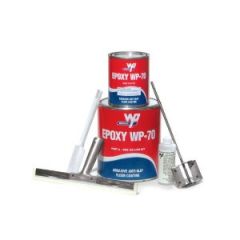
WP-70 Non-Skid Epoxy Coating