




More Information
| Manufacturer | Mats-Inc |
|---|
Reviews
- Great companyEasy team to work with for all needs
Posted on
$222.00

Have a question? We're here to help!
Description
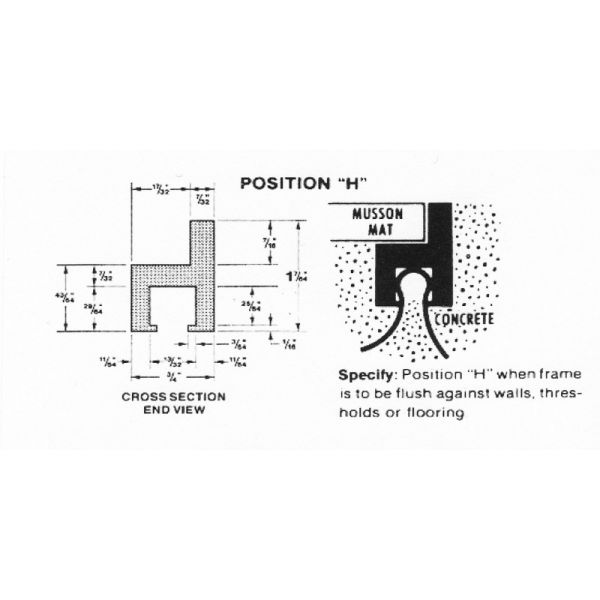
A recessed mat well only works if its edges are clean and square — and that's the job of the recess frame. It's an extruded aluminum border set into the floor around the well, giving the recess a finished, durable edge that holds the mat flush and keeps the surrounding floor from chipping under traffic. It comes pre-cut and ready to drop in, so the well is ready when the mat arrives.
What a recess frame does before the well edge breaks down
A recessed mat well is a shallow pit cut into the floor that a walk-off mat or grate drops into so it sits flush. Without a finished border, the edge of that well is just raw concrete or cut tile — and a raw edge at a doorway chips, crumbles, and turns ragged fast under foot traffic.
The recess frame is the fix. It lines the perimeter of the well with a solid aluminum edge, so the mat seats cleanly against it, the floor finish outside it stays protected, and the threshold keeps a crisp, level line instead of a broken one. It's the difference between a recessed mat well that looks built-in and one that looks cut-in.
Why extruded aluminum, and why this frame
The frame is made from heavy-gauge 6063 T-5 extruded aluminum — an alloy and temper chosen for structural edges that take abuse without bending or corroding. That matters at a doorway, where the frame edge gets stepped on, rolled over, and scraped every day, and where rust would show.
It arrives pre-cut at the factory and ready to assemble on site, supplied with aluminum corner pins and steel anchor keys that lock it into the floor. Because it's cut to your dimensions ahead of time, you skip field measuring and the construction delays that come with it — you can order the mat in advance and drop it in once the frame is set.
Corners can come square for an open-end recess or mitered for a clean closed border, factory-cut or finished on the job. A single frame runs up to 17 feet, and for anything longer, straight connecting pins join sections into one continuous edge.
Where it belongs, and what it is not
A recess frame belongs anywhere you're setting a mat or grate into the floor rather than laying it on top — building lobbies, vestibules, and corridors where a flush, built-in entrance is the goal. It's the finishing edge for our recessed grate systems and recessed mats alike, sized to receive common mat and tile thicknesses.
It is not the walking surface itself — it's the border that holds and frames that surface. And it's not a surface-mount product; it's for recessed installations, where the well is cut into the floor and the frame defines its edge. If you're laying a mat on top of an existing floor, you want a surface-applied mat with its own ramped edge instead.
Three things to check before you spec it
First, order by the finished inside size. The size you give is the inside measurement of the frame — the finished opening where the mat fits — not the rough hole in the floor. Getting this right is what makes the mat drop in cleanly, so confirm it against the mat's finished dimensions before you order.
Second, match it to the mat thickness and floor build-up. The frame is set with a cement screed about 7/16" below the floor line so the mat finishes flush, and it installs in one of several positions to suit the floor outside it. Know the mat or tile thickness and the surrounding floor before you set the frame.
Third, plan the corners and the length. Decide whether you need square ends for an open recess or mitered corners for a closed border, and remember a single frame tops out at 17 feet. For a wider entrance, connecting pins join sections — but that's worth planning before the order, not after.
Why Mats Inc.
We've specified entrance flooring since 1964, and the frame is the part people forget until the edge of a recessed well starts breaking up. Getting it right means matching the frame to the mat, the thickness, and the floor it sits in, then having it pre-cut so the install goes in clean. We help you size and position it correctly and ship it ready to set. Mats Inc. specifies the system; your installer sets the frame and screeds the base.
| Material | Heavy-gauge 6063 T-5 extruded aluminum |
| Function | Forms the finished perimeter edge of a recessed mat or grate well; holds the mat flush and protects the floor edge |
| Finish | Mill aluminum standard; Medium Bronze available (electrostatically applied) |
| Maximum single length | 17'; straight connecting pins supplied for longer runs |
| Corners / ends | Square (open-end recess) or mitered (factory or on-site) |
| Ordering | Order by the finished inside dimension — the opening where the mat fits |
| Supplied with | Aluminum corner pins and steel anchor keys; pre-cut at factory |
| Installation | Recessed; set with a cement screed ~7/16" below floor level, using the frame edge as guide; multiple install positions to suit the floor build-up |
| Receives | Recessed entrance mats and tiles at common thicknesses (3/8", 7/16", 1/2") |
| Warranty | 1-year limited (Mats Inc.) |
Frequently Asked Questions
What is a recess mat frame, and what's it made of?
Answered by Dustin Thompson, Owner & CEO
It's the aluminum border that lines the edge of a recessed mat well — the well being the shallow pit a walk-off mat or grate sits down into. This one is made from heavy-gauge 6063 T-5 extruded aluminum, and it ships pre-cut with aluminum corner pins and steel anchor keys that lock it into the floor.
Set into the perimeter of the well, it gives the recess a clean, finished edge and holds the mat flush with the surrounding floor.
Why use a metal frame instead of just a concrete recess?
Answered by Dustin Thompson, Owner & CEO
A bare concrete or cut-tile edge at a doorway doesn't hold up. Every step, cart wheel, and dragged item works at that edge until it chips and crumbles, and a ragged recess edge becomes both an eyesore and a trip hazard.
The aluminum frame takes that abuse instead of the floor — it keeps the edge square and intact for years, protects the flooring outside the well, and gives the mat a solid border to seat against.
How is the frame installed?
Answered by Dustin Thompson, Owner & CEO
The frame sets into the perimeter of the recessed well. A cement base is screeded into the interior about 7/16 inch below the floor line — using the frame edge as the guide — so the mat finishes flush once it drops in. Steel anchor keys lock the frame to the floor, and it's installed in one of several positions to suit the surrounding floor build-up.
Because it's pre-cut, the install is mostly assembly and setting, not measuring and cutting on site.
Does it have to look like bare metal?
Answered by Jinna Hopson, Vice President of Marketing
Not necessarily. The standard frame is mill-finish aluminum, which reads clean and neutral against most floors, and a medium bronze finish is available when you want the edge to warm up or settle into a darker floor.
Since the frame is the visible line around your entrance mat, it's worth picking the finish with the surrounding floor in mind rather than defaulting to bare aluminum.
What size do I order, and can it fit a long or unusual entrance?
Answered by Jinna Hopson, Vice President of Marketing
You order by the finished inside size — the opening where the mat fits — so it's best to settle the mat's finished dimensions first and order the frame to match. A single frame runs up to 17 feet; for a wider entrance, sections join with connecting pins into one continuous edge.
Corners can be square for an open recess or mitered for a closed border, so an entry that isn't a simple rectangle can still get a clean frame.
How do I make sure the frame and mat actually fit together?
Answered by Jinna Hopson, Vice President of Marketing
The cleanest approach is to spec the frame and the mat as a pair, sized to the same finished dimensions, so the mat drops into the frame without gaps or trimming. Because the frame is pre-cut to order, you can have it on site and set ahead of time, then drop the mat in when it arrives.
Tell us the mat you're using and we'll size the frame to receive it — that's what makes a recessed entrance look built-in rather than improvised.
By Dustin Thompson, Owner & CEO, Mats Inc.
Ordering Info
Weight: .4#/LF
Length: 16' 6" maximum length per section. Larger sizes will be provided in multiple pieces.
Reviews
Customer Reviews
- Great companyEasy team to work with for all needs
Posted on
Write Your Own Review
Related Products
Super Scrape Rubber Mats
Safety Track Non-Skid Tape - Coarse

Smooth Marbleized Vinyl Switchboard Matting (Mil Spec)
Super Scrape Rubber Logo Mats
Strip Doors
Perfec Clean 3/8" Rollup Mats - Aluminum Hinge
Perfec Clean 3/8" Rollup Mats - Rubber Hinge
Perfec Clean 3/4" Rollup Grate - Rubber Hinge
Perfec Clean 1-5/8" Grate
WP-70 Non-Skid Epoxy Coating