




Description
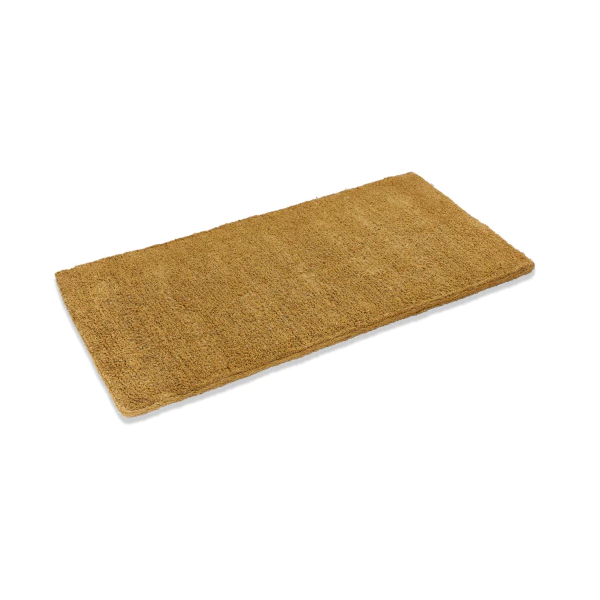
Woven Backed Cocoa Mats are the coir doormat most people picture when they hear the word: a thick, hand-woven slab of coconut fiber with braided edges and a woven base, in natural tan, with nothing printed on it. It is one of the oldest coco matting constructions still made, and it is still made because the design works at a door.
What a Coir Doormat Does Before the Floor Inside Pays for It
The job of a doormat is to take what shoes carry and keep it. Coir is good at both halves. The stiff fiber ends brush grit and dry soil off soles, and the dense weave soaks up the water that comes in with them. ISSA research puts the stakes plainly: about twelve times more dirt comes through a door during wet weather than on a dry day.
What separates this mat from a thin one is depth. A thick woven coir mat has fiber to spare, so grit works down into the mat instead of sitting on top where the next shoe carries it inside. That depth is also what lets the mat hold moisture without a wet film forming on the surface, which is where a threshold turns slick.
The way this mat fails is by staying wet. Coir that soaks and never dries goes soft and can mildew from the underside. The woven back is the answer to that: the maker's own description is that it lets water seep through the fibers rather than waterlogging the mat. Give it a spot where air reaches it and it dries between storms.
Why a Hand-Woven Coir Slab, and Why This One
This mat is woven, not tufted onto a rubber or vinyl sheet. Heavy coir yarn, spun by the maker from coconut husk, is worked into a tough woven base so the pile and the backing are one piece of fiber. There is no glue line to fail and no plastic layer to trap water against the floor.
The edges are braided rather than stitched or bound with tape. On a doormat that gets kicked, dragged, and shaken out every week, the edge is where a mat comes apart first. A braided coir edge is fiber locked onto fiber, so it wears at the same pace as the mat instead of peeling off ahead of it.
The maker rates the mat strong enough to stand up to heavy foot traffic, and notes that it lasts longer kept under a sheltered patio or porch. Both points come from the same fact: this is one hundred percent natural coir. It shrugs off scuffing and scraping. What shortens its life is constant weather, not feet.
Mats Inc. offers it in six sizes, from 18 by 30 inches for a single back door up to 48 by 72 inches for a double door or a lobby, all in natural tan. The maker also builds custom sizes to order, so an odd-width door or a long vestibule is a quote, not a compromise.
Where It Belongs, and What It Is Not
The maker places this mat at household and commercial entrances, and that is where it earns its keep: the front door of a house, the covered entry of a shop, a church or club porch, a lodge or inn where a black rubber mat would look wrong. It also suits a mudroom or a covered service door where boots come off.
Because it is plain, it fits places a printed or lettered mat cannot. A historic storefront, a garden center, a spa entrance, or a rental property that changes tenants all take a plain coconut doormat without anyone rethinking the message at the door.
What it is not: a mat for open weather. Sustained rain and sun shorten the life of any natural fiber, and the maker says so. It is also not a sealed mat. Water that drains through the woven back reaches the surface beneath, so it belongs on a porch, a stoop, or a hard floor that can take moisture, not on finished hardwood.
It is not a recessed-well mat either. A thick woven slab sits on top of the floor and announces itself. If you need matting cut to a shape or set flush into a well, a backed product designed for that is the better tool.
Three Things to Check Before You Spec It
First, cover. Look up. A roof, an awning, or a deep entry alcove over the door is the single biggest factor in how long this mat lasts. A covered entry is years of service. An open stoop in a wet climate is a season or two, and that is a fair trade only if you plan for it.
Second, the door swing. A thick coir doormat sits well above the floor. Measure the gap under an out-swinging door before you pick a size that reaches under it, and on an in-swinging door make sure the mat clears the sweep. Where the gap is tight, keep the mat outside the swing rather than under it.
Third, the width of the walk. A doormat narrower than the door invites people to step around it. Match the mat to the opening at minimum: a single door takes a mat close to its width, and a pair of doors or a lobby wants the 72-inch mat so both leaves land on coir.
Why Mats Inc.
Plain coir doormats have been on our shelf in Houston for as long as we have been in business, which since 1964 is long enough to have watched thin ones curl and cheap borders peel. This is the version we would put outside our own front door. Call us with the doorway and the exposure, and we will tell you which size to order and whether coir or a backed mat is the honest fit.
| Material | 100% natural coir (coconut-husk fiber) |
| Construction | Hand-woven heavy coir yarn on a woven base |
| Backing | Woven coir; lets water seep through rather than waterlog |
| Edges | Braided |
| Sizes offered | 18" x 30", 22" x 36", 30" x 48", 36" x 48", 36" x 60", 48" x 72"; custom sizes to order |
| Color | Natural tan |
| Placement | Household and commercial entrances; longest life under cover |
| Warranty | 1-year limited (Mats Inc.) |
Frequently Asked Questions
How is a woven backed cocoa mat made, and what does the woven back do?
Answered by Dustin Thompson, Owner & CEO
It is hand-woven from heavy coir yarn, which is spun from the fiber of the coconut husk. The yarn is worked into a tough woven base, and the edges are braided from the same fiber, so the whole mat is one material front to back with no rubber or vinyl layer and no glue.
The woven back is what keeps the mat from turning into a sponge. Water that the pile takes in can seep down through the fibers and out, instead of sitting in the mat. That is the maker's stated purpose for it, and it is why this construction dries between rains where a sealed mat would hold water.
How long does a coir doormat last, and what wears it out?
Answered by Dustin Thompson, Owner & CEO
Under a covered entry, expect one to three years of daily use, and often more at a lightly used door. That range is our field judgment from what customers report, not a laboratory figure. The maker's own note is that the mat lasts longer kept under a sheltered patio, and that matches what we see.
Feet are not what kill it. Weather is. Constant rain keeps the fiber wet, and constant sun bleaches and stiffens it until the pile starts to shed. A mat that gets both, on an open stoop facing the weather, can be down to a season. Move it under cover and the same mat lasts years.
Where should a coco mat go, and how do I clean it?
Answered by Dustin Thompson, Owner & CEO
Put it on the outside of the door, under cover if you have it, on a porch, stoop, or hard-floor entry that can take some moisture. It works at house doors and at commercial entrances alike. Keep it off finished hardwood, since water drains through the back, and keep it clear of an in-swinging door's sweep.
Cleaning is the easy part. Shake it out, or turn it face down and beat the back so the trapped grit falls out. A vacuum with a brush head handles the rest. Let it dry fully before it goes back down, because a coir mat that is put away damp is the one that mildews.
What size coir doormat do I need for a single door, a double door, or a lobby?
Answered by Jinna Hopson, Vice President of Marketing
Match the mat to the opening, then go a little wider. A standard single door is happiest with the 36 by 48 or 36 by 60 inch mat, which covers the width and gives a full stride. The 18 by 30 and 22 by 36 sizes suit a narrow back door or a mudroom step where the mat has to fit a tight spot.
For a coir double doormat spanning a pair of doors, or for a lobby where people arrive in groups, the 48 by 72 inch mat is the one. Six feet across means both door leaves land on coir, and 48 inches deep gives two steps before the floor. If none of the six fits, custom sizes can be built to order.
Does a plain coco mat look right at a commercial entrance?
Answered by Jinna Hopson, Vice President of Marketing
It does, and often better than a printed mat. Natural tan coir with a braided edge reads as warm and settled, which is why you see it at inns, clubs, churches, historic storefronts, and garden centers. It says the building has been here a while. A black rubber or carpet mat can look like a facilities purchase; this looks like a choice.
Expect the color to change a little. New coir is golden; it mellows toward a softer tan with use and lightens in sun. If two doors sit side by side, buy both mats at once so they age together.
Is this a welcome mat, and can I get lettering, a border, or a custom size?
Answered by Jinna Hopson, Vice President of Marketing
It is a plain coir doormat in the old sense: no lettering, no logo, and no colored border. If you want a mat that says welcome, or one that carries a business name, that is a different, printed construction. This one is for the doorway where you want the fiber itself to be the statement.
Size is the part that flexes. Beyond the six stock sizes, the maker builds custom dimensions to order, so a wide farmhouse door, a long vestibule, or a run of matching mats for several entrances can be quoted. Send us the openings and we will price it.
By Jinna Hopson, Vice President of Marketing, Mats Inc.
Ordering Info
COLOR: Natural Tan
| THICKNESS | SIZE | WT/MAT |
| 1 1/2" | 18" x 30" | 6.0# |
| 1 1/2" | 22" x 36" | 8.3# |
| 1 1/2" | 30" x 48" | 15.0# |
| 1 1/2" | 36" x 48" | 23.0# |
| 1 1/2" | 36" x 60" | 27.0# |
| 1 1/2" | 48" x 72" | 41.0# |
Reviews
Write Your Own Review
Related Products
Super Scrape Rubber Mats
Safety Track Non-Skid Tape - Coarse
Smooth Marbleized Vinyl Switchboard Matting (Mil Spec)
Super Scrape Rubber Logo Mats
Strip Doors
Perfec Clean 3/8" Rollup Mats - Aluminum Hinge
Perfec Clean 3/8" Rollup Mats - Rubber Hinge
Perfec Clean 3/4" Rollup Grate - Rubber Hinge
Perfec Clean 1-5/8" Grate
WP-70 Non-Skid Epoxy Coating