




Description
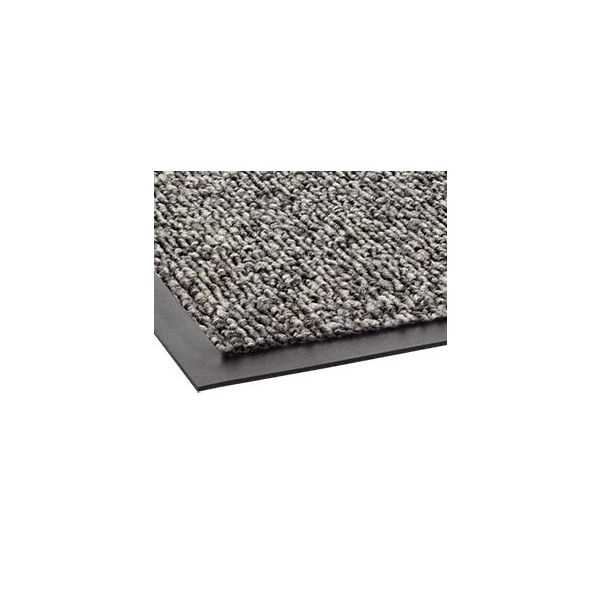
Stat-Zap Matting is an anti-static floor mat for the places a black rubber ESD mat would look wrong: the cashier station, the registration desk, the computer workstation in an office or a library. It is a pewter loop-pile carpet with conductive fibers woven into the top and a vinyl anti-slip backing underneath, grounded through a cord so the static a person builds up walking to the desk drains away before it reaches the keyboard.
What Stat-Zap Does Before a Shock Reaches the Register
Most offices have a spot where static is a daily nuisance. Someone crosses a carpeted room, touches the till or the workstation, and the equipment reboots, drops a card read, or locks up. The charge that does it is small. The problem is that ordinary carpet holds it on the person until the first grounded thing they touch, and at a service counter that thing is the machine.
An anti-static carpet mat changes where the charge goes. The conductive top fibers give it a path down through the mat and out along a grounding cord to a building ground, so the person standing on the mat is bleeding off charge the whole time they are there. The maker publishes a resistivity of 10¹⁰ ohms, which places this mat in the anti-static band of the scale rather than the faster-draining dissipative or conductive bands.
That band is the right one for the job this mat does. It is a nuisance-static mat for equipment protection at a counter, not a bench mat for handling bare circuit boards. Knowing the difference is what keeps a buyer from putting a carpet mat where a rated dissipative mat belongs, and from paying for an industrial mat at a front desk that only needed the shocks to stop.
Why a Conductive-Fiber Carpet, and Why This One
The static control here is in the yarn, not sprayed on. Conductive fibers run through the nylon loop pile as part of the construction, so the property does not wash out with cleaning or wear off with traffic. What you vacuum in year three is the same mat you laid in year one, electrically as well as visually.
Under the carpet is a vinyl backing built to grip the floor. On a hard office floor, the failure that matters most for a small mat is creep: the mat walks a few inches a day until it sits crooked against the counter or curls at the corner where people step. The anti-slip backing holds it where it was placed, which is also what keeps the grounding cord from being tugged loose.
The whole mat is 5/16 inch thick, low enough that a rolling stool or a wheeled cart crosses it without a lip to catch on. Every stock-size mat ships with one grounding cord. For rolls and custom cuts, the maker recommends one grounding cord for every ten feet of matting. Rolls are supplied without edging on the cut ends unless you specify it.
Mats Inc. offers it in seven stock sizes, from 2 by 3 feet for a single seat to 4 by 10 for a shared counter, plus 60-foot rolls in 3 and 4 foot widths and custom cuts up to 60 feet long in those two widths. One color, pewter, chosen to sit under office furniture and beside a service desk without drawing attention.
Where It Belongs, and What It Is Not
The maker lists the placements plainly: computer workstations, cashier stations, offices, ATMs, service counters, registration desks, schools, universities, and libraries. What those share is a person standing or sitting at a piece of electronic equipment on a dry interior floor, in a room where the mat is seen by the public and needs to look like carpet.
It also fits the small static-sensitive corners of a building that never got their own flooring: a copier alcove, a shared printer station, a self-checkout island, a help desk with a rolling stool. Roll goods let you run a continuous strip down a row of terminals or along an IT repair counter without seams every few feet.
What it is not: a dissipative or conductive mat for electronics assembly and test. Where a specification cites a resistance class or a program standard for handling components, choose a mat rated to that class from our anti-static matting lineup instead. Stat-Zap is rated for nuisance static at equipment, and it says so in its own numbers.
It is also not a wet-area mat or an anti-fatigue mat. The carpet face holds water and the backing is meant for dry floors, so it stays out of entrances, wash-down zones, and kitchens. And at 5/16 inch it is a thin carpet mat, not a cushion; a cashier who stands all shift gets static protection from it, not relief for their feet.
Three Things to Check Before You Spec It
First, name the problem. If the complaint is equipment glitching when someone touches it, or customers getting zapped at the counter, this mat is built for that. If the requirement is a written ESD program with a resistance class, it is the wrong band, and a rated dissipative mat is the answer. The EOS/ESD Association standards that specifications cite are about the second case, not the first.
Second, find the ground before you place the mat. The cord needs a verified building ground within reach, usually the center screw of a grounded outlet cover, and the mat has to sit where the cord will not be walked on or kicked out. A carpet mat that looks grounded and is not does nothing, and nobody notices until the reboots come back.
Third, size to the seat, not the room. A single workstation takes the 2 by 3 or 3 by 4; a two-person counter takes the 3 by 5 or 4 by 6; a run of terminals takes a 3 or 4 foot roll cut to length with a cord every ten feet. Measure where feet actually rest, and remember that roll ends arrive unbound unless you ask for edging.
Why Mats Inc.
Front-desk static is one of those problems we have been asked about since our first office and school customers in the 1960s, and the honest answer has always started with which kind of static you have. We will tell you when a carpet mat is the right fix and when it is not, before you order, and we ship this one with its cord and its published figure rather than a promise. Send us the counter layout and we will size it.
| Surface | Nylon loop-pile carpet with conductive top fibers |
| Backing | Vinyl anti-slip backing |
| Overall thickness | 5/16" |
| Resistivity | 10¹⁰ ohms (anti-static band) |
| Grounding | One grounding cord included with each stock mat; one cord per 10' recommended for rolls and custom cuts |
| Stock sizes | 2' x 3', 3' x 4', 3' x 5', 3' x 10', 4' x 6', 4' x 8', 4' x 10' |
| Rolls and custom | 3' x 60', 4' x 60'; custom cuts up to 60' in 3' and 4' widths; roll ends unedged unless specified |
| Color | Pewter |
| Use area | Interior dry areas |
| Warranty | 1-year limited (Mats Inc.) |
Frequently Asked Questions
How does a carpet mat control static, and is it really anti-static or just carpet?
Answered by Dustin Thompson, Owner & CEO
It is carpet with a path built in. Conductive fibers are woven into the nylon loop pile, so charge on a person's shoes can move down through the mat instead of sitting on them. A grounding cord clipped to the mat carries that charge to a building ground. Ordinary carpet does the opposite: it generates charge and holds it.
The maker publishes a resistivity of 10¹⁰ ohms. On the scale specifiers use, that is the anti-static band, above the dissipative and conductive bands. It is the right rating for stopping nuisance shocks at equipment. It is not a rating for handling bare components, and we would not sell it to you for that.
How long does the anti-static property last, and what wears the mat out?
Answered by Dustin Thompson, Owner & CEO
Because the conductive fiber is part of the yarn rather than a coating, the static property lasts as long as the pile does. Vacuuming and spot cleaning do not remove it. What ends the mat's life is ordinary carpet wear: a matted traffic lane where a stool rolls all day, or a fraying cut end on a roll that was never edged.
At a single workstation, expect three to five years before the pile looks tired; that range is our field judgment for loop-pile office matting, not a maker's figure. Keep it on a dry floor, vacuum it with the rest of the carpet, and check once a year that the cord is still clipped and the outlet screw is still grounded.
Where should Stat-Zap go, and how do I ground it?
Answered by Dustin Thompson, Owner & CEO
Put it where the person stands or sits at the equipment: under the cashier, in front of the registration desk, at the computer workstation, beside the ATM. Every stock-size mat comes with one grounding cord. Clip it to the mat's terminal and fasten the other end to a verified ground, most often the center screw of a grounded outlet cover.
For rolls and custom cuts, the maker recommends one grounding cord for every ten feet of matting, so a 30-foot run down a row of terminals wants three. Route the cord along the wall or under the counter where it will not be stepped on. An anti-static mat with the cord pulled loose is just a pewter rug.
What size do I need for one workstation, a shared counter, or a row of terminals?
Answered by Jinna Hopson, Vice President of Marketing
For one person at a desk or a register, the 2 by 3 covers the chair-and-feet zone and the 3 by 4 gives room to stand back. A two-person counter or a registration desk usually takes the 3 by 5 or 4 by 6, so both staff stay on the mat as they move. The 3 by 10 and 4 by 10 suit a long service counter or a bank of self-checkouts.
For a row of terminals or an IT counter, a 3 or 4 foot wide roll cut to length is cleaner than butting mats together. Custom cuts run up to 60 feet in either width. Ask for edging on the cut ends if the run will be seen from the public side; standard roll ends arrive unbound.
What does it look like, and will it fit an office or a library rather than a shop floor?
Answered by Jinna Hopson, Vice President of Marketing
It looks like a piece of commercial carpet, which is the whole idea. The pewter loop pile is a mid-tone gray that sits under a desk or beside a counter without announcing itself, and at 5/16 inch it lies nearly flush with the floor. Nobody walking up to a registration desk reads it as safety equipment.
The maker names schools, universities, libraries, and offices among its intended homes, and that is where we see it chosen: places that need the static gone but would never put a black rubber mat at the front desk. If your carpet is a warm tone, pewter reads as a deliberate neutral rather than a mismatch.
Is this the mat for an electronics bench, a computer desk, or a chair?
Answered by Jinna Hopson, Vice President of Marketing
It is the mat for the floor at a computer desk or a counter where the goal is to stop static from reaching the equipment or shocking the customer. It is a floor mat, not a bench-top or table mat, so it goes under feet, not under the keyboard or the parts tray.
It is not an ESD bench mat for assembling or testing components, which calls for a dissipative rating and a written grounding program. And while its low profile lets a rolling stool cross it, it is not a chair mat; use a chair mat for casters and put this where the feet land. If you are unsure which of those you need, describe the desk and we will tell you.
By Jinna Hopson, Vice President of Marketing, Mats Inc.
Ordering Info
COLOR: Pewter
| Size | Qty 1. Price |
| 2' x 3' | $68.00 |
| 3' x 4' | $126.00 |
| 3' x 5' | $151.00 |
| 3' x 10' | $265.00 |
| 4' x 6' | $219.00 |
| 4' x 8' | $282.00 |
| 4' x 10' | $348.00 |
| 3' x 60' | $1,395.00 |
| 4' x 60' | $1,850.00 |
Reviews
Write Your Own Review
Related Products
Super Scrape Rubber Mats
Safety Track Non-Skid Tape - Coarse

Smooth Marbleized Vinyl Switchboard Matting (Mil Spec)
Super Scrape Rubber Logo Mats

Strip Doors
Perfec Clean 3/8" Rollup Mats - Aluminum Hinge
Perfec Clean 3/8" Rollup Mats - Rubber Hinge
Perfec Clean 3/4" Rollup Grate - Rubber Hinge
Perfec Clean 1-5/8" Grate
WP-70 Non-Skid Epoxy Coating