





Have a question? We're here to help!
Description
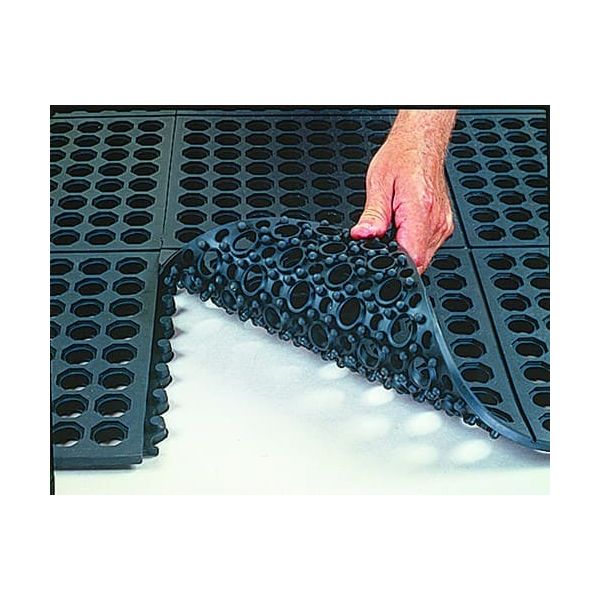
Safety Step rubber mats take a different approach to wet-area matting: instead of one big mat, you build the footprint you need from 3-by-3-foot modular sections with molded-in connectors on two sides. Perforations drain water and oil through the surface, cushioned rubber eases long standing shifts, and when one section finally wears out, you replace that section — not the whole installation.
What Safety Step Does Before a Layout Outgrows Its Matting
Most wet-area mats are cut to a rectangle and stay that way. Work areas aren't. Lines wrap around equipment, stations get added, a sanding cell moves across the shop — and a fixed mat that fit last year now leaves gaps where feet land on bare, wet floor.
A modular anti-fatigue mat solves that at the design level. Sections connect into whatever shape the work takes, wrap odd corners, and re-assemble when the layout changes. Underneath, a multi-nib backing lifts the whole surface off the floor so drained liquid keeps moving and the floor beneath can actually dry, instead of holding a wet film under the rubber.
Why This Construction, and Why This One
The mat comes in two compounds, and choosing between them is most of the spec decision. The black version is general-purpose rubber for wet duty — water, washdowns, standard cleaners — with recycled content up to 47%. The terra cotta version is a nitrile rubber blend built to resist grease, for kitchens and stations where oil reaches the floor daily.
Both wear hard: surface loss measures at or under 1% after 1,000 abrasion cycles on the standard test. And both share the modular system's quiet economics — a high-wear section at the sink or the grinder swaps out individually, while the rest of the installation stays in service.
Edging is optional rather than built in. Snap-on beveled ramps finish exposed sides where traffic steps on and off; sides butted against equipment or walls can stay square. Adding edging extends the mat roughly 3 inches per finished side, which matters when you're sizing to a tight footprint.
Where It Belongs, and What It Is Not
Safety Step earns its place in factories, workstations, sanding and grinding cells, dish rooms, and food service areas — heavy-duty wet and oily zones, and especially the large or odd-shaped ones a single rectangular mat can't cover cleanly. If the matting footprint might change in the next few years, modular is the format that keeps up.
It is not a dry-station comfort mat — a salon chair or standing desk wants a solid surface, not perforations. And for one fixed, standard-sized station that will never move, a single one-piece mat from the anti-fatigue mats and runners range does the job without assembly. This mat's case is coverage that's big, irregular, or likely to change.
Three Things to Check Before You Spec It
First, what reaches the floor. Water and cleaning solution point to the black general-purpose version. Grease, fryer oil, or petroleum-based fluids point to the terra cotta nitrile blend — putting the general-purpose compound under daily grease shortens its life and turns the surface slick sooner.
Second, the true footprint. Sections are 3-by-3, custom assemblies run up to 12 by 30 feet, and workstation layouts order in full-foot increments. Sketch the actual standing and walking zone around the equipment — the point of modular is covering that real shape, not the rectangle that approximates it.
Third, the exposed edges. Count the sides where people step on and off, and spec snap-on ramps for those; remember each finished side adds about 3 inches to the overall dimension. An unramped edge in a walk path is a stubbed toe waiting for a rush.
Why Mats Inc.
Modular matting gets ordered wrong in predictable ways — the compound that doesn't match the fluids, the layout that forgot the edging inches, the section count that's one short. Send us a sketch of the work area with what lands on the floor, and we'll spec the sections, compound, and ramps so the kit that arrives assembles into the mat you actually needed.
| Format | Modular sections, molded-in connectors on two adjoining sides |
| Section size | 3' x 3' |
| Custom assemblies | Up to 12' x 30'; workstations in full-foot increments |
| Compounds / colors | Black — general-purpose rubber (recycled content up to 47%); Terra Cotta — grease-resistant nitrile rubber blend |
| Drainage | Perforated surface; multi-nib backing aerates so floors dry quickly |
| Hardness | Black 55 / Terra Cotta 60 (ASTM D2240 durometer) |
| Abrasion resistance | ≤1% loss at 1,000 cycles (ASTM D3884), both compounds |
| Edging | Optional snap-on beveled ramps; each finished side adds ~3" |
| Warranty | 1-year limited (Mats Inc.) |
Frequently Asked Questions
What's the difference between the black and terra cotta versions?
Answered by Dustin Thompson, Owner & CEO
The compound. Black is general-purpose rubber — right for wet zones where water and standard cleaners are the exposure, and it carries up to 47% recycled content. Terra cotta is a nitrile rubber blend formulated to resist grease and oil, which is what you want under a fry line, in a machine shop, or anywhere petroleum-based fluids hit the floor.
If you're unsure, name the messiest thing that reaches that floor in a normal week. Grease in the answer means terra cotta.
How long does a modular drainage mat like this last?
Answered by Dustin Thompson, Owner & CEO
The wear data is unusually strong: both compounds lose 1% or less of their surface after 1,000 cycles on the standard abrasion test, which puts heavy daily duty in the multi-year range — three to five years is a fair expectation with routine rinsing.
The modular format changes the replacement math, though. Wear never lands evenly — the section at the sink or the grinder goes first. Here you swap that one section and keep the rest in service, instead of retiring a whole mat because one corner died.
How do the sections install, and do they need adhesive?
Answered by Dustin Thompson, Owner & CEO
No adhesive. Each section has connectors molded into two adjoining sides, so you lay the first section at the primary work position and snap outward until the footprint is covered. Check every joint as you go — a proud seam collects debris and catches toes.
Start on a clean, dry floor, orient the assembly so drainage runs toward the floor drain, and snap ramps onto any edge that faces foot traffic. Reconfiguring later is the same process in reverse.
Will terra cotta look better than black in a kitchen guests can see into?
Answered by Jinna Hopson, VP of Marketing
Often, yes — and not just on looks. Terra cotta is the traditional working color of commercial kitchens, so in an open-kitchen or chef's-counter setting it reads as authentic professional equipment. It also happens to be the grease-resistant compound, so the aesthetic choice and the right technical choice usually point the same direction in food service.
Black suits back-of-house and industrial floors where it disappears against dark concrete. Whichever you pick, keep it consistent across connected sections — a checkerboard of mixed colors reads as patched.
What sizes can I build, and can it fit an odd-shaped area?
Answered by Jinna Hopson, VP of Marketing
Odd shapes are the point. Sections are 3-by-3 feet and connect in any direction, so an L around a prep island, a U inside a work cell, or a long dish-room run all assemble from the same units. Custom assemblies go up to 12 by 30 feet, ordered in full-foot increments.
Two sizing notes: optional edging adds about 3 inches per finished side, and it's worth ordering to the real standing zone rather than rounding down — a footprint that stops one section short leaves someone half off the cushion all shift.
Is this the right choice over a single one-piece drainage mat?
Answered by Jinna Hopson, VP of Marketing
It depends on the shape and the future. One fixed station with standard dimensions is happily served by a one-piece mat — nothing to assemble, nothing to seam. Choose modular when the area is large, wraps equipment, doesn't match stock rectangles, or is likely to be rearranged.
The section-replacement benefit tips close calls: if one spot in your layout takes far more punishment than the rest, modular means that spot never forces a full replacement.
By Dustin Thompson, Owner & CEO, Mats Inc.
Reviews
Write Your Own Review
Related Products
Super Scrape Rubber Mats
Safety Track Non-Skid Tape - Coarse

Smooth Marbleized Vinyl Switchboard Matting (Mil Spec)
Super Scrape Rubber Logo Mats
Strip Doors
Perfec Clean 3/8" Rollup Mats - Aluminum Hinge
Perfec Clean 3/8" Rollup Mats - Rubber Hinge
Perfec Clean 3/4" Rollup Grate - Rubber Hinge
Perfec Clean 1-5/8" Grate
WP-70 Non-Skid Epoxy Coating