




More Information
| Manufacturer | Crown Matting |
|---|
$137.00

Have a question? We're here to help!
Description
What Safe Walk Jr. Does Before a Wet Floor Takes Someone Down
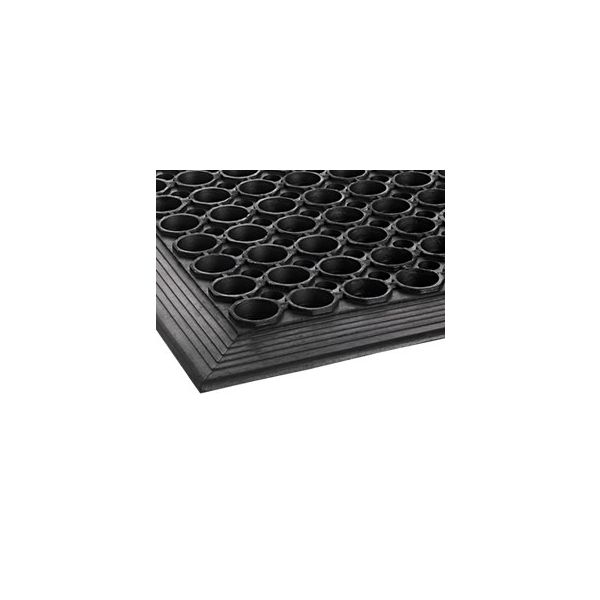
Safe Walk Jr. is a lightweight anti-fatigue drainage mat for wet areas. Its raised base keeps liquids moving underneath instead of pooling where shoes land, while the rubber surface gives feet better slip resistance than the ceramic and cement floors it covers — and cushions the hours spent standing over them.
Wet floors don't announce themselves. Rinse water, dish spray, and spills collect through a shift, and the moment someone hurries — a rush order, a carried tray — is exactly when footing matters most. A slip at a busy station means an injured worker, a stopped line, and an incident report. Drainage under the feet changes those odds.
Why a Raised-Base Drainage Design, and Why This One
The mechanism is simple and constant: the raised base holds the standing surface above the floor, so spills and rinse-down drain through and keep moving rather than sitting under someone's next step. The result the vendor testing points to is a safer work environment — traction that outperforms bare ceramic and cement underfoot.
The rubber is a general-purpose SBR compound in black — the workhorse choice for everyday water duty. It's the right material where the floor's daily challenge is moisture rather than chemistry: dependable grip, a cushioned stand, and a surface that shrugs off the constant wet-dry cycle of a working station without fuss.
The rest of the design is built around easy living. A low profile with molded edging keeps the transition on and off the mat clean, the whole mat contains up to 60 percent recycled material, and the lightweight build means it actually gets lifted, hosed off, and put back — clean underneath included.
Where It Belongs, and What It Is Not
Safe Walk Jr. is a medium-duty solution for wet floors: dish and rinse-down stations, kitchens and cafeterias, food processing facilities, and packaging operations. It suits the stations where water is a daily reality but not an extreme one — and where the crew doing nightly cleanup will appreciate a mat one person can handle.
What it is not: the answer to every hard floor. Where oil and fats hit the floor daily, a grease-rated nitrile compound is the honest spec, and where deep grease, harsh chemicals, or punishing traffic rule the zone, the heavier-duty drainage constructions in our anti-fatigue mats and runners lineup carry that load. Matching the duty level honestly is what makes this one earn its keep for years.
Three Things to Check Before You Spec It
First, confirm water is the main event. Walk the station at the end of a real shift: if what's on the floor is rinse water, dish spray, and the day's spills, this general-purpose rubber is squarely in its lane. If there's an oil film in the picture daily, spec a grease-rated compound instead — same drainage idea, different chemistry.
Second, plan the run. Every size is 3 feet wide, with lengths of 5, 10, 15, and 20 feet, so a single mat can trace a full dish line or packing row. One planning note: mats 10 feet and longer carry a seam every 5 feet — worth knowing before you map coverage.
Third, be honest about duty level. This is a medium-duty mat by design — that's what makes it light enough to lift daily and easy to keep clean. If your environment reads heavy-industrial, step up a class instead of asking a lighter mat to survive it.
Why Mats Inc.
Not every wet floor needs the heaviest mat in the warehouse — and we've spent decades since 1964 helping buyers land on the right duty level rather than the biggest one. We carry this mat for the kitchens and lines it genuinely fits, we verify what's behind it before it ships, and we back it with a 1-year limited Mats Inc. warranty.
| Construction | Drainage mat; raised base promotes movement of liquids |
| Material | SBR rubber (general purpose) |
| Color | Black |
| Thickness | 1/2" |
| Sizes | 3' x 5', 3' x 10', 3' x 15', 3' x 20' (10' and longer have a seam every 5') |
| Edges | Low profile, molded edging |
| Traction | Provides better slip resistance than ceramic and cement floors |
| Recycled Content | Up to 60% |
| Duty / Use Area | Medium duty; wet areas |
| Warranty | 1-year limited (Mats Inc.) |
Frequently Asked Questions
How does the raised base actually make the floor safer?
Answered by Dustin Thompson, Owner & CEO
It separates feet from liquid. The raised base lifts the standing surface off the floor, so water drains down and keeps moving instead of forming the slick film that causes falls. Up top, the rubber surface grips better than the ceramic and cement floors it typically covers — so the shoe meets traction while the spill meets the drain path. The low-profile molded edging finishes the safety picture at the transition on and off the mat.
What is the mat made of, and how long will it hold up?
Answered by Dustin Thompson, Owner & CEO
It's a general-purpose SBR rubber — a proven, hard-wearing compound for water duty — with up to 60 percent recycled material in the mat. Kept in its lane, it holds up well: the wet-dry cycle of a dish station or rinse-down zone is exactly what it's built to live with. What ages it early is asking it to do a different mat's job — daily oil and fats belong on a grease-rated compound, and harsh industrial zones belong on a heavier class.
How heavy-duty is it, honestly?
Answered by Dustin Thompson, Owner & CEO
It's a medium-duty mat, and that's a feature, not a confession. Kitchens, cafeterias, dish lines, food processing, and packaging floors get exactly the drainage and traction they need in a build light enough for one person to lift and hose off nightly. Where the environment turns heavy-industrial — deep grease, harsh chemicals, relentless cart traffic — a heavier drainage class is the honest spec. Matching duty to reality is what makes any mat last.
Is a plain black mat the right look outside the back of house?
Answered by Jinna Hopson, Vice President of Marketing
Black earns its place almost anywhere a wet-area mat lives. It disappears visually against most commercial flooring, hides the scuffs and soil that land between cleanings, and the low profile keeps it reading as part of the floor rather than an obstacle on it. In a cafeteria serving line or a visible dish pass, that quiet, tidy look is usually exactly right — the mat does its safety work without asking anyone to notice it.
What lengths should I plan for a dish line?
Answered by Jinna Hopson, Vice President of Marketing
Measure the working run, not the room. Every size is 3 feet wide, and lengths of 5, 10, 15, and 20 feet let one mat follow the full path a dish crew or packer actually walks — no gaps where a wet stride lands on bare floor between two short mats. Note that mats 10 feet and longer carry a seam every 5 feet, so plan seam positions away from the busiest pivot points where you can.
Will the crew actually keep it clean?
Answered by Jinna Hopson, Vice President of Marketing
That's the quiet advantage of the lightweight build. A mat that's easy to handle gets lifted at close, rinsed, and set back — while heavy mats tend to get mopped around, letting the floor beneath become the dirtiest surface in the kitchen. This one is designed to be easy to handle, clean, and maintain, which means the drainage path stays open and the whole system keeps doing its job week after week instead of just the first one.
By Dustin Thompson, Owner & CEO, Mats Inc.
Reviews
Write Your Own Review
Related Products
Super Scrape Rubber Mats
Safety Track Non-Skid Tape - Coarse

Smooth Marbleized Vinyl Switchboard Matting (Mil Spec)
Super Scrape Rubber Logo Mats
Strip Doors
Perfec Clean 3/8" Rollup Mats - Aluminum Hinge
Perfec Clean 3/8" Rollup Mats - Rubber Hinge
Perfec Clean 3/4" Rollup Grate - Rubber Hinge
Perfec Clean 1-5/8" Grate
WP-70 Non-Skid Epoxy Coating