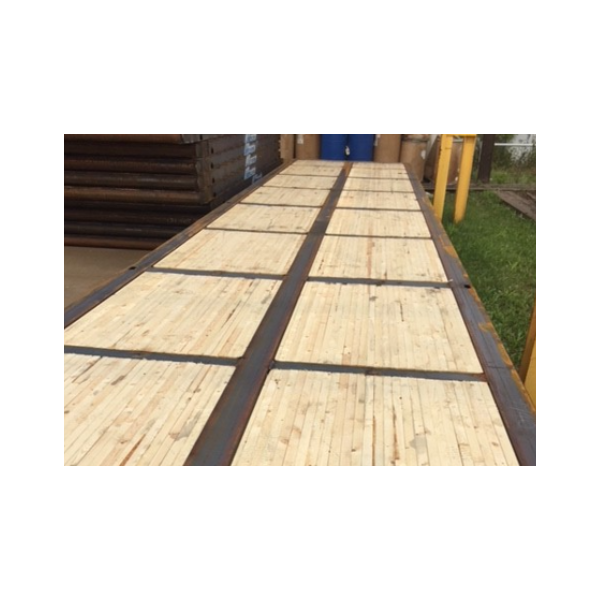
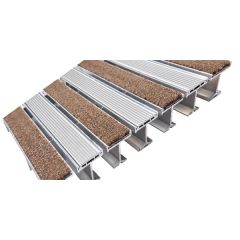
A rig mat is a structural platform, not a floor covering. Steel beams carry the load, laminated timber sections spread it between them, and the whole assembly sits directly on ground that was never engineered to hold a drilling rig. Get the platform right and the location stays workable through freeze, thaw, and everything the season does to it.
What Rig Mats Do Before the Pad Gives Way
Ground failure under a location is rarely dramatic. A corner settles a few inches, the substructure comes out of level, and suddenly there is a rig alignment problem that stops work while somebody figures out how to jack and re-shim under load. The soil did not fail all at once; it gave way where the pressure was highest.
Drilling rig mats interrupt that by turning point loads into distributed ones. Weight entering through a substructure foot, a crane outrigger, or a truck tire gets carried into the steel beams, transferred laterally across the mat, and delivered to the soil across the mat's whole footprint. Pressure at any one spot drops far enough that the ground holds.
The second job is what the ground looks like when you leave. Matting boards on a drilling rig keep traffic and equipment off the soil itself, which limits rutting, compaction, and the mixing of surface material into subsoil. Reclamation obligations get written against the condition you leave behind, and a matted location is a different conversation than an unmatted one.
Why Steel Beam and Laminated Timber Construction
These mats are built as two continuous wood sections, with the laminations both glued and nailed together rather than fastened alone. That combination is what gives the mat its rigidity. Nails hold the plies in position; the glue line bonds them into a single working section so the timber behaves as one piece under load instead of as a stack of boards.
Strength comes primarily from the steel beams running the length of the mat. The wood sections do real structural work too, and lateral flat bars help transfer part of the load from one beam to the next, so a wheel or foot landing over one beam does not load that beam alone. Steel and timber are working together rather than steel simply framing wood.
The glue line does something else that matters more in the field than it sounds on paper. Bonded laminations resist liquid absorption, which means the mat does not take on water and gain weight through a wet season. Mats that soak up moisture get heavier to handle every year they stay in service, and the wood inside them degrades from within.
Service life reflects that construction. Average life runs about 10 years, and mats in continued active service at 15 to 20 years are common rather than exceptional. These have been shipped since 1968, which is a long enough production record that the wear behavior is well understood. Both this product and the drill floor traction matting a rig needs on deck are grouped under Rotary Table & Rig Floor Mats.
Where They Belong, and What They Are Not
The core application is the rig pad itself: a level, load-bearing working platform under the substructure and the equipment that surrounds it. From there, the same mats build crane and pump pads, lay-down and storage areas, and the working surfaces around tanks and shale bins where crews and forklifts operate all day.
They also work as access surfaces over unimproved ground, which is where the product line overlaps with road matting. Laminated and walking rig mat builds are both available, with walking mats specified for operations that move a rig between wells on a location rather than rigging down between them.
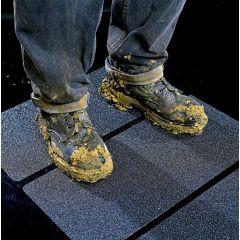
What they are not: a traction surface. A rig mat gives you a stable, continuous platform, but it does not solve the problem of oil-based fluid on a walking surface. Drill floor traction matting is a separate product for a separate hazard, and rigs commonly need both without either substituting for the other.
They also are not a temporary drop-and-go product. Steel-framed timber mats are heavy, need equipment to place and pull, and are specified for locations that will hold equipment for weeks or seasons. Short access needs across turf or landscaping are usually a different product entirely.
Three Things to Check Before You Spec It
First, ask how the laminations are bonded, not just what the mat is made of. Glued and nailed construction and nailed-only construction look identical on delivery and behave very differently after two wet seasons. The bonded build resists absorption, and that single detail drives whether your mats are gaining weight and softening internally or staying dimensionally stable.
Second, work out the platform footprint before the quantity. Map the substructure dimensions, the equipment positions around it, the crane and pump pads, and the lay-down area, then treat access as a separate line. Locations routinely order enough matting for the rig and discover the support equipment is still sitting on dirt.
Third, confirm what documentation comes with the order. Mill certificates for the steel and the lumber can be supplied, and if your operator, regulator, or client requires material traceability in the project file, that has to be requested at order rather than reconstructed afterward. Ask early if compliance documentation is part of your process.
Why Mats Inc.
Traceability is the part most matting suppliers cannot produce on request, and it is the part that stops an audit conversation cold. We can supply mill certificates covering the steel and the wood lumber in these mats, so the material record exists when someone asks for it. We have been in industrial flooring and matting since 1964, and on structural product that paperwork is as much a part of the specification as the build itself.
Specifications
| Construction | Steel beam frame with two continuous laminated wood sections |
| Lamination Method | Plies glued and nailed together for rigidity |
| Primary Strength Member | Steel beams |
| Load Transfer | Wood sections with lateral flat bars distributing load between beams |
| Moisture Behavior | Glue line reduces liquid absorption; resists field weight gain |
| Available Builds | Laminated rig mats and walking rig mats |
| Average Service Life | Approximately 10 years; many remain active 15–20 years |
| Material Traceability | Mill certificates available for steel and wood lumber |
| Production Record | In production since 1968 |
| Sizes and Load Ratings | Confirmed at quote — contact us with your platform layout |
| Warranty | 1-year limited (Mats Inc.) |
Frequently Asked Questions
What is actually inside a rig mat, and why does the lamination method matter?
The mat is a composite of steel and timber working together. Steel beams run the length and carry most of the load, while two continuous laminated wood sections sit within the frame and lateral flat bars move load sideways from beam to beam. The lamination detail is where builds diverge. Plies that are glued and nailed bond into a single structural section, so the wood behaves as one piece under a wheel or a foot. Plies that are only fastened can work against each other over time, and the gaps between them become paths for water. That is a construction difference you cannot see on a delivery truck but will feel three seasons in. — Dustin Thompson
How long do these last in continuous service?
Average life runs around 10 years, with many mats still in active service at 15 to 20 years. The spread comes down to how hard they are worked and how they are handled, since most damage happens during placement and pickup rather than under load. Moisture is the other variable, and it is the one the construction addresses directly: the glue between laminations limits liquid absorption, so the mats do not steadily gain weight through wet seasons the way absorbent builds do. A mat that has not taken on water is both easier to handle and structurally closer to where it started. — Dustin Thompson
Where on a location should the matting go?
Start under the substructure, since that is where the heaviest sustained load sits and where settlement causes the most disruptive problem. From there the priorities are the crane and pump pads, then the lay-down and storage areas where forklifts and crews work daily, then access. A useful way to think about it: mat everything that will hold weight in one place for an extended period first, and treat travel surfaces as the next tier. Locations that mat the rig and leave support equipment on dirt end up dealing with the soft spots later anyway. — Dustin Thompson
How do we figure out how much matting a location needs?
Work from a layout rather than a square footage estimate. Map the substructure footprint, then the equipment positions around it, the crane and pump pads, the lay-down area, and the access route in, treating each as its own zone. The zones people forget are the ones between things: the space crews walk and drive between the rig and the tanks, and the turning area where trucks reposition. Sizes and load ratings are confirmed at quote against your specific layout, so send us the location plan and the heaviest equipment going onto it and we will work the count with you. — Jinna Hopson
What condition are they in after a few seasons, and does weathering hurt them?
They look like working equipment, with surface scuffing on the timber and wear on the steel frame from lifting and placement. Weather exposure is expected and designed for, and the meaningful question is not appearance but whether the mat has taken on water. Bonded laminations resist that absorption, so a mat coming off its fourth location should handle at roughly the weight it did originally rather than noticeably heavier. Weight gain is the field signal that laminations have opened up, and it usually shows up before any visible damage does. — Jinna Hopson
Can we get material documentation for our compliance file?
Yes, and it is worth asking for at the time you order rather than later. Mill certificates can be supplied covering both the steel and the wood lumber used in the mats, which gives you a traceable material record for the project file. Operators, regulators, and prime contractors increasingly want that documentation on structural products, and reconstructing it after delivery is far harder than requesting it up front. If material traceability is part of your quality process, tell us at quote and we will make sure the certificates come with the order. — Jinna Hopson
Written by Dustin Thompson, Owner & CEO, Mats Inc.