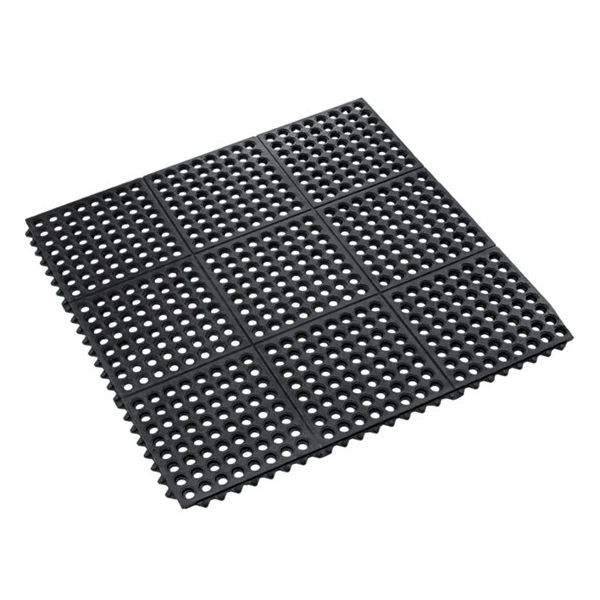
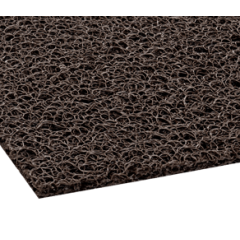
The Interlocking Horse Trailer Mat is a perforated rubber tile that locks edge to edge into a continuous floor. The interlocking design keeps tiles from sliding underfoot, and the open, perforated surface lets water and waste drain through instead of pooling on top. Each tile is light enough to lift out for cleaning — which is what keeps moisture from sitting against the trailer floor and causing damage.
Each tile is molded from a blend of recycled and virgin rubber at 5/8" thick, with a slip-resistant top and a multi-nib underside. The nibs hold the mat slightly off the floor, so air and water move underneath rather than getting trapped. The perforations carry liquid down and away — which matters anywhere urine or wash water would otherwise sit, whether that's a trailer floor, a wash area, or a stall aisle.
Because the tiles connect to each other, the floor behaves as one piece. It won't creep toward the back of the trailer or bunch under a braced horse the way loose mats do, and you don't glue or screw anything down. That matters: fastening mats in place traps moisture against the subfloor, which is the exact thing that rots wood and corrodes aluminum. Within our horse trailer floor mats range, this is the interlocking option.
The tiles come in a 3' x 3' size and lay out in sections to cover the area you need. When one section wears, you replace that tile rather than the whole floor. Each tile weighs about 28 pounds, so one person can lift it to sweep, hose, and dry the surface underneath. That simple routine is what keeps rubber mats for horses working over the long run, in a trailer or a stall.
| Material | Blend of recycled and virgin rubber |
| Thickness | 5/8" |
| Tile size | 3' x 3' |
| Weight | Approx. 28 lb per tile |
| Surface | Perforated, slip-resistant |
| Backing | Multi-nib, aids drainage |
| Format | Interlocking |
| Color | Black |
| Warranty | 1-year limited (Mats Inc.) |
Frequently Asked Questions
Do the tiles stay in place without glue or screws?
Answered by Dustin Thompson, Owner & CEO
Yes. The tiles lock to each other at the edges, so the floor acts as one connected surface instead of separate loose mats. That, plus the weight of the rubber, keeps it from sliding or bunching. The reason not to glue or screw the mats down is moisture: fastening them in place seals water against the floor underneath, which is what leads to rot and corrosion over time.
How do I clean the mat and the floor under it?
Answered by Dustin Thompson, Owner & CEO
Between uses, sweep the surface and rinse it with low-pressure water — the perforations let most of it drain straight through. Once a month, lift the tiles out, hose the underside and the floor below, check for soft or pitted spots, and let everything dry before you put the tiles back. At about 28 pounds each, one person can handle the tiles without help.
Can the mat be laid out to fit my trailer or stall?
Answered by Jinna Hopson, Vice President of Marketing
The tiles come in a 3' x 3' size and connect in sections, so you arrange as many as you need to cover the floor area. Send us the interior dimensions of your trailer or stall and we'll work out how many tiles the layout takes before you order. If one tile wears down the line, you swap that single tile rather than re-doing the whole floor.
Can I use the same mat across my trailer, wash area, and stalls?
Answered by Jinna Hopson, Vice President of Marketing
Yes. The same perforated, slip-resistant black tile works wherever you need a surface that drains and lifts out for cleaning — a trailer floor, a wash area, or a stall aisle. Using one tile type across those spaces keeps the look consistent and makes restocking simple, since every tile is interchangeable with the next.
By Dustin Thompson, Owner & CEO, Mats Inc.