





Have a question? We're here to help!
Description
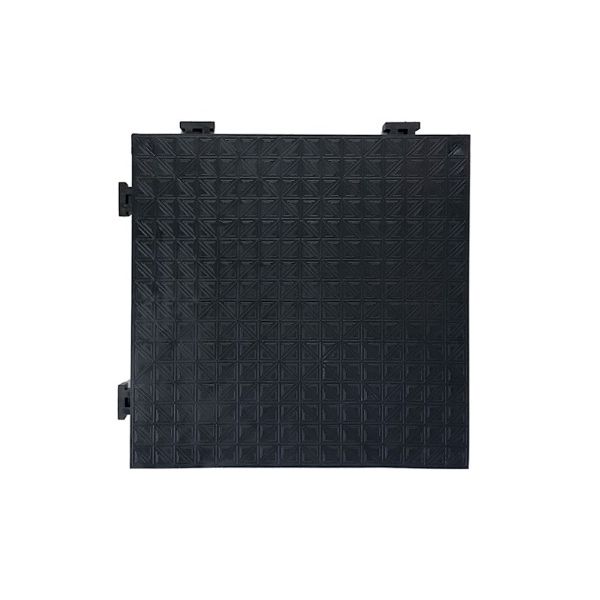
Solid Top Cushion Tile is a modular anti-fatigue mat for dry work areas: solid-surface vulcanized rubber sections that lock together into whatever footprint your line, cell, or bench run actually needs. The top stays sealed so debris sweeps off instead of falling in, while rubber nibs underneath keep air moving beneath the mat and add give to every step.
What Solid Top Cushion Tile Does Before a Dry Floor Wears Your Crew Down
Dry industrial floors punish people twice. Concrete stiffens legs and backs over a shift, and the fixed rectangular mats most facilities buy never quite fit the workspace — so operators end up standing half on, half off the cushion, right where the work happens.
A modular solid-top mat closes both gaps. Sections connect into the real shape of the station, so the cushion is under every position that matters. The textured surface keeps footing sure, and the sealed top means metal shavings, dust, and packaging debris stay where a broom can reach them.
The nib underside does quiet work too: it holds the mat off the floor so air circulates beneath, keeping the concrete under the mat drier instead of sealing in mopping moisture and condensation.
Why This Construction, and Why This One
The body is vulcanized rubber with an anti-fatigue textured surface, and it wears like it sounds: surface loss of half a percent or less after 1,000 cycles on the standard abrasion test. At 2.2 pounds per square foot, an assembled installation has real heft — it stays where you put it without adhesive.
Connectors are molded into two sides of each 3-by-3-foot section, so assemblies build out in any direction, reconfigure when the work cell changes, and let a worn high-traffic section swap out individually. The compound carries 47% recycled material, and flammability is rated to DOC FF 1-70.
Edging is optional: snap-on beveled ramps, in black or safety yellow, finish any side that faces foot traffic. Each finished side adds roughly 3 inches to the overall dimension.
Where It Belongs, and What It Is Not
This tile earns its footprint in factories, workstations, large work cells, and assembly lines — dry areas where coverage is big, irregular, or likely to be rearranged, and where debris control matters as much as cushion. If your matting needs to wrap a machine base or follow an L-shaped bench run, modular is the format that fits.
It is not a wet-area mat: no drainage means standing liquid stays on top, so washdown zones and greasy lines call for a perforated mat instead. And a single fixed station with standard dimensions is served more simply by a one-piece mat from the anti-fatigue mats and runners range. This tile's case is dry coverage shaped like your work, not like a stock rectangle.
Three Things to Check Before You Spec It
First, confirm the area truly runs dry. Occasional mopping is fine — the nib underside helps the floor beneath dry — but recurring spills, washdowns, or oil point you to a drainage-style mat rather than a solid top.
Second, map the real footprint. Sections are 3 by 3 feet, custom assemblies run up to 12 by 30 feet, and workstation layouts order in full-foot increments. Sketch where people actually stand and walk through a full shift — the point of modular is covering that shape edge to edge.
Third, plan the ramps. Count the sides that face open floor and spec snap-on beveled edging for those — yellow where you want the perimeter to announce itself, black where you don't — and remember each finished side adds about 3 inches to the assembly.
Why Mats Inc.
Modular dry-area installations succeed or fail at the sketch stage — the section count, the ramp sides, the 3 inches the edging adds. Send us the dimensions of the cell and a note on what the floor sees in a week, and we'll turn it into a section-and-ramp order that assembles into full coverage the first time, with no orphan gaps where someone stands.
| Format | Modular solid-surface sections; molded-in connectors on two sides |
| Section size | 3' x 3' |
| Custom assemblies | Up to 12' x 30'; workstations in full-foot increments |
| Material / surface | Vulcanized rubber with anti-fatigue textured solid top; rubber nib underside for comfort and aeration |
| Color | Black |
| Abrasion resistance | ≤0.5% loss at 1,000 cycles (ASTM D3884) |
| Weight | 2.2 lbs per sq. ft. |
| Flammability | DOC FF 1-70 |
| Recycled content | 47% |
| Edging | Optional snap-on beveled ramps, black or yellow; each finished side adds ~3" |
| Warranty | 1-year limited (Mats Inc.) |
Frequently Asked Questions
When is a solid top the right call instead of a perforated mat?
Answered by Dustin Thompson, Owner & CEO
When the floor runs dry and the debris is solid. In a machine shop or on a packing line, shavings, dust, and scrap stay on a sealed surface where a broom clears them in seconds — the same material falling into perforations gets ground underfoot and works into the openings.
The moment liquid becomes a daily fact of that floor, the logic flips and drainage wins. Solid top is the dry-area specialist.
How durable is it, really, and what would end its life early?
Answered by Dustin Thompson, Owner & CEO
The wear numbers are about as strong as this class gets: half a percent or less surface loss after 1,000 abrasion cycles, in dense vulcanized rubber weighing 2.2 pounds per square foot. Treated as a floor fixture rather than a consumable, installations commonly run many years — and a high-wear section in front of one machine swaps out without touching the rest.
What cuts life short: parking it under standing liquid it was never meant to drain, or letting grit sit in the connector joints until seams stop locking flat.
How does installation work across a big or odd-shaped cell?
Answered by Dustin Thompson, Owner & CEO
No adhesive, no tools. Each section carries connectors on two sides — start at the primary operator position, lock sections outward until the footprint is covered, and press every joint flush as you go. The assembly's own weight keeps it planted.
Snap ramps onto the sides that face walking traffic, wrap sections around machine bases as the shape demands, and when the cell gets rearranged next year, unlock and rebuild to the new layout.
It only comes in black — how do I keep a big installation from looking grim?
Answered by Jinna Hopson, VP of Marketing
Lean into it. A continuous black rubber field reads as deliberate, engineered flooring — far cleaner than a patchwork of mismatched mats collected over the years. The uniformity is the aesthetic.
Yellow snap-on ramps are your accent tool: they trace the perimeter in the same visual language as floor marking, which makes the whole cell look planned and keeps edges conspicuous exactly where people step on and off.
What sizes can I build, and how does the edging change the math?
Answered by Jinna Hopson, VP of Marketing
Sections are 3 by 3 feet and build into custom assemblies up to 12 by 30 feet, ordered in full-foot increments — L-shapes, U-shaped cells, and long assembly-line runs all come from the same units.
Budget the edging into your dimensions: each ramped side adds about 3 inches. In a tight aisle, that's the difference between a clean fit and a mat that crowds the cart path, so measure to the walls, not just the work.
Would this work outside a factory — a stockroom, a workshop, a packing bench at home?
Answered by Jinna Hopson, VP of Marketing
Anywhere someone stands for hours on a dry hard floor, yes — retail stockrooms, shipping benches, framing counters, a serious garage workshop. The modular format is actually friendlier outside the factory, since small spaces rarely match stock mat sizes and a two- or three-section assembly fits exactly.
Just hold the one rule: dry duty. If the space doubles as a wash bay or sees regular spills, choose a drainage mat instead.
By Dustin Thompson, Owner & CEO, Mats Inc.
Reviews
Write Your Own Review
Related Products
Super Scrape Rubber Mats
Safety Track Non-Skid Tape - Coarse

Smooth Marbleized Vinyl Switchboard Matting (Mil Spec)
Super Scrape Rubber Logo Mats
Strip Doors
Perfec Clean 3/8" Rollup Mats - Aluminum Hinge
Perfec Clean 3/8" Rollup Mats - Rubber Hinge
Perfec Clean 3/4" Rollup Grate - Rubber Hinge
Perfec Clean 1-5/8" Grate
WP-70 Non-Skid Epoxy Coating