




More Information
| Manufacturer | Apache Mills |
|---|
$799.00

Have a question? We're here to help!
Description
What Counter Tread Does Before Oil and Slag Own the Walkway
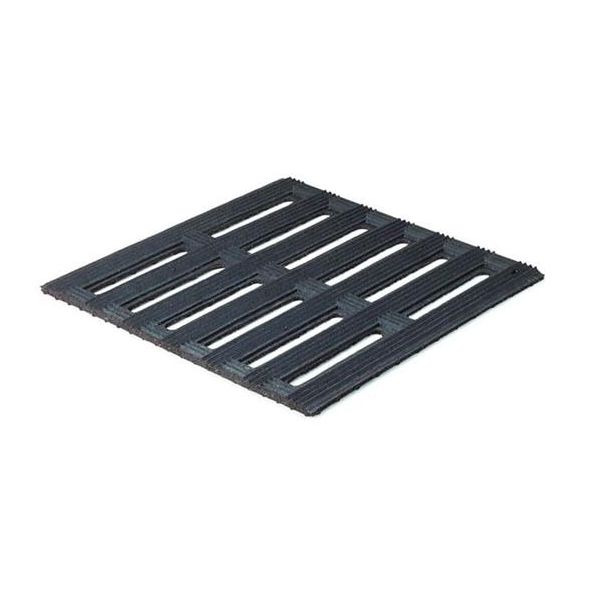
Counter Tread is a heavy-duty, open-slot rubber drainage runner for the toughest walking paths in a facility. Open slots let oil, water, and debris drop through instead of pooling underfoot, a multi-directional rib surface grips shoes from every angle, and the dense rubber body adds anti-fatigue give to floors that offer none.
The walkways it's built for punish everything: welding lines shedding slag, machine-shop aisles slick with cutting oil, catwalks and grating where footing is the whole safety story. Left bare, these paths collect the day's hazards exactly where boots land. A runner built for that duty changes the surface people actually walk on.
Why Dense Recycled Rubber in an Open-Slot Runner
The body is dense rubber manufactured with 50 percent recycled content — and made in the USA. Density is the design choice here: instead of a foam that harsh exposure would break down, the rubber itself provides the cushion, the wear resistance, and the mass that keeps a long runner lying flat under cart wheels and constant boots.
Up top, the multi-directional rib design does two jobs at once. The ribs give shoes traction in every direction of travel — forward down the line, sideways at a station, pivoting at a junction — while the raised profile adds comfort underfoot. Between the ribs, the open slots keep liquids moving through, and the water-repellant rubber sheds what lands on it.
The format is a true runner: rolls in 2, 3, and 4 foot widths at 20-foot lengths, with special cuts available in those widths up to 20 feet. One roll traces an entire welding line or catwalk in a single piece, so the protection has no gaps where a wet boot meets bare steel or concrete.
Where It Belongs, and What It Is Not
Counter Tread belongs on the hard-duty paths: welding areas, heavy assembly lines, grating and catwalks, and the machine shops and production floors where oil and solvents reach the ground daily. Anywhere a long walking or standing run needs drainage, traction, and cushioning at industrial strength, this is the format built for it.
What it is not: a lift-and-hose kitchen mat or a light station pad. This is walkway infrastructure — rolls run 90 to 176 pounds — meant to be placed deliberately and left working. Food-service lines and lighter standing stations are better matched to the options in our anti-fatigue mats and runners lineup built for daily handling.
Three Things to Check Before You Spec It
First, walk the run and measure the true path. Widths of 2, 3, and 4 feet at 20-foot lengths cover most lines and catwalks in one piece, and special cuts in the same widths handle in-between lengths — so map where boots actually travel, including the pivot points at each end, before choosing.
Second, plan the placement like an install, not a toss-down. At 90 to 176 pounds per roll, positioning is a two-person job done once — which is exactly what keeps a runner flat, aligned, and trip-free on a catwalk. Decide the layout, place it deliberately, and it stays where the work is.
Third, check every direction traffic crosses it. Because the rib design grips multi-directionally, junctions, station turn-ins, and crossing paths keep their traction — but the runner still needs to cover those spots. Extend coverage through intersections rather than stopping short, so no hurried sidestep lands on bare, oily floor.
Why Mats Inc.
Welding lines and catwalks are where we're most careful about what we recommend, because the floor is doing safety work every minute of a shift. We've specified runner matting for these paths since 1964, this one is American-made with half its rubber recycled, and every claim on this page is verified against the manufacturer's published materials. Backed by a 1-year limited Mats Inc. warranty.
| Construction | Heavy-duty open-slot rubber drainage runner; multi-directional rib surface |
| Material | Dense rubber, 50% recycled content; water repellant; wear resistant |
| Color | Black |
| Roll Sizes | 2' x 20', 3' x 20', 4' x 20' |
| Custom Cuts | 2', 3', and 4' widths up to 20' in length; custom configurations available |
| Roll Weight | 90–176 lbs depending on size |
| Origin | Made in USA |
| Use Area | Welding, heavy assembly, grating and catwalks, machine shops, production areas with oil and solvents |
| Warranty | 1-year limited (Mats Inc.) |
Frequently Asked Questions
How does dense rubber cushion without any foam?
Answered by Dustin Thompson, Owner & CEO
The give comes from the geometry as much as the material. The raised multi-directional ribs flex under each step, and the dense rubber body returns that energy instead of packing down the way foam does under harsh service. It's a deliberate trade: a foam core would cushion more softly and die quickly around slag and solvents, while dense rubber cushions honestly and simply refuses to quit — which is the right math for a welding line.
How does it hold up around slag, oil, and solvents?
Answered by Dustin Thompson, Owner & CEO
This is the environment it's recommended for by design — welding, heavy assembly, and the machine shops and production areas where oil and solvents are part of the floor's daily life. The wear-resistant, water-repellant rubber sheds what lands on it, and the open slots keep liquids from sitting on the walking surface at all. Half the rubber already survived a previous industrial life as recycled content, which tells you something about the material's temperament.
Why is it recommended for grating and catwalks specifically?
Answered by Dustin Thompson, Owner & CEO
Catwalks concentrate every footing risk in one narrow path: elevated, often slick, no room to step around a hazard. A runner there has to drain rather than pool, grip in every direction a worker might move, and lie dead flat without curling into a trip edge — which is exactly the open-slot, ribbed, heavy-bodied combination this construction delivers. Its own mass is part of the safety design: a runner this dense stays put.
What sizes should I order for a full line?
Answered by Jinna Hopson, Vice President of Marketing
Measure the walking path end to end, then pick the width by how people use it. The 2-foot width suits a strict single-file catwalk, 3 feet covers a standard working aisle, and 4 feet gives room where workers pass each other or step back from a station. Standard rolls run 20 feet, special cuts come in the same widths up to 20 feet, and custom configurations are available — so odd layouts don't have to settle for gaps.
How hard is it to handle and put in place?
Answered by Jinna Hopson, Vice President of Marketing
Treat it as a small install rather than a daily chore. Rolls weigh 90 to 176 pounds depending on size, so plan a two-person placement, decide the layout before unrolling, and set it once — after that, the weight works for you, holding the runner flat and in position through months of traffic. It's a different rhythm than a lift-and-rinse kitchen mat, and for a permanent walkway that's precisely the point.
Does the recycled content actually mean something?
Answered by Jinna Hopson, Vice President of Marketing
It's a real, reportable figure: the runner is manufactured with 50 percent recycled rubber content, and it's made in the USA. For facilities tracking sustainability goals or domestic-sourcing requirements, that's two line items satisfied by the same purchase — and neither comes at the cost of duty rating, since the recycled dense rubber is the very thing that makes the runner tough enough for welding lines in the first place.
By Dustin Thompson, Owner & CEO, Mats Inc.
Reviews
Write Your Own Review
Related Products

Heritage Personalized Coir Door Mat

Script Name Personalized Coir Door Mat
Monogram Crest Personalized Coir Door Mat
Script Welcome Personalized Coir Door Mat
House Number Coir Door Mat
Coastal Anchor Personalized Coir Door Mat
Laurel Initial Personalized Coir Door Mat
Business Monogram Coir Entrance Mat
#775 Epoxy Flooring Adhesive
#560 Rubber Flooring Adhesive