What Martial Arts Matting Does Before Someone Lands Wrong
A throw puts a full body on the floor in a fraction of a second. The mat's job is to stretch that impact across more time and more area, so the force never concentrates into one hip or one shoulder. Concrete does the opposite. It sends everything back, instantly, through the smallest contact point available.
That is the real argument for martial arts matting, and it is not comfort. It is load management. A surface that gives in a predictable way under a falling athlete keeps a breakfall boring, which is exactly what you want. Boring breakfalls mean your students keep drilling instead of sitting out.
The failure you are buying against is cumulative. One hard landing on a thin mat rarely ends a training career. Two hundred of them across a season is how knees, wrists, and necks get worn down quietly. Thickness and foam density are not comfort features here. They are the whole safety margin.
Why Vinyl Over Sports Foam, and Why This Build
These are roll-out mats, not tiles. The core is 2.2 lb density sports foam, dense enough to absorb a throw without letting a body sink through to the subfloor. The face is 24 oz non-slip vinyl with antimicrobial protection built into the material rather than sprayed on afterward.
That antimicrobial layer matters more in grappling than almost anywhere else in a gym. Skin spends the entire class on the mat surface. Built-in protection works alongside your cleaning routine rather than replacing it, and it does not wear away the way a topical treatment does.
The surface carries a light texture, which is a deliberate middle ground. A face that is too slick lets a planted foot slide during a takedown attempt. A face that is too aggressive catches skin during a scramble. The light texture holds a foot without grabbing at a forearm.
Thickness is where the real spec decision lives, and the source is specific about it. The 1-1/4 inch build is rated for striking and stand-up styles only. The 1-5/8 inch build is the grappling and throwing spec. The 2 inch build adds shock absorption beyond that for programs that want more margin.
Where It Belongs, and What It Is Not
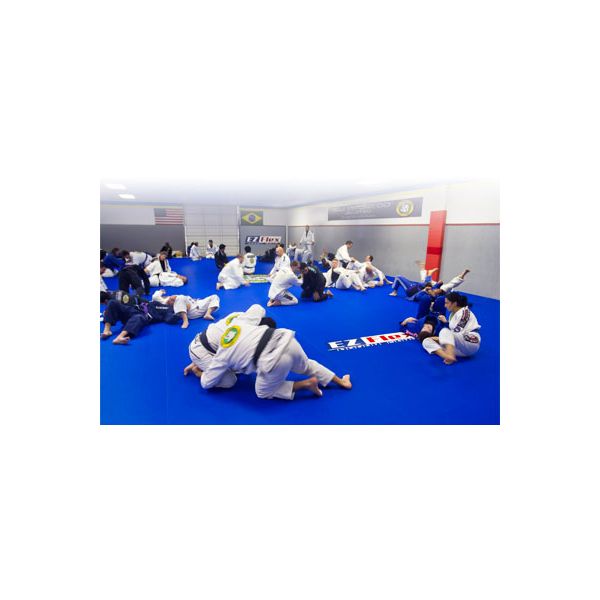
This build fits MMA gyms, BJJ academies, judo clubs, karate and taekwondo schools, and the home garage or basement space that has become a real training floor. Roll-out format means a section covers ground fast and comes up just as fast when the room needs to do something else that evening.
It is worth being clear about what this is not. It is not an interlocking puzzle tile product, so if you were shopping jigsaw foam squares, this is a different animal. It is not wall padding, which is a separate build. And nothing in the source rates it for outdoor exposure, so plan on it living indoors.
The face is smooth vinyl, not a woven-look textured surface. If your image of a dojo floor is a heavily textured mat, this will read cleaner and more modern than that. It grips the same. It just does not carry the visual pattern.
Within the broader range of martial arts mats, roll-out vinyl sits in the middle of the format spectrum. Tiles win on shipping and storage for very small rooms. Permanent bonded floors win on seam count. Roll-out wins when you need real thickness over a large area and still want the floor back.
Three Things to Check Before You Spec It
First, match thickness to what actually happens in your classes. If people are being thrown, 1-1/4 inch is not your spec. The source draws that line clearly, and it is not a suggestion. Programs that mix striking and grappling should spec to the grappling side, because that is where the impact lives.
Second, think about where the seams will fall. Sections join with mat tape, and a tape line running straight through your throwing area takes far more traffic than one sitting along a wall. Send us the room dimensions and how the space actually gets used, and the layout can put seams where they get stepped on least.
Third, look at what is underneath. These mats manage impact, but they are not a substitute for a sound subfloor. A soft or uneven base changes how the mat behaves under load, and a subfloor that traps moisture will shorten the life of anything you put on top of it.
Why Mats Inc.
Martial arts matting gets specified wrong more often than most flooring, usually by someone who bought on thickness alone and skipped the discipline question. We spec to what your program actually does on the floor. If your rooms serve different styles, we will size them differently rather than pushing one build across the whole facility.
Martial Arts Matting — Specifications
| Format | Roll-out sections, custom-made to size |
|---|
| Available thicknesses | 1-1/4″ (striking / stand-up styles only)
1-5/8″ (grappling / throwing)
2″ (added shock absorption) |
|---|
| Core | 2.2 lb density sports foam |
|---|
| Surface | Smooth 24 oz non-slip vinyl with light surface texture and built-in antimicrobial protection |
|---|
| Colors | Royal Blue, Navy Blue, Purple, Red, Maroon, Black, Green, Gray, Gold, White, Orange |
|---|
| Reference section weight | 6′ × 42′ section: approx. 108 lb at 1-1/4″, approx. 116 lb at 1-5/8″, approx. 124 lb at 2″ |
|---|
| Rolled dimensions | Approx. 36″ diameter × 72″ (1-1/4″ and 1-5/8″); approx. 41″ diameter × 72″ (2″) |
|---|
| Seaming | Sections joined with mat tape |
|---|
| Included | One nylon strap with metal buckle per roll |
|---|
| Custom artwork | Logos and mat graphics reproduced from vector files |
|---|
| Field trimming | Cut to size with a straight edge and heavy-duty snap-blade utility knife |
|---|
| Origin | Made in the USA |
|---|
| Warranty | 1-year limited (Mats Inc.) |
|---|
Frequently Asked Questions
What is actually inside martial arts matting?
Two layers doing two jobs. The core is 2.2 lb density sports foam, which handles the impact. The face is 24 oz non-slip vinyl with antimicrobial protection built into the material. The foam controls how a landing feels. The vinyl controls grip, cleanability, and how long the surface survives daily use.
Density is the number people skip. A low-density foam feels soft on day one and packs out by month six, leaving you with a thin mat that still looks fine from across the room. The 2.2 lb spec is what keeps the shock absorption you paid for actually present a year later.
— Dustin Thompson
How heavy are these, and what should I expect from them over time?
Weight scales with thickness. A 6 foot by 42 foot reference section runs roughly 108 lb at 1-1/4 inch, 116 lb at 1-5/8 inch, and 124 lb at 2 inch. Rolled up, the thinner builds come to about 36 inches in diameter by 72 inches long; the 2 inch build runs closer to 41 inches. Plan your storage space around that.
Those numbers also tell you something practical: moving these is a two-person job, not a one-person job. Facilities that roll mats up nightly should account for that in how they staff closing. Ours carry a 1-year limited warranty.
— Dustin Thompson
Can I put this over concrete in a garage or basement?
Yes, and that is a common setup for home training floors. The mat is doing the impact work, so a hard, flat, dry slab is actually a good base. What you want to avoid is an uneven slab, because high spots concentrate load and the mat will telegraph them under a body.
Moisture is the thing to check first. Concrete below grade can push vapor upward, and anything trapped between slab and mat will eventually become a smell problem and then a hygiene problem. If your basement has ever felt damp, address that before the mat goes down.
— Dustin Thompson
Can I get a size that actually fits my room?
Yes. These are custom-made rather than sold in fixed stock sizes, so we build to your dimensions instead of asking you to work around ours. That matters most in rooms with a column, an angled wall, or a doorway swing that a rectangular stock mat would fight with.
Send us the room measurements and any obstructions. If you need to make a small adjustment after delivery, the mats can be trimmed on site with a straight edge and a heavy-duty snap-blade utility knife.
— Jinna Hopson
What does the surface look like, and what colors are available?
The face is smooth vinyl with a light texture worked into it. On the floor it reads as a clean, even training surface rather than a heavily patterned one, which tends to photograph well and makes the room feel larger than a busy surface would.
Eleven colors are available: Royal Blue, Navy Blue, Purple, Red, Maroon, Black, Green, Gray, Gold, White, and Orange. Most schools pick from their own brand colors. If you are choosing between a light and a dark version of the same idea, darker tones tend to keep scuffs and traffic marks less visible between deep cleans.
— Jinna Hopson
Can we put our school logo on the mat?
Yes. Send artwork in a vector format such as .ai, .eps, or .pdf, and it gets reproduced into the mat rather than printed on top. Vector files scale to mat size without going soft at the edges, which is why the format requirement exists. If all you have is a raster logo, it can be redrawn.
A logo on the floor does more work than people expect. It shows up in every class photo, every promo clip, and every phone video a student posts after a good round. For schools building a brand, the mat is the most photographed surface you own.
— Jinna Hopson
Written by Dustin Thompson, Owner & CEO, Mats Inc.