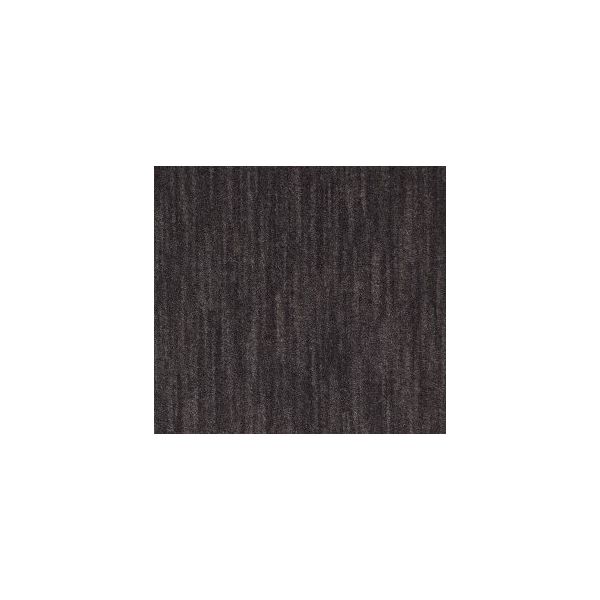
Kensington is a premium commercial carpet tile for spaces that need to look refined and still absorb heavy traffic. It is tufted from 100 percent space-dyed nylon at a 30 ounce pile weight, carrying a designer striae pattern inspired by the banding found in nature. Most floors force a choice between looking considered and lasting well. This one is built not to.
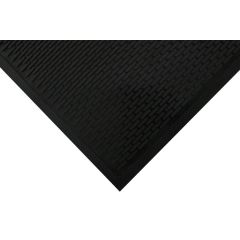
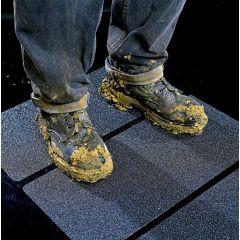
The part that sets it apart is not the tile itself. Kensington exists as carpet tile, as sheet goods in two widths, and as custom and logo matting, all in the same design family. That means one look can run through an entire building instead of stopping at the edge of each room.
What a Multi-Format Line Does Before Your Building Looks Assembled by Committee
Most commercial buildings end up with three different flooring stories. Tile through the offices, broadloom in the conference rooms or executive areas, and a mat at the front door that was ordered separately, from a different supplier, in whatever colors were available.
Nobody plans it that way. Each decision is reasonable in isolation, and each one is made months apart by different people solving different problems. The result is a building where the floor changes character every time you walk through a doorway.
Entrances take the worst of it. The mat at the door is the first flooring anybody sees, and it is almost always the piece that matches nothing. It reads as equipment rather than as part of the space, which undercuts whatever the lobby was designed to convey.
A line that spans tile, sheet and matting closes those gaps. The offices, the seamless areas and the entry all draw from the same design family, so the building reads as one continuous decision rather than a sequence of unrelated ones.
Why a Premium Multi-Format Line, and Why This One
Refined and hard-wearing usually pull in opposite directions. Surfaces that look considered tend to be finer and mat down faster; surfaces that shrug off traffic tend to look industrial. What buys you both is fiber and density, and that is where this tile spends its construction.
The fiber is 100 percent space-dyed PA6 nylon rather than the polyester used in most stock commercial tile. Nylon recovers from compression better, which is what keeps a pile standing in a corridor after a few years of the same footfall. Space dyeing puts tonal variation into the yarn itself, which is where the depth in the striae pattern comes from.
The weights back that up. Pile weight is 30 ounces per square yard against a 150 ounce total weight, at a total height of 0.375 inches over a 0.275 inch pile. That is a substantially denser build than a general-purpose tile, and density is the specification that decides whether a floor still looks maintained in year six.
The three formats each solve a different problem. Modular tile gives you replaceability, so a damaged square in a corridor lifts out on its own. Sheet goods, at 6 feet 7 inches or 13 feet 2 inches wide, give you an unbroken surface where seams would distract. Custom matting puts the same design at the door.
Specifying across all three from one family also removes a coordination problem that otherwise never fully resolves. Matching color and character across separate manufacturers is guesswork under real lighting, and it is the reason so many buildings end up with a floor that nearly matches.
Where It Belongs, and Where It Is Not the Right Tile
The natural fit is anywhere appearance carries weight and traffic is real: corporate offices, hotel and hospitality interiors, conference rooms, airports, libraries, retail and specialty store floors, government buildings, educational interiors, pharmacies and drugstores. Anywhere the floor is part of how the space presents itself.
It works particularly well on projects covering a whole building rather than a single room. If you are specifying a lobby, corridors, offices and an entrance in one pass, the multi-format range is doing work that a tile-only product cannot.
Where it is not the answer is a purely functional space. A stockroom, a back corridor or a utility area does not need premium construction, and that density is better placed on the floors people see. The full range of carpet tiles is organized around matching the grade to the zone.
Two constraints are worth knowing before you commit. This is an indoor-only product, rated for zones two and three rather than the exposed threshold itself. And it is not recommended over in-floor heating, because the insulation value of the tile works against the system underneath.
Three Things to Check Before You Spec It
First, work out your formats before your colors. Walk the building and decide which areas want replaceable tile, which want seamless sheet, and whether the entrance should carry artwork. Getting that map settled first is what makes a single specification cover the whole project.
Second, plan for a quarter-turn layout, because the manufacturer specifies it. Alternate tiles are turned 90 degrees to produce a checker pattern, and an arrow on the back of each tile marks pile direction. On a striae design that quarter turn is not a formality — crossing the banding is what produces the movement the pattern is designed for.
Third, sort quantities and attic stock together. Tiles run 19.69 inches square and ship 20 to a box covering 54.18 square feet, so take the area, add for perimeter cuts, then add five to ten percent ordered in the same run and stored flat and dry. Only tiles from the same batch number should be laid together.
Why Mats Inc.
Buildings rarely get specified all at once, which is how floors end up mismatched — the lobby happens in one budget year and the entrance mat in another. We have been working commercial floors since 1964, and with a line that spans tile, sheet and matting the useful move is to plan all three now even if you install them in stages. Tell us the building and we will map it out so the pieces still agree in two years.
| Tile size | 19.69 in. x 19.69 in. (±2%) |
| Tiles per box | 20 |
| Coverage per box | 54.18 sq. ft. |
| Total height | 0.375 in. (±7.5%) |
| Pile height | 0.275 in. (±0.5 mm) |
| Colorways | Five: Dark Grey, Charcoal Black, Navy Blue, Taupe, Red |
| Also available as | Sheet/roll goods in 6 ft. 7 in. or 13 ft. 2 in. width; custom and logo matting |
| Manufacturing process | Tufted |
| Surface aspect | Designer striae pattern |
| Fiber | 100% space-dyed PA6 nylon |
| Primary backing | Premium eco bitumen |
| Pile weight | 30 oz/sy (±7.5%) |
| Total weight | 150 oz/sy (±7.5%) |
| Application | Indoor only; zones 2–3 |
| Indoor air quality | Green Label Plus certified |
| Dimensional stability | Pass (ASTM D7570-09) |
| Sound insulation | ≥24 dB (ISO 10140-1:2010) |
| Thermal retention | 0.13 m·K/W, pass (ISO 11092) |
| Electrostatic propensity | >2 kV (EN 1815) |
| Electrical resistivity | Pass at RH ≥40% (IBM / ICL) |
| Radiant panel | Class 1 (ASTM E648 / DIN 4102) |
| Smoke density | Pass (ASTM E662) |
| Surface flammability | Pass (FF 1-70 / ASTM D2859) |
| Color fastness | Light 5; water 5; shampoo 4–5; rubbing 4 dry, 3–4 wet (ISO 105) |
| LEED-NC | MR Credit 4; IEQ Credits 4.1, 4.3, 5 |
| Warranty | 1-year limited (Mats Inc.); professional installation required for coverage |
Frequently Asked Questions
How can one tile be both refined-looking and heavy-traffic rated?
Answered by Dustin Thompson, Owner & CEO
The two are not opposed, but hitting both takes a heavier build. This one is tufted from 100 percent space-dyed PA6 nylon at 30 ounces per square yard of pile weight, with a 150 ounce total weight and a 0.275 inch pile. Nylon recovers from compression better than the polyester used in most stock commercial tile, which is what keeps a corridor from developing visible lanes.
The looks come from the same place. Space dyeing puts tonal variation into the yarn before it is tufted, so the striae banding has depth in it rather than being printed on. Cheaper tiles pick a side: toughness from a coarse flat surface that reads utilitarian, or looks from a finer surface that crushes in the traffic. Send us your traffic levels and we will confirm the figures against your spec.
How long should a premium tile like this last?
Answered by Dustin Thompson, Owner & CEO
Commercial carpet tile generally plans out at ten to fifteen years in offices and moderate-use rooms and seven to ten on busier retail and hospitality floors, with the hardest-worked lanes turning over sooner than the field around them. A 30 ounce nylon construction tends to land at the top of whichever band applies rather than shifting the band.
The variable that moves those numbers most is what reaches the floor from outside, which is worth remembering when you are specifying the entrance from the same line. Kensington carries a 1-year limited warranty from Mats Inc., and warranty coverage on this line depends on professional installation — worth building into the plan rather than treating as optional.
How do we handle layout and ordering across the different formats?
Answered by Dustin Thompson, Owner & CEO
Order everything in one go if the schedule allows. Tile, sheet and matting produced in the same run will agree on shade in a way that staged orders cannot guarantee, and only tiles carrying the same batch number should be laid together. If the project has to phase, tell us up front so we can plan around it.
For the tile portion the method is specified rather than optional. Tiles are laid with alternate squares turned 90 degrees to a checker pattern, working outward from a center line so full tiles land in doorways, over a flat, dry, clean subfloor with cracks filled and dusty areas primed. On large installations one row in five gets secured with double-sided tape, and tiles under caster chairs are fully secured. Where tile meets sheet goods, plan the transition height in advance.
When should we use tile versus sheet goods?
Answered by Jinna Hopson, Vice President of Marketing
Tile wherever things get spilled, dragged or worn unevenly — corridors, open offices, retail floors, anywhere a single damaged square would otherwise mean living with a patch. Replaceability is worth a great deal in a working space, and each box covers 54.18 square feet so quantities are easy to plan around.
Sheet goods where the eye should travel uninterrupted. Boardrooms, executive floors, hotel suites and smaller formal rooms all benefit from a surface with no grid in it, in either a 6 foot 7 inch or 13 foot 2 inch width. Those are also the rooms where the acoustic figure earns attention: this construction is rated at 24 decibels or better for sound insulation, which matters more in a quiet room than a busy one.
What colors does the range come in?
Answered by Jinna Hopson, Vice President of Marketing
Five colorways: Dark Grey, Charcoal Black, Navy Blue, Taupe and Red. That is a wider palette than most premium commercial ranges offer, and the two saturated options matter — Navy and Red let a floor carry brand color without going to a custom dye run, which is rare in a stock program.
The same design family runs across all three formats, so a color decision made once holds across the whole project. That consistency is worth more than the specific shade in most cases. Choosing a floor tone that agrees with your walls, furniture and branding is straightforward when you choose once. It gets difficult when the entrance mat comes from a different supplier's color card six months later.
Can we put our logo or branding into the entrance?
Answered by Jinna Hopson, Vice President of Marketing
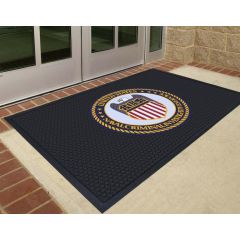
Yes, and this is the part of the line most people overlook. Custom and logo matting comes from the same family as the tile, so an entrance carrying your artwork sits in the same design language as the floor behind it rather than reading as a separate item.
The entrance is the highest-value place in a building to put branding, because it is the one piece of flooring everyone looks directly at. Doing it within the same line means it also does its actual job — catching what comes in off the street — without looking like equipment parked in your lobby. Send us your artwork and the door dimensions and we will work it through.
By Jinna Hopson, Vice President of Marketing, Mats Inc.