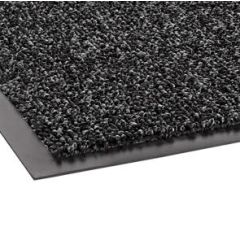
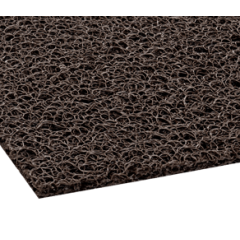
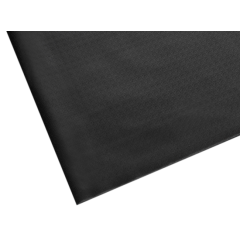
Hercules is a ribbed commercial carpet tile built for floors that take a beating. The face is a four-by-two rib, a corduroy texture made from unusually thick cords, and that cord thickness is what keeps the surface from flattening under constant foot traffic. It's one of the harder-wearing options among our commercial carpet tiles, and it's made for indoor use.
What Hercules Does Before Your Traffic Lanes Start to Show
Walk through any busy building and you can see the path people take. The carpet in that lane goes flat and dull first, months before the rest of the floor is anywhere near worn out. That's pile crush, and it's the main reason commercial carpet squares get pulled early. Hercules is built to slow it down.
The thick cords in the rib do that work. A dense, low, tightly packed face has less room to bend over and stay bent, so footsteps push the surface down and it springs back instead of laying flat. The rib also breaks up the light across the floor, so the traffic lane doesn't read as a stripe through the room.
Why the Ribbed Construction, and Why This Tile
Hercules is a non-woven tile, not a tufted one. Rather than yarn loops stitched into a backing, the fibers are bonded into a dense mat and formed into the rib. The fiber is a polypropylene and polyester blend, both of which shed moisture and clean up well. Total weight runs 170 ounces per square yard.
Under the face sits a premium eco bitumen backing. Bitumen is what lets a carpet tile lie flat on its own: it's heavy, it's stable, and it doesn't need glue spread across the whole floor. The tile passes EN 986 for dimensional stability, which is the test for whether tiles stay square instead of shrinking or curling at the corners.
Total height is 0.47 inch, with 0.375 inch of that being pile. That's a low profile, so doors clear it and chair casters roll without fighting the surface. You also pick up 24 dB or better of sound insulation under ISO 10140-1, which takes the edge off footstep noise in a corridor or an open office.
If you're documenting a project, the tile carries LEED-NC credit as well: MR Credit 4, plus IEQ Credits 4.1, 4.3, and 5. Those reference the older LEED-NC credit set, so confirm how they map if you're certifying under a current version of the standard.
Where It Belongs, and Where It Doesn't
This is a floor-field tile. It's made for offices, conference rooms, lobbies, libraries, corridors, retail and department stores, airports, resorts, restaurant entryways, and spas. Those are the indoor spaces where traffic is heavy all day and the floor still has to look presentable to everyone walking across it.
It is indoor only. There's no UV package and no drainage, so it doesn't belong outside, in a vestibule that catches weather, or anywhere standing water collects. It's also not a walk-off tile. Hercules doesn't scrape grit or hold moisture below the walking surface the way a bi-level entrance tile does. Put a real walk-off system at the door and let Hercules take the floor behind it.
A few other honest limits. It's a loose-lay tile, not an interlocking or peel-and-stick one, so it isn't a fit for stairs. And the radiant panel flammability rating is Class II. That's the standard commercial rating, but exit corridors in healthcare and some institutional buildings are written to require Class I, so check the code that applies to your building before you spec it there.
Home use isn't off the table. Hercules works in a finished basement, a home office, or a media room, and the modular format means you swap one square instead of pulling up the whole room. Just know it's built as a commercial product. It's firmer and flatter underfoot than a soft residential carpet, and it ships with the Mats Inc. 1-year limited warranty.
Three Things to Check Before You Spec It
First, check what's under the tile. Hercules loose-lays on a floor that's flat, dry, and clean. Cracks need filling, uneven spots need covering with hardboard, and a dusty slab needs priming. If the room has underfloor heating, this isn't the tile. Its insulation value is high enough that laying it over a heated slab isn't recommended.
Second, count the room, not just the square footage. Tiles are 19.69 inches square, which is the 50 centimeter metric size. That's a little under 20 inches, and noticeably smaller than the 24 inch square some people picture. They come 12 to a box, covering 32.5 square feet. Order a spare box and keep it, because batch-matched tiles are how you fix damage years later.
Third, plan for how the floor gets held down. Loose-lay is fine for most rooms, but on very large installations it's worth taping one row in five with double-sided tape. Anywhere caster chairs roll, whether that's desks, workstations, or a conference table, those tiles should be fully secured or the wheels will walk them out of line.
Why Mats Inc.
We've been supplying floors and mats to commercial buildings since 1964, and we've watched a lot of carpet tile go in and a lot of it come back out early. Hercules earns its spot on our shelf because the thick-cord rib holds its look in the traffic lane, which is where most tile gives up first. If you're not sure it's dense enough for your building, ask us before you order.
| Construction | Non-woven, four-by-two ribbed corduroy |
| Fiber | Polypropylene and polyester blend |
| Primary backing | Premium eco bitumen (alternate backing system available) |
| Pile height | 0.375 inch (± 0.5 mm) |
| Total height | 0.47 inch (± 7.5%) |
| Total weight | 170 oz/sy (± 7.5%) |
| Tile size | 19.69 inch x 19.69 inch (± 2%) |
| Packaging | 12 tiles per box (32.5 sq. ft.) |
| Color | Heather Grey |
| Dimensional stability | Pass (EN 986) |
| Electrical resistivity | Pass at 40% relative humidity or above (IBM / ICL) |
| Sound insulation | 24 dB or greater (ISO 10140-1:2010) |
| Thermal retention | 0.13 m K/W, Pass (ISO 11092) |
| Radiant panel flammability | Class II (ASTM E648) |
| Smoke density | Pass (ASTM E662) |
| Surface flammability | Pass (FF 1-70 / ASTM D2859) |
| LEED-NC | MR Credit 4; IEQ Credits 4.1, 4.3, 5 |
| Use | Indoor only |
| Warranty | 1-year limited (Mats Inc.) |
Frequently Asked Questions
What does "four-by-two rib" actually mean?
Answered by Dustin Thompson, Owner & CEO
It's the name of the rib pattern on the face, a 4 x 2 ribbed corduroy, and it's what gives the tile that fine linear texture. What matters more than the pattern name is what's under it. The cords are unusually thick, and that thickness is what resists crushing.
The tile is non-woven, so the fibers are bonded into a dense mat rather than stitched in as yarn loops. The fiber itself is a polypropylene and polyester blend. Both of those shed moisture rather than soaking it up, which is part of why the tile cleans back to looking decent.
How does Hercules hold up in a high-traffic corridor?
Answered by Dustin Thompson, Owner & CEO
That's the environment it's built for. Total weight is 170 ounces per square yard, with a 0.375 inch pile on a 0.47 inch overall height, so it's a dense, low tile with very little room to lay over. Density is what buys you appearance retention in a lane that sees thousands of footsteps a day.
How long it actually lasts still comes down to maintenance. Vacuum weekly in quiet areas and daily or twice daily in the busy ones. A motor-driven brush with a beater bar pulls up to 80% of surface dirt, and soil is roughly 15% oil, which is why it clings to fiber and resists a light pass. Frequent light cleaning beats occasional deep cleaning.
How is it installed, and do I need adhesive across the whole floor?
Answered by Dustin Thompson, Owner & CEO
No, Hercules loose-lays. The floor has to be flat, dry, and clean first: fill cracks, cover uneven areas with hardboard, prime anything dusty. Let the tiles sit at room temperature, 60 to 70 degrees Fahrenheit, before you start laying them.
Work from a marked cross in the center of the room outward, turning every other tile 90 degrees to get the checkerboard. There's an arrow on the back of each tile showing pile direction, and only tiles from the same batch should be laid together. On large jobs, tape one row in five with double-sided tape. Under caster chairs, secure the tiles fully.
What size are the tiles, and how do I work out how many I need?
Answered by Jinna Hopson, Vice President of Marketing
Each tile is 19.69 inches square, which is the 50 centimeter metric size. That's just under 20 inches, and noticeably smaller than the 24 inch squares people sometimes assume when they hear "carpet tile." They ship 12 to a box, covering 32.5 square feet.
Measure the room, divide by 32.5, and round up. Then add roughly 5 to 10 percent for cuts around doorways, columns, and awkward corners, and buy a spare box beyond that. Tiles are matched by production batch, so a box set aside now is your best insurance against a stained or damaged square three years from now.
What does it look like in a finished space?
Answered by Jinna Hopson, Vice President of Marketing
It reads as a fine linear texture rather than a pattern you actively notice, a corduroy rib in a heathered grey. That's deliberate. A busy pattern dates a space and shows soil in obvious ways, while a tight rib in a mid-tone grey stays quiet and hides daily traffic much better.
One practical note on color. Shade can vary slightly between production runs, and a sample swatch is cut from a larger piece, so the swatch shows you the character rather than an exact match. Order a single space from one batch, and lay the tiles quarter-turned so any variation blends instead of lining up into visible bands.
Can I use Hercules at an entrance, or in a home?
Answered by Jinna Hopson, Vice President of Marketing
At an interior entrance, yes. Restaurant entryways and lobbies are exactly the kind of space it's made for. What it shouldn't do is the walk-off job. It doesn't scrape grit or hold water below the walking surface, so put a proper entrance mat or walk-off tile at the door and let Hercules carry the floor behind it. It's indoor only, so it never goes outside the threshold.
At home it works well in a basement, an office, or a media room, and swapping one square beats replacing a whole room. Just expect a firmer, flatter feel than a soft residential carpet. This tile is built to be walked on hard, not to be plush underfoot.
By Dustin Thompson, Owner & CEO, Mats Inc.