




More Information
| Manufacturer | Musson Rubber Company |
|---|
$770.00

Have a question? We're here to help!
Description
Landings and lobbies fail differently than the floors around them. Traffic arrives from one direction and leaves in another, carts and equipment get pushed across at an angle, and everything wet from outside gets deposited in the first twenty feet. Raised disc rubber tile puts a resilient, textured surface over that zone — one that grips a shoe without fighting a wheel.
What Raised Disc Rubber Tile Does Before a Landing Turns Into a Maintenance Problem
The wear on a landing is rotational. Feet pivot rather than push straight, and that twisting motion is what polishes terrazzo smooth, drives grit into concrete, and strips finish off a hard floor in a narrow band you can see from across the room. A resilient tile absorbs that twist and recovers instead of transmitting it into the substrate.
The second problem is water. A landing at the top or bottom of a flight collects everything tracked in, and on a smooth hard floor that water spreads into a film across the exact area where people are changing direction. A raised profile breaks that film up and gives the water somewhere to sit below the walking plane.
The third is cleaning. A textured floor that traps dirt costs more in labor every single day than it ever saved in specification. The disc pattern is an open field rather than a channelled one, which means a mop or an autoscrubber clears the surface between discs instead of pushing debris along a groove.
Why a High Raised Disc Profile, and Why This Tile
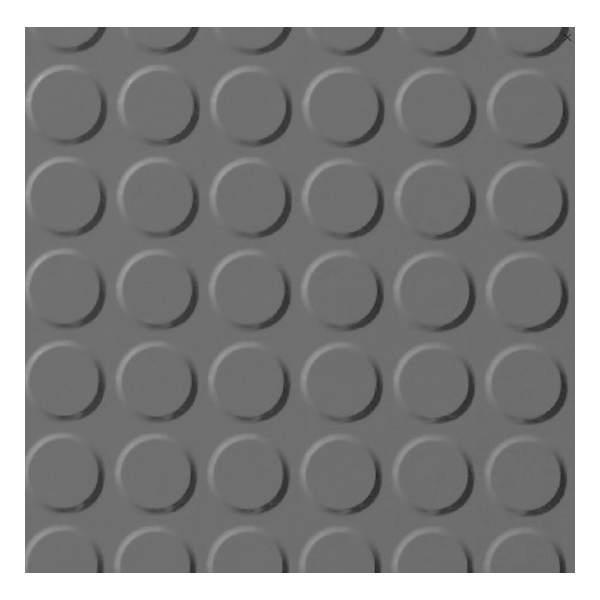
The discs measure 1-3/32" across and stand 3/64" proud of the base, spaced a quarter inch apart. That is a high profile by landing tile standards, and the height is the point: it is enough for a shoe sole to compress against and get positive grip, rather than a shallow texture that stops working the moment the floor is wet.
The disc shape is what makes that height workable under wheels. A round profile presents no edge for a caster to catch on from any approach angle, so carts, dollies, and wheeled equipment roll across the field rather than bumping over it. A raised pattern with straight edges gives you grip at the cost of a rougher ride and more noise.
Overall tile thickness is 5/32". The rubber is non-staining and non-discoloring, which matters on a surface that will see salt, cleaning chemicals, and rubber wheel marks over its life. Tiles are factory cut square at 19-11/16" (50 cm), so joints close tightly and the disc field lines up across the whole landing.
Where It Belongs — and Where It Doesn't
Stair landings are the core application, but this tile earns its place anywhere foot traffic and wheeled traffic share the same floor: lobbies, entrances and vestibules, corridors, elevator cabs and elevator lobbies, ramps, and the areas around concessions and vending where spills are routine. It sits alongside the rest of the interior stair and landing line.
It is not a stair tread. There is no nose, so it cannot cover a step edge and should never go on the steps themselves. It is also not a loose-lay mat or an interlocking tile — it bonds to the substrate permanently, which is exactly what lets it survive cart traffic that would shift anything unbonded.
For exterior landings and entry steps, do not assume this tile transfers. Outdoor installations bring freeze-thaw movement and water sitting under the tile, and the adhesive bond carries the entire system. That application needs to be confirmed rather than inferred — tell us the exposure and we will spec it properly.
Three Things to Check Before You Spec It
Tile jobs are decided in the layout, before anything ships. Three checks will keep the cuts where you want them and the order accurate.
First, plan the layout around a metric module. The tile is 19-11/16" square, which is 50 cm — it will not divide evenly into any imperial landing dimension, so cut tiles are guaranteed rather than possible. Decide up front whether the partial tiles sit against the wall, at the stair edge, or split evenly on both sides, because on a small landing a badly placed cut row is the first thing anyone sees.
Second, assess the substrate before ordering. The tile is adhered, so the floor has to be flat, sound, dry, and clear of old adhesive ridges. Rubber conforms to what is underneath it rather than bridging over it, so a high spot or a trowel ridge will telegraph through the finished surface. Adhesive selection depends on what you are bonding to, so tell us the substrate.
Third, match the profile to how the floor gets used. If wheeled equipment crosses the area constantly, the round disc profile is the reason to choose this pattern over an angular one. If the space is foot traffic only and coordinating with patterned stair treads matters more, a different pattern may serve you better. Tell us what rolls across it and how it gets cleaned.
Why Mats Inc.
Mats Inc. has supplied stair and landing coverings since 1964, and landing tile is where orders most often come up short — usually because someone calculated from square footage and forgot that cut waste is real. We will take your landing dimensions, work the tile count and the carton math, plan where the cut row falls, and match the adhesive to your substrate before anything ships. Send the measurements and we will handle it.
| Material | Molded rubber, non-staining and non-discoloring |
|---|---|
| Pattern | High profile raised disc |
| Tile size | 19-11/16" x 19-11/16" (50 cm x 50 cm), factory cut |
| Overall thickness | 5/32" |
| Profile height | 3/64" |
| Profile diameter | 1-3/32" |
| Coverage per tile | 2.69 sq. ft. |
| Tiles per carton | 16 |
| Coverage per carton | 43 sq. ft. |
| Weight per carton | 50 lbs. |
| Installation | Adhered; adhesive selected to substrate |
| Warranty | 1-year limited (Mats Inc.) |
Frequently Asked Questions
What does the raised disc profile actually do that a flat tile doesn't?
Answered by Dustin Thompson, Owner & CEO
Three things. It breaks up the water film — tracked-in moisture drops into the quarter-inch gaps between discs instead of spreading across the whole surface, so the shoe is contacting rubber rather than water. It gives the sole something to compress against, which is where the grip actually comes from on a resilient floor.
And it keeps the contact area small. Only the disc tops touch the shoe, so debris that would otherwise sit under the full footprint has somewhere to go. That is also why the pattern cleans well: the field between the discs is open, not channelled, so nothing gets pushed along a groove and left there.
Will the discs wear flat over time?
Answered by Dustin Thompson, Owner & CEO
Much more slowly than people expect, because rubber does not wear the way a hard surface does. Under load it deforms and recovers rather than having material ground off it. The discs stand 3/64" above a 5/32" tile, and that profile height is molded into the material, not applied to the top of it.
Where you will see change first is not wear but polish — the disc tops picking up a sheen in the heaviest traffic lane. That is cosmetic and does not meaningfully reduce traction, since the grip comes from the profile geometry and the drainage gaps as much as from surface texture. If a landing is degrading fast, the usual cause is grit being left on it rather than the tile giving out.
Can this go anywhere other than a stair landing, including outdoors?
Answered by Dustin Thompson, Owner & CEO
Indoors, yes, and it is a strong choice well beyond landings. Lobbies, vestibules, corridors, elevator cabs, ramps, and service areas around concessions and vending all suit it. The disc profile is particularly good where foot traffic and wheeled traffic share a floor, because casters roll over a round profile without catching.
Outdoors is a question I would not answer by assumption. Exterior installations put freeze-thaw movement and standing water under the tile, and the adhesive bond is carrying everything. Before specifying this on an exterior landing or entry, talk to us so we can confirm the right product and adhesive for that exposure rather than guessing from an indoor spec.
What size are the tiles and how many do I need?
Answered by Jinna Hopson, Vice President of Marketing
Each tile is 19-11/16" square — that is 50 cm, a metric module — and covers about 2.69 square feet. They ship 16 to a carton, which is 43 square feet and about 50 pounds, so a single carton handles a typical landing with tiles left over.
To count them, measure your landing in inches, divide each dimension by 19-11/16, and round up on both. That gives you the tile count including the partials you will cut. Do not work from square footage alone — it under-orders every time, because it assumes zero cut waste. Add a few spares as well: door jambs, floor registers, and stringer details all eat tiles you did not plan for, and spares from the same run beat a near-match years later.
What does a finished disc floor actually look like?
Answered by Jinna Hopson, Vice President of Marketing
Clean and deliberate. The discs are just over an inch across and evenly spaced, so the surface reads as a regular field rather than a busy texture, and it sits comfortably in a modern lobby or a utilitarian service corridor equally well. It is one of the few safety surfaces that does not look apologetic in a finished space.
The detail worth getting right is alignment. Because the disc field is regular, a tile set slightly out of square is visible immediately across the whole landing — far more so than with an irregular pattern. Have the installer snap lines and work from a true reference edge rather than following a wall that may not be straight. Done properly, the joints disappear and the discs read as continuous.
How do I choose between a disc pattern and a diamond pattern?
Answered by Jinna Hopson, Vice President of Marketing
Start with what crosses the floor. If carts, dollies, gurneys, or any wheeled equipment use the space regularly, the disc profile is the better answer — round shapes give casters nothing to catch on from any direction. If the traffic is almost entirely on foot, the choice opens up.
The second consideration is what the landing connects to. If your stair treads carry a specific pattern, matching the landing to them makes the stairwell read as one designed surface instead of two separate purchases. So: wheeled traffic points to discs, and tread coordination points to whichever pattern your treads already use. Tell us both and we will make the call with you.
Written by Dustin Thompson, Owner & CEO, Mats Inc.
Ordering Info
19-11/16" x 19-11/16" per Tile
5/32" Overall Thickness
16 Tiles per Carton
43 sq ft of Coverage per Carton
Reviews
Write Your Own Review
Related Products
Super Scrape Rubber Mats
Safety Track Non-Skid Tape - Coarse
Smooth Marbleized Vinyl Switchboard Matting (Mil Spec)
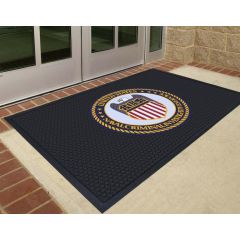
Super Scrape Rubber Logo Mats
Strip Doors
Perfec Clean 3/8" Rollup Mats - Aluminum Hinge
Perfec Clean 3/8" Rollup Mats - Rubber Hinge
Perfec Clean 3/4" Rollup Grate - Rubber Hinge
Perfec Clean 1-5/8" Grate
WP-70 Non-Skid Epoxy Coating