




Description
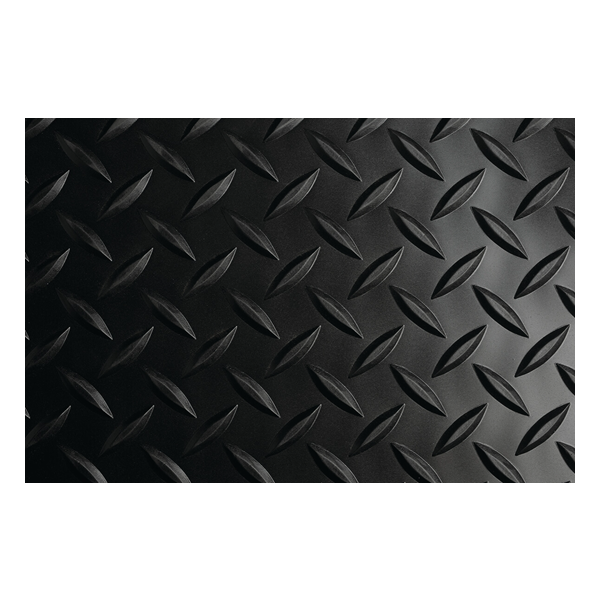
Diamond Plate Vinyl Matting is a 5/32-inch vinyl floor runner with a high-profile embossed diamond pattern, the same raised-lozenge tread you see on steel deck plate, molded into a solid vinyl sheet. The raised diamonds grip a sole from any direction, the surface sweeps clean, and rolling carts cross it without catching. It is oil, grease, and chemical resistant, UV-resistant, meets FMVSS 302 flammability requirements, and comes in black or gray in 24-, 36-, and 48-inch widths on 75-foot rolls, plain or with a yellow safety border.
What a Diamond Plate Runner Does Before the Busiest Floor in the Building Wears Out
Some lanes take more than foot traffic. A tool-crib aisle, a service bay walk-around, a plant corridor between two production lines, a ramp from a dock into a shop: these floors take boots from every angle, carts rolling through, dropped parts, and tracked-in oil and grit. A runner there has to grip whichever way a foot lands, take the wear, and still look like it belongs.
The diamond pattern is the answer to the first two. Raised lozenges set at alternating angles give a shoe an edge to catch no matter which direction it moves, which is why the vendor rates the traction as coming from any direction. And because the pattern stands proud of the sheet, the wear lands on the diamond tops first, not on the sheet that protects the floor.
The look is the third job. A diamond plate runner reads as deliberate industrial flooring, not a strip of matting laid down as an afterthought. On a floor customers, inspectors, or visiting management walk across, that is the difference between a lane that looks managed and one that looks patched.
Why Embossed Diamond Plate in 5/32-Inch Vinyl, and Why This One
The pattern is embossed rather than printed or glued on: the diamonds are formed into the vinyl itself, so there is nothing to peel or delaminate and the traction lasts as long as the sheet. The vendor describes the profile as high-profile diamond embossing, which is the version of the pattern that grips rather than just looks like steel plate.
The gauge is 5/32 inch, heavier than the 1/8-inch runners built for foot traffic and lighter than a 1/4-inch corrugated roll. That is the middle the diamond plate was designed for: enough vinyl under the pattern to take carts and dropped parts, low enough that a caster rolls up onto it and the edge does not become a lip in a busy lane. The vendor states the surface will accommodate rolling carts.
The compound is the industrial vinyl runner formulation: oil, grease, and chemical resistant, UV-resistant, meeting FMVSS 302. UV resistance is the detail that separates this runner from the rest of the ribbed family; it is the one to put near a roll-up door or under skylights where sun reaches the floor. It also cleans by sweeping, since the raised diamonds leave nothing for grit to pack into.
Roll weights tell the rest of the story: 120 pounds for the 24-inch, 175 for the 36-inch, and 240 for the 48-inch, each 75 feet long. Black and gray are stocked, and the vendor produces custom colors, gauges, widths, and lengths for fitted and OEM installations.
The safety-striped version is the same runner with a yellow border along each edge. The border is molded in, not painted on, so it does not scuff off the way a painted floor line does under forklift and boot traffic. Choose it where the runner is also the walkway marking: it puts a visible pedestrian boundary on a plant floor and keeps the lane obvious from a forklift seat.
Where It Belongs, and What It Is Not
Run it down the hardest-working lanes: tool cribs, service-bay walk-arounds, plant corridors between lines, dock-to-shop ramps, the aisles in a parts department, and any walkway where carts and people share the floor and traffic comes from every direction. Gray suits a shop or plant where the runner is seen; black suits a lane where oil and scuffs are the daily condition; the yellow safety border suits a marked pedestrian lane in mixed forklift traffic. It sits among the industrial and commercial vinyl floor runners we stock as the one for heavy, multi-directional traffic that has to look right.
The vendor also lists it for OEM use, and in practice that means it gets cut for truck beds, trailer floors, equipment decks, cabinet bases, and toolbox liners, anywhere a diamond-plate surface is wanted without the weight of steel. The UV resistance is what makes it workable for vehicle interiors that sit in the sun.
What it is not is a cushion or a drainage mat. A solid 5/32-inch sheet has no foam, so someone standing all shift wants an anti-fatigue mat at that station. The diamonds shed water sideways but do not drain it through; a floor that holds standing water wants a perforated mat. And a lane that only sees light foot traffic in a straight line does not need this much runner; a 1/8-inch ribbed roll does that job.
Three Things to Check Before You Spec It
First, confirm the lane earns the gauge. If carts, hand trucks, or dropped parts hit the floor daily, or traffic comes from several directions, diamond plate at 5/32 inch is the right runner. If the lane is single-file foot traffic in a straight line, it is more runner than the floor needs, and a lighter ribbed roll will do.
Second, pick width to the traffic and color to the setting. Twenty-four inches covers a single-file path; 36 inches an aisle where a cart and a walker pass; 48 inches a full bay or a walkway you want covered edge to edge. Gray reads lighter and shows grit sooner, which suits a shop that sweeps daily; black hides oil. Rolls are 75 feet and cut to length on site, with custom widths and lengths available for a fitted run.
Third, fix the edges where wheels cross. At 5/32 inch the runner sits proud enough that a caster meeting a loose edge will catch it. Loose-lay is fine for a straight run on a clean, dry floor, but tape or glue the edges and end cuts at doorways, corners, and anywhere carts cross the side of the runner. Where two lengths meet, butt them square rather than overlapping.
Why Mats Inc.
We carry this runner for the floor that takes the most punishment and is still on display: the tool crib, the bay, the plant corridor the customer walks through. An embossed diamond surface that grips from any direction, holds up to carts, shrugs off oil and sun, and looks like it was specified rather than dropped in place is the right answer there. Mats Inc. has been putting that answer on hard-working floors since 1964.
| Type | Diamond plate vinyl runner matting, sold by the roll |
| Material | Vinyl |
| Top surface | High-profile embossed diamond plate pattern; traction from any direction |
| Thickness | 5/32" |
| Stock sizes & roll weights | 24" x 75' — 120 lbs 36" x 75' — 175 lbs 48" x 75' — 240 lbs |
| Colors | Black, gray; custom colors on request |
| Border | Plain, or yellow safety border along each edge (safety-striped version) |
| Resistance | Oil, grease, and chemical resistant; UV-resistant |
| Flammability | Meets FMVSS 302 |
| Cart traffic | Accommodates rolling carts |
| Cleaning | Sweeps clean; hose or mop as needed |
| Custom | Custom colors, gauges, widths, and lengths available |
| Warranty | 1-year limited (Mats Inc.) |
Frequently Asked Questions
How is the diamond pattern made, and does it wear off?
Answered by Dustin Thompson, Owner & CEO
The diamonds are embossed into the vinyl sheet itself, not printed on top or bonded as a separate layer, so there is nothing to peel, and the pattern is as deep as the vendor's high-profile embossing puts it. The runner is one material through its 5/32-inch thickness. The compound is oil, grease, and chemical resistant, UV-resistant, and meets FMVSS 302 flammability requirements.
The pattern does wear, the way any raised tread does, at the diamond tops in the busiest track first. That is by design: the wear lands on the raised part and the sheet underneath keeps protecting the floor. It stays effective until the diamonds are worn low enough to stop catching a sole.
How long does it last, and what wears it out faster?
Answered by Dustin Thompson, Owner & CEO
The vendor does not publish a service-life figure; traffic decides it. At 5/32 inch with a raised pattern, this is one of the harder-wearing vinyl runners, and under the cart-and-foot traffic it is built for it stays in service until the diamond tops in the main track are worn flat. It carries a 1-year limited (Mats Inc.) warranty, and a look at the pattern depth in the busiest lane once a year tells you where it stands.
What shortens it is edges and chemistry. A loose edge under caster traffic gets kicked, folded, and torn, so fix the edges where wheels cross. The compound handles shop oil, grease, and common cleaners; strong solvents left to sit will soften vinyl, so wipe them up. Its UV resistance means sun near a door is not the problem it is for other vinyl runners.
Do I need to glue it down, and can I cut it to fit?
Answered by Dustin Thompson, Owner & CEO
A straight run on a clean, dry floor loose-lays; at 120 to 240 pounds per roll the runner holds its position, and you can lift it to wash underneath. Because it sits 5/32 inch proud, the edges matter more than on a thinner runner: tape or glue the edges and end cuts at doorways, corners, and anywhere a cart crosses the side of the runner rather than running along it.
It cuts with a sharp utility knife along a straightedge. Unroll it and let it relax flat at room temperature first so it does not hold a curve, then cut to the run. Where two lengths meet, butt them square; an overlap on a diamond plate runner is a lip every caster finds.
Which width should I choose?
Answered by Jinna Hopson, Vice President of Marketing
Match it to how the lane is used, not the width of the floor. Twenty-four inches covers a single-file walkway or a strip in front of a bench. Thirty-six inches is the standard for an aisle where a cart and a walker pass, or the walk-around side of a vehicle bay. Forty-eight inches covers a full bay, a two-way corridor, or a floor you want protected edge to edge in one piece.
All three come on 75-foot rolls and are cut to length on site. Custom widths and lengths are available for a fitted installation, which matters more for a truck bed or equipment deck than for a floor. Measure the lane end to end before ordering.
What does it look like, and when should I pick the yellow safety border?
Answered by Jinna Hopson, Vice President of Marketing
It looks like steel deck plate laid on the floor: rows of raised diamonds set at alternating angles, with the sheen of vinyl rather than metal. Of all the vinyl runners, it is the one that reads as intentional industrial flooring instead of matting, which is why it turns up in showroom-adjacent shop floors and parts counters as often as in plants.
Gray is the choice where the runner is on display; black hides oil and scuffs between cleanings. Pick the yellow safety border when the runner has to do a second job as a walkway marking: a pedestrian lane across a plant floor, an aisle edge in forklift traffic, or a route you want visible from across the building. The border is part of the runner, so it stays sharp where a painted line would wear away.
Is this the right runner for a service bay or a plant walkway with carts?
Answered by Jinna Hopson, Vice President of Marketing
Yes; that combination of carts, multi-directional foot traffic, and oil on the floor is what the diamond pattern was made for. The raised diamonds grip a boot from any angle, the vendor rates the surface for rolling carts, the vinyl shrugs off oil and grease, and the 48-inch roll covers a bay walk-around in one piece. It also holds up near a roll-up door where sun reaches the floor.
Keep the fit honest: it steadies footing and protects the floor, but it is not a cushion, so a station where a technician stands still for long stretches still wants an anti-fatigue mat there.
By Jinna Hopson, Vice President of Marketing, Mats Inc.
Ordering Info
COLOR: Black, Gray
| THICKNESS | WIDTH | LENGTH | WT/SF |
| *5/32" | 24" | 75 LF | 0.87# |
| 5/32" | 36" | 75 LF | 0.87# |
| 5/32" | 48" | 75 LF | 0.87# |
* Full Rolls Only
Reviews
Write Your Own Review
Related Products
Super Scrape Rubber Mats
Safety Track Non-Skid Tape - Coarse

Smooth Marbleized Vinyl Switchboard Matting (Mil Spec)
Super Scrape Rubber Logo Mats
Strip Doors
Perfec Clean 3/8" Rollup Mats - Aluminum Hinge
Perfec Clean 3/8" Rollup Mats - Rubber Hinge
Perfec Clean 3/4" Rollup Grate - Rubber Hinge
Perfec Clean 1-5/8" Grate
WP-70 Non-Skid Epoxy Coating