




More Information
| Manufacturer | M+A Matting |
|---|
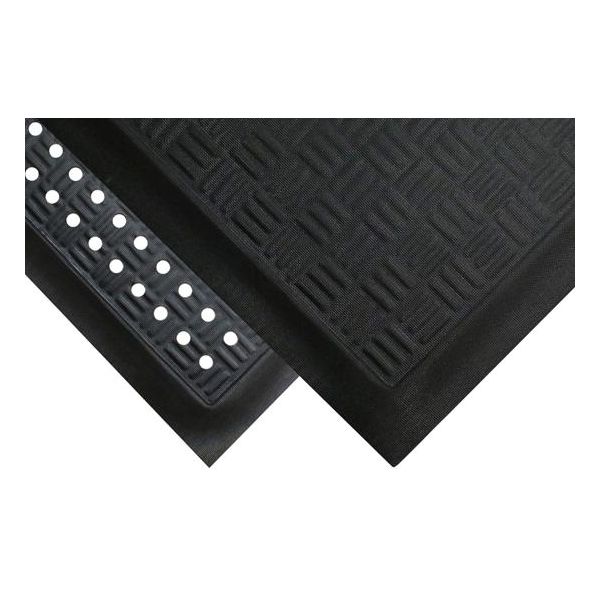
$64.00

Have a question? We're here to help!
Description
What Cushion Station Does Before Fatigue and Hygiene Become Competing Problems
Cushion Station is an anti-fatigue mat built for floors where comfort alone isn't enough — the mat itself has to stay sanitary. A 7/16-inch high-density nitrile rubber foam cushions long standing shifts, while a lifetime anti-microbial treatment protects the mat against odors and degradation between cleanings.
In healthcare and food environments, an ordinary mat becomes a liability twice over: the crew still aches by mid-shift, and the mat quietly turns into the hardest thing in the room to keep clean. Floors like these need a mat that supports the people standing on it and survives the sanitation regimen the space demands.
Why Closed-Cell Nitrile, and Why This One
The cushion is a high-density, closed-cell nitrile foam — a material chosen for what it refuses to absorb. It's grease and oil proof, chemical resistant, and welding safe, so the exposures that soak into and destroy open foams simply stay on the surface here, where cleaning can remove them completely.
Safety is certified rather than claimed: the surface carries high-traction certification from the National Floor Safety Institute, and beveled edges give feet and cart wheels a safe transition from floor to mat. Two surface options cover both floor types — a solid top for dry areas, or drainage holes that carry liquids away from feet in wet zones.
Then comes the part that sets it apart: the sanitation ceiling. The flexible construction scrubs clean with a deck brush and neutral-pH detergent, rinses with a hose or pressure washer, hangs to dry — and when the protocol demands more, the mat can be autoclave sterilized. It also meets FDA and USDA standards for non-contact surfaces in food processing and preparation areas.
Where It Belongs, and What It Is Not
Cushion Station belongs where standing work and strict hygiene share a floor: healthcare facilities, food service and food manufacturing lines, and the industrial or commercial stations that get sanitized on a schedule. The holes version handles dish, prep, and washdown zones; the solid version covers dry stations in the same demanding buildings.
What it is not: the default for every standing post. Where hygiene protocols aren't part of the floor's life — a dry workshop bench, a cashier stand — the simpler dry-area options in our anti-fatigue mats and runners lineup do that job well. This mat earns its place where the cleaning regimen would defeat anything less.
Three Things to Check Before You Spec It
First, choose the surface by the floor's normal day. If liquid reaches the floor daily — dish spray, rinse-down, prep runoff — the drainage-hole version keeps water moving away from feet. If the station stays dry, the solid top gives a continuous standing surface with nothing for small items to fall through.
Second, size to the full working path. Eleven standard sizes run from a compact 2 by 3.2 feet up to 4 by 20.1 feet, in 38-inch and 48-inch widths — enough range to cover a single scrub sink or a whole production line in one piece. Sizes are approximate, with a 3 to 5 percent manufacturing variance, so leave allowance where the fit is tight.
Third, match the mat to your sanitation protocol before it arrives. Decide how it will be cleaned — deck brush and hose on the floor, pulled and pressure-washed, or autoclave sterilized — and who owns that cycle. A mat that fits the existing protocol gets cleaned on schedule; one that doesn't gets cleaned around.
Why Mats Inc.
Hygiene-critical floors are where mat choices get audited — by inspectors, infection-control teams, and food-safety programs — and we've been helping facilities pass those checks since 1964. We carry this mat because it's the rare cushion that keeps up with a sanitation regimen, we verify every claim against the manufacturer's published data, and we back it with a 1-year limited Mats Inc. warranty.
| Material | High-density, closed-cell nitrile rubber foam |
| Thickness | 7/16" |
| Surface Options | Solid (dry areas) or drainage holes (wet areas) |
| Resistance | Grease and oil proof; chemical resistant; welding safe |
| Hygiene | Lifetime anti-microbial treatment; autoclave sterilizable; meets FDA and USDA standards for non-contact surfaces |
| Traction | Certified high-traction by NFSI |
| Edges | Beveled for safe floor-to-mat transition |
| Sizes | Eleven standard sizes from 2' x 3.2' up to 4' x 20.1', in 38" and 48" widths; approximate, 3–5% variance |
| Cleaning | Deck brush with neutral-pH detergent; hose or pressure-washer rinse; hang to dry; autoclave sterilizable |
| Use Area | Healthcare, food service and manufacturing, industrial and commercial settings; wet or dry per surface option |
| Warranty | 1-year limited (Mats Inc.) |
Frequently Asked Questions
Why closed-cell nitrile for a hygiene-critical floor?
Answered by Dustin Thompson, Owner & CEO
Because sanitation only works on surfaces that don't absorb. Closed-cell nitrile foam keeps grease, oil, chemicals, and wash water on the outside of the material, where a brush and rinse can remove them completely — open foams drink those things in and slowly become what you're trying to clean off. Add the lifetime anti-microbial treatment guarding against odors and degradation, and the mat stays part of the sanitation solution instead of joining the problem.
How does it keep footing safe in wet, greasy conditions?
Answered by Dustin Thompson, Owner & CEO
Two certified and built-in ways. The surface carries high-traction certification from the National Floor Safety Institute — independent slip-resistance testing, not a marketing line — and the beveled edges slope to the floor so a hurried step on or off never catches a raised lip. In wet zones, the drainage-hole version adds the third layer: liquids pass through and away from feet rather than pooling where the next step lands.
Should I choose the solid top or the drainage holes?
Answered by Dustin Thompson, Owner & CEO
Walk the station during a real shift and watch the floor. Daily liquid — dish spray, prep runoff, washdown — calls for the holes, which keep water moving instead of sitting underfoot. A floor that stays dry calls for the solid top, which gives a continuous surface where dropped items stay in reach and cleaning is a straight wipe-down. Same nitrile construction, same certifications either way; the surface is purely a match to the floor's habits.
Can it really live in a healthcare facility?
Answered by Jinna Hopson, Vice President of Marketing
That's the environment it was designed to satisfy. The detail that wins over infection-control teams is the sterilization ceiling: beyond daily scrubbing and rinsing, the mat can be autoclave sterilized — the same standard the most demanding equipment in the building is held to. Combined with the lifetime anti-microbial treatment, it means the comfort under a standing team doesn't have to be the exception to the facility's hygiene rules.
What sizes make sense for a full production line?
Answered by Jinna Hopson, Vice President of Marketing
Think in continuous runs. With eleven standard sizes reaching 4 feet wide and just over 20 feet long, one mat can trace an entire line or sink row without seams collecting debris between sections. Choose the 38-inch width for standard aisleside stations and the 48-inch width where workers step back and pivot. And plan with a little slack: sizes are approximate, varying 3 to 5 percent as rubber expands and contracts, so a tight alcove deserves a measuring margin.
How much work is it to keep clean?
Answered by Jinna Hopson, Vice President of Marketing
Less than the environments it serves would suggest. The routine is honest floor-crew work: scrub with a deck brush and neutral-pH detergent as needed, rinse with a hose or pressure washer, hang it to dry. The flexible construction means lifting and moving it isn't a two-person project, which is what keeps the floor beneath it in the cleaning rotation too. When protocol calls for a deeper reset, the autoclave option is there — most mats can't follow you that far.
By Dustin Thompson, Owner & CEO, Mats Inc.
Reviews
Write Your Own Review
Related Products

Heritage Personalized Coir Door Mat

Script Name Personalized Coir Door Mat
Monogram Crest Personalized Coir Door Mat
Script Welcome Personalized Coir Door Mat
House Number Coir Door Mat
Coastal Anchor Personalized Coir Door Mat
Laurel Initial Personalized Coir Door Mat
Business Monogram Coir Entrance Mat
#775 Epoxy Flooring Adhesive
#560 Rubber Flooring Adhesive