




More Information
| Manufacturer | Notrax |
|---|
$95.00

Have a question? We're here to help!
Description
What Cushion Dek Does Before a Wet Platform Becomes a Slip Report
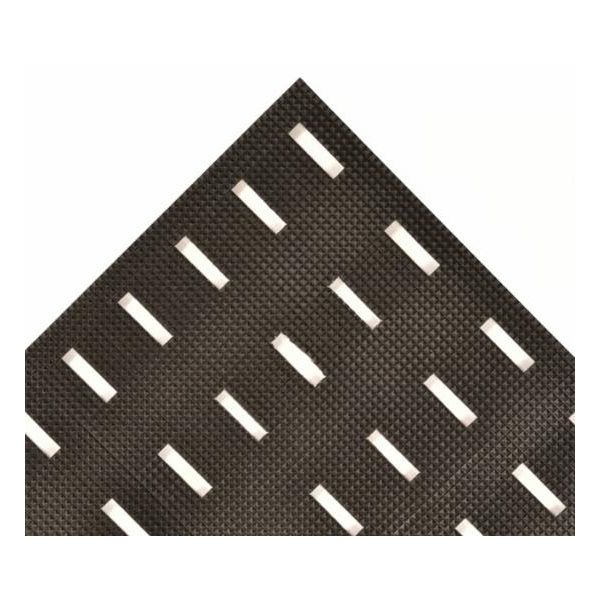
Cushion Dek is a one-piece anti-slip drainage mat for wet worker platforms. A molded pyramid surface gives shoes traction from every angle, slotted perforations carry moisture down off the standing surface, and a studded underside raises the whole mat so water keeps channeling away beneath it — three answers to a wet floor in one tough sheet of PVC.
Wet stations fail people quietly. Rinse water and process moisture spread a film across the platform, and the hurried step — the one taken mid-rush, carrying something — is the one that finds it. A worker platform that drains itself and grips through the wet changes what that hurried step lands on.
Why Pyramid-Molded PVC, and Why This One
The mat is molded from a tough PVC compound — made from 100 percent recycled PVC — with the traction built into the geometry itself. Raised pyramids present a gripping edge to a shoe in every direction of movement, so the surface holds footing whether the worker is planted, pivoting, or stepping through.
Drainage runs on two levels. Up top, slotted perforations — 1/2 inch wide by 1-7/8 inches long — let moisture escape the worker platform instead of pooling where shoes land. Underneath, the studded bottom surface raises the mat off the floor, channeling that moisture away while allowing continuous aeration, so the space under the mat isn't a sealed wet pocket.
The profile stays practical at 7/16 inch — enough body to do drainage work, low enough to keep transitions manageable — and the format runs from compact station mats up to a 4-foot-wide, 30-foot roll for continuous coverage down a full wet line.
Where It Belongs, and What It Is Not
Cushion Dek belongs on wet worker platforms: dish and prep stations, wet processing and wash areas, and the industrial posts where moisture reaches the floor as part of the job. Anywhere a crew stands over water for a shift, the pyramid grip and the two-level drainage earn their place together.
What it is not: a plush dry-area comfort mat, and not a modular build-your-own platform for wrapping machines and odd footprints — it's the simpler tool, a one-piece deck you lay down and put to work. Dry stations and configurable platforms are both served elsewhere in our anti-fatigue mats and runners lineup; this page is for the wet floor that needs a straightforward answer.
Three Things to Check Before You Spec It
First, confirm the platform genuinely runs wet. If moisture reaches the standing surface daily — spray, rinse-down, process water — the slotted drainage is solving a real problem. If the floor stays dry, a solid-top construction keeps small items from finding the slots and gives the same standing comfort without holes.
Second, choose mat or roll by the shape of the work. Station mats cover a single wet post, while the 4-foot by 30-foot roll traces an entire line in one continuous piece — no seams collecting debris, no gaps where a wet stride lands on bare floor between mats.
Third, build the lift-and-look habit. The studded base keeps air moving underneath, which works in your favor — but the floor under any wet-area mat still belongs in the cleaning rotation. Lift it on schedule, rinse what gathered, and both the mat and the floor stay in honest condition.
Why Mats Inc.
Wet platforms are where mat decisions stop being about comfort and start being about incident reports — and we've been specifying drainage matting for those floors since 1964. We verify every claim on this page against the manufacturer's published materials, and Cushion Dek is backed by a 1-year limited Mats Inc. warranty.
| Construction | One-piece molded drainage mat; raised pyramid traction surface; slotted perforations; studded underside |
| Material | Tough PVC compound, made from 100% recycled PVC |
| Drainage | Slotted perforations 1/2" x 1-7/8"; studded bottom raises mat, channels moisture, and allows continuous aeration |
| Thickness | 7/16" |
| Color | Black |
| Mat Sizes | 2' x 3', 2' x 6', 3' x 4', 3' x 6', 4' x 6', 4' x 8' |
| Roll Size | 4' x 30' |
| Use Area | Wet worker platforms and wet environments |
| Warranty | 1-year limited (Mats Inc.) |
Frequently Asked Questions
How do the pyramids and the slots work together?
Answered by Dustin Thompson, Owner & CEO
They split the job a wet floor creates. The molded pyramid pattern is the grip — raised edges meeting the shoe in every direction it moves, so traction doesn't depend on which way the worker turns. The slotted perforations are the exit — each slot 1/2 inch by 1-7/8 inches — giving the water that lands on the platform somewhere to go besides underfoot. Grip handles what's on the surface; drainage keeps the surface from having much on it.
What does the studded bottom actually do?
Answered by Dustin Thompson, Owner & CEO
It solves the problem most drainage mats create. Water that drains through a mat has to live somewhere, and a flat-bottomed mat seals it against the floor — a trapped wet layer that never dries. The studded underside raises Cushion Dek off the floor, so the moisture that passes through keeps channeling away, and continuous aeration lets the space beneath actually dry between cleanings. The floor under the mat stays part of the solution instead of becoming the hidden problem.
How does recycled PVC hold up in constant wet duty?
Answered by Dustin Thompson, Owner & CEO
The compound is the point: this is a tough, molded PVC — not a foam that wet cycles break down — and PVC's indifference to water is exactly why it's the material here. The whole mat is molded as one piece from 100 percent recycled PVC, so there's no laminated wear layer to peel and no absorbent core to swell. Wet-dry cycling, the routine that ages softer constructions, is simply this mat's normal operating condition.
When is a one-piece mat the right call versus a modular platform?
Answered by Jinna Hopson, Vice President of Marketing
When the station is a rectangle, simplicity wins. A one-piece deck lays down in seconds, lifts in one motion for cleaning, and has no components to assemble, track, or reconfigure — the right rhythm for dish lines, wash stations, and straightforward wet posts. Modular platforms earn their complexity when the footprint is genuinely odd: wrapping machines, turning corners, covering an irregular cell. If you're not solving that puzzle, don't buy the puzzle pieces.
Which size fits a station, and when does the roll make sense?
Answered by Jinna Hopson, Vice President of Marketing
Match the footprint to the standing pattern. A single wet post — one person at a sink or station — is covered by the compact sizes, while wider working stances and two-person posts step up through the mid-sizes to 4 by 8 feet. The 4-foot by 30-foot roll is for the line: one continuous drainage surface down an entire wet run, with no seams to collect debris and no bare-floor gaps where a wet stride lands between mats.
What's the recycled content worth beyond the label?
Answered by Jinna Hopson, Vice President of Marketing
It's the full number: the mat is made from 100 percent recycled PVC — not a percentage blended in for the brochure, but the whole compound. For organizations reporting sustainability metrics, that's a clean, defensible line item. And there's no trade-off hiding behind it, since the recycled compound is the same tough, molded PVC delivering the traction and the wet-duty endurance the mat is specified for. The responsible choice and the durable one are the same purchase.
By Dustin Thompson, Owner & CEO, Mats Inc.
Reviews
Write Your Own Review
Related Products
Super Scrape Rubber Mats
Safety Track Non-Skid Tape - Coarse

Smooth Marbleized Vinyl Switchboard Matting (Mil Spec)
Super Scrape Rubber Logo Mats
Strip Doors
Perfec Clean 3/8" Rollup Mats - Aluminum Hinge
Perfec Clean 3/8" Rollup Mats - Rubber Hinge
Perfec Clean 3/4" Rollup Grate - Rubber Hinge
Perfec Clean 1-5/8" Grate
WP-70 Non-Skid Epoxy Coating