




More Information
| Manufacturer | Apache Mills |
|---|
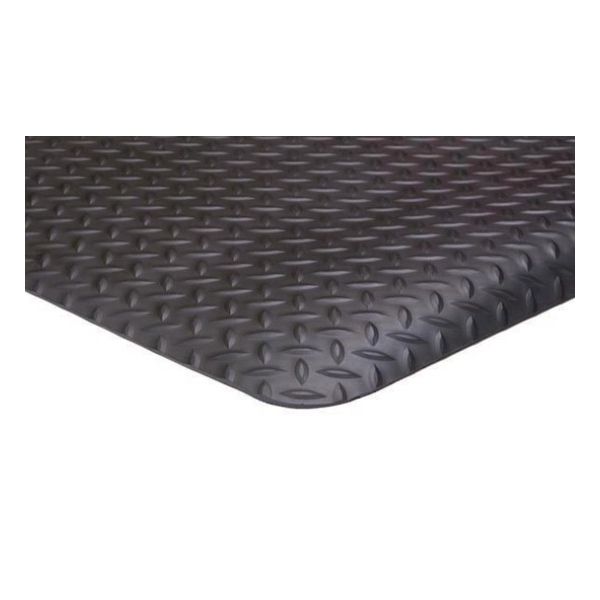
Conductive Diamond Deck Plate Anti-Fatigue Mat
Product Number:
#0698
$188.00

Have a question? We're here to help!
Description
The Conductive Diamond Deck Plate Anti-Fatigue Mat does two jobs at one workstation: it carries static charge off the person standing on it, and it gives that person a cushioned floor for the shift. It is a conductive vinyl diamond plate surface bonded to a closed-cell vinyl foam base, beveled on the edges, made for the industrial stations where sensitive electronics are handled and someone stands in one place for hours.
What a Conductive Anti-Fatigue Mat Does Before a Charge Reaches the Bench
A technician standing at a bench builds up a static charge just by shifting their weight and moving their feet. On an ordinary floor that charge waits for the first grounded thing it touches, which is often the component in their hand. A conductive floor mat under the technician, connected to building ground, gives the charge a path out through the shoes and the mat instead of through the part.
This mat sits in the conductive band, not the dissipative one. The maker publishes resistance-to-ground and resistance top-to-top of 10⁴ to 10⁵ ohms, which is well below the 10⁶ line where dissipative floors begin. That means charge drains fast, which is what a station handling bare boards, drives, or components is usually specified to have.
The same station is almost always a standing station. A hard floor for eight hours wears down a worker's attention and precision by the afternoon, and a plain anti-fatigue mat fixes that while doing nothing about static. Here the foam base carries the comfort job so the operator is not choosing between a grounded floor and one they can stand on.
Why a Diamond Plate Top on Closed-Cell Foam, and Why This One
The surface is a vinyl diamond plate pattern, which is there for footing: the maker rates it for anti-slip traction and wear resistance, and the raised pattern keeps its grip when a dry floor picks up dust or dropped hardware. Vinyl also makes it water repellent by the maker's rating, so a spilled coffee or a mopped floor next to it does not soak in. It is still a dry-area mat; water repellent is not the same as rated for washdown.
Under the vinyl is a closed-cell vinyl foam base bonded to the surface. Closed-cell foam holds its shape because the cells do not collapse into each other under repeated load, which is what separates an anti-fatigue mat that still works in year three from one that has gone flat. The edges are beveled so a heel or a cart wheel rides up rather than catching.
The maker makes this mat in the USA and will install a grounding snap on any standard-size mat on request. The snap is the connection point for a grounding cord to a building ground; without it, the mat has nowhere to send the charge it collects. Ask for the snap when you order rather than after the mat arrives.
Where It Belongs, and What It Is Not
The maker's recommended use is industrial workstations receptive to static electricity. In practice that is a standing assembly or inspection station, a soldering or rework bench, a test position, a kitting area for boards and drives, and any spot on a production floor where a person stands still with a sensitive part in hand. Its conductive-band rating suits the stations where a dissipative floor would not drain charge quickly enough.
It is a station mat first. In 2' by 3', 3' by 5', and 3' by 10' it covers one standing position. In 3-foot and 4-foot rolls up to 75 feet it can run a whole bench line, but the foam is doing its work where someone stands, not where carts cross. For a grounded walkway with no standing traffic, a conductive runner without the foam layer is the lighter tool, and the rest of the conductive floor mats range covers that case.
It is not an electrical safety mat. A conductive mat is built to carry charge from a person to ground, which in front of a live switchboard is exactly the path you do not want. Insulating switchboard matting stops current so a worker at live panels is not the route to ground. Keep this mat at the workstation and keep it away from open switchgear.
Three Things to Check Before You Spec It
First, the band your program requires. At 10⁴ to 10⁵ ohms this mat is conductive by the numbers. If your ESD program specifies a conductive floor, that is the fit. If it specifies dissipative only, with a floor on the resistance, ask us before you order; some programs want charge to bleed off more slowly than a conductive surface allows. Read the requirement against the figure, not the product name.
Second, the snap and the ground. Order the grounding snap with the mat, then walk the station and confirm a grounded outlet or ground point is within cord reach of where the snap will sit. Verify the outlet is actually grounded before you rely on it. A cord clipped to a painted surface or an ungrounded outlet is not a ground, and a mat with no path to ground is just a comfortable place to stand.
Third, what lands on the surface. Floor finish, wax, and some cleaning residues leave an insulating film on a conductive top, and the mat stops draining charge while it looks fine. Keep the polish machine off it, wipe it with a damp cloth or a static-control floor cleaner, and test resistance from the surface to ground on a schedule rather than trusting the mat by eye.
Why Mats Inc.
We carry this mat because it answers the question a standing ESD station actually asks, which is how to ground the worker without making them stand on a hard floor all day. Tell us the station size, how many positions the bench has, and your program's resistance requirement, and we will confirm the size, the snap, and whether a station mat or a runner is the right shape. If the maker's published figure does not meet your spec, we will say so before you order, not after.
| Construction | Conductive vinyl diamond plate surface bonded to closed-cell vinyl foam |
| Resistance to ground (RTG) | 10⁴ to 10⁵ ohms |
| Resistance top-to-top (RTT) | 10⁴ to 10⁵ ohms |
| Standard mat sizes | 2' x 3', 3' x 5', 3' x 10' |
| Roll sizes | 3' x 75', 4' x 75' |
| Custom | 3' and 4' widths to 75' length; custom shapes on request |
| Color | Black |
| Edges | Beveled |
| Grounding | Grounding snap installed on standard mats on request |
| Surface ratings | Anti-slip traction, water repellent, wear resistant |
| Origin | Made in the USA |
| Warranty | 1-year limited (Mats Inc.) |
Frequently Asked Questions
What is this mat made of, and is it conductive or dissipative?
Answered by Dustin Thompson, Owner & CEO
A conductive vinyl surface with a diamond plate pattern, bonded to a closed-cell vinyl foam base. It is conductive by the numbers: the maker publishes resistance-to-ground and resistance top-to-top of 10⁴ to 10⁵ ohms, which is below the 10⁶ line where the dissipative band starts. That is the band most stations handling bare components specify, because charge leaves fast.
If your program calls for a dissipative floor with a minimum resistance, this mat may be lower than it allows. Compare the figure to the written requirement before you order.
How long does the mat last, and what shortens its life?
Answered by Dustin Thompson, Owner & CEO
The maker rates the surface wear resistant and the foam closed-cell, and does not publish a year figure or an abrasion number, so we will not invent one. In practice a closed-cell foam base is the reason an anti-fatigue mat still has spring in year three; open-cell foam packs down where a chair or a person stays in one spot. The vinyl top outlasts the foam under normal station use.
What ends its static life is different from what ends its physical life. Floor finish tracked onto the top, a cord knocked loose from the snap, or oil soaked into the surface all stop it draining charge while it looks new. Test resistance from mat to ground periodically. The mat carries a 1-year limited (Mats Inc.) warranty.
How do I ground it?
Answered by Dustin Thompson, Owner & CEO
Order the mat with a grounding snap, which the maker installs on any standard-size mat on request. A grounding cord runs from the snap to a verified building ground, usually the ground screw on an outlet cover or a dedicated ground point. A long run from a roll needs more than one connection so every part of the mat has a short path to ground; tell us the run length and we will confirm the snap count.
Confirm the outlet is grounded before you trust the mat. Facilities with an ESD program test the path from mat surface to ground on a schedule, and that test, not the cord being attached, is what proves the station is working.
What size should I order for a workstation?
Answered by Jinna Hopson, Vice President of Marketing
Measure the space the person actually stands in, not the bench. A single operator at a fixed position is covered by a 2' by 3' or 3' by 5'. A bench where the operator moves between two or three positions wants the 3' by 10'. A line of stations along a wall is a roll, in 3-foot or 4-foot width, cut to the run.
The 4-foot width matters where chairs roll back from the bench; it keeps the wheels on the mat instead of dropping off the edge. Leave the beveled edge exposed on the side people step onto.
What does it look like on the floor, and does it come in other colors?
Answered by Jinna Hopson, Vice President of Marketing
Black only, with a raised diamond plate pattern that reads as industrial and matches most production floors. The beveled edge gives it a finished outline rather than a cut-sheet look. It is not meant to disappear into an office; if a station sits in a client-facing space, a static-dissipative carpet tile is the better visual fit for the room, with this mat only at the bench where components are handled.
Because it is a single color, mats from different orders match, so a station added next year will not stand out from the ones installed today.
Can it be made in a custom size or shape?
Answered by Jinna Hopson, Vice President of Marketing
Yes, more than most mats in this class. The maker cuts custom lengths at 3-foot and 4-foot widths up to 75 feet, and will build custom configurations, meaning shapes cut to fit a workspace, an L-shaped bench, or a cutout around a fixed leg. Send us a sketch with dimensions and we will confirm what the maker can produce before you commit.
Remember that a grounding snap is added on request, so specify where on a custom piece you want it so it lands near the ground point rather than at the far end.
By Dustin Thompson, Owner & CEO, Mats Inc.
Reviews
Write Your Own Review
Related Products
Super Scrape Rubber Mats
Safety Track Non-Skid Tape - Coarse

Smooth Marbleized Vinyl Switchboard Matting (Mil Spec)
Super Scrape Rubber Logo Mats

Strip Doors
Perfec Clean 3/8" Rollup Mats - Aluminum Hinge
Perfec Clean 3/8" Rollup Mats - Rubber Hinge
Perfec Clean 3/4" Rollup Grate - Rubber Hinge
Perfec Clean 1-5/8" Grate

WP-70 Non-Skid Epoxy Coating