




More Information
| Manufacturer | Crown Matting |
|---|
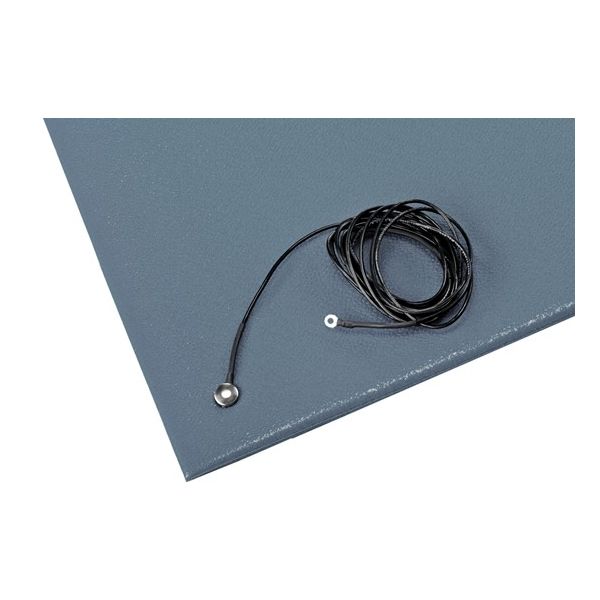
Comfort King Anti-Static Anti-Fatigue Matting
Product Number:
#0603
$97.00

Have a question? We're here to help!
Description
What Anti-Static Anti-Fatigue Matting Does Before Static Reaches Your Components
Standing at a bench all shift is hard on your body, and the static charge your body builds along the way is hard on your work. One casual touch can discharge through a circuit board and quietly ruin it — no spark you'd feel, just a component that fails testing later, or worse, fails in the field. Anti-static anti-fatigue matting works both problems at once.
Comfort King Anti-Static Anti-Fatigue Matting is a cushioned standing mat that also gives static a safe way out. The foam underfoot keeps legs and backs fresher through long hours on hard floors, while the mat's static-dissipative construction routes built-up charge to a grounding cord instead of letting it jump into sensitive electronics.
That matters anywhere people stand and handle boards, chips, drives, or test equipment. Static damage rarely announces itself. It shows up later as intermittent faults, failed QC runs, and lost data — the kind of trouble that eats hours of diagnosis before anyone suspects the floor.
Why Energized Sponge Foam, and Why This One
Plenty of ESD mats are hard vinyl sheets that protect components but do nothing for feet. This mat takes the opposite approach. It's built from a highly energized sponge foam that's static-dissipative all the way through, not a comfort layer with a coating on top. The softness, the resilience, and the static control all come from the same material.
The numbers back that up. The foam runs 3/8" thick with a durometer of 50±5 — soft enough that your weight keeps shifting naturally, firm enough that you're never fighting for balance. Electrical resistivity measures approximately 10⁵ ohms per square, squarely in the static-dissipative range, so charge bleeds off in a controlled way rather than all at once.
The compound is engineered to last three times longer than conventional sponge foam, so the cushion doesn't pack down into a flat pad after one hard season. At roughly 0.72 pounds per square foot, the mat stays planted through a workday yet lifts easily for floor cleaning, and beveled edges ease the step up so feet and cart wheels don't catch.
A pebbled surface texture gives shoes something to hold in dry conditions, and the format flexes with the job. It comes as individual standing mats and as 60-foot rolls, so you can cushion a single test station or run a continuous anti-fatigue mat roll down an entire assembly line.
Where It Belongs, and What It Is Not
This is a dry-area mat, and it's happiest where electronics work happens: assembly benches, electronic testing stations in laboratories, repair counters, and offices where standing workers share space with sensitive equipment. It earns a spot at standing desks too, anywhere a stray discharge could cost you hardware or the data sitting on it.
It is not a wet-area mat. Wash-down water, oils, and food-service grease belong on drainage matting built for those conditions, and this foam isn't that. It's also static-dissipative rather than conductive — it bleeds charge off gradually and safely, which is exactly the behavior you want around circuit boards. If your floor problem is fatigue without the static risk, our full range of anti-fatigue mats and runners covers dry and wet work areas alike.
Three Things to Check Before You Spec It
First, plan the grounding. A static-dissipative mat only does its job when charge has somewhere to go. Every stock-size mat ships with one grounding cord included. Full rolls and custom cuts don't — cords for those are ordered separately, and the working rule is one grounding cord for every 10 feet of matting. Specify where you want the cord connections placed when ordering rolls or custom cuts.
Second, size it to the workstation, not just the person. Stock mats run from 2' x 3' up through 4' x 12', and rolls come in 2', 3', 4', and 6' widths at 60 feet long, with custom cuts available in those same widths. One detail worth knowing before you order: 6-foot custom cuts are not beveled on the cut ends.
Third, confirm the environment stays dry year-round. A bench that catches occasional wash-down spray or condensation calls for a wet-area product instead. While you're at it, settle the color question — black disappears into most industrial floors, while steel gray reads lighter and shows debris sooner, which some supervisors prefer because the mat gets swept before grit grinds in.
Why Mats Inc.
We've been matching floors to the work done on them since 1964, and static-sensitive work is where guesswork shows up as failed boards and lost data. Every spec on this page is verified against the manufacturer's published data, we'll help you plan grounding-cord counts and placement before the order goes in, and the mat is backed by a 1-year limited warranty from Mats Inc.
| Material | Static-dissipative energized sponge foam (single-compound construction) |
| Thickness | 3/8" |
| Electrical resistivity | Approx. 10⁵ ohms per square (static-dissipative range) |
| Durometer | 50±5 |
| Weight | 0.72 lbs per sq ft (average) |
| Stock sizes | 2' x 3', 3' x 5', 3' x 12', 4' x 6', 4' x 12' |
| Roll sizes | 2' x 60', 3' x 60', 4' x 60', 6' x 60' |
| Custom cuts | Available in 2', 3', 4', and 6' widths (6' custom cuts not beveled on cut ends) |
| Grounding | One grounding cord included with stock mats; one cord per 10' recommended for rolls and custom cuts (sold separately) |
| Colors | Black, Steel Gray |
| Surface / edges | Pebbled surface, beveled edges |
| Use area | Dry areas only |
| Warranty | 1-year limited (Mats Inc.) |
Frequently Asked Questions
How does this mat actually dissipate static?
Answered by Dustin Thompson, Owner & CEO
The dissipation is built into the foam itself, not applied as a surface layer. As you shift and walk in place at a bench, the charge your body generates migrates through the energized foam and out the attached grounding cord to ground. With resistivity around 10⁵ ohms per square, that transfer happens gradually — a controlled bleed rather than a sudden discharge, which is what keeps nearby components safe. The practical upshot: a technician can work a full shift at a test station without carrying a charge to the first board they pick up.
How long will the cushioning hold up under daily use?
Answered by Dustin Thompson, Owner & CEO
The foam compound is engineered to last three times longer than conventional sponge foam, and the 50±5 durometer is the figure to watch — it's the balance point where the mat rebounds under every weight shift instead of gradually crushing flat. At about 0.72 pounds per square foot it holds position through a workday of foot traffic. Like everything we sell, it's backed by a 1-year limited warranty from Mats Inc.
What do I need to know about grounding cords before I order?
Answered by Dustin Thompson, Owner & CEO
Every stock-size mat includes one grounding cord, so a single bench install is ready out of the box. Full 60-foot rolls and custom cuts are different: cords are purchased separately there, and the recommendation is one grounding cord for every 10 feet of matting. If you're lining a full assembly row, count your footage, order cords to match, and tell us where along the run you want the connections placed — placement is specified at order time for rolls and custom cuts.
What sizes does it come in, and can I get a custom length?
Answered by Jinna Hopson, Vice President of Marketing
Stock mats come in 2' x 3', 3' x 5', 3' x 12', 4' x 6', and 4' x 12', which covers everything from a single soldering station to a shared workbench. For longer runs there are 60-foot rolls in 2', 3', 4', and 6' widths, and custom cuts are available in those same widths — handy when a bench row measures an awkward 17 feet and you'd rather have one clean piece than a patchwork. One note for planning: 6-foot custom cuts aren't beveled on the cut ends.
What does it look like on the floor?
Answered by Jinna Hopson, Vice President of Marketing
You've got two colors: black, which settles quietly into most shop and lab floors, and steel gray, which reads lighter and gives a cleaner, more finished look in customer-visible spaces like repair counters. The surface carries a subtle pebbled texture, and at 3/8" with beveled edges the profile stays low and tidy — it looks like part of the workstation, not an afterthought laid over the floor.
Is this the right mat for my space?
Answered by Jinna Hopson, Vice President of Marketing
If your people stand in a dry area around anything static-sensitive — electronics assembly, testing stations in a lab, an IT repair counter, a standing desk beside expensive equipment — this is the mat built for that exact overlap of comfort and protection. If your floors see water, oil, or kitchen grease, look to a wet-area drainage mat instead. And if you love the cushioning but don't need static control, we carry plenty of dry-area anti-fatigue options without the grounding hardware.
By Dustin Thompson, Owner & CEO, Mats Inc.
Reviews
Write Your Own Review
Related Products
Super Scrape Rubber Mats
Safety Track Non-Skid Tape - Coarse

Smooth Marbleized Vinyl Switchboard Matting (Mil Spec)
Super Scrape Rubber Logo Mats
Strip Doors
Perfec Clean 3/8" Rollup Mats - Aluminum Hinge
Perfec Clean 3/8" Rollup Mats - Rubber Hinge
Perfec Clean 3/4" Rollup Grate - Rubber Hinge
Perfec Clean 1-5/8" Grate
WP-70 Non-Skid Epoxy Coating