




More Information
| Manufacturer | Musson Rubber Company |
|---|
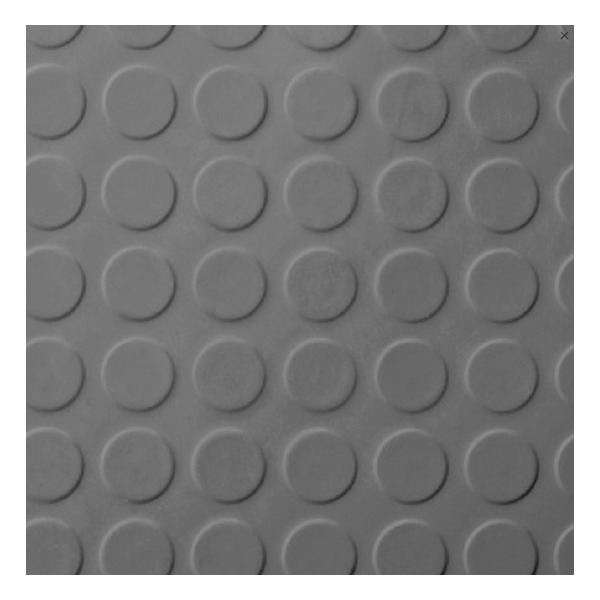
$706.00

Have a question? We're here to help!
Description
A coin tile is a rubber landing tile with a low profile disc pattern molded across the whole field. It goes where a staircase meets a floor: the landing at the bottom, the platform at the top, the half-turn between flights. The discs carry the same look as the stair treads running up to them, so the two read as one surface.
That coordination is most of the point. A landing finished in something unrelated to the stairs reads as an afterthought, and the joint between the two becomes the first place the floor starts to look tired. Matching the pattern across both surfaces is what makes a stairwell look designed rather than assembled from whatever was available.
What a Landing Tile Does Before the Landing Outwears the Stairs
Landings take a different kind of abuse than steps do. On a stair, each foot lands once and moves on. On a landing, people pivot. They turn a corner, shift direction, plant and rotate, and all of that grinding happens on a patch of floor a few feet square.
That is why landings wear through first. The stairs still look serviceable while the landing has a dull, scuffed track worn into it exactly where everybody turns. Once that shows, the whole stairwell reads as neglected no matter how good the treads still are.
Whatever is on the landing usually was not chosen for that job. Sheet vinyl, a leftover run of tile, sometimes bare concrete with paint on it. None of those were specified for pivoting traffic, and none of them match the treads, so the landing looks like a patch even before it wears.
A rubber landing tile answers both problems at once. Homogeneous rubber takes the twisting load without telegraphing a wear track, and the disc field ties the landing visually to the stair treads. The full range of stair treads, risers and landing tiles is built around exactly that pairing.
Why a Low Profile Disc, and Why This One
The disc field here is deliberately shallow. Each disc measures 1-9/64 inches across and stands just 1/64 inch proud of the surface. You can read that straight off the thickness figures: the tile is 1/8 inch overall, and 7/64 inch measured between the discs. The difference between those two numbers is the entire profile.
That subtlety is a design choice, not a compromise. A deeper raised disc grabs more, but it also holds more, and the valleys between the discs turn into a dirt trap that a mop rides straight over. A shallow disc keeps the field readable and lets a wet mop actually reach the floor between them.
It also means wheels behave. Carts, hand trucks, wheeled luggage and mop buckets all cross a low profile disc without the judder you get from an aggressive pattern. In a stairwell that doubles as a service route, that matters more than most people expect at specification time.
Be clear about what the discs are and are not. They add texture and break up a flat plane, which is genuinely different from a smooth sheet underfoot. They are not an aggressive traction surface, and at 1/64 inch nobody should specify this expecting it to behave like a grit strip or a heavy raised profile.
The rubber itself is homogeneous, so color runs through the full 1/8 inch rather than sitting on top as a wear layer. Scuffs and turning marks do not expose a different colored substrate underneath, which is the failure that makes a printed or laminated surface look bad long before it is actually worn out.
Where It Belongs, and Where It Is Not the Right Tile
Specify it on interior stair landings, intermediate platforms and the floor immediately at the top and bottom of a flight, paired with a matching disc-pattern tread. It suits the places where stairwell traffic concentrates: office buildings, schools, healthcare corridors, apartment and hotel stairwells, and back-of-house service stairs.
It works equally well as a general rubber floor tile in the areas that feed a stairwell. Elevator lobbies, landings that open into a corridor, and small transition spaces all take it, and running the same tile through those areas keeps the disc pattern reading as intentional rather than isolated to one square of floor.
This is an interior product. It does not belong on an exterior stair landing, an open platform or anywhere exposed to weather and freeze-thaw. It also is not the right surface for an entrance, where the job is scraping grit and holding meltwater, and a 1/64 inch profile does neither.
Where it is genuinely the wrong pick is anywhere that needs an aggressive slip-resistant surface as a specified requirement. Wet process areas, kitchen floors and ramps all want a purpose-built profile. This is a landing tile chosen for wear, cleanability and appearance, and it should be specified on those terms.
Three Things to Check Before You Spec It
First, measure the landing and do the layout before you order. The tile is 19-11/16 inches square, which is 50 centimeters rather than a round 20 inches. That inch-and-a-third shortfall against a nominal 20 inch grid changes the cut pattern on a landing sized in feet, and it will not drop into a layout planned around a 20 inch or 18 inch module.
Second, confirm the subfloor. Rubber tile at 1/8 inch telegraphs whatever is underneath it, so ridges, old adhesive, and cracks all show through as shadows in the finished surface. Fill and flatten first, and check for moisture on any slab at or below grade before adhesive goes anywhere near it.
Third, sort out the height transition at the edge of the landing. At 1/8 inch this sits well below most stair tread thicknesses and below the level of a carpeted corridor. Wherever the tile field stops and another surface begins, that junction needs a planned detail rather than a butt joint discovered on site.
Why Mats Inc.
Stairwells get specified in pieces. Somebody picks treads, somebody else works out the landing later, and the two arrive from different sources in colors that almost match. We have been supplying commercial stair and floor surfaces since 1964, and the conversation worth having up front is simple: what is going on the steps, what is going on the landings, and are those two decisions being made by the same person.
| Tile size | 19-11/16 in. x 19-11/16 in. (50 cm x 50 cm) |
| Overall thickness | 1/8 in. (3.175 mm) |
| Thickness without profile | 7/64 in. (2.78 mm) |
| Profile height | 1/64 in. (0.4 mm) |
| Profile diameter | 1-9/64 in. (28.97 mm) |
| Pattern | Low profile disc, continuous field |
| Material | Homogeneous rubber |
| Tiles per carton | 16 |
| Coverage per carton | 43 sq. ft. |
| Carton weight | 42 lbs. |
| Colorways | 25 total — 11 solid, 14 marbleized |
| Solid colors | Chocolate, dust, hazel, regal, mid gray, wine, charcoal, almond, pine, onyx, putty gray |
| Marbleized colors | Dusty, chestnut, hazel, onyx, charcoal, almond, cream, brick red, beryl, mid grey, harvest, lawn, marlin, violet |
| Application | Interior stair landings and floor areas |
| Installation | Full-spread adhesive over a flat, clean, dry subfloor |
| Warranty | 1-year limited (Mats Inc.); professional installation required for coverage |
Frequently Asked Questions
How much texture does a low profile disc actually give you?
Answered by Dustin Thompson, Owner & CEO
Less than the pattern suggests, and that is deliberate. The discs stand 1/64 inch above the field, which you feel as a subtle break in a flat plane rather than as grip. The tile reads as textured to the eye and nearly smooth to the foot.
If a project calls for a specified slip-resistant surface, this is not the product to argue for. Wet areas, ramps and process floors want a purpose-built profile with a real coefficient behind it. What this pattern buys you is a floor that does not look or feel like sheet goods, cleans easily between the discs, and lets wheeled equipment cross without fighting it.
Will turning traffic wear a track into it?
Answered by Dustin Thompson, Owner & CEO
Pivoting is the hardest thing you can do to a landing, and it is where most surfaces give up first. The advantage of homogeneous rubber is that the color runs through the full 1/8 inch rather than sitting on top. There is no wear layer to scuff through and no different-colored substrate waiting underneath to show.
What you should still expect is polishing. Heavy turning traffic will eventually take the sheen off the high points of the discs in the main path, which reads as a slightly different finish rather than as damage. Marbleized colorways hide that better than flat solids, which is worth knowing before you pick one.
What does the subfloor need to look like before we install?
Answered by Dustin Thompson, Owner & CEO
Flat, clean and dry, and stricter than people assume. At 1/8 inch the tile follows the substrate rather than bridging it, so a ridge of old adhesive, a trowel line or a crack will show through as a shadow in the finished surface. Grind and patch first, and vacuum rather than sweep.
On any slab at or below grade, test for moisture before adhesive goes down, because vapor pushing up through concrete is the most common cause of a failed rubber tile installation. Tiles go down in full-spread adhesive with the field laid out from a center line so the cuts land at the edges. Let cartons acclimate to room temperature before you start.
What do the colors look like, and how do I pick one?
Answered by Jinna Hopson, Vice President of Marketing
Twenty-five in total, split into eleven solids and fourteen marbleized. The solids run from soft neutrals like dust and putty gray through mid gray and charcoal to deeper tones including wine, pine and onyx. They give you a clean, even field where the disc pattern is the only thing happening visually.
The marbleized range is the more forgiving choice for a working stairwell. Swirled tones like charcoal, chestnut, harvest and mid grey break up the surface, so scuffs, tracked-in grit and the polish that develops in a turning path all disappear into the pattern instead of announcing themselves. If the landing gets real traffic and cleaning is on a schedule rather than on demand, go marbleized.
How many tiles do I need, and how do they lay out?
Answered by Jinna Hopson, Vice President of Marketing
Each carton holds 16 tiles and covers 43 square feet, at 42 pounds a box. Measure the landing, add for cuts and waste, and round up to whole cartons. Ordering a spare box is worth it: colors run in batches, and a replacement sourced two years later may not sit invisibly next to the original field.
Layout deserves a few minutes on paper first. Each tile is 19-11/16 inches square, which is 50 centimeters rather than a round 20 inches, and that difference compounds fast across a landing measured in feet. Snap a center line, dry-lay the field, and adjust so the cut tiles land at the walls rather than leaving a sliver at one edge.
Does it have to match the stair treads?
Answered by Jinna Hopson, Vice President of Marketing
It does not have to, but matching is why the tile exists in this pattern. The disc field is made to line up with the disc treads that run up to the landing, so the stairs and the platform read as one designed surface instead of two decisions made separately. That continuity is most of what makes a stairwell look finished.
Contrast is a legitimate choice too, and often a better one. Running a darker landing against lighter treads, or the reverse, marks the change in level clearly, which helps anyone reading the stairs at a glance. What tends to look wrong is the near-match: a landing color that almost agrees with the treads but not quite. Either commit to matching or commit to contrast.
By Jinna Hopson, Vice President of Marketing, Mats Inc.
Ordering Info
19-11/16" x 19-11/16" per Tile
1/8" Overall Thickness
16 Tiles per Carton
43 sq ft of Coverage per Carton
Reviews
Write Your Own Review
Related Products
Super Scrape Rubber Mats
Safety Track Non-Skid Tape - Coarse

Smooth Marbleized Vinyl Switchboard Matting (Mil Spec)
Super Scrape Rubber Logo Mats
Strip Doors
Perfec Clean 3/8" Rollup Mats - Aluminum Hinge
Perfec Clean 3/8" Rollup Mats - Rubber Hinge
Perfec Clean 3/4" Rollup Grate - Rubber Hinge
Perfec Clean 1-5/8" Grate
WP-70 Non-Skid Epoxy Coating