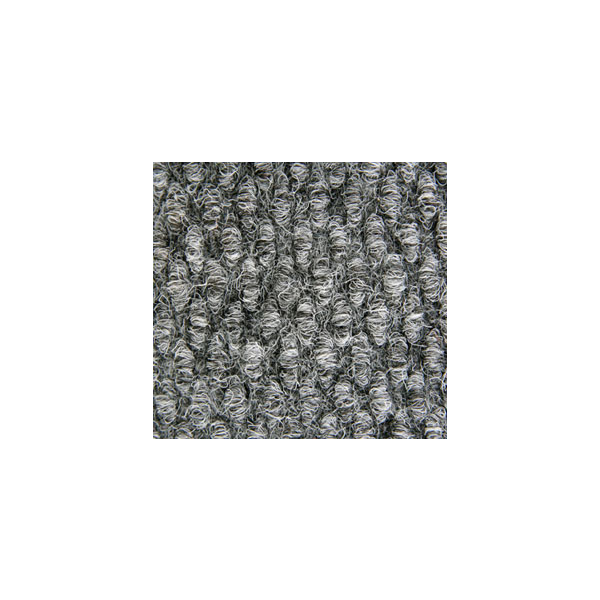
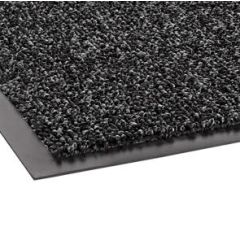
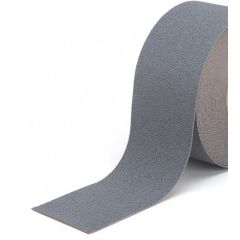
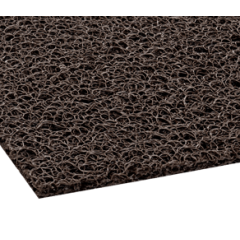
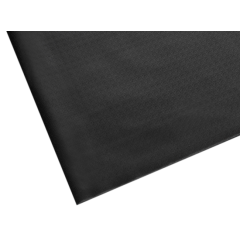
Astoria Nop is the low-profile roll in our needlepunched carpet line: a dense 37-ounce polypropylene felt with a hobnail berber surface, three-eighths of an inch thick overall, in six neutral colors. It is rated for indoor use and for outdoor use under an overhang, and it is light enough to lift and move as loose matting. When a corridor or entry needs a commercial carpet roll that stays flat, moves easily for cleaning, and does not argue with the decor, this is the one.
What Astoria Nop Does Before a Lifted Edge Becomes a Trip Point
Every walk-off carpet has to do two things at once. It has to pull grit and water off shoes, and it has to stay flat while doing it. A carpet that curls, ripples, or creeps at the threshold stops being a floor protector and becomes a hazard, and that risk grows every time a heavy mat gets dragged aside for mopping and dropped back crooked.
Astoria Nop is built with that second job in mind. At 64 ounces per square yard total, it weighs a good deal less than the heavier needlepunched rolls, so a facilities crew can lift a 10- or 20-foot runner, clean beneath it, and set it back square without a second person. A mat that gets moved gets cleaned under, and the floor beneath it stays sound.
The first job is still covered. The felted hobnail surface holds sand and salt in the low spots between the bumps, and the composite rubber backing keeps that grit and any water on the carpet rather than working through to the floor. What gets past a walk-off carpet is what grinds the finish off terrazzo, polished concrete, and wood, and that damage does not mop away.
Why Dense, Lightweight Needlepunch, and Why This One
Needlepunched carpet is felt, not fabric. Fibers are locked together by barbed needles rather than stitched through a backing in rows, so there is no loop to catch and no row to run. That construction also lets the material be cut to any shape without the edges raveling, which is why the maker recommends it for both plain runners and inlaid logo mats.
The word to notice on the spec sheet is dense. Astoria Nop packs 37 ounces of fiber per square yard into a pile only an eighth of an inch high. The maker's own description says that density is what keeps the mat from crushing under heavy traffic. A thin pile that stays upright wears better than a tall pile that flattens in the walking lane.
The fiber is 100 percent solution-dyed, UV-stabilized polypropylene. Color is locked into the fiber when it is made, not applied afterward, so sun and cleaning chemicals do not lift it. The maker states the material is not affected by extreme climate conditions, which is why it carries an indoor/outdoor rating. The color-fastness results back that up: 5 to light and 5 to water on the ISO 105 scale.
For a spec file, the material passes ASTM D2859 surface flammability and ASTM E662 smoke density, passes ASTM D7570 for dimensional stability, and is Green Label Plus certified for indoor air quality. It can contribute toward LEED-NC MR Credit 4 and IEQ Credits 4.1, 4.3, and 5.
Where It Belongs and What It Is Not
The maker lists office environments, runners, conference rooms, lobbies, libraries, department stores, and entryways as the intended uses. In practice it lands in three places: as a loose-laid runner in a corridor that gets mopped around it, as a low-profile entry carpet where a thicker roll would catch a door sweep, and as the field for a cut-shape or logo mat.
That low profile matters at doors. At 0.375 inch total height, Astoria Nop clears most door sweeps and sits close to flush with adjoining hard floor, so there is less of a lip at the transition. In a revolving-door well or a shallow recess, that is often the difference between a carpet that fits and one that binds.
Outdoors, the rating comes with a condition: the maker specifies outdoor use with an overhang. A covered walkway or an entry canopy is right. An open patio that takes standing rain is not, because the pile will hold the water and has nowhere to send it.
What it is not: a heavy scraper for caked mud, a cushioned anti-fatigue surface, or a runner for pallet jacks and loaded stock carts. Put a rubber or coir scraper ahead of it where boots arrive muddy, and use a vinyl or rubber runner in lanes that take constant heavy rolling loads.
Three Things to Check Before You Spec It
First, will the mat be moved, or fixed in place? Astoria Nop is the roll to choose when the answer is moved. Its handling weight and dimensional stability are what make loose-lay practical. If the run is long, turns a corner, or sits where doors pivot across it, an adhesive is still the right call, and the maker requires professional installation to honor its own warranty.
Second, check the clearance at the door. Measure the gap under the door sweep and the depth of any recess before ordering. Astoria Nop's 0.375-inch total height is one of the lowest in the roll-goods line. If the gap is tighter than that, a recessed frame is the fix, not a thinner carpet.
Third, pick from the palette you actually have. Six colors are offered: sterling, charcoal, steel blue, sisal, zinc, and walnut. All are neutrals meant to sit quietly against stone, tile, and wood. If the project needs a brand red or a school blue, this is not the roll. If it needs to disappear into a finished lobby, it is.
Why Mats Inc.
The question we hear most about Astoria Nop is whether a dense, thin carpet can really replace a thicker one at a busy door. The honest answer depends on the door. We ask about sweep clearance, whether the crew will lift the mat to clean, and how far the wet track runs, and we will say when a heavier roll or a scraper ahead of it is the better fit. Rolls are cut to length, and shapes for wells and turns are routine.
| Specifications |
|---|
| Construction | Non-woven, needlepunched |
| Surface | Hobnail (berber) pattern |
| Fiber | 100% solution-dyed, UV-stabilized polypropylene |
| Backing | Composite rubber |
| Pile height | 0.125" (±0.5 mm) |
| Total height | 0.375" (±7.5%) |
| Pile weight | 37 oz/sq yd (±7.5%) |
| Total weight | 64 oz/sq yd (±7.5%) |
| Roll width | 6' 7" or 13' 2" (±2%) |
| Lengths | 10' to 100' in 10' steps; custom lengths and cut shapes available |
| Use | Indoor; outdoor with an overhang |
| Colors | Sterling, Charcoal, Steel Blue, Sisal, Zinc, Walnut |
| Edge | Can be cut to any shape without edge ravel |
| Dimensional stability | ASTM D7570: Pass |
| Flammability | Surface flammability (FF 1-70 / ASTM D2859): Pass; Smoke density (ASTM E662): Pass |
| Color fastness | To light (ISO 105 B02): 5; to water (ISO 105 E01): 5; to shampoo (ISO 105 C06): 4-5; to rubbing (ISO 105 X12): 4 dry, 3-4 wet |
| Indoor air quality | Green Label Plus certified |
| LEED-NC | May contribute to MR Credit 4; IEQ Credits 4.1, 4.3, 5 |
| Maintenance | Vacuum with a motor-driven brush and beater bar: weekly in low-traffic areas, daily or twice daily in high-traffic areas |
| Warranty | 1-year limited (Mats Inc.) |
Frequently Asked Questions
How can a carpet this thin hold up under heavy foot traffic?
Answered by Dustin Thompson, Owner & CEO
Because it is dense, not because it is tall. Astoria Nop packs 37 ounces of polypropylene fiber into every square yard of a pile that stands just an eighth of an inch. The fibers are needlepunched into a felt, so they support each other from the side rather than standing alone like tufted yarn. The maker states plainly that this density is what prevents the mat from crushing.
The practical result is a carpet that looks the same in the walking lane as it does at the edges long after a taller pile would show a flattened track. The low height also means there is less fiber to hold moisture, so it dries faster between wet rushes.
How long should Astoria Nop last, and what wears it out?
Answered by Dustin Thompson, Owner & CEO
The maker defines wear as complete removal of the wear layer, pattern, and color under normal traffic and backs the material for five years of commercial service against that. In our experience a well-kept runner in a busy corridor reaches that mark, and a loose-laid mat that gets lifted and vacuumed on schedule often goes longer. Mats Inc. covers the product with a 1-year limited warranty.
What ends it early is ground-in soil. The maker notes that roughly 15 percent of tracked-in dirt is oil, which bonds grit to the fiber if it sits. Regular vacuuming with a beater bar removes up to 80 percent of surface dirt before that happens. Daily in a busy entry, weekly in a quiet hall, and the carpet keeps both its look and its grip on grit.
Can I use it outside, and does it have to be glued down?
Answered by Dustin Thompson, Owner & CEO
Outside, yes, with a roof over it. The maker rates Astoria Nop for outdoor use with an overhang and states that extreme climate does not affect the material, so covered walkways, covered porches, and entry canopies are fine. Skip it where rain can stand on the surface with no drainage.
Gluing is a choice, not a requirement, for short straight runs indoors. The lighter weight is exactly why many buildings loose-lay it and lift it to clean. Long runs, corners, and doorways with pivoting traffic should be set with adhesive, and the maker requires professional installation to honor its own warranty. Tell us the location and we will recommend the method.
What sizes come standard, and can it be cut to an odd shape?
Answered by Jinna Hopson, Vice President of Marketing
Rolls are 6 feet 7 inches wide and cut in ten-foot steps from 10 to 100 feet, with a 13-foot-2-inch width available for wide lobbies and double doors. Custom lengths between those steps are no trouble.
Odd shapes are where this material shines. The maker confirms it can be cut into any shape without the edges raveling, so a curved recess, a revolving-door well, or an L-shaped corridor mat can be cut to fit and hold a clean edge without binding. Send a sketch with dimensions and we will plan the cut.
What does Astoria Nop look like in a finished space?
Answered by Jinna Hopson, Vice President of Marketing
Quiet and even. The hobnail berber texture reads as a fine, uniform pebble rather than a bold pattern, and the low profile keeps it from looking like a mat dropped on the floor. It reads as part of the flooring, which is what most lobby and corridor designs want from a walk-off carpet.
The six colors are all neutrals: sterling and zinc on the gray side, charcoal for a dark floor, steel blue for a cool accent, and sisal and walnut for warm interiors with wood or stone. Because a felted fiber shifts under lobby lighting, ask us for a swatch and look at it in the actual space before committing a whole run.
Is Astoria Nop a good choice for a logo mat?
Answered by Jinna Hopson, Vice President of Marketing
Yes, and the maker says so directly, listing it as a good choice for both logo and plain mats. The clean-cut edge is the reason: an inlaid logo is a set of shapes cut and fitted together, and a material that does not ravel at the cut gives those shapes crisp lines that stay crisp.
The trade-off is palette. With six neutral colors, Astoria Nop suits a tone-on-tone mark, a monogram, or a wayfinding word set into a gray or walnut field. A full-color brand logo needs a wider color range, and we will steer you to the right material for that. Send your artwork through the proof request on this page and we will return a digital proof before anything is cut.
By Dustin Thompson, Owner & CEO, Mats Inc.