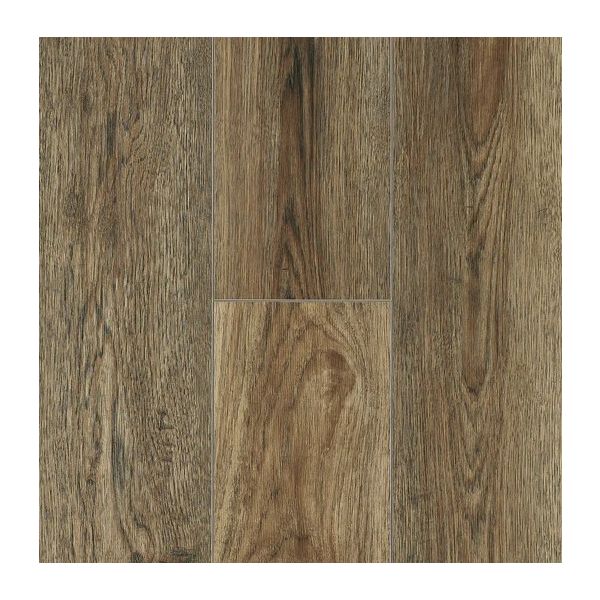
Lutea Zen is a 7" x 60" luxury vinyl plank with an oak wood look and a soft, low-shine finish. The planks click together and lay over your existing floor, so there is no glue and no mess. At nearly a quarter inch thick, they feel solid underfoot rather than thin and hollow.
That thickness is the whole argument for this plank. Flexible vinyl plank conforms to whatever is beneath it. A rigid core does not. What follows is how that changes the floor's behavior, where it belongs, and what to settle before you order.
What a Rigid Core Does Before Your Subfloor Shows Through
Most floors fail from underneath. A trowel ridge in the old adhesive, a seam in the plywood, a dip where the slab settled — none of it looks like much during installation. Six months later it is a visible line running across the room, catching light at exactly the angle you notice.
Thin vinyl plank telegraphs those defects because it bends to meet them. It is thin enough to follow the shape of what it covers. Rigid core plank resists that. The board holds its own shape and bridges minor irregularities instead of draping over them, so the finished floor reads flat.
The same stiffness handles point loads. A chair leg, a table foot, a dropped tool — these press into a soft floor and leave a dimple that never comes back out. A dense core spreads that force across a wider area, which is why dent resistance is the specification people actually notice years later.
When a plank floor does dent or telegraph, there is no repair. You cannot sand a printed floor flat. The boards come up, the room shuts down, and the work happens again.
Why This Construction, and Why This Plank
Rigid core is a different animal from glue-down vinyl plank flooring. The board carries its own structure, joins to its neighbors with a mechanical locking edge, and floats over the subfloor rather than bonding to it. No adhesive, no trowel, no open time.
At 0.196" thick and 7.1" wide by 60" long, these are full-size planks. The width matters visually as much as structurally — wider boards mean fewer seams across a room, and fewer seams is most of what separates a floor that reads as wood from one that reads as vinyl plank tiles.
The surface is a traditional oak visual in low gloss. Low gloss is the deliberate choice here. High-shine finishes throw glare, and more to the point they broadcast every scuff and footprint. A low sheen hides daily traffic instead of advertising it, which is why it has become the default in wood-look flooring.
The wear layer is urethane. That coating is what stands between shoes and the printed grain, and it is why routine care is sweeping and damp mopping rather than waxing or buffing. Nine colorways run across the Zen design — three greys, four beiges, and two browns — covering cool to warm without leaving the natural-wood register.
Where It Belongs, and What It Is Not
This plank is rated for any room, at, below, or above ground level. Below-grade approval is the useful part of that sentence — basements defeat a lot of flooring, and a floating rigid core floor handles a below-grade slab better than most alternatives.
The natural fit is living areas, bedrooms, kitchens, hallways, finished basements, and the lighter-duty rooms in small offices and professional suites. Within our vinyl flooring range, this is the plank you reach for when the room wants a wood look and the subfloor is not perfect.
Now the honest part. This is a residential-duty floor. It is not built for heavy commercial traffic — not retail sales floors, not restaurant service paths, not healthcare corridors, not any space where hundreds of people cross the same square foot daily. Those rooms need a commercial-rated floor, and we carry them. Ask, and we will route you there instead.
Two more limits worth naming. Floating rigid core plank is not a stair product — vinyl stair treads are a separate item with their own nosing and fastening, and a click-lock plank does not substitute. And it is not a mat. Grit at the entry is what kills a wood-look floor, so put matting where the traffic enters and let the plank live beyond it.
Three Things to Check Before You Spec It
First, how flat the subfloor really is. A rigid core bridges minor irregularities, but "minor" has a limit, and it is smaller than people assume. Lay a long straightedge across the room in several directions and look for daylight underneath. Anything meaningful gets patched or ground before the first plank goes down, not after.
Second, whether the room's duty matches the floor's. Count the traffic honestly, including the wheeled traffic — office chairs and rolling carts do more damage than feet. If the answer is commercial-scale, this is the wrong plank and finding that out now is far cheaper than finding out in year two.
Third, expansion and layout. Floating floors move with temperature and humidity, so they need a perimeter gap left clear and covered by trim, and long runs may need transitions. Decide plank direction and starting wall before delivery. Vinyl plank flooring installation goes fast when that thinking is already done and slowly when it is not.
Why Mats Inc.
We have been supplying floors since 1964, and the most valuable thing we do on a plank like this is tell people when it is not the right floor. A rigid core plank in a room that needed commercial-duty material is a problem that surfaces slowly and expensively. Describe the room to us — what is under it, who walks on it, what rolls across it — and we will tell you straight whether this is your plank or whether you want something else in the catalog.
7" x 60" Lutea Zen Luxury Vinyl Plank — Specifications
| Plank size | 7.1" wide x 60" long |
| Thickness | 0.196" |
| Construction | Rigid core luxury vinyl plank, floating installation |
| Visual | Traditional wood — oak |
| Gloss level | Low gloss |
| Wear layer type | Urethane |
| Colorways | 9 — 3 grey, 4 beige, 2 brown |
| Coverage | 29.53 sq. ft. per box |
| Grade level | Any room — above, on, or below grade |
| Duty rating | Residential |
| Warranty | 1-year limited (Mats Inc.) |
Frequently Asked Questions
What makes a rigid core plank different from regular vinyl plank flooring?
Flexibility, and everything that follows from it. Standard vinyl plank is thin and bends easily, so it is glued down and takes on the shape of whatever is underneath. A rigid core plank is thicker and structurally stiff, joins mechanically at the edges, and floats over the subfloor without adhesive.
In practice that means three things. It bridges minor subfloor imperfections instead of telegraphing them. It resists denting from point loads better, because a stiff board spreads the force. And it installs without trowels or adhesive open time, which is why this style of vinyl plank installation moves quickly.
— Dustin Thompson, Owner & CEO, Mats Inc.
How much traffic will this plank actually take?
This is a residential-duty floor, and we would rather be blunt about that than have you find out later. It is built for homes and lighter-duty professional spaces — living areas, bedrooms, kitchens, hallways, finished basements, small offices, private suites. In those rooms it holds up well.
Where it is not the right call: retail sales floors, restaurants, healthcare corridors, schools, anything with sustained commercial foot traffic or heavy rolling equipment. Those rooms need a commercial-rated floor, which is a different product with different testing behind it. Tell us the space and we will point you at the right one.
— Dustin Thompson, Owner & CEO, Mats Inc.
How many boxes do I need, and what does the subfloor have to be like?
Each box covers 29.53 square feet. Measure the room, divide by 29.53, and round up — then add roughly ten percent for cuts and waste, more if the room has angles, closets, or an offset layout. Keep a box back as attic stock, because matching a production run years later is difficult.
On the subfloor: clean, dry, structurally sound, and flat. Run a long straightedge across the space in several directions and check for gaps underneath. The rigid core handles small variations, but real dips and ridges get corrected before installation, not covered up by it.
— Dustin Thompson, Owner & CEO, Mats Inc.
Can I install this in a basement, and can I put it on stairs?
Basements, yes. This plank is approved for any room above, on, or below grade, and below-grade rooms are where a floating floor earns its keep — it is not bonded to a slab that may carry moisture. Confirm the slab is dry and follow the moisture guidance for the space before you start.
Stairs are a different answer: no. A floating click-lock plank has no correct way to wrap a nosing or fasten to a riser, and stairs are the last place to improvise. Stair treads are a separate product engineered for that job, and we would rather sell you the right one than watch this one fail there.
— Jinna Hopson, Vice President of Marketing, Mats Inc.
What does the finish look like in a real room?
Low gloss, traditional oak. It reads as a lived-in wood floor rather than a polished one, which is the point — high-shine finishes look impressive in a showroom and then show every scuff, footprint, and skid mark once furniture and people arrive.
The 7 by 60 inch board is what sells the effect. Long, wide planks mean fewer seams across a room, and seam density is most of what tells your eye whether a floor is wood or a wood look. Order samples and set them on the actual floor, in the room's own light, before you commit.
— Jinna Hopson, Vice President of Marketing, Mats Inc.
How do I pick a colorway from nine options?
Let the fixed elements decide. Cabinets, countertops, trim, and doors are far harder to change than a floor, so start by ruling out anything that fights them. That usually cuts nine down to three quickly. The range spans three greys, four beiges, and two browns — cool and contemporary at one end, warm and traditional at the other.
Then look at the light. North-facing rooms pull cool, and a grey floor can go flat and cold in them; warm beiges hold up better. South and west light does the opposite and can push warm tones orange by late afternoon. View samples at the hour the room is busiest, not just at midday.
— Jinna Hopson, Vice President of Marketing, Mats Inc.
Written by Dustin Thompson, Owner & CEO, Mats Inc.