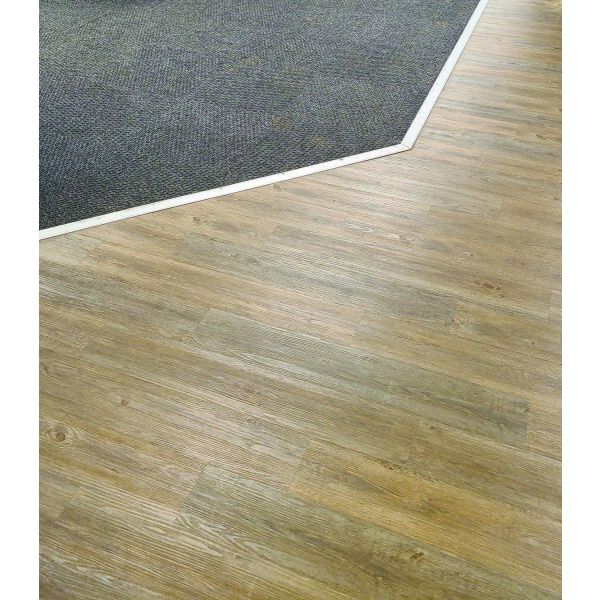
This 6" x 36" luxury vinyl plank has a rustic wood look and one of the thickest top layers we carry, at 40 mil. It was made for rooms that take a beating — heavy foot traffic, rolling carts, dropped equipment. It handles 2,000 psi of pressure without denting.
What a 40 Mil Wear Layer Does Before Your Floor Takes the Room Out of Service
Wood floors don't fail dramatically. They accumulate. A dropped tray dents one board, a rolling cart scars a lane, a spill sits too long near a doorway. None of it is urgent alone, and none of it can be fixed alone either.
That's the real cost of hardwood in a commercial space. Repair means refinishing, refinishing means sanding and sealing across a whole area, and the room is unusable for days. A retail floor, a hotel lobby, a clinic corridor — none can go dark while a crew works.
Vinyl plank flooring changes that arithmetic twice over. Damage stays local to the plank it happened to, and replacement is genuinely simple: warm the plank with a hair dryer to soften the adhesive, lift it with a putty knife, prep the spot, set a new one. The room is back in use the same day.
The wear layer is what keeps damage rare in the first place. It's the clear film over the printed surface, measured in mils, and at 40 mil this sits above the 28 mil tier most specifications treat as heavy commercial. Abrasion resistance tests at under 0.15 grams per 1,000 cycles, and static load holds to 2,000 psi.
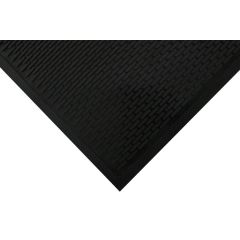
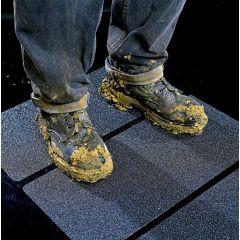
What actually consumes a wear layer is grit. Sand and street soil ride in on shoes and grind at the surface underfoot, and guidance from ISSA holds that soil keeps transferring off shoes for the first six to eight footsteps past a door. Entrance matting ahead of a vinyl floor extends its life by more than most people expect.
Why 40 Mil, a Rustic Visual, and a 1x Coating
Overall thickness is 3.175 mm — an eighth of an inch — with 1.0 mm of that being wear layer. That ratio matters more than the total. Two planks of identical thickness can carry very different wear layers, and the wear layer is the part standing between traffic and the printed visual underneath.
The surface carries a protective coating the manufacturer measures at a 26.6% improvement over most leading coatings on the market. That's a scratch-resistance claim rather than a wear-layer claim, and the two work on different problems — the coating handles the daily scuffs, the wear layer handles the years.
The rustic character does something practical alongside the aesthetic. Grain movement, knots, and tonal variation break up the surface visually, so scuffs and everyday marks have nothing uniform to contrast against. A smooth pale floor announces every scratch; a rustic one absorbs them. It's a Type B embossed surface, so the texture is physical rather than printed.
The test results back the commercial positioning. Flammability passes ASTM E648 Radiant Panel at Class 1, smoke density passes ASTM E662 under 450, and slip resistance measures 0.61 to ASTM D2047 — exceeding ADA standards. Indentation resistance passes under 8%, stain and chemical resistance rates excellent, and it exceeds HUD and FHA requirements.
One spec worth noting for anyone doing acoustic work: sound insulation measures 4 dB to DIN 52210. That's modest, and in spaces where noise transmission matters you'll want an underlayment conversation rather than relying on the plank.
Where It Belongs, and Where It Doesn't
The manufacturer's suggested uses run wide: beauty salons, conference rooms, corporate lunchrooms, general office, hospitals, libraries, pharmacies, retail and department stores, resorts, restaurants, spas, and supermarkets. The common thread is steady traffic on a floor that still has to look considered.
Within a building it belongs in circulation and occupied space — corridors, open offices, sales floors, waiting areas, and guest rooms. It also goes where wood couldn't, since vinyl doesn't swell or cup with moisture. It sits with the rest of our vinyl flooring, which spans the other plank formats and tile.
It's rated indoor only, and that's a hard limit rather than a preference. No covered patios, no sunrooms with direct exposure, no anywhere temperature swings.
It's also not an entrance surface. Vinyl plank is not matting, and making it the first thing a wet, gritty shoe touches means it absorbs the full abrasive load daily. Put a proper scraper and wiper system at the door and let the plank start behind it.
And it isn't a stair tread. Stairs need a purpose-built tread with a proper nosing for edge definition and grip, and running plank up a staircase is a different product decision with real safety implications. We carry treads separately for that reason.
Three Things to Check Before You Spec It
First, plan for professional glue-down installation. This is a wet-set adhesive product requiring a 1/16 inch square-notch trowel and a 100 pound three-section roller, with the floor re-rolled after an hour or two. Material and adhesive both need conditioning at 65°F minimum for 24 hours before and after. It also must be professionally installed to validate the manufacturer's warranty.
Second, test the subfloor for moisture before anything else. The instructions are explicit that adhesive must not be used where moisture is present in concrete or wood subfloors, because moisture can retard or prevent the adhesive setting entirely. On concrete, a latex primer both aids adhesion and helps block moisture between plank and slab. Test first — this is the most common reason a good floor fails early.
Third, expect real variation and see it at scale. The manufacturer states plainly that significant color and design variation is normal and part of the design. That's the point of a rustic visual, but a small swatch can't show how much movement appears across a full floor. Ask us for large samples and lay several out in the actual room, in the actual light.
Why Mats Inc.
We've been specifying commercial flooring since 1964, and vinyl is where a sample box does buyers the most damage. A chip shows the color and hides everything that decides whether the floor survives — the wear layer, the static load rating, whether it was built for a supermarket or a spare bedroom. This one publishes all of it, which is why we carry it. Tell us what happens in your space and we'll confirm the numbers match before you order.
| Product Type |
Luxury vinyl plank (LVP), glue down |
| Plank Size |
6 in. x 36 in. |
| Wear Layer |
40 mil (1.0 mm) |
| Overall Thickness |
0.125 in. (3.175 mm) |
| Manufacturing Standard |
Class III printed film vinyl plank, coated, Type B embossed surface |
| Visual |
Rustic wood grain — Weathered Barn |
| Packing |
26 planks per carton / 39 sq. ft. / 38.82 lb. |
| Slip Resistance |
ASTM D2047 — 0.61, exceeds ADA standards |
| Static Load |
ASTM F970 modified — 2,000 psi |
| Abrasion Resistance |
EN 660 — excellent, less than 0.15 g per 1,000 cycles |
| Indentation Resistance |
F 1914 — pass, less than 8% |
| Stain & Chemical Resistance |
ASTM 925 — excellent |
| Flammability |
ASTM E648 Radiant Panel — Class 1 |
| Smoke Density |
ASTM E662 — pass, less than 450 sdi |
| Sound Insulation |
DIN 52210 — 4 dB |
| Other Standards |
FloorScore certified; stability EN 986 pass; light resistance F 1515 pass; heat stability ASTM 1514 pass; exceeds HUD/FHA requirements |
| Use Rating |
Zone 3, indoor only |
| Installation |
Glue down, wet set; professional installation required |
| Warranty |
1-year limited (Mats Inc.) |
Frequently Asked Questions
What does a 40 mil wear layer actually mean?
The wear layer is the clear protective film over the printed surface, and it's measured in mils — thousandths of an inch. At 40 mil, or 1.0 mm, this sits at the top of the commercial range. Light residential product often runs 6 to 12 mil, and 20 to 28 mil is common for commercial work, so this is above the tier most specifications treat as heavy duty.
What that buys you is time before the printed visual underneath starts showing through. The abrasion testing supports it — under 0.15 grams lost per 1,000 cycles, rated excellent to EN 660. Worth understanding that wear layer is separate from overall thickness. Total thickness here is 0.125 inch, but a plank of the same thickness with a 12 mil wear layer is a fundamentally different product. Always compare the wear layer, not the total. — Dustin Thompson, Owner & CEO, Mats Inc.
Will it handle heavy equipment, carts, and point loads?
Static load tests at 2,000 psi under ASTM F970 modified, which covers the concentrated loads that come from shelving legs, equipment feet, and furniture in commercial use. Indentation resistance passes under 8% to F 1914, meaning it recovers rather than holding a permanent dimple.
Two practical notes from the maintenance guidance. Vacuum wheels can cause indenting and scuffing, so check them for embedded grit — a wheel with a stone in it will mark a floor faster than foot traffic. And when vacuuming, turn the beater bar off and use a hose or upholstery attachment instead. Small habits, but they're the difference between a floor that ages well and one that looks worn early. — Dustin Thompson, Owner & CEO, Mats Inc.
How does it install, and can I do it myself?
It's a glue-down wet-set product, and the manufacturer requires professional installation to validate the warranty — so this isn't a self-install job. The method is specific: 1/16 inch square-notch trowel, adhesive spread in small sections so it doesn't skin over, each section rolled immediately with a 100 pound three-section roller, then the whole floor re-rolled after an hour or two.
Conditioning matters too. Planks and adhesive both need to sit at 65°F minimum for 24 hours before installation and 24 hours after. Don't wash or treat the floor for at least 48 hours. And the subfloor has to be structurally sound, clean, smooth, and dry — adhesive must not be used where moisture is present in concrete or wood, since moisture can prevent it setting. Over concrete, a latex primer aids adhesion and helps block moisture. Test the slab before you schedule anyone. — Dustin Thompson, Owner & CEO, Mats Inc.
How much do I need, and what does a carton cover?
Each carton holds 26 planks covering 39 square feet and weighs 38.82 pounds, which makes the math straightforward and the cartons easy to move around a site.
Measure each room's length and width in feet, multiply for square footage, add your rooms together, then add roughly ten percent for cuts around door frames, columns, and irregular walls, plus attic stock for later replacements. Push that closer to fifteen percent if the space has a lot of angles, built-ins, or a diagonal layout, since all three generate more offcuts. Divide the total by 39 and round up for cartons — or send us the room dimensions and we'll run it with you. — Jinna Hopson, Vice President of Marketing, Mats Inc.
What does the rustic visual look like across a whole floor?
It's a weathered barn wood character — grain movement, knots, tonal shifts, the marks a real reclaimed board carries. The surface is Type B embossed, meaning the texture is physically pressed into the plank rather than printed, so it reads as wood underfoot as well as to the eye.
The manufacturer is direct that significant color and design variation is normal and enhances the look, and that's worth taking seriously in both directions. It's what makes the floor convincing rather than a repeating print, and it means a small swatch genuinely can't represent the finished result. There's a maintenance dividend as well: all that variation gives scuffs and everyday marks nothing uniform to sit against, so the floor stays presentable between cleanings. Ask us for large samples and see them in your own light. — Jinna Hopson, Vice President of Marketing, Mats Inc.
Does it work in a modern or branded space, and what about air quality?
Rustic wood usually works better in a contemporary space than a clean visual does. Warmth and texture are what stop a room full of glass, metal, and painted drywall from feeling clinical, which is exactly why modern interiors reach for natural texture so often. As a warm neutral base it sits underneath signage, fixtures, and your palette rather than competing with them.
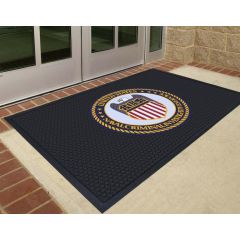
On air quality, it's FloorScore certified — the standard for indoor air quality emissions in hard surface flooring, and one that matters for occupied spaces like hospitals, libraries, and offices, as well as for green building credits. If you're working to a brand standard or chasing certification points, send us the requirements and we'll tell you how this fits. A custom logo mat at the entrance gives you a deliberate brand moment with the plank running the space behind it. — Jinna Hopson, Vice President of Marketing, Mats Inc.
Written by Dustin Thompson, Owner & CEO, Mats Inc.