




More Information
| Manufacturer | Dimex |
|---|
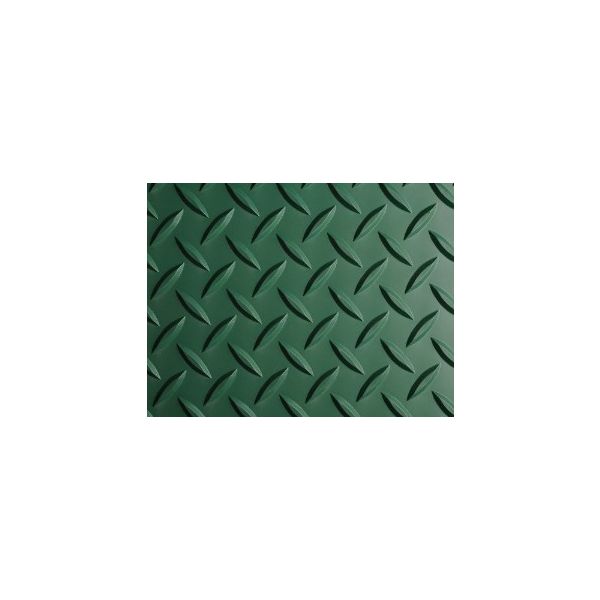
Diamond Plate Vinyl Switchboard Matting (Mil Spec)
Product Number:
#0213VM
$1,099.00

Have a question? We're here to help!
Description
This is diamond plate vinyl switchboard matting built to MIL-DTL-15562G, Type III — the military specification for electrical insulating matting. It carries a dielectric test voltage of 30,000 VAC, is proof tested across its entire surface at 15,000 VAC, and has a recommended maximum use voltage of 3,000 VAC. It ships in 36 inch by 75 foot rolls at 3/16 inch thick.
What This Matting Does, and the Assumption That Gets It Specified Wrong
The mechanism is the same as any insulating mat. Current needs a complete circuit, and a worker standing on bare floor in front of live equipment is half of one. Put an insulating barrier underfoot and the circuit has nowhere to close, so contact with an energized part stops being a path through a person.
Here's where this product needs a plain warning. "Military specification" sounds like a higher rating, and people reach for it on that basis. The recommended maximum use voltage on this mat is 3,000 VAC. Commercial ASTM D178 Class 2 matting is rated to 17,000. The military spec is not the higher-rated product.
That gap trips up buyers who reasonably assume defense standards outrank commercial ones. What MIL-DTL-15562G actually does is apply a much wider safety margin between what the material survives in testing and what it's cleared for in service. It's a more conservative philosophy, not a more capable material.
So the specification decision is straightforward once you know it. Buy this when a contract, drawing, or facility standard names MIL-DTL-15562G. If you're selecting on voltage alone, check the number against your equipment before anything else, because the name on the standard tells you nothing useful about the rating.
Why MIL-DTL-15562G Type III, and What the Numbers Mean
MIL-DTL-15562G is the current designation for the military detail specification covering electrical insulating matting. It replaced MIL-M-15562F, and older drawings still reference that earlier number — worth knowing when you're reading a legacy spec package and trying to work out whether it's been superseded.
Type III is a classification within the military spec, and it has no relationship to ASTM's Type I and Type II. Same word, entirely different numbering system. A drawing calling for Type III under MIL-DTL-15562G is not asking for anything ASTM Type designations describe.
The three voltage figures do different jobs. Dielectric test voltage of 30,000 VAC is the level the material is proven to withstand under laboratory conditions. Proof testing at 15,000 VAC runs across the entire surface of every roll — not sampled sections, because a barrier is only as good as its weakest square inch.
Recommended maximum use voltage of 3,000 VAC is the only one that governs where the mat goes. The distance between 15,000 and 3,000 is the margin the military specification builds in deliberately, and it isn't reserve capacity you're meant to draw on.
Construction is vinyl at 3/16 inch with a diamond plate surface. The raised pattern is multidirectional, so traction holds regardless of which way somebody plants a foot — useful around equipment where people pivot and sidestep rather than walking a straight line. It also gives debris no continuous channel to travel along.
Where It Belongs, and Where It Doesn't
This belongs wherever MIL-DTL-15562G is called out by name: military installations, shipboard and naval facilities, defense contractor floors, and any site working to federal specification packages. It also fits industrial work at lower voltages where the diamond plate surface and the insulation both matter. It sits with the rest of our electrical and switchboard matting, which covers the ASTM types and classes.
The practical boundary is the 3,000 VAC rating. Control cabinets, distribution panels, and workbench areas operating within that limit are a good fit. Medium and high voltage switchgear are not, and no amount of military-specification pedigree changes that.
If your requirement is voltage rather than compliance, look at the commercial standard instead. ASTM D178 offers classes rated well above this one, and there's no advantage in specifying a military standard for equipment it wasn't rated to cover.
What it is not: an ESD or anti-static mat. Those are conductive by design, built to drain static charge to ground and protect sensitive electronics. This blocks that path entirely. Grounding it would defeat its purpose, and the two are not interchangeable in either direction.
It's also not an anti-fatigue mat or general floor protection, and it is not primary protection. De-energizing, verification, protective equipment, and trained procedure come first. This is the layer beneath all of that — the one still working when something else doesn't.
Three Things to Check Before You Spec It
First, confirm the standard is what your job actually requires. If a contract or drawing names MIL-DTL-15562G, or references the older MIL-M-15562F, this is the product. If nothing names it, ask why you're buying to a military specification — the commercial standard covers a wider voltage range and may fit your equipment better.
Second, check 3,000 VAC against your equipment before anything else. Find the actual working voltage at each panel or cabinet rather than assuming. This is the single most common error on this product, because the specification name suggests capability the rating doesn't support. If your voltage exceeds 3,000, you need a different product regardless of what the drawing says.
Third, plan coverage around movement. This comes 36 inches wide. Watch how people work the equipment — how far they step back, how far they reach sideways — and confirm one run keeps them on the mat throughout. Cutting a 75-foot roll into sections is normal, so a single roll usually serves several positions.
Why Mats Inc.
Since 1964 we've handled enough specification packages to know that the hardest part is often reading what the drawing actually asks for. On this product we'll ask two questions before quoting: does your paperwork name the military standard, and what voltage are you working at. Those answers point to different products often enough that we'd rather ask than assume, and we'd rather send you to the commercial line than sell you a mat your equipment outranks.
| Product Type | Insulating (non-conductive) switchboard matting |
| Standard | MIL-DTL-15562G (formerly MIL-M-15562F), Type III |
| Dielectric Test Voltage | 30,000 VAC |
| Proof Test | 15,000 VAC, tested over the entire surface |
| Recommended Max Use Voltage | 3,000 VAC |
| Material | Vinyl |
| Surface | Diamond plate |
| Thickness | 3/16 inch |
| Size | 36 inch width x 75 ft. length |
| Recommended For | Military and defense facilities, industrial electrical work within the rated voltage |
| Static Control | None — this is an insulator, not an ESD or anti-static product |
| Warranty | 1-year limited (Mats Inc.) |
Frequently Asked Questions
What does MIL-DTL-15562G Type III mean, and is Type III the same as ASTM Type I or II?
MIL-DTL-15562G is the military detail specification for electrical insulating matting. It supersedes MIL-M-15562F, which still shows up on older drawings — so if you're reading a legacy package that cites the F revision, this is the current product answering it.
On the second question: no, and it's a genuine trap. Type III belongs to the military specification's own classification system and has no connection to ASTM D178's Type I and Type II. The word is identical, the numbering systems are unrelated, and the two standards sit side by side in most catalogs. A drawing calling for Type III under MIL-DTL-15562G is not asking for anything an ASTM Type designation describes, and vice versa. Read which standard is named before you read the type number. — Dustin Thompson, Owner & CEO, Mats Inc.
Why is the maximum use voltage only 3,000 when it's tested at 15,000?
Because the military specification builds in a much wider safety margin than the commercial one does. The 30,000 VAC dielectric figure is what the material withstands in laboratory testing. The 15,000 VAC proof test is applied across the entire surface of every roll, not sampled sections. The 3,000 VAC recommended maximum use voltage is what governs where you can actually put it.
That margin is deliberate and it is not reserve capacity to draw on. It's also why this product needs care in specification: people see "military grade" and assume a higher rating, when commercial ASTM D178 Class 2 matting is rated to 17,000 volts — more than five times this one. Neither product is better. They're written to different philosophies, and the only thing that matters is whether the published use voltage covers your equipment. — Dustin Thompson, Owner & CEO, Mats Inc.
Where should it go, and does it need grounding or fastening?
Put it in front of equipment operating within 3,000 VAC — control cabinets, distribution panels, and workbench areas — and anywhere a contract or facility standard names the military specification. It should cover the full area a worker occupies, with enough margin that they can shift, step back, or reach sideways without a foot landing on bare floor.
No grounding, and this deserves bluntness. Grounding an insulating mat destroys its entire function, because the mechanism is that no path runs from the worker through the floor to ground. Anyone used to ESD matting may reach for a ground cord from habit, and here that habit is dangerous. On fastening, it's meant to lie loose so it can be lifted, inspected underneath, and replaced without demolition — adhesives and mechanical fasteners can puncture or contaminate the barrier. Let it relax flat after unrolling, then cut with a sharp blade against a straightedge. — Dustin Thompson, Owner & CEO, Mats Inc.
What size does it come in, and how much should I order?
One configuration: 36 inches wide by 75 feet long at 3/16 inch thick, sold as a full roll. At 3/16 inch it's thinner than the 1/4 inch commercial mats, which makes it a bit easier to handle and means less of a step at the edge — worth knowing if door clearance or a transition is tight.
For quantity, work position by position rather than room by room. Measure the width of each panel, cabinet, or bench, add margin on both sides so a worker never runs out of mat when they move, and total those lengths. Seventy-five feet usually covers several positions once it's cut to length. Send us your equipment list with the voltages and the specification your drawing calls for, and we'll size it with you. — Jinna Hopson, Vice President of Marketing, Mats Inc.
What does it look like and what's it like to work with?
Black with a raised diamond pattern — the same visual language as a steel stair tread or a truck bed, which reads correctly as equipment rather than as flooring. Underfoot it's a low, broad pattern that grips without feeling like standing on texture.
The practical advantage of the pattern is that it works in every direction. Corrugated ridges grip best across their line and less well along it; a diamond layout doesn't care which way you plant a foot, which matters when someone is pivoting between adjacent cabinets rather than walking a straight path. It also stays presentable, because there's no continuous channel for grit and shavings to collect in — a sweep keeps it looking maintained. — Jinna Hopson, Vice President of Marketing, Mats Inc.
Do I need the military spec version or the commercial one?
Let your paperwork decide it. If a contract, drawing, or facility standard names MIL-DTL-15562G or the older MIL-M-15562F, buy this one — a commercial mat won't satisfy that call-out no matter how it's rated. Defense work, shipboard installations, and federal facilities often specify it directly.
If nothing names the military standard, the commercial line is usually the better fit. ASTM D178 covers a much wider voltage range, with Class 2 rated to 17,000 volts and higher classes above that, so it can serve equipment this product can't. And if your paperwork names the military spec but your equipment runs above 3,000 volts, that's a conflict to raise with whoever wrote the drawing rather than a decision to make on the floor. Send us the call-out and the voltage and we'll help you sort out which one you actually need. — Jinna Hopson, Vice President of Marketing, Mats Inc.
Written by Dustin Thompson, Owner & CEO, Mats Inc.
Ordering Info
| Size | Qty 1 Price |
| Green - 36" x 75' x 3/16" | $1,099.00 |
| Gray - 36" x 75' x 3/16" | $1,099.00 |
Reviews
Write Your Own Review
Related Products
Heritage Personalized Coir Door Mat

#775 Epoxy Flooring Adhesive
#560 Rubber Flooring Adhesive
#110 Epoxy Nose Caulk
#300 Water Based Contact Adhesive

#400 Neoprene Contact Adhesive
Rotary Table & Rig Floor Mats
Fore-Runner Mat
Safety Track Resilient Medium Non-Skid Tape
3M Vinyl Loop Wet Area Matting