




More Information
| Manufacturer | Notrax |
|---|
$85.00

Have a question? We're here to help!
Description
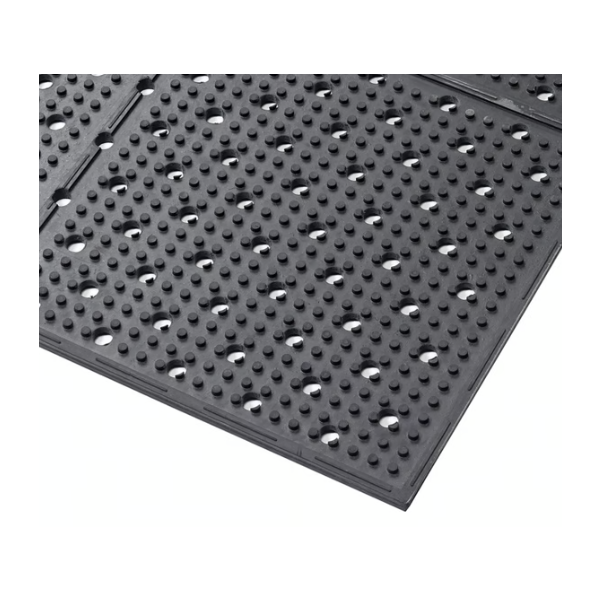
Multi-Mat II Rubber Matting is a reversible drainage mat for wet and greasy floors. The open-pattern rubber lets water, rinse, and light grease fall through to the floor instead of pooling under a boot, the non-skid surface holds footing on both faces, and a low profile lets carts roll on and off without a bump. When one side wears, flip it. Cut sizes run from 2 by 3 feet to 4 by 8 feet in black general-purpose rubber.
What a Drainage Mat Does Before Standing Water Puts Someone Down
A solid mat on a wet floor moves the problem, it does not solve it. Water runs off the edges or sits on top, and a boot on a wet solid surface is a boot on a slide. Dish pits, wash-down bays, bar wells, locker-room walkways, and food-prep lines all put liquid on the floor faster than anyone mops it, and the person standing there is the one who pays for it.
A drainage mat changes the physics. The surface is an open grid of rubber with holes through it, so liquid drops through to the floor and away from the sole. The rubber that is left is what the foot lands on, and its non-skid texture does the gripping. The worker stands on a surface that stays clear even while the floor under it is soaked.
The stakes are simple. A wet-area slip is the injury that shows up most in kitchens and wash bays, and the fix is not a sign or a mop schedule; it is putting a surface between the worker and the water. This mat is built for that specific job, and the way it is built decides how long it keeps doing it.
Why a Reversible Open-Grid Rubber Mat, and Why This One
The mat is solid rubber with no top layer, backing, or foam core, molded as an open drainage pattern that is identical on both faces. That is what makes it reversible: when the top face wears or gets stained, turn the mat over and the second face is new. The vendor's own phrase for it is a design that adds to the service life of the mat, and in practice it doubles the surface you paid for.
The compound is general-purpose rubber in black, manufactured with an anti-microbial additive that inhibits the growth of bacteria and fungi in the rubber. On a mat that spends its life wet, that is the difference between one that is hosed and returned to service and one that smells by the second month. The vendor also produces a heavy-duty nitrile version in red for heavier grease and oil exposure; the black mat here is rated for some exposure to grease, oil, and water.
The profile is low. A drainage mat that sits tall becomes a lip that carts and hand trucks catch on and a step that tired feet trip over. This one is designed for easy cart access, so a bus cart, a dish rack dolly, or a keg on a hand truck rolls across it. That is why the vendor lists it for longer runs as well as single stations.
Underfoot there is a little give in the rubber, enough to be kinder than bare tile, but this is not a cushion mat. Its comfort comes from getting the water away from the feet and giving them something to grip, not from foam.
Where It Belongs, and What It Is Not
Put it where liquid hits the floor and someone has to stand or walk on it anyway: dish machines and pot sinks, bar wells and beer coolers, wash-down bays, food-prep and packing lines, shower and locker-room walkways, and the strip along a wet counter. The vendor specifies it for workstation environments and longer runs where drainage, a non-slip surface, and cart clearance are the requirements. It sits among the heavy-duty rubber runner mats as the one that lets the water through.
The black general-purpose compound is right for water and light grease. Where the floor sees heavy fryer oil, fat, or constant petroleum exposure, the vendor's nitrile version is the one to ask about instead. Match the compound to the liquid.
What it is not is an anti-fatigue mat or a dry-area runner. It does not have foam under it, so someone standing eight hours at a dry register wants a cushioned mat. And on a dry floor the open grid has nothing to drain and simply collects crumbs and grit; a solid runner is the better surface there.
Three Things to Check Before You Spec It
First, confirm the floor is actually wet, and with what. If water pools or runs across the floor during a shift, a drainage mat earns its place. If the liquid is mostly water and rinse with light grease, the black general-purpose compound covers it. If it is heavy oil or fat every shift, ask about the nitrile version rather than putting general-purpose rubber in a fryer zone.
Second, size it to the wet zone and to the carts that cross it. A 2-by-3 covers a single sink or bar-well position. A 3-by-4 or 3-by-5 covers a dish station where the worker moves a step either way. A 4-by-6 or 4-by-8 covers a wash-down area or a short run along a wet line. Keep the mat clear of the drain grate itself and leave room at the edges for the cart wheels to roll on square.
Third, plan the flip and the rinse. The mat is reversible, so mark a date and turn it over on schedule rather than waiting for one face to look tired. At close, pick it up, hose both faces, and let it drain before it goes back down; the anti-microbial compound does its best work on a mat that dries. A mat left down on a wet floor around the clock never gets that chance.
Why Mats Inc.
We stock this mat for the floors that are wet by design: the dish pit, the bar back, the wash bay. A solid runner in those spots just moves the puddle, and a cushion mat soaks it up. An open rubber grid that drains, grips on both faces, flips over when one side wears, and lets a cart roll across it is the right tool for that floor, and Mats Inc. has been putting the right tool on the right floor since 1964.
| Type | Reversible drainage anti-slip mat |
| Material | General-purpose rubber, black (heavy-duty nitrile version in red available on request) |
| Surface | Non-skid, open drainage pattern; identical on both faces |
| Reversible | Yes; flip to extend service life |
| Profile | Low profile for easy cart access |
| Anti-microbial | Rubber compound inhibits growth of bacteria and fungi |
| Exposure rating | Wet or dry; some exposure to grease, oil, and water |
| Sizes | Cut sizes from 2' x 3' to 4' x 8'; longer roll lengths available on request |
| Cleaning | Lift, hose both faces, allow to drain before replacing |
| Warranty | 1-year limited (Mats Inc.) |
Frequently Asked Questions
How is Multi-Mat II built, and what is it made of?
Answered by Dustin Thompson, Owner & CEO
It is a single piece of molded rubber with an open drainage pattern that runs all the way through, so both faces are the same non-skid surface. There is no foam core, fabric, or bonded backing. The black version is a general-purpose rubber compound, manufactured with an anti-microbial additive that inhibits bacteria and fungi in the rubber itself rather than as a coating that washes off.
Because the two faces are identical, the mat is reversible: flip it when the top face wears or stains and you are standing on a fresh surface. The vendor also makes the same mat in a heavy-duty nitrile compound, colored red, for heavier grease and oil.
How long does it last, and what shortens its life?
Answered by Dustin Thompson, Owner & CEO
The vendor does not publish a service-life figure. What it does state is that the reversible construction adds to the service life, and that is the practical number: two working faces instead of one, so a mat that would be worn out on one side keeps going on the other. It carries a 1-year limited (Mats Inc.) warranty, and flipping it on a schedule rather than when it looks tired is what gets the most out of it.
What shortens it is the wrong liquid and no dry time. General-purpose rubber rated for some grease exposure will soften and get slick under heavy fryer oil every shift; that floor wants the nitrile version. And a drainage mat left down wet around the clock never dries, which defeats the anti-microbial compound. Lift it, hose it, let it drain.
Where should I use it, and where should I not?
Answered by Dustin Thompson, Owner & CEO
Use it where the floor is wet while someone works on it: dish machines and pot sinks, bar wells, wash-down bays, food-prep and packing lines, shower and locker-room walkways, and along wet counters. The vendor specifies it for workstations and longer runs that need drainage, a non-slip surface, and low-profile cart access, and the black compound is right for water and light grease.
Do not use it as a cushion for a dry standing station; it has no foam and an anti-fatigue mat does that job. Do not put it on a dry floor as a runner, where the open grid only collects grit. And do not put the black general-purpose compound under constant heavy oil; ask about the nitrile version for that.
Which size should I pick?
Answered by Jinna Hopson, Vice President of Marketing
Size it to the wet zone, not the room. A 2-by-3 covers one sink or one bar-well position. A 3-by-4 or 3-by-5 covers a dish station where the worker takes a step either way. A 4-by-6 or 4-by-8 covers a wash-down area, a two-person station, or a short run along a wet line. Longer runs are available as roll lengths on request.
Two placement habits help. Keep the mat clear of the floor drain grate so the water it sheds has somewhere to go, and leave a few inches at the cart side so wheels roll on square rather than catching a corner. Measure the puddle, not the floor plan.
What does it look like in a kitchen or bar?
Answered by Jinna Hopson, Vice President of Marketing
A black open-grid rubber mat: a lattice of textured rubber with regular drainage openings, low to the floor, and the same pattern on both faces. It reads as working equipment rather than decor, which is exactly right for a dish pit, a bar back, or a wash bay where staff see it and customers do not. Black hides the stains that a wet, greasy floor puts on any mat between rinses.
Because the vendor's nitrile version comes in red, some operations use the two colors as a code: red where the fryer oil is, black everywhere else wet. For a front-of-house floor where the mat is on display, this is not the product; it lives behind the line.
Is this a good fit for a dish pit or wash bay where carts come through?
Answered by Jinna Hopson, Vice President of Marketing
Yes; that combination of standing water and rolling carts is the case it was designed around. The drainage pattern takes the rinse water and light grease off the surface, the non-skid faces keep the dish crew upright, and the low profile means a bus cart, dish dolly, or hand truck rolls across it instead of stopping at a lip. The vendor specifies it for exactly that: drainage, anti-slip surface, low profile for cart traffic.
Plan the routine and it stays that way: lift at close, hose both faces, let it drain, and flip it on a schedule so the two faces wear evenly. At a dish machine that runs all day, that habit is what keeps the mat from becoming the thing that smells.
By Dustin Thompson, Owner & CEO, Mats Inc.
Ordering Info
| Size | Qty 1 Price |
| 2' x 3' | $44.00 |
| 2' x 8' | $143.00 |
| 3' x 4' | $89.00 |
| 3' x 8' | $204.00 |
| 4' x 8' | $323.00 |
Reviews
Write Your Own Review
Related Products
Super Scrape Rubber Mats
Safety Track Non-Skid Tape - Coarse

Smooth Marbleized Vinyl Switchboard Matting (Mil Spec)
Super Scrape Rubber Logo Mats
Strip Doors
Perfec Clean 3/8" Rollup Mats - Aluminum Hinge
Perfec Clean 3/8" Rollup Mats - Rubber Hinge
Perfec Clean 3/4" Rollup Grate - Rubber Hinge
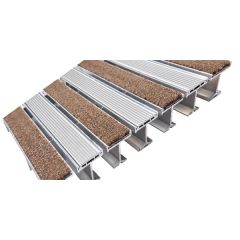
Perfec Clean 1-5/8" Grate
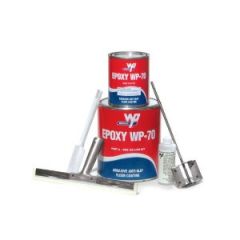
WP-70 Non-Skid Epoxy Coating