




Description
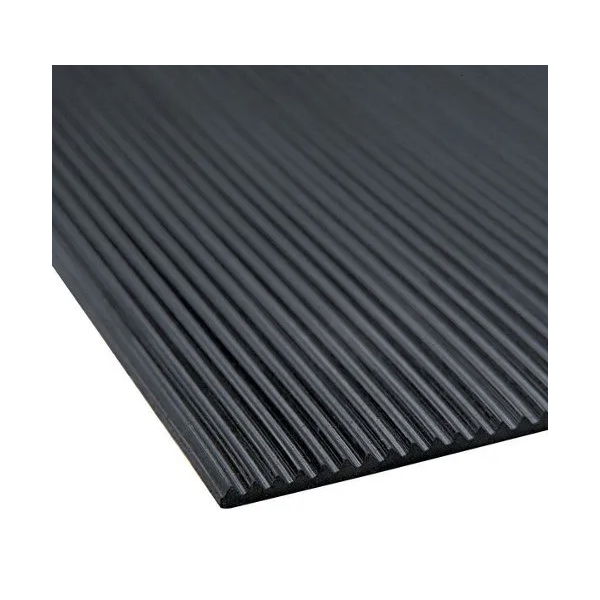
Corrugated Rubber Matting is a nitrile rubber runner sold by the roll: 1/8 inch thick, 75 feet long, in 24-, 36-, and 48-inch widths. The top is an angular-tooth ribbed pattern, the back is textured to grip the floor, and the rubber is formulated for indoor and outdoor use in low or high temperatures. It is a ribbed rubber runner for long floors that need traction, protection, and less noise, and it is meant to be cut to length on site.
What a Corrugated Rubber Runner Does Before the Floor Wears Through
A long hard floor fails in a stripe. The aisle between racks, the hallway from the shop door to the bench, the run behind a counter: that is where every boot, cart, and dropped part lands, and it is where concrete pits, coatings wear off, and tile cracks first. A rolled rubber mat over that stripe takes the abuse instead of the floor.
The ribs do the second job. The angular-tooth pattern gives a boot sole edges to bite against, and it channels water and grit into the grooves instead of leaving a film on top. On a floor that gets tracked-in rain, coolant mist, or wash-down water, that is the difference between a walkway and a slide.
The third job is quieter, literally. Rubber between a hard sole and a hard floor cuts the impact noise of footsteps and carts. In a shop or plant that runs all day, a runner down the main aisle takes a measurable edge off the background noise, which is one of the reasons buyers who came for floor protection keep it.
Why Nitrile Rubber, and Why This One
This runner is solid nitrile rubber, one material through the full 1/8-inch thickness. There is no cushion layer, no fabric, and no bonded backing to separate. What you get is a thin, dense, flexible sheet that lies flat, rolls back up when it needs to move, and does not depend on a glue line to stay in one piece.
The formulation is rated for indoor and outdoor use and for low or high temperatures. That is the practical distinction from a general-purpose runner: it can run from a loading dock through a roll-up door and down a plant aisle without stiffening in the cold section or softening in the hot one. It also meets FMVSS 302 flammability requirements.
The two surfaces are built for different jobs. The top pattern is an angular tooth, sharper-edged than a rounded rib, so it holds a shoe rather than letting it skate along the groove. The back is textured rather than smooth, which gives the runner friction against the floor and helps a loose-laid length stay where it was put.
The 1/8-inch gauge is a choice, not a compromise. A thin runner sits low enough that carts, hand trucks, and rolling tool chests cross it without a bump, and it does not fight door clearances or floor transitions. It is also light enough per foot to cut and reposition without a crew.
Where It Belongs, and What It Is Not
Run it down any long hard floor that takes foot and wheel traffic: warehouse and stockroom aisles, shop and garage floors, service corridors, the strip behind a bar or counter, a covered walkway or ramp, an equipment room. Because it handles cold and heat, the same roll works from an unheated dock into a conditioned plant. It is one of the roll options among the heavy-duty rubber runner mats we stock, and the one to pick when the run is long and the floor is hard.
The vendor also lists it for OEM uses, which in practice means it is cut and fitted as a liner or protective layer inside equipment, vehicles, and cabinetry as well as laid on floors. The same roll that covers an aisle can be trimmed for a truck bed, a tool crib shelf, or a machine base.
What it is not is a comfort mat. There is no cushion in a solid 1/8-inch sheet, so a person standing in one spot for a shift will feel the floor through it. Where someone holds a station, pair it with a cushioned anti-fatigue mat at that station and let the runner handle the walking between them.
Three Things to Check Before You Spec It
First, measure the run and pick the width to the traffic, not the space. Twenty-four inches covers a single-file path where people walk one at a time. Thirty-six inches is the standard aisle width where two people pass or a cart shares the lane with a walker. Forty-eight inches covers a wide bay, a two-way corridor, or a floor you want protected wall to wall. Each roll is 75 feet, and runs are cut to length on site.
Second, decide loose-lay or fixed. The textured back holds a straight run on a clean, dry floor without adhesive, and loose-lay lets you pull the runner up to clean under it. Where the runner crosses a doorway, turns a corner, or lives under constant cart traffic, tape or glue the edges and the end cuts so they cannot lift and become the trip hazard the runner was bought to prevent.
Third, plan the seam and the cut. A 75-foot roll covers most aisles in one piece; where a run is longer, butt the two ends square rather than overlapping them, since an overlap in a cart lane catches wheels. Cut with a sharp utility knife along a straightedge, and let the roll relax flat at room temperature before trimming so the cut stays true.
Why Mats Inc.
We stock this runner because a long hard aisle is the most common floor problem a facility brings us, and the fix is not complicated: a dense rubber sheet with ribs on top and grip on the back, in a width that matches the lane, cut to the run. Mats Inc. has been fitting runners to real traffic since 1964, and this is the roll we reach for when the answer is a straight length of ribbed rubber rather than a stack of cut mats.
| Type | Corrugated rubber runner matting, sold by the roll |
| Material | Nitrile rubber |
| Top surface | Angular-tooth corrugated (ribbed) pattern |
| Back | Textured |
| Thickness | 1/8" |
| Roll sizes & weights | 24" x 75' — 113 lbs 36" x 75' — 168 lbs 48" x 75' — 215 lbs |
| Color | Black |
| Use | Indoor and outdoor; formulated for low and high temperatures; floor and OEM applications |
| Flammability | Meets FMVSS 302 |
| Function | Floor protection, slip and fall reduction, noise reduction |
| Warranty | 1-year limited (Mats Inc.) |
Frequently Asked Questions
What is this runner made of, and how is it built?
Answered by Dustin Thompson, Owner & CEO
Solid nitrile rubber, 1/8 inch thick, with no cushion layer or bonded backing. The top carries an angular-tooth corrugated pattern, which is a sharper-edged rib than a rounded corrugation and holds a shoe instead of letting it slide along the groove. The back is textured so the runner has friction against the floor.
The formulation is rated for indoor and outdoor use and for low or high temperatures, and it meets FMVSS 302 flammability requirements. Single-material construction is why it rolls, unrolls, and gets cut repeatedly without anything coming apart.
How long does a corrugated rubber runner last, and what wears it out?
Answered by Dustin Thompson, Owner & CEO
The maker does not publish a service-life figure, and on a solid rubber runner the traffic decides it. A dense 1/8-inch nitrile sheet under normal foot and cart traffic wears at the rib tops slowly and evenly, and the runner stays serviceable until the ribs flatten enough to stop channeling water. It carries a 1-year limited (Mats Inc.) warranty, and a look at the rib height and the edges once a year tells you where it stands.
Two things end it early. A loose edge or end in a cart lane gets kicked, folded, and torn, so fix edges where wheels cross. And an overlap seam takes the full impact of every caster; butt joints do not. Keep the edges down and the seams square and the runner outlasts the floor coating under it.
Do I need to glue it down, and how do I cut it?
Answered by Dustin Thompson, Owner & CEO
Not for a straight run on a clean, dry floor. The textured back and the runner's own weight, 113 to 215 pounds per roll depending on width, hold it in place, and loose-lay lets you pull it up to clean underneath. Where it crosses a doorway, turns a corner, or sits under constant wheeled traffic, tape or glue the edges and end cuts so nothing can lift.
Cutting is a sharp utility knife along a straightedge. Unroll the runner and let it relax flat at room temperature first; rubber that has been rolled tight or stored cold holds a curve and cuts crooked. Cut to the run, butt the ends square where two lengths meet, and do not overlap.
Which width should I order?
Answered by Jinna Hopson, Vice President of Marketing
Match the width to how people and carts actually use the lane. Twenty-four inches covers a single-file walkway, a narrow service corridor, or the strip behind a counter where staff walk one at a time. Thirty-six inches is the standard for an aisle where two people pass or a cart and a walker share the lane. Forty-eight inches covers a wide bay, a two-way corridor, or a floor you want protected edge to edge.
Every width comes on a 75-foot roll, so length is decided on site with a knife rather than at order time. Measure the run first; for a lane longer than 75 feet, plan the butt seam somewhere carts do not stop or turn.
What does it look like once it is down?
Answered by Jinna Hopson, Vice President of Marketing
A clean black band of fine, evenly spaced ribs running the length of the lane. The angular-tooth profile reads as crisp lines rather than a rounded wave, and because the rubber is black and the ribs are shallow, tracked-in grit and scuffs settle into the grooves instead of showing on the surface. At 1/8 inch it sits nearly flush with the floor.
It looks right in a shop, a plant, a stockroom, or a back-of-house corridor, where a straight black runner reads as intentional and tidy. For a front-of-house floor that customers judge by eye, a carpeted or fabric-topped runner is the better-looking choice; this one is built for the floors that do the work.
Can it be used outdoors or in unheated spaces, and where should it not go?
Answered by Jinna Hopson, Vice President of Marketing
Yes. The rubber is rated for indoor and outdoor use and for low or high temperatures, so it works on a covered dock, a ramp, an unheated warehouse, or a run that passes through a roll-up door from outside to in. That flexibility is the main reason to choose it over a general indoor runner when the lane is not fully climate-controlled.
Where it should not go is anywhere someone stands still for hours; there is no cushion in it, and a standing station needs an anti-fatigue mat. It is also a floor runner rather than a drainage mat, so a pit that holds standing water wants an open-pattern mat that lets liquid fall through.
By Dustin Thompson, Owner & CEO, Mats Inc.
Ordering Info
| Size | Qty 1 Price |
| 1/8" x 24" x 75' | $536.00 |
| 1/8" x 36" x 75' | $667.00 |
| 1/8" x 48" x 75' | $950.00 |
| 1/4" x 36" x 75' | $1,260.00 |
Reviews
Write Your Own Review
Related Products
Super Scrape Rubber Mats
Safety Track Non-Skid Tape - Coarse

Smooth Marbleized Vinyl Switchboard Matting (Mil Spec)
Super Scrape Rubber Logo Mats
Strip Doors
Perfec Clean 3/8" Rollup Mats - Aluminum Hinge
Perfec Clean 3/8" Rollup Mats - Rubber Hinge
Perfec Clean 3/4" Rollup Grate - Rubber Hinge
Perfec Clean 1-5/8" Grate
WP-70 Non-Skid Epoxy Coating