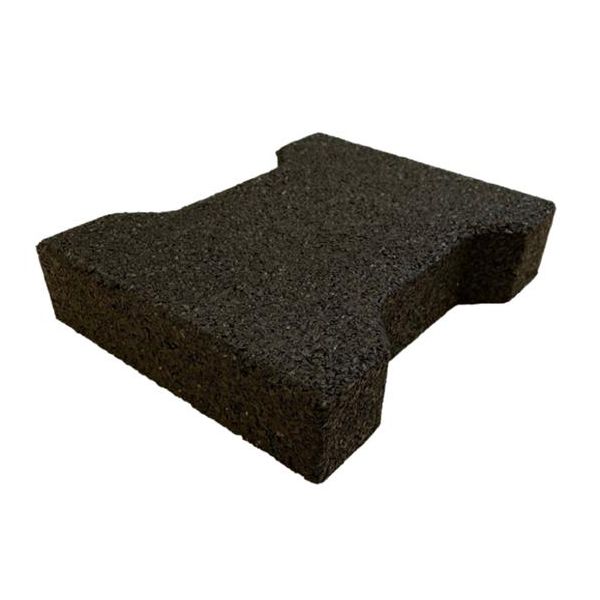
Rubber pavers solve a problem that concrete and gravel both handle badly: a surface that has to be firm underfoot, kind to hooves, and able to move a little when the ground beneath it does. These are molded from 100% recycled rubber in a dog-bone profile that locks piece to piece, so a walkway, wash bay, or patio goes down as one connected field rather than a set of loose blocks.
What Rubber Pavers Do Before the Path Turns to Mud
High-traffic ground around a barn takes a beating that nobody plans for. The route from the aisle to the wash bay, the ring at the tie post, the strip outside the tack room door — these wear down to bare dirt, then to mud, then to something that holds standing water every time it rains. Once that starts, the surface stops draining and the footing gets worse each season.
Interlocking rubber pavers put a stable, high-traction surface over that ground and keep it there. Because the pieces lock together, foot and hoof traffic pushes against the field as a whole instead of shifting individual pavers out of place. The recycled rubber gives underfoot rather than staying rigid, which is what makes a horse willing to walk on it confidently.
The same behavior matters for people. The material provides real foot cushioning and anti-fatigue properties, which is noticeable in the places where you stand still for long stretches: saddling areas, wash bays, and the spot beside the trailer where tacking up actually happens.
Why Re-Vulcanized Recycled Rubber, and Why the Dog-Bone Profile
The rubber here is re-vulcanized, meaning it has been chemically treated to form stronger bonds within the material itself. The result is denser and more durable than untreated recycled rubber, and the practical payoff is that these pavers stay flat instead of curling at the corners under stress and sun. Curling edges are how most outdoor rubber products eventually fail.
Being 100% recycled rubber is what makes the material appropriate for outdoor exposure in the first place. It does not rot, does not need sealing, and holds up to weather cycling year after year. Available in 1-3/4" and 7/8" thicknesses and in black, green, grey, and red.
The dog-bone shape is doing more work than it appears to. Each piece keys into its neighbors on multiple faces, so the field resists spreading in every direction rather than just along one axis. It also means layouts are not locked to a grid: the same pavers combine into different patterns, widths, and shapes depending on how you run them.
Every piece can be cut, shaped, and saw-cut on site, which is what lets a path curve around a post, meet a doorway squarely, or finish against an existing slab without an awkward gap. That flexibility is why the product fits alongside the stalls and aisles in Horse Stall Mats rather than competing with them.
Where They Belong, and What They Are Not
Around a barn, these earn their place in the transition zones: aisle ways, saddling and grooming areas, wash bays, service roads, and the paths connecting buildings. They work indoors as well as out, so a run can carry through from a barn aisle to an exterior walkway without changing surface material partway.
Outside the equine setting, the same pavers make garden pathways, patios, yard walkways, and any exterior route where anti-slip protection matters more than a decorative finish. Buyers looking at rubber patio pavers or rubber landscape tiles are generally solving the same problem in a different location.
What they are not: playground safety surfacing. Fall protection for play equipment is qualified against a tested critical fall height, and that rating is a separate specification these pavers do not carry. If you are surfacing under swings or a climbing structure, that is a different product and the rating is not optional.
They also are not a substitute for a stall floor. Stalls have their own requirements around seamlessness, drainage, and bedding retention, and dedicated stall matting handles those better than a paver field will.
Three Things to Check Before You Spec It
First, sort out the base before you order a single paver. The manufacturer is direct about this: an appropriate sub-floor is what keeps the installation on even ground. Pavers laid over soft, rutted, or uneven dirt will follow that contour and telegraph every low spot. Compacted screenings or an existing slab both work; unprepared soil generally does not.
Second, confirm whether your configuration needs adhesive. Certain sizes are glued down rather than dry-laid, and which ones applies to your order is worth pinning down at quote rather than discovering on install day. It changes both your material list and how permanent the installation is.
Third, decide the layout before the count. Because the dog-bone profile supports multiple patterns and the pieces saw-cut to shape, the same square footage can be run several ways, and edges and curves change how many pieces you actually need. Sketch the run, including where it meets doorways and existing hardscape, then work out quantity from that.
Why Mats Inc.
Paver layouts are where a project either looks intentional or looks improvised, and the difference is usually decided before anything is ordered. We have been in commercial and equine matting since 1964, and on this product that mostly means walking through your run with you — where it curves, where it transitions, which color reads best against your existing surfaces — so the field goes down once and looks right.
Specifications
| Material | 100% recycled rubber, re-vulcanized |
| Profile | Dog-bone interlocking shape; multi-directional keying |
| Thickness | 1-3/4" and 7/8" |
| Colors | Black, green, grey, red |
| Surface | High-traction; foot cushioning with anti-fatigue properties |
| Use | Interior and exterior |
| Installation | Interlocking over a prepared sub-floor; certain sizes require adhesive |
| Install Time | Typically within a day |
| Modification | Cut, shaped, and saw-cut on site |
| Cleaning | Pressure-washable; leaf blower for surface debris |
| Paver Dimensions | Confirmed at order — contact us with your layout |
| Warranty | 1-year limited (Mats Inc.) |
Frequently Asked Questions
What does re-vulcanized mean, and why does it matter outdoors?
Vulcanizing is a chemical treatment that forms stronger bonds inside the rubber itself. Re-vulcanizing recycled rubber puts the material through that process again, which produces a denser, more durable product than recycled crumb simply pressed and bound together. The visible payoff outdoors is that the pavers stay flat. Recycled rubber that has not been treated this way tends to curl at the corners under heat cycling and sustained load, and once a corner lifts it becomes a trip point and catches a boot or a hoof. A denser body also means the surface holds up under stress rather than compressing permanently where traffic concentrates. — Dustin Thompson
How do they hold up to weather and cleaning over time?
They are built for outdoor exposure, so rain, sun, and freeze-thaw cycling are expected conditions rather than things that shorten their life. Rubber does not rot, absorb water the way wood does, or need periodic sealing the way some hardscape materials do. For cleaning, the pavers are strong enough to be pressure-washed when you want a deep clean, which matters in wash bays and anywhere manure and bedding accumulate. Day to day, a leaf blower clears surface debris in a couple of minutes. That combination is why they hold up in spots where a decorative surface would need constant attention. — Dustin Thompson
Can these go directly on dirt, or do they need a base?
They need a prepared base, and this is the single most important thing to get right. The manufacturer is clear that an appropriate sub-floor is required to keep the installation on even ground. Rubber pavers are flexible by design, which means they conform to whatever is under them — lay them over rutted or soft soil and every dip transfers straight through to the walking surface. Compacted screenings or crushed stone works well, and an existing concrete slab works too. If you are converting a worn dirt path, budget the time to grade and compact it first, because that prep determines whether the finished surface stays level. — Dustin Thompson
How do I figure out how many I need?
Start with a sketch of the actual run rather than a square footage number. Because the dog-bone shape supports several layout patterns and every piece can be cut to fit, the same area can be covered different ways, and the edges are where the count shifts. Curves, doorway thresholds, and the line where the pavers meet an existing slab all involve cut pieces. Individual paver dimensions are confirmed at order, so send us the length and width of the run, where it turns, and what it butts up against, and we will work the quantity with you rather than having you estimate and come up short. — Jinna Hopson
What colors are available, and how do they weather?
Black, green, grey, and red. Black is the most common choice around barns because it reads as a working surface and hides the dirt that inevitably ends up on it, while grey tends to suit patios and garden paths where you want the surface to recede rather than announce itself. Green and red are the ones people use to define a zone deliberately — marking a wash bay or a walkway edge so it is visually distinct from what surrounds it. The color runs through the material rather than sitting on top as a coating, so scuffing does not expose a different color underneath. — Jinna Hopson
Can I use these under playground equipment?
No, and this is worth being direct about. Surfacing under swings, slides, and climbing structures has to be tested and rated to a specific critical fall height, and that certification is what makes it playground safety surfacing rather than just a soft surface. These pavers are not rated for fall protection. They are an excellent walkway, patio, and barn surface, and they will feel cushioned underfoot, but cushioned is not the same as tested. If you are surfacing a play area, ask us about products carrying an actual fall-height rating and we will point you to the right ones. — Jinna Hopson
Written by Jinna Hopson, Vice President of Marketing, Mats Inc.