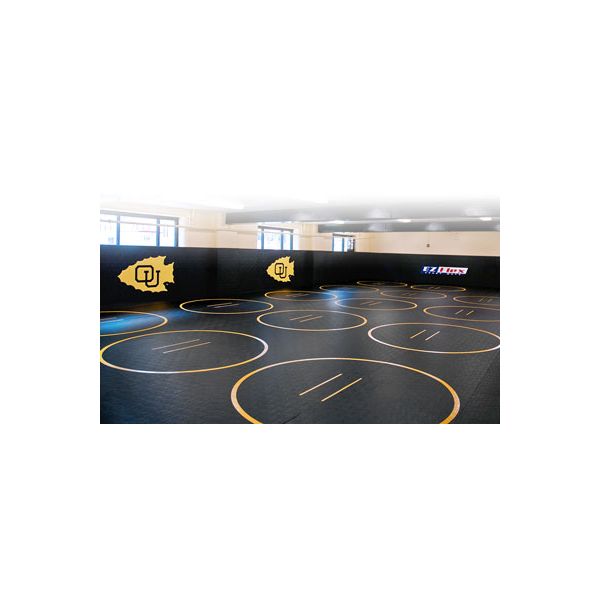
Roll up wrestling mats are what a program puts down when the floor has to behave like one piece. Sections unroll, tape at the seams, and the surface stops being a set of parts. When practice ends, they roll back up and the room becomes something else. This is one of the athletic surfaces in our gym flooring range.
What the Mat Absorbs Before Anyone Feels It
A wrestling mat's real job happens in the fraction of a second when a body hits it. The foam compresses, spreads the force sideways instead of straight down, and rebounds before the next takedown lands on the same spot. That cycle repeats a few hundred times per practice.
Get it wrong and the consequence isn't a worn floor — it's a wrestler taking the full impact of a slam through to whatever's underneath. These mats are impact tested to the ASTM F1081 and F355 standards at both thicknesses, which is the measurable version of that protection rather than a claim about it.
Why Roll-Out Construction, and Why This One
The alternative most buyers weigh is interlocking foam tiles. They cost less and look right in the room, but lateral force from a hard shot works the seams apart, leaving a gap and an exposed edge under two athletes already on the ground. Roll-out sections are six feet wide, so there are far fewer joints to begin with, and mat tape closes the ones that remain.
Underneath the vinyl is 2.2 lb density sports foam — the layer doing the absorbing. Over it sits 24 oz non-slip vinyl with antimicrobial protection built into the material rather than applied as a coating that wears off under daily scrubbing.
Two thicknesses cover the sport. 1-5/8" is the high school and collegiate specification. 2" is the international specification, with more depth for the higher-amplitude throws that rule set produces. Both are made in the USA.
Where It Belongs, and What It Is Not
This is a competition and practice surface. It suits school and college wrestling rooms, clubs, tournament floors, and home rooms where someone is actually drilling takedowns rather than stretching. Grappling and jiu-jitsu programs use the same construction for the same reason.
It is not a general-purpose gym floor. It won't take a dropped barbell — that's a job for rubber, not foam, and putting weights on a wrestling mat damages both. It also isn't an outdoor surface. Sunlight and standing water shorten the life of vinyl, and neither belongs anywhere near a mat you're rolling up wet.
Sections cut down with a heavy-duty utility knife and a straight edge, so an odd room doesn't rule the mat out. Custom sizes are available if trimming isn't the right answer.
Three Things to Check Before You Spec It
First, the rule set. 1-5/8" meets high school and collegiate requirements; 2" is specified for international competition. If your program competes, the thickness isn't a preference — check what your association requires before anything else.
Second, how the mat moves. A 6' x 42' section at 1-5/8" weighs about 116 lbs and rolls to 36" in diameter by 72" long. At 2" it's roughly 124 lbs and 41" in diameter. That determines whether two people can handle it, what the storage closet needs to hold, and whether a cart is part of the order.
Third, the room's real dimensions. Standard mats build from six-foot rolls, so a 42' x 42' floor is seven sections and a 30' x 30' floor is five. Measure the doorway and ceiling height too — a 72" roll has to get in and out.
Why Mats Inc.
Mats Inc. has specified matting since 1964, and the questions a wrestling coach asks are ones we answer every week in other buildings: how much impact does the surface take, how often does it get cleaned, and who has to move it. We spec rather than install, so our interest is in matching thickness and size to your rule set and your room, not in selling more mat than the floor needs. Backed by our one-year limited warranty.
Specifications
| Thicknesses | 1-5/8" (high school / collegiate); 2" (international) |
| Foam | 2.2 lb density sports foam |
| Surface | 24 oz non-slip vinyl with built-in antimicrobial protection |
| Impact standards | Meets or exceeds ASTM F1081 / F355 at both thicknesses |
| Roll width | 6' |
| Standard sizes | 42' x 42', 42' x 40', 42' x 38', 36' x 36', 30' x 30', 24' x 24', 18' x 18' |
| Custom sizes | Available |
| Section weight (6' x 42') | Approx. 116 lbs at 1-5/8"; approx. 124 lbs at 2" |
| Rolled dimensions (6' x 42') | 36" dia. x 72" at 1-5/8"; 41" dia. x 72" at 2" |
| Seam method | Traditional mat tape (no tapeless option) |
| Included | One nylon hook & loop storage strap per roll |
| Vinyl colors | Royal Blue, Red, Navy Blue, Maroon, Black, Gray, Green, White, Gold, Orange, Purple |
| Artwork | Custom graphics reproduced from vector files (.ai, .eps, .pdf) |
| Origin | Made in USA |
| Warranty | 1-year limited (Mats Inc.) |
Frequently Asked Questions
How do the mat sections join together?
Answered by Dustin Thompson, Owner & CEO
With traditional mat tape along the seams. There's no tapeless connector on this mat, and that's worth knowing up front — taping is part of every setup, so budget the tape and the time when you're planning a tournament turnaround. Once it's down, the taped floor behaves as a single surface, which is the whole point of roll-out construction. Six-foot roll widths keep the number of seams low to begin with.
What are these mats made of, and how do they hold up?
Answered by Dustin Thompson, Owner & CEO
The core is 2.2 lb density sports foam, and the top is 24 oz non-slip vinyl with antimicrobial protection built into the material rather than sprayed on. That matters over years of daily disinfecting, because a coating wears off and a built-in property doesn't. Both thicknesses are impact tested to ASTM F1081 and F355. What actually shortens a mat's life is UV exposure and rolling it up wet, not the wrestling.
What size do I need, and how does it break down?
Answered by Dustin Thompson, Owner & CEO
Standard mats run from 42 by 42 feet down to 18 by 18, all built from six-foot-wide rolls — so a full 42 by 42 floor is seven sections and a 30 by 30 is five. Competition rooms are usually built around the largest footprint their association calls for, with practice mats alongside. If none of the standard sizes fits your room, sections cut down with a utility knife and a straight edge, or we can quote a custom size.
Can I use one of these at home, in a garage or basement?
Answered by Jinna Hopson, Vice President of Marketing
Plenty of families do, and it's the same construction the schools get. The thing to plan for is handling. A full-size section is around 116 lbs and rolls to about 36 inches across by six feet long, which is a two-person job and a real storage decision. Smaller mats are far easier to move solo and store on end against a wall. Each roll comes with a nylon hook and loop strap to keep it tidy.
What colors are available?
Answered by Jinna Hopson, Vice President of Marketing
Eleven vinyl colors: royal blue, red, navy blue, maroon, black, gray, green, white, gold, orange, and purple. For a school program that usually comes down to team colors, and the mat ends up being the most photographed surface in the building on meet day. Screen colors are always approximate, so if you're matching something specific, tell us and we'll talk it through before you commit.
Can we put our school logo or mascot on the mat?
Answered by Jinna Hopson, Vice President of Marketing
Yes. Send artwork in vector format — .ai, .eps, or .pdf — and it gets reproduced onto the mat surface. Vector matters because those files scale to a 42-foot floor without going soft at the edges, which a logo pulled off a website will not do. If you only have a raster file, it can usually be redrawn for a small fee. Custom room layouts and wall padding can be designed alongside the mat.
By Dustin Thompson, Owner & CEO, Mats Inc.