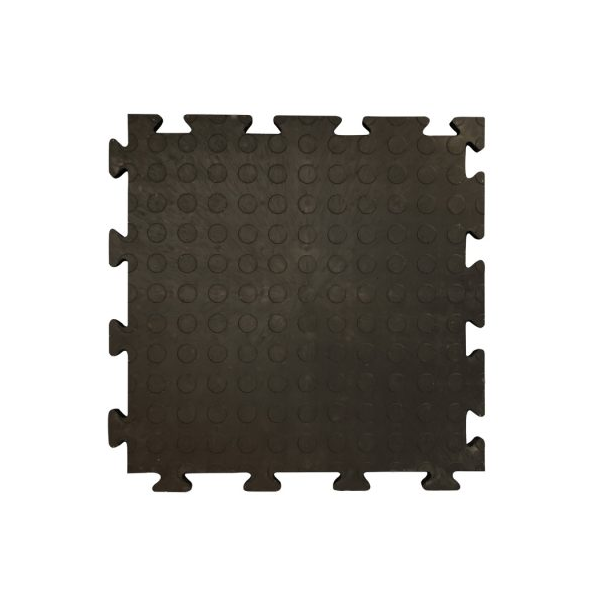
PennyLok is an interlocking PVC floor tile with a classic coin pattern — raised round discs across the face. It lays straight over concrete with no adhesive, locks together at the edges, and lifts back out whenever you need to get underneath it.
At 9/16" thick and 18" x 18" per tile, it covers large areas quickly and cuts to fit with a utility knife. The coin face gives it grip underfoot and a finished look that suits spaces people actually see.
What This Tile Does Before Your Slab Takes the Damage
Concrete is porous. It absorbs oil, brake fluid, solvents, and road salt, and it keeps them. A stain that soaks into a slab does not come back out, and salt working into the surface leads to spalling and dust. Sealing helps for a while, but resealing means clearing the entire floor.
This tile puts a non-porous layer between the slab and everything that lands on it. Flexible PVC resists most oils and acids, so a spill sits on the surface until it gets mopped instead of soaking in. The concrete underneath stays clean, which matters most in a leased space you hand back at the end of a term.
The tiles also lift out. Damage stays local — pull the affected tile, drop in a replacement, and the floor carries on. That is the practical difference between a tile floor and a poured or rolled surface, where damage in one spot is a problem for the whole installation.
Why Coin-Pattern PVC, and Why This One
The tile is flexible polyvinyl chloride, non-porous throughout rather than a coating over a core. That matters for chemical exposure: there is no surface layer to wear through and expose something more absorbent underneath. The material resists most oils and acids, and it holds up to extreme temperatures without going brittle or soft.
The coin pattern is a functional surface as much as a visual one. The raised discs break up the contact area underfoot for grip, and the surface is hard-wearing and slip resistant. Because the discs sit proud of a flat field rather than forming a deep texture, dirt does not pack into the pattern and a damp mop clears it.
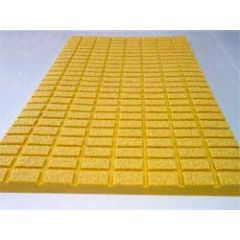
The interlocking edge is a jigsaw profile that locks tile to tile without adhesive or fasteners. Matching ramped edging strips finish the perimeter in male and female profiles, supplied in 1'8" lengths in black and yellow. They remove the trip point at an open floor line and give wheeled traffic a transition onto the floor.
That combination makes the tile fully compatible with wheelchairs, strollers, and shopping carts — worth knowing anywhere the public crosses the floor.
Black is made entirely from recycled material that would otherwise have gone to landfill, and every color is fully recyclable at the end of its life.
Where It Belongs, and What It Is Not
This tile is built for garages, workshops, work stations, storage areas, locker rooms, and gym and fitness spaces. The common thread is a hard floor that takes abuse and needs protecting, in a room where the floor is also seen. It is one of the interlocking options in our garage flooring range, and it works the same way in a fitness room or a locker room.
In a workshop or service area, the draw is chemical resistance and the lift-out repair. In a gym or fitness space, it is shock and noise absorption — the PVC dampens impact and cuts sound transfer to rooms below or next door. In a locker room, it is the non-porous surface and the mop-clean maintenance.
It is also genuinely removable, which suits temporary floor protection: cover a floor for the duration of a job or a season, then lift the tiles and take them with you.
What it is not: a lifting platform. It absorbs shock, but loaded barbells dropped from height need a purpose-built platform in that spot. It is not an outdoor product either — the recycled black tile has no rated UV stability, so open, sun-exposed installations are a question to raise before ordering rather than an assumption to make.
And if what you need is containment under one leaking vehicle, or comfort at a single standing workstation, a mat is the better and cheaper answer. Tiling a whole room to solve a one-spot problem is overbuying.
Three Things to Check Before You Spec It
First, check the slab. The tiles lie loose and follow whatever is underneath them, so they bridge minor imperfections but will not correct a badly humped or dished floor. Grind or level anything significant first. The surface should be clean and dry when you start, and no adhesive or special tools are needed after that.
Second, plan the color around where vehicles park. Rubber tires can permanently stain light-colored tiles — a reaction between the antioxidant in some tire compounds and the plasticizer in vinyl — and it cannot be cleaned out afterward. Black and gray are unaffected, so put those under the tires and save any color for walkways, work zones, and borders.
Third, measure the whole floor and order it in one go. Color is matched within a single production batch, and a run ordered months later is not guaranteed to match what is already down. Order the full area plus a few spare tiles at the same time. Those spares are your repair stock, and they are what makes a damaged tile a five-minute fix instead of a visible patch.
Why Mats Inc.
We have been specifying commercial flooring since 1964, and on a tile floor the value we add is knowing what goes wrong before you find out. The tire staining rule, the batch-matching problem, the fact that a jack stand needs a spreader plate under it — none of that appears on a spec sheet, and all of it decides whether you are still happy two years in.
We will also tell you when this is the wrong product. Plenty of jobs are better served by a mat at one station than a tiled room, and we would rather size the job correctly than sell you square footage you do not need.
| Material | Flexible polyvinyl chloride (PVC), non-porous |
| Surface pattern | Classic coin |
| Thickness | 9/16" (14mm), tolerance ± 0.5" |
| Tile size | 18" x 18" nominal, tolerance ± 1/2" |
| Weight | 1.4 lb per sq ft |
| Colors | Black and gray stock; other colors to order |
| Edging | Ramped male and female strips, 1/2" x 2" x 1'8", black or yellow |
| Chemical resistance | Resistant to most oils and acids |
| Acoustic | Sound absorbing; reduces noise transfer |
| Recycled content | Black made from 100% recycled material; fully recyclable |
| Installation | Loose lay, interlocking; no adhesive or special tools |
| Warranty | 1-year limited (Mats Inc.) |
Frequently Asked Questions
What are these tiles actually made of?
Answered by Dustin Thompson, Owner and CEO
Flexible PVC, non-porous the whole way through rather than a coating over a different core. That construction is what carries the chemical resistance — there is no surface layer that can wear off and expose something absorbent underneath.
The black tiles are made entirely from recycled material, and every color can be recycled again at end of life. Performance is identical across the colors; the recycled content is specific to black.
How long will this floor last, and what ends its life early?
Answered by Dustin Thompson, Owner and CEO
We do not quote a fixed number of years, because on a tile floor the failure is almost never the material giving out. Three things end these floors early: point-load damage where a jack stand or similar sits without a spreader plate under it, permanent tire staining on light-colored tiles, and sun exposure in an open bay, since the recycled black tile has no rated UV stability.
The useful part is that failure stays local. A damaged section is one tile, not the floor, so a room with spare tiles on the shelf effectively keeps going as long as you keep swapping them in.
Can I lay this straight over my concrete, or does it need prep?
Answered by Dustin Thompson, Owner and CEO
Straight over, in most cases. The tiles lock together and lie loose, so there is no adhesive, no fasteners, and no special tools. The slab needs to be clean and dry, and reasonably flat — the tiles bridge small imperfections but follow a badly humped or dished floor rather than fixing it.
Cuts at walls, posts, and thresholds are made with a sharp utility knife and a straightedge as you lay. Because nothing is glued down, the floor can also be lifted and moved later, which is why it works for temporary protection as well as permanent installations.
How many tiles do I need for my space?
Answered by Jinna Hopson, Vice President of Marketing
Each tile is 18" x 18", so four tiles cover roughly nine square feet. Measure your length and width, work out the square footage, and divide by 2.25 to get a tile count.
Then add about ten percent. That covers the offcuts from trimming at walls and around obstacles, and it leaves you with spare tiles. Order those spares with the original run rather than later — color is matched within a production batch, and a batch ordered months down the line is not guaranteed to match what is already on your floor.
How does the coin pattern actually look in a room?
Answered by Jinna Hopson, Vice President of Marketing
It reads as a finished floor rather than shop equipment. The raised discs form a soft, regular texture that catches light evenly, so it photographs well and does not compete with whatever else is in the room. That is what makes it the choice for a garage attached to the house, a display or showroom bay, or a fitness space people spend time in.
If you want the opposite — a floor that announces itself as a working surface and hides scuffing in a busier pattern — that is the checker-plate option rather than this one. They are built identically, so it is purely a look decision.
Can I get custom colors, or design a layout with more than one color?
Answered by Jinna Hopson, Vice President of Marketing
Black and gray are stock, and other colors are available to order — call us for a quote on anything outside the standard two. You can build a lot with just the stock pair: a black-and-gray checkerboard reads deliberate rather than plain, and blocks of one color mark a parking bay off from a walkway or set a work zone apart.
The ramped edging strips come in black and yellow, so a yellow edge frames an aisle or a work zone as a visible boundary while it solves the trip point at the same time. Keep the staining rule in mind when you plan: darker tiles where vehicles park, color where people walk.
By Jinna Hopson, Vice President of Marketing, Mats Inc.