




More Information
| Manufacturer | Crown Matting |
|---|
$159.00

Have a question? We're here to help!
Description
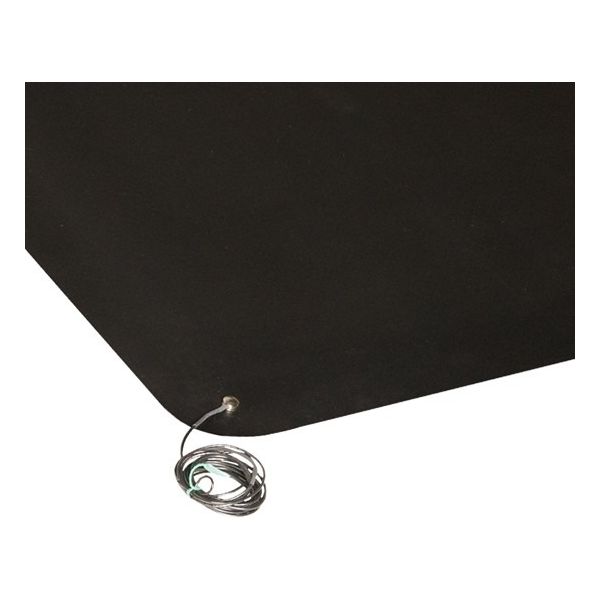
Conductive Smooth Vinyl Runner Matting is a grounded ESD floor mat with a smooth vinyl top over a foam backing, 1/2" thick, supplied by the roll and cut to the length of a bench line or an aisle. Its surface drains static charge off the people on it, and the foam underneath gives them something softer than concrete to stand on, which makes it the mat for computer workstations, test stations, and cashier positions where the floor has to be both grounded and easy to keep clean.
What a Smooth ESD Runner Does Before a Charge Reaches the Equipment
Every person walking or standing on a floor carries a static charge they cannot feel. Near a computer terminal, a test station, or a rack of boards, that charge finds the first grounded thing it can, and a component is a better path than the floor. A grounded ESD floor mat changes that: the charge leaves through the shoes into the mat and down a cord to building ground before it reaches anything that matters.
This mat's surface is rated at a resistivity of 10⁶ ohms per square, and the maker publishes static decay from 20,000 volts to harmless in a tenth of a second. That figure sits at the boundary between the conductive band and the static-dissipative band, which is why the maker calls the surface conductive in one breath and static dissipative in the next. Most computer and electronics stations specify inside that range.
The runner format is the point. One continuous length along a row of stations means one grounded surface with no seams to lift, no gaps between mats, and no cart wheel catching an edge. Add a grounding cord every 10 feet and the whole run is one path to ground.
Why a Smooth Vinyl Top on Foam, and Why This One
The top is extruded vinyl with a smooth finish and no pattern. Smooth is a choice, not an absence: it wipes clean with a damp cloth, it does not trap the dust and shavings that a ribbed surface holds, and a chair or a cart rolls across it without chatter. The maker publishes abrasion loss of 0.025 grams on the ASTM D4060 wheel test, which is a low number for a vinyl floor surface and the reason the finish holds up under rolling traffic.
Under the vinyl is a PVC foam backing that brings the mat to 1/2" thick and gives it its anti-fatigue relief. The backing is separately rated at 10⁹ ohms by the ASTM D257 method, so the layer between the conductive surface and the floor is defined, not left to chance. The edges are beveled so the transition from floor to mat does not catch a heel or a wheel.
Grounding comes with the mat. A stock mat ships with one grounding cord that connects to the ground on an electrical outlet, and the maker's rule is one cord for every 10 feet of matting. Roll and custom lengths do not include cords, so a 75-foot run wants eight, ordered with it.
Where It Belongs, and What It Is Not
The maker rates it for dry areas: computer workstations and terminals, cashier stations, and test and electronics stations. It is a medium-duty mat, which puts it in offices, help desks, retail counters with point-of-sale equipment, repair benches, and light assembly rooms rather than a heavy industrial line with dropped hardware. The smooth top is the tell: it belongs where the floor is kept clean and the traffic is people, chairs, and carts.
Where a floor sees dropped parts, grit, or an occasional wet spot, a diamond deck plate surface with the same grounding gives better footing and is the right trade. Where nobody stands still and the mat is purely a grounded walkway, this mat still works, but the foam layer is doing nothing for you. The rest of the conductive floor mats range covers both of those cases.
It is not an electrical safety mat. A static mat is designed to carry charge from a person to ground, which in front of a live panel is exactly the wrong direction. Insulating switchboard matting stops current so a technician at live switchgear is not the path to ground. Keep this mat at the workstations and keep it away from open panels.
Three Things to Check Before You Spec It
First, whether your program accepts the boundary figure. At 10⁶ ohms this mat sits where conductive meets dissipative. If your ESD program specifies a dissipative floor, that fits. If it specifies conductive with an upper limit below 10⁶, ask us before ordering rather than after. Read the number against the requirement, not the word on the label.
Second, the run and the cords. Measure the row of stations the mat will cover, then count one grounding cord per 10 feet and find where each will reach a grounded outlet. A run that cannot reach ground at intervals is not a grounded run; it is a long vinyl mat with a foam back. Plan the outlets before you plan the cut.
Third, the cleaning routine. A smooth ESD surface stays conductive only while it stays clean. Floor finish, wax, and some cleaning residues leave a film that insulates the top and stops it draining charge while it looks perfect. Wipe with a damp cloth or a cleaner meant for static control floors, keep the polish machine off it, and test resistance from surface to ground on a schedule.
Why Mats Inc.
We stock this mat as a roll because that is how a row of workstations actually gets covered, and we will cut it to the run you measure rather than sell you three mats with two seams. Give us the run length and where the outlets are and we will count the cords with you. If your ESD requirement is tighter than the maker's published figure, we will say so and steer you to a mat that meets it instead of shipping one that does not.
| Construction | Extruded vinyl, smooth surface, over PVC foam backing |
| Thickness | 1/2" |
| Roll size | 3' x 75'; custom lengths at 3' width |
| Color | Black |
| Edges | Beveled |
| Surface resistivity | 10⁶ ohms per square |
| Static decay | 20,000 volts to harmless in 1/10 second |
| Backing electrical properties | 10⁹ ohms, ASTM D257 |
| Abrasion resistance | 0.025 g loss, ASTM D4060 |
| Grounding | One grounding cord included with stock mats; one cord recommended per 10' of mat; cords for rolls and custom lengths ordered separately |
| Duty and environment | Medium duty; dry areas only |
| Warranty | 1-year limited (Mats Inc.) |
Frequently Asked Questions
What is this runner made of, and is it conductive or dissipative?
Answered by Dustin Thompson, Owner & CEO
A smooth extruded vinyl top over a PVC foam backing, 1/2" thick in total. The surface is rated at 10⁶ ohms per square, which is the line between the conductive band and the static-dissipative band, so the maker uses both words for it. The foam backing is separately rated at 10⁹ ohms, so the layer under the conductive top is a defined dissipative layer rather than an unknown.
For most computer, terminal, and test-station programs, a 10⁶ surface is inside the requirement. If yours calls for a specific band with a hard limit, match the figure to it before ordering.
How long will the runner last, and what shortens it?
Answered by Dustin Thompson, Owner & CEO
The maker publishes no year figure, and we will not invent one. It does publish 0.025 grams of abrasion loss on the ASTM D4060 wheel, which is a low number for vinyl and means the smooth top holds up well under chairs and carts. The foam is the softer layer and will compress where a chair sits in one spot for years; a medium-duty rating means it is not meant for dropped hardware or forklift traffic.
What ends its static life is usually a film, not wear. Floor finish or wax tracked or mopped onto the surface insulates it. Keep the polish machine off, clean with a damp cloth or a static-control floor cleaner, and test surface-to-ground resistance on a schedule. The runner carries a 1-year limited (Mats Inc.) warranty.
How is it grounded, and how many cords does a roll need?
Answered by Dustin Thompson, Owner & CEO
A grounding cord snaps to the mat and connects to the ground on an electrical outlet. The maker's rule is one cord for every 10 feet of matting, so a full 75-foot roll needs eight and a 30-foot cut needs three. Stock mats include one cord; rolls and custom lengths do not, so order the cords with the run.
Verify the outlets are grounded before you rely on the mat, and treat the periodic mat-to-ground resistance test as the proof the floor is working. A cord that is attached to an ungrounded outlet is decoration.
How much should I order for a row of workstations?
Answered by Jinna Hopson, Vice President of Marketing
Measure the full length of the row, wall to wall or bench end to bench end, and order that as one cut at the standard 3-foot width. One continuous length means one grounded surface and no seams in the walkway. If the row turns a corner, treat each straight run as its own cut and butt them at the corner rather than trying to bend the mat.
Three feet of width covers the space a seated or standing operator uses at a bench. If chairs roll back farther than that, the mat should be wide enough that the wheels stay on it, which may mean two runs side by side.
What does it look like in an office or at a front counter?
Answered by Jinna Hopson, Vice President of Marketing
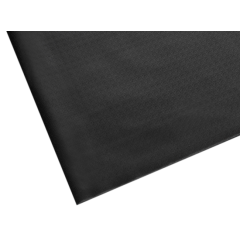
Plain black with a smooth, low-sheen finish and a beveled edge. Of the grounded floor mats we carry, it is the one that reads least like a shop floor, which is why the maker lists cashier stations and computer terminals among its applications. It will not disappear into a carpeted office, but at a counter or behind a help desk it looks like a deliberate mat rather than industrial equipment.
Black is the only color. Because the finish is smooth, it shows dust and footprints more readily than a textured mat, so a quick wipe is part of keeping it looking right as well as working right.
Can it be cut to a custom length or shape?
Answered by Jinna Hopson, Vice President of Marketing
Custom lengths at the standard 3-foot width are available from the maker, and a full roll is 75 feet. Give us the run length and we will confirm the cut. Widths other than 3 feet and notched or angled shapes are not standard, so a station with a bench leg in the way is usually handled by running the mat to the leg and starting again on the other side.
Remember that a custom length ships without grounding cords; count one per 10 feet and add them to the order so the run is grounded the day it goes down.
By Jinna Hopson, Vice President of Marketing, Mats Inc.
Reviews
Write Your Own Review
Related Products
#775 Epoxy Flooring Adhesive
#560 Rubber Flooring Adhesive

#110 Epoxy Nose Caulk
#300 Water Based Contact Adhesive

#400 Neoprene Contact Adhesive
Rotary Table & Rig Floor Mats
Fore-Runner Mat
Safety Track Resilient Medium Non-Skid Tape
3M Vinyl Loop Wet Area Matting
Protect Vinyl Matting