




More Information
| Manufacturer | Dimex |
|---|
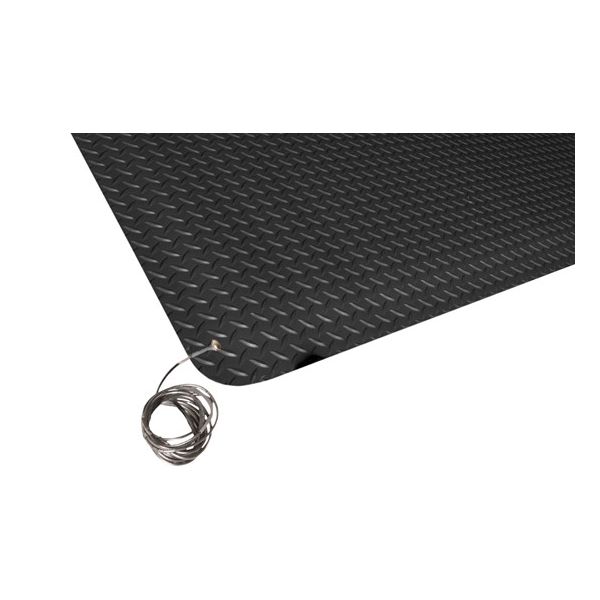
Conductive Diamond Plate Vinyl Runner Matting
Product Number:
#0212D
$180.00

Have a question? We're here to help!
Description
Conductive Diamond Plate Vinyl Runner Matting is a grounded ESD floor runner: a 5/32" PVC sheet with a raised diamond top, sold by the roll and laid down the aisles and along the bench lines where static has to be drained off people before it reaches the equipment. It is thin, it sweeps clean, and it takes a rolling cart, which is what separates it from the thick station mats a technician stands on.
What a Conductive Runner Does Before a Charge Walks Into the Room
Static does not start at the bench. It builds on a person walking across the floor, and by the time they reach the station they are carrying a charge they cannot feel. If the first grounded thing they touch is a board or a drive, that is where it goes. A conductive floor runner along the path to the bench drains the charge on the way, through the shoes and the mat and down a cord to building ground.
This runner's surface is rated at 10⁶ ohms surface resistivity, tested to ESD-S7.1, the flooring standard published by the ESD Association. That figure is the line where the conductive band meets the static-dissipative band, which is why the maker rates it for light-duty electrical protection rather than for the fastest possible drain. For aisles, kitting areas, and the floor between stations, that is the normal spec.
The stakes are simple. A component damaged by a discharge usually does not fail on the bench; it fails in the field, weeks later, with no trace of why. A grounded path from the door to the station is how a facility keeps that from being the story.
Why a Thin Diamond Plate Sheet, and Why This One
The runner is PVC, 5/32" thick, with a high-profile embossed diamond pattern on top. The pattern is there for footing in every direction, so a worker turning with a cart or stepping off sideways gets the same grip as one walking straight down the aisle. Because it is embossed rather than molded into a soft base, the surface sweeps clean with a broom and does not hold the dust and shavings a ribbed mat collects.
The thin gauge is the design choice that matters. There is no foam under this sheet, so a cart rolls across it without sinking or chattering, and the edge is low enough that a wheel rides onto it rather than stopping at it. That is what makes it an aisle runner instead of a station mat. The trade is that it offers no anti-fatigue relief; a person who stands still on it for a shift is standing on the floor with a conductive skin over it.
It is sold by the roll and cut to the run, so one bench line or one aisle gets a single continuous grounded surface instead of a row of mats with seams. Grounding cords connect the runner to building ground; we spec one cord for every 10 feet of runner, and cords for roll cuts are ordered with the run.
Where It Belongs, and What It Is Not
The maker rates it for light-duty electrical applications: the floors around vulnerable electronic equipment where people walk and carts move. In practice that is the aisle between assembly benches, the path from the door to a test area, the floor of a kitting or packaging room handling boards and drives, a server or telecom room where techs walk the rows, and any OEM line where a grounded walkway is specified.
It is not the mat for the person standing still at the bench. A technician on their feet for a shift needs cushion under them, and this sheet has none. Pair it with a conductive anti-fatigue station mat at each standing position and use the runner between them; the rest of the conductive floor mats range covers that station mat.
It is not electrical safety matting either. A conductive runner is built to carry charge from a person to ground, which in front of a live switchboard is exactly the wrong direction. Insulating switchboard matting stops current so a worker at live panels is not the path to ground. Keep this runner in the ESD area and keep it away from open switchgear.
Three Things to Check Before You Spec It
First, what your program requires at the surface. At 10⁶ ohms this runner sits at the boundary between conductive and dissipative. If your ESD program specifies a dissipative floor, that fits. If it specifies conductive with a ceiling below 10⁶, ask us before you order. Match the written requirement to the figure, not to the word conductive in the name.
Second, the run and its ground points. Measure the aisle or bench line wall to wall, then count one grounding cord per 10 feet and find a grounded outlet within reach of each. A long run grounded only at one end is a long vinyl sheet, not a grounded floor. Verify the outlets are actually grounded; a cord on a painted surface or an ungrounded receptacle is not a ground.
Third, the traffic and the cleaning. A thin diamond plate runner is the right pick where carts roll and people walk; it is the wrong pick where a person stands still for hours. And a conductive surface stays conductive only while it is clean: floor finish, wax, and some cleaning residues leave an insulating film. Sweep it, damp-mop with a static-control cleaner, keep the polish machine off, and test resistance to ground on a schedule.
Why Mats Inc.
We sell this runner by the roll because an aisle is one grounded surface or it is not grounded. Give us the run length and the outlet locations and we will cut it to fit and count the cords with you, so the runner is grounded the day it goes down and not after the first audit finds it isn't. If your program's resistance requirement is tighter than the maker's published figure, we will say so before you order and point you to a mat that meets it.
| Material | PVC (vinyl) |
| Surface | High-profile embossed diamond plate |
| Thickness | 5/32" |
| Surface resistivity | 10⁶ ohms |
| Test standard | ESD-S7.1 2001 (surface resistivity) |
| Color | Black |
| Roll sizes | 36" x 75' (191 lb); 48" x 75' (287 lb) |
| Grounding | One grounding cord per 10' of runner; cords ordered separately |
| Rated use | Light-duty electrical applications; accommodates rolling carts |
| Origin | Made in the USA |
| Warranty | 1-year limited (Mats Inc.) |
Frequently Asked Questions
What is this runner made of, and how is it different from a conductive anti-fatigue mat?
Answered by Dustin Thompson, Owner & CEO
It is a single sheet of PVC, 5/32" thick, with a diamond pattern embossed into the top. There is no foam layer and no separate backing. That is the whole difference from a conductive anti-fatigue mat, which puts the same kind of conductive surface on top of a cushioned base. The runner is for the floor people walk and roll carts across; the station mat is for the spot where one person stands.
Both drain static to ground through a cord. If a room needs both a grounded aisle and grounded standing positions, it usually gets both products, with the runner between the mats.
How long does the runner last, and what wears it out?
Answered by Dustin Thompson, Owner & CEO
The maker publishes no year figure or abrasion number for this runner, so we will not invent one. What we can say is that a solid PVC sheet with no foam has nothing to compress or delaminate; the surface wears where carts turn and where an edge gets kicked up and stepped on. Keep the edges flat and the runner will outlast most of what rolls over it.
Its static life is a separate matter. Floor finish, wax, or residue on the surface insulates it, and the runner stops draining charge while looking fine. A loose or missing cord does the same. Test resistance to ground on a schedule; that test, not the runner's appearance, is what tells you it is working. The runner carries a 1-year limited (Mats Inc.) warranty.
How do I ground a long run, and how many cords do I need?
Answered by Dustin Thompson, Owner & CEO
A grounding cord connects the runner to a verified building ground, usually the ground screw on an outlet cover or a dedicated ground point. We spec one cord for every 10 feet of runner, so a 40-foot aisle wants four, spaced along its length rather than bunched at one end, so every part of the sheet has a short path to ground. Cords are ordered with the run, not included in it.
Before you trust the floor, confirm each outlet is grounded. Facilities with an ESD program test surface-to-ground resistance at intervals, and that is the only way to know the runner is doing its job.
How much should I order for an aisle or a bench line?
Answered by Jinna Hopson, Vice President of Marketing
Measure the full run, wall to wall or bench end to bench end, and order it as one continuous cut. One piece means one grounded surface with no seams for a cart wheel to catch or for charge to skip across. If the run turns a corner, order each straight leg as its own cut and butt them at the corner rather than trying to bend the sheet.
It comes in 36" and 48" widths. Match the width to the aisle; a runner narrower than the walkway leaves a strip of ungrounded floor along one side, and people will walk on it.
What does it look like once it is down?
Answered by Jinna Hopson, Vice President of Marketing
Black, with a raised diamond pattern that reads as clean industrial flooring rather than a mat someone added later. Because it is thin, it lies flat and low, so it looks like part of the floor from across the room. It is a production-floor finish; in a client-facing space, a static-dissipative carpet tile is the better visual fit for the room, with this runner reserved for the working areas.
Black is the only color. The surface sweeps clean and does not hold dust in a pattern the way a ribbed runner does, so it keeps its look with a broom and a damp mop.
Is this the right runner for my floor, or do I need something else?
Answered by Jinna Hopson, Vice President of Marketing
It is the right runner if the floor is where people walk and carts roll, the equipment nearby is static-sensitive, and your program accepts a surface at 10⁶ ohms. Aisles between benches, kitting and packaging rooms, server and telecom rows, and OEM lines all fit. It is the wrong product if one person stands in one spot for a shift, which wants a conductive anti-fatigue mat, or if the hazard is live electrical work, which wants insulating switchboard matting.
If you are not sure which side of that line your floor is on, call with the room layout and what gets handled in it. We would rather tell you it is the wrong runner than sell you one.
By Dustin Thompson, Owner & CEO, Mats Inc.
Reviews
Write Your Own Review
Related Products
Heritage Personalized Coir Door Mat

#775 Epoxy Flooring Adhesive
#560 Rubber Flooring Adhesive

#110 Epoxy Nose Caulk

#300 Water Based Contact Adhesive

#400 Neoprene Contact Adhesive
Rotary Table & Rig Floor Mats
Fore-Runner Mat
Safety Track Resilient Medium Non-Skid Tape
3M Vinyl Loop Wet Area Matting