A cushioned carpet tile is built for one specific situation: rooms where people stand in place for hours rather than passing through. A 3/8 inch closed-cell foam backing gives underfoot, easing pressure on feet and legs, and the dense velour surface adds warmth to the room while it does it.
Pharmacies have made it a favorite for exactly that reason. It is the same reason it shows up behind service counters, at reception desks, in interior drive-thru positions, and anywhere a job keeps somebody standing in one spot all shift.
What a Cushion-Backed Tile Does Before Your Floor Turns Into a Patchwork
Watch what happens in a building where staff stand all day on a hard floor. Somebody brings in a mat for behind the counter. Somebody else brings in a different one. Within a year the floor is a collection of mismatched rectangles in various states of curling.
Those mats create problems of their own. Edges lift and become trip hazards. They collect dirt underneath where nobody cleans. They slide out of position. And the floor stops reading as a designed space and starts reading as a workaround.
The underlying complaint is real, though. Standing still on an unyielding surface is harder on the body than walking on one, because the same muscles hold the same position with nothing absorbing the load. That is why people improvise a solution rather than putting up with it.
Building the give into the floor itself removes the whole problem. Commercial carpet tiles with padding put the cushioning under the entire working area, with no edges, no gaps, and nothing to reposition. The floor stays one continuous surface and still gives when somebody stands on it.
Why a Closed-Cell Foam Backing and a Velour Surface, and Why This One
The cushioning comes from a 3/8 inch closed-cell expanded PVC backing bonded to the tile rather than from a separate pad underneath. That is a meaningful distinction. The tile installs as one piece, with nothing to align, nothing to shift under the carpet, and one less material in the assembly to fail.
Closed-cell is the important part of that description. The foam's cells are sealed rather than open, so the backing does not soak up spills or hold moisture the way an open-cell pad would. That matters behind a pharmacy counter or a beverage station more than it does in a corridor.
Cushion density is 14 pounds per cubic foot nominal, which is what makes the foam supportive rather than merely soft. Cushioning that compresses too easily feels unstable underfoot and makes rolling anything across it a chore. This is engineered to absorb pressure through each step and return to shape, not to sink.
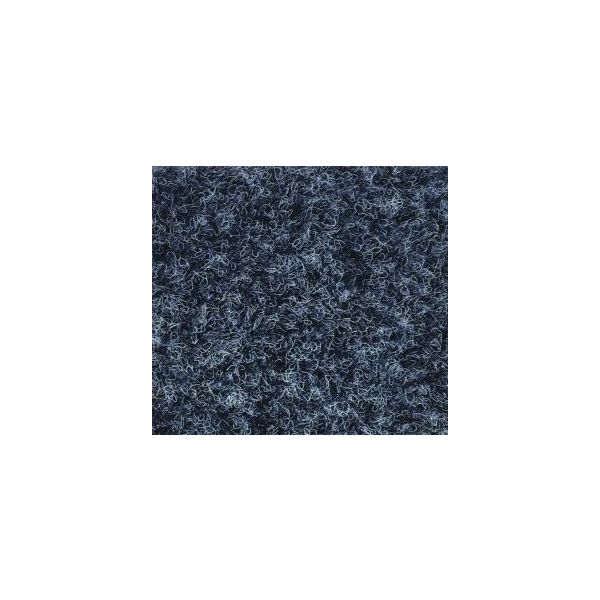
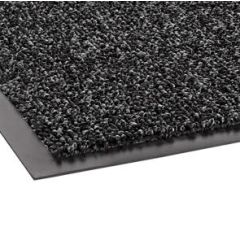
The surface is a non-woven dense velour in 100 percent polyester, and it is doing more than looking plush. The density is what makes it resilient, so it recovers from being stood on rather than holding an impression, and it carries a warmth a flat commercial loop does not. In a room people occupy for eight hours, that warmth registers.
The weights tell you how much material is actually here: 28 ounces per square yard of pile against a 359 ounce total weight, at a 0.24 inch pile within a 0.62 inch total height. That total is almost entirely backing, which is the whole point of the product.
Put the two together and you get a floor that performs like a comfort surface but installs and behaves like a commercial tile. Every square still lifts out individually, so a damaged section behind a counter gets replaced without touching the rest of the room.
Where It Belongs, and Where It Is Not the Right Tile
Specify it where people stand rather than where they walk: pharmacy and drugstore dispensing areas, interior drive-thru positions, retail service counters, hospitality front desks, office reception, and the working side of any specialty store counter. Government service windows fall into the same pattern.
It also earns its place in rooms that want acoustic help. Rated at 24 decibels or better for sound insulation, the foam backing absorbs footfall noise instead of transmitting it, which changes how a hard-surfaced room with a lot of glass actually sounds to the people working in it.
Where it is not the right choice is under heavy rolling loads. Carts, pallet trucks, and constant chair-caster traffic all concentrate weight on a small contact patch, and a cushioned backing is the wrong construction to put under that. Those areas want a dense, firm-backed tile instead, and the full range of carpet tiles sorts by exactly that question.
It also does not belong anywhere near a threshold. This carries an interior zone three rating, the deepest interior zone and the one furthest from the door. Entrance duty means scraping grit and holding moisture, which no interior tile is built to do, cushioned or otherwise.
One more exclusion, and it surprises people: this is not recommended over in-floor heating. The same insulation value that makes a foam-backed tile warm underfoot works directly against a system trying to push heat up through the floor. If radiant heat is already in the slab, this is the wrong surface to put on top of it.
Three Things to Check Before You Spec It
First, separate the standing zones from the walking ones. The value here is concentrated where somebody holds a position, so mark those areas on a plan and be honest about how much of the floor genuinely qualifies. A pass-through corridor gains very little from a cushioned backing.
Second, check what rolls. Chairs are the thing people forget. If there are caster chairs in the area, those tiles need to be fully secured rather than loose laid, or the wheels will work them apart. If carts move through regularly, that zone probably wants a different construction entirely.
Third, pick your tile size and confirm your transitions together. This comes as an 18 inch square shipping 10 to a box at 22.5 square feet, or an 18 by 36 inch plank shipping 10 to a box at 45 square feet. At 0.62 inches total height it sits considerably taller than a standard-backed tile, so any junction with another flooring product needs a planned height change rather than a discovered one.
Why Mats Inc.
Comfort flooring gets specified as an afterthought more often than not, usually after somebody complains. We have been working on commercial floors since 1964, and the useful conversation happens before that point: which positions in your building keep people standing, how big those zones actually are, and what is moving across them. Answer those three and this tile either fits obviously or it does not.
| Tile sizes | 18 in. x 18 in. or 18 in. x 36 in. (±2%) |
| Tiles per box | 10, either size |
| Coverage per box | 22.5 sq. ft. (18 x 18 in.); 45 sq. ft. (18 x 36 in.) |
| Total height | 0.62 in. (±7.5%) |
| Pile height | 0.24 in. (±0.5 mm) |
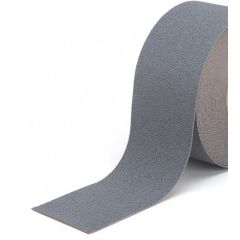
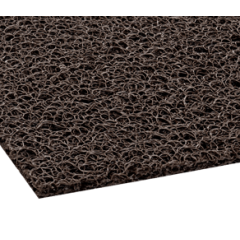
| Colorways | Two: Charcoal, Brown |
| Construction | Non-woven needle-felt, dense velour pattern |
| Fiber | 100% non-woven polyester with coating |
| Primary backing | Closed-cell expanded PVC, 3/8 in. foam |
| Cushion density | 14 lbs/cu. ft. nominal |
| Pile weight | 28 oz/sy (±7.5%) |
| Total weight | 359 oz/sy (±7.5%) |
| Underlay | Not required — cushioning is integral to the backing |
| Application | Indoor; zone 3 |
| Indoor air quality | CRI Green Label Plus certified |
| Dimensional stability | Pass (EN 986) |
| Sound insulation | ≥24 dB (ISO 10140-1:2010) |
| Thermal retention | 0.13 m·K/W, pass (ISO 11092) |
| Electrostatic propensity | >2 kV (EN 1815) |
| Electrical resistivity | Pass at RH ≥40% (IBM / ICL) |
| Radiant panel | Class I (ASTM E648) |
| Smoke density | Pass (ASTM E662) |
| Surface flammability | Pass (FF 1-70 / ASTM D2859) |
| Color fastness | Light 5; water 4–5; shampoo 5; rubbing 4–5 dry and wet (ISO 105) |
| LEED-NC | MR Credit 4; IEQ Credits 4.1, 4.3, 5 |
| Warranty | 1-year limited (Mats Inc.); professional installation required for coverage |
Frequently Asked Questions
How does a foam backing actually help someone standing all day?
Answered by Dustin Thompson, Owner & CEO
Standing still is harder on the body than moving. When you walk, your weight shifts constantly and different muscles take turns carrying it. Hold one position on a hard floor and the same muscles stay loaded the whole time, with nothing underneath absorbing any of it.
A 3/8 inch cushion at 14 pounds per cubic foot gives slightly under each step and returns, which spreads pressure across the foot instead of concentrating it. That density is the number that matters. Softer foam would feel unstable, firmer foam would not give at all. It is not a medical device and we would not pitch it as one. It is a floor that stops working against the person standing on it.
Will the cushion flatten out over time?
Answered by Dustin Thompson, Owner & CEO
Foot traffic is not what compresses a foam backing. Distributed weight from standing and walking is exactly the load closed-cell expanded PVC is built for, and it recovers between steps rather than accumulating a set. At 359 ounces per square yard, most of what you are laying down is backing material doing that work.
Point loads are the real enemy. A heavy fixture leg, a filing cabinet corner, or a chair caster concentrates weight onto a tiny area and holds it there, and that will leave a permanent impression. Put wide load spreaders under fixed furniture, secure any area with caster chairs, and route carts around rather than across.
Do we need an underlay, and how does it install?
Answered by Dustin Thompson, Owner & CEO
No underlay. The cushioning is part of the backing, so what you lay is the finished assembly, with no pad to cut, align, or worry about shifting underneath. That is the practical advantage over pairing a standard tile with separate padding, where the two layers can move independently and telegraph through.
Installation follows the manufacturer's method: store tiles at 60 to 70 degrees first, work over a flat, dry, clean subfloor with cracks filled and dusty surfaces primed, then snap a center line and work outward so full tiles land in the doorways. Alternate tiles turn 90 degrees into a checker pattern, an arrow on the back marks pile direction, and only tiles from the same batch go down together. Secure one row in five with double-sided tape on large installations, and fully secure anywhere with caster chairs.
What does a velour surface actually look and feel like?
Answered by Jinna Hopson, Vice President of Marketing
Softer and warmer than most people expect from a commercial floor. This is a dense non-woven velour, so the surface is close and even with a slight sheen to it, and it reads as a considered material rather than as workplace carpet. Underfoot it feels smooth rather than textured or ribbed.
It is also resilient, which matters in a standing zone. A less dense surface would hold the impression of someone who stood in the same spot for six hours. This one springs back, so the floor behind a counter does not develop a visible worn patch where the person actually works. It comes in charcoal and brown, both of which carry soil well in a working area.
Would this work in a home?
Answered by Jinna Hopson, Vice President of Marketing
It is one of the better commercial carpet squares for residential use, and the reasons overlap more than you would think. A kitchen you cook in, a laundry room, a hobby bench, a standing desk in a home office. All of those keep you in one spot, and a cushioned floor changes how long you last there comfortably. The closed-cell backing also means a spill does not soak into the padding.
It suits a basement too, where a bare slab underneath is usually the actual complaint. Check the slab for moisture before anything goes down, since that is the most common cause of a failed install below grade, and skip it entirely if the room has in-floor heating. Each square staying individually replaceable is worth as much in a house as in a store.
What sizes does it come in, and can we run it alongside another tile?
Answered by Jinna Hopson, Vice President of Marketing
Two formats: an 18 inch square and an 18 by 36 inch plank, both shipping 10 to a box, at 22.5 square feet for the square and 45 for the plank. The square is easier to fit into an awkward working area behind a counter. The plank covers a long service line with fewer seams. Both come in charcoal and brown.
Running it alongside a firmer tile is the usual approach and a good one. Put the cushioned surface through the standing zones and a standard-backed tile across the walking areas, so you get comfort where it counts without putting foam under a cart route. The one thing to sort out early is the height difference, since at 0.62 inches this is roughly three times the thickness of a typical modular tile and that transition needs a proper detail rather than a butt joint.
By Dustin Thompson, Owner & CEO, Mats Inc.