




Description
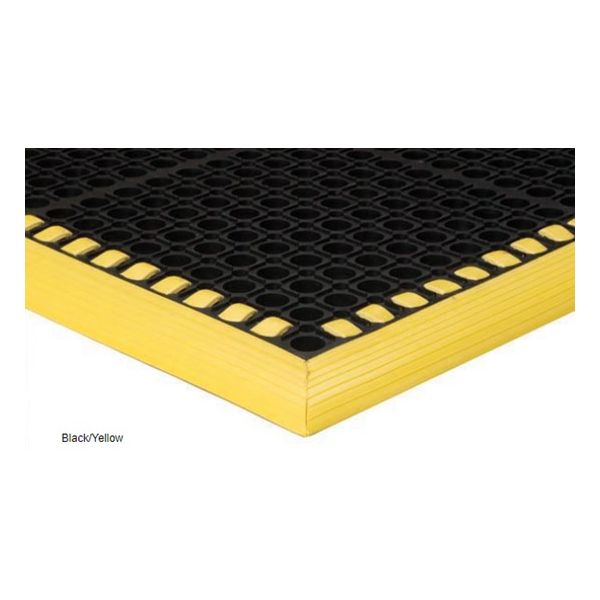
Safety Tru-Tread rubber mats are built for the floors that stay wet and greasy all shift — dish pits, bar lines, oily industrial workstations. The heavy rubber body cushions long hours of standing while drainage holes send liquid through instead of letting it pool underfoot, and a bright yellow or orange border marks the mat's edge so nobody misjudges a step in a busy work zone.
What Safety Tru-Tread Does Before a Wet Floor Becomes an Incident
On a washdown floor, the danger stacks twice: liquid where feet land, and a mat edge nobody sees during a rush. This anti-fatigue mat answers both. Holes in the mat let water, grease, and debris pass through, while nibs on the underside lift the whole mat off the floor so what drains through keeps moving instead of sitting underneath.
The colored border handles the second problem. Against a black mat body and a dark floor, a high-visibility yellow or orange edge tells fast-moving staff exactly where the mat starts and stops. That's the difference between a rubber standing mat that quietly does its job and one that becomes the thing someone clips a toe on at hour nine.
Why This Construction, and Why This One
The body is 7/8-inch heavy-duty rubber — thick enough that the cushion holds up under all-day standing on concrete, in a compound that resists oil and grease rather than swelling and breaking down in it. That compound choice matters anywhere fryer grease, machine oil, or cleaning chemicals reach the floor.
The safety edging is beveled, so the transition on and off the mat stays low even with the added visibility. A grit-surface version is available where footing needs every extra bit of bite, and built-in connector hardware links multiple mats into one continuous run for longer lines.
One detail worth knowing before you order: the mats come in three-sided and four-sided bevel versions. Three-sided mats leave one short edge square to sit flush against a counter or wall; four-sided mats are beveled all the way around for open-floor placement.
Where It Belongs, and What It Is Not
This mat earns its keep in commercial kitchens, dish stations, bars, breweries, and oily or greasy industrial workstations — anywhere the job includes standing on ground that gets hosed, splashed, or dripped on. It handles dry duty fine, but wet and greasy floors are where its drainage and compound pay for the space they take up.
It is not the pick for a salon chair, an office standing desk, or a retail counter. Those dry stations are better served by a solid-surface mat with nothing for debris to settle into. And it isn't an entrance mat — the holes manage liquid at a workstation, not dirt at a doorway. Within the wider range of anti-fatigue floor mats, this is the wet-duty safety workhorse.
Three Things to Check Before You Spec It
First, the bevel configuration. Walk the spot where the mat will live. If one edge sits against a counter, sink base, or wall, order the three-sided bevel so the square edge tucks flush. If the mat floats in open floor with foot traffic from any direction, four-sided beveling keeps every approach low-profile.
Second, the border color. Yellow and orange both do the visibility job — match whichever your facility already uses for floor-level safety marking so the mat reads as part of the system, not an exception to it.
Third, the footprint. Standard sizes run from a single-station 26-by-40-inch mat up to 124-inch lengths, and connectors join mats into a continuous run for a full line. Measure the actual standing path — a run that stops short leaves someone working half on, half off the cushion.
Why Mats Inc.
Wet-duty matting is where a spec sheet and a real floor part ways, and we've put enough of these into kitchens and machine shops to know which questions matter before the order: what's in the liquid, where the drain sits, and how the mat gets rinsed. Tell us those three things and we'll confirm the size, bevel, and border that fit your line the first time.
| Total thickness | 7/8" |
| Construction | Heavy-duty rubber, oil- and grease-resistant compound |
| Drainage | Through-holes; nib underside elevates mat for flow beneath |
| Body / border colors | Black body with yellow or orange beveled safety border |
| Surface option | Grit-textured surface available for added traction |
| Sizes (3-sided bevel) | 26" x 40", 38" x 52", 38" x 64", 38" x 124" |
| Sizes (4-sided bevel) | 28" x 40", 40" x 52", 40" x 64", 40" x 124" |
| Larger coverage | Connectors join multiple mats; custom configurations available |
| Warranty | 1-year limited (Mats Inc.) |
Frequently Asked Questions
What makes Safety Tru-Tread hold up in greasy environments where other mats fail?
Answered by Dustin Thompson, Owner & CEO
Two things: the compound and the clearance. The rubber is formulated to resist oil and grease, so fryer splatter and machine oil don't soften or swell it the way they do a general-purpose mat. And the nib underside lifts the mat off the floor, so what drains through the holes keeps flowing instead of pooling into a slick film underneath.
How long should a mat like this last in daily washdown duty?
Answered by Dustin Thompson, Owner & CEO
The 7/8-inch body is nearly double the thickness of a typical half-inch kitchen mat, and the oil-tolerant compound removes the usual early killer in greasy spaces. Rinsed on schedule, three to five years of daily duty is a realistic run, and heavy rubber like this often goes past it.
What ends it early: holes left clogged until the rubber around them tears, or cart wheels repeatedly riding an edge. If a drainage hole is torn or a border won't lie flat, it's time.
How should it be positioned, and when do I need three-sided versus four-sided beveling?
Answered by Dustin Thompson, Owner & CEO
Set the mat where feet actually plant — at the sink, along the rail, in front of the machine — and orient it so drainage moves toward the floor drain rather than the walk path. No adhesive is needed; the mat's weight holds it.
Three-sided bevel is for mats butted against a counter or wall: the square edge tucks flush with no gap. Four-sided is for open floor, where people step on from every direction and every edge should slope.
Will the yellow or orange border look out of place in a customer-visible bar area?
Answered by Jinna Hopson, VP of Marketing
Behind the rail, a black mat with a clean colored border reads as professional equipment — the same visual language as marked steps and taped floor zones, which guests register as a well-run operation rather than clutter. The border sits low and stays on the working side of the bar.
If your space uses safety marking elsewhere, matching the border color ties it together. Yellow beside yellow floor tape looks planned; a lone orange accent can read as an afterthought.
What sizes does it come in, and can I cover a whole line with it?
Answered by Jinna Hopson, VP of Marketing
Standard sizes start at roughly 2-by-3 feet for a single station and run to 124-inch lengths for longer stretches. For a full prep line or a multi-position bar, connectors link mats into one continuous surface — no loose edges between stations and one consistent look down the whole run.
If the line doesn't match standard dimensions, custom configurations are available; measure the standing path end to end before you order.
Is this the right mat for my space, or is it more than I need?
Answered by Jinna Hopson, VP of Marketing
Simple test: does the floor at that station get wet or greasy as part of the workday? If yes — dish pit, bar, prep line, machine shop — this is the right tool, and the safety border is a bonus in any space where staff move fast. If the floor stays dry, a solid-surface anti-fatigue mat gives you the comfort without holes you don't need.
A home kitchen sits in the second camp for most people, unless yours runs like a commercial one.
By Dustin Thompson, Owner & CEO, Mats Inc.
Reviews
Write Your Own Review
Related Products
Heritage Personalized Coir Door Mat
#775 Epoxy Flooring Adhesive
#560 Rubber Flooring Adhesive
#110 Epoxy Nose Caulk
#300 Water Based Contact Adhesive
#400 Neoprene Contact Adhesive
Rotary Table & Rig Floor Mats
Fore-Runner Mat
Safety Track Resilient Medium Non-Skid Tape
3M Vinyl Loop Wet Area Matting