




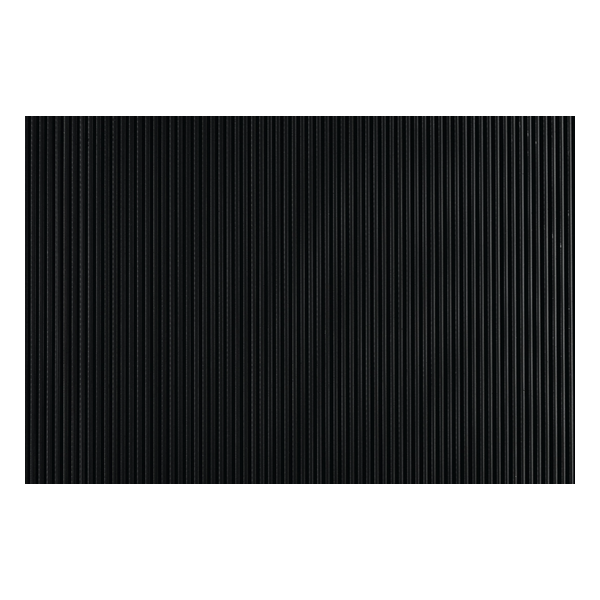
Description
Corrugated Vinyl Matting is the straight-rib vinyl floor runner, sold by the roll in two gauges. The top is an angular-tooth pattern with the ribs running lengthwise, the back is textured to hold the floor, and the vinyl is oil, grease, and chemical resistant and meets FMVSS 302 flammability requirements. The 1/8-inch gauge comes in 24-, 36-, and 48-inch widths on 75-, 105-, and 150-foot rolls; the 1/4-inch gauge in the same widths on 75-foot rolls. It is the runner for long straight lanes that get wet, walked, and rolled over.
What a Corrugated Runner Does Before the Lane Becomes a Slide and a Stripe
A long aisle fails twice. First it gets slick: tracked-in rain, mop water, coolant mist, or a spill spreads across a smooth floor and stays there until somebody falls on it. Then it wears: the same stripe of concrete or tile takes every boot and every cart wheel, and the coating goes first, then the surface under it. A vinyl runner down that lane addresses both at once.
The ribs handle the slick. An angular tooth is a sharp-edged rib rather than a rounded one, so a shoe sole catches its edge instead of sliding along it, and the lengthwise grooves carry water toward the end of the run rather than letting it film across the surface. The floor under the runner can be wet while the ribs the boot lands on stay clear.
The sheet handles the wear, and it does one more thing the vendor calls out: a silencing effect. Vinyl between a hard sole and a hard floor cuts the impact noise of footsteps and cart wheels, which on a plant aisle that runs all day is a change people notice on the first shift.
Why Angular-Tooth Corrugation in Two Gauges, and Why This One
The profile is the vendor's angular-tooth pattern: ribs with defined edges rather than soft ridges. That edge is the traction. Rounded ribs are easier to sweep and gentler underfoot; angular ribs bite harder, which is the trade a wet, working lane wants. The ribs run the length of the roll, so the grooves drain along the run instead of across it.
The back is textured. On a clean, dry floor that texture gives the runner friction against concrete or sealed tile, so a straight loose-laid length stays where it was put without adhesive and can still be lifted for cleaning underneath. It is the detail that makes loose-lay practical on a long roll.
The two gauges are the real choice. Eighth-inch is the foot-traffic and light-cart runner: it lies flat, crosses door thresholds without a bump, and cuts and moves easily. Quarter-inch is the heavy-duty corrugated vinyl matting: it doubles the vinyl under the ribs for lanes that see hand trucks, pallet jacks, and dragged loads; it takes wheel wear far longer and sits proud enough that its edges should be fixed down where wheels cross.
The compound is the same across both: oil, grease, and chemical resistant, and meeting FMVSS 302. Custom colors, gauges, widths, and lengths are available, which is why this profile turns up as an OEM liner as well as a floor runner. Roll lengths are the other variable; the 1/8-inch gauge is stocked in 75, 105, and 150 feet so a buyer can match the roll to the lane instead of storing what is left.
Where It Belongs, and What It Is Not
Run it down any long straight lane that takes water and traffic: warehouse and stockroom aisles, workshop and garage floors, receiving corridors, the walkway from a dock door into a plant, the strip behind a bar or a wash sink, a covered ramp. Pick 1/8 inch for feet and light carts and 1/4 inch for wheeled loads. It is the straight-rib option among the industrial and commercial vinyl floor runners we stock, and the one with the most roll lengths to choose from.
It is also a fitted-liner material. The same corrugated profile is cut to line truck beds, cabinet floors, tool-crib shelves, and equipment bases where a ribbed, oil-resistant surface keeps parts from sliding and protects what is underneath. Offcuts from a floor roll rarely go to waste in a shop.
What it is not is a comfort mat or a drainage mat. There is no cushion in a solid vinyl sheet, so a standing station wants an anti-fatigue mat instead. And the ribs channel water; they do not drain it through. A floor that holds standing water during a shift wants a perforated mat, not a runner. Where people turn and pivot rather than walk straight, a non-directional surface grips better than lengthwise ribs.
Three Things to Check Before You Spec It
First, choose the gauge by the heaviest wheel that uses the lane. If the answer is feet, rolling chairs, and hand carts, 1/8 inch does the job and lies flattest. If a pallet jack, hand truck, or dragged load crosses it daily, go to 1/4 inch; the thinner runner will wear through its rib tops in the wheel track first. When in doubt, watch the lane for a shift and count the wheels.
Second, match the roll length to the run. The 1/8-inch gauge comes in 75-, 105-, and 150-foot rolls, so measure the aisle end to end and buy the roll that covers it with the least left over. A run longer than one roll gets a butt seam where two lengths meet square; place it where carts do not stop or turn. The 1/4-inch gauge is 75 feet only.
Third, decide loose-lay or fixed, then cut once. The textured back holds a straight 1/8-inch run without adhesive. Fix the edges and end cuts with tape or glue wherever the runner crosses a doorway, turns a corner, or takes wheels at an edge, and treat the 1/4-inch gauge as fixed in any wheel lane. Let the roll relax flat at room temperature, then cut with a sharp utility knife along a straightedge.
Why Mats Inc.
We stock this runner in two gauges and three roll lengths because the most common runner question we get is not "which pattern" but "how long and how thick." A straight-rib vinyl runner that channels water, quiets a lane, shrugs off oil, and comes in a roll that matches the aisle is the answer to most of those calls, and Mats Inc. has been sizing that answer to real floors since 1964.
| Type | Corrugated vinyl runner matting, sold by the roll |
| Material | Vinyl |
| Top surface | Angular-tooth corrugated pattern, ribs running lengthwise |
| Back | Textured |
| Gauges | 1/8" and 1/4" |
| Stock sizes | 1/8": 24", 36", 48" widths x 75', 105', or 150' rolls 1/4": 24", 36", 48" widths x 75' rolls |
| Color | Black |
| Resistance | Oil, grease, and chemical resistant |
| Flammability | Meets FMVSS 302 |
| Function | Floor protection, slip and fall reduction, silencing effect |
| Custom | Custom colors, gauges, widths, and lengths available |
| Warranty | 1-year limited (Mats Inc.) |
Frequently Asked Questions
What is the difference between the 1/8-inch and the heavy-duty 1/4-inch version?
Answered by Dustin Thompson, Owner & CEO
Same pattern, same compound, twice the vinyl. The 1/8-inch runner is built for foot traffic and light carts; it lies flat, crosses thresholds without a lip, and is the one to loose-lay and move. The 1/4-inch runner is built for wheeled loads: hand trucks, pallet jacks, dragged pallets. The extra material under the ribs is what keeps the rib tops from wearing through in the wheel track.
The trade-off is the edge. A 1/4-inch edge is tall enough for a caster to catch, so it should be fixed down wherever wheels cross it, and it only comes on 75-foot rolls where the 1/8-inch comes in 75, 105, or 150.
How long does a corrugated vinyl runner last, and what wears it out?
Answered by Dustin Thompson, Owner & CEO
The vendor does not publish a service-life figure, and on a runner the traffic decides it. Matched to its load, the rib tops wear slowly and evenly, and the runner stays in service until the ribs in the busiest stripe are low enough to stop channeling water and gripping a sole. It carries a 1-year limited (Mats Inc.) warranty; look at the rib height in the wheel track once a year.
What ends it early is the wrong gauge under a wheel and a loose edge. A pallet jack on the 1/8-inch runner cuts the ribs down in months, and an unfixed edge in a cart lane gets kicked, folded, and torn. The compound handles shop oil, grease, and cleaners; strong solvents left to sit will soften any vinyl, so wipe them up.
Do I need to glue it down, and how do I cut it?
Answered by Dustin Thompson, Owner & CEO
The 1/8-inch runner loose-lays on a clean, dry floor; the textured back and the roll's weight hold a straight run, and you can lift it to wash underneath. Tape or glue the edges and end cuts where it crosses a doorway, turns a corner, or takes wheels at an edge. Treat the 1/4-inch runner as fixed in any wheel lane; its edge is tall enough to catch a caster.
Cut with a sharp utility knife along a straightedge after unrolling the runner and letting it relax flat at room temperature; a roll stored tight or cold holds a curve and cuts crooked. Where two lengths meet, butt the ends square rather than overlapping them.
Which width and roll length should I order?
Answered by Jinna Hopson, Vice President of Marketing
Width follows the lane. Twenty-four inches covers a single-file walkway or the strip behind a counter. Thirty-six inches is the standard aisle where two people pass or a cart shares the lane with a walker. Forty-eight inches covers a wide bay, a two-way corridor, or a floor you want protected edge to edge.
Length follows the run. Measure the aisle end to end and pick the 1/8-inch roll that covers it with the least left over: 75, 105, or 150 feet. If the run is longer than one roll, plan the seam where carts do not stop or turn. The 1/4-inch gauge comes in 75 feet, and custom widths and lengths are available for a fitted installation.
What does it look like once it is down?
Answered by Jinna Hopson, Vice President of Marketing
A black runner with tight, crisp lengthwise ribs, sharper and denser than a rounded-rib runner, so it reads as fine straight lines running down the lane. At 1/8 inch it sits nearly flush; at 1/4 inch it reads as a defined strip with a visible edge. Black hides oil, scuffs, and tracked-in grit between cleanings, and the grooves keep debris out of sight until the next sweep or hose.
It looks right in a warehouse, shop, plant, or back-of-house corridor, where a straight black runner reads as equipment placed on purpose. For a corridor customers see, a rounded-rib runner in gray reads softer and cleaner; this one is for the working lanes.
Is this the right runner for a warehouse aisle or a wet shop lane?
Answered by Jinna Hopson, Vice President of Marketing
Yes; that is the lane it is built for. A warehouse aisle that gets rain tracked in from the dock, a shop lane with coolant mist, or the wet strip behind a bar sink all want a runner whose ribs carry water along the run while a sole lands on the rib edges. The vinyl shrugs off oil and grease, the lane gets quieter, and the floor under it stops wearing in a stripe.
Two honest limits: it is a straight-lane runner, so where people turn and pivot constantly a non-directional surface grips better, and it is not a cushion, so a station where someone stands all shift still wants an anti-fatigue mat at that spot.
By Dustin Thompson, Owner & CEO, Mats Inc.
Ordering Info
| Size | Qty 1 Price |
| 1/8" x 24" x 75' | $399.00 |
| 1/8" x 24" x 105' | $560.00 |
| 1/8" x 24" x 150' | $799.00 |
| 1/8" x 36" x 75' | $509.00 |
| 1/8" x 36" x 105' | $713.00 |
| 1/8" x 36" x 150' | $1,018.00 |
| 1/8" x 48" x 75' | $632.00 |
| 1/8" x 48" x 105' | $884.00 |
| 1/8" x 48" x 150' | $1,263.00 |
| 1/4" x 24" x 75' | $668.00 |
| 1/4" x 36" x 75' | $1,065.00 |
| 1/4" x 48" x 75' | $1,511.00 |
Reviews
Write Your Own Review
Related Products
Super Scrape Rubber Mats
Safety Track Non-Skid Tape - Coarse

Smooth Marbleized Vinyl Switchboard Matting (Mil Spec)
Super Scrape Rubber Logo Mats
Strip Doors
Perfec Clean 3/8" Rollup Mats - Aluminum Hinge
Perfec Clean 3/8" Rollup Mats - Rubber Hinge
Perfec Clean 3/4" Rollup Grate - Rubber Hinge
Perfec Clean 1-5/8" Grate
WP-70 Non-Skid Epoxy Coating