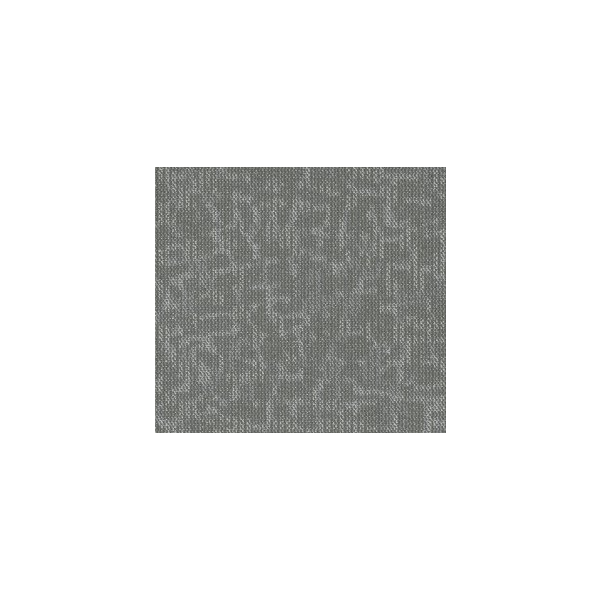
Freestahyl is a patterned scroll tile aimed at a specific frustration: most patterned commercial carpet tiles are either too loud to coordinate with anything or too quiet to be worth specifying. This one is built to sit between those, translating the geometry of abstract urban murals into a floor that gives a room character without becoming the focal point.
It runs across 24 inch tiles in seven saturated neutral tones, on a solution-dyed fiber carrying recycled content. The tile is NSF/ANSI 140 Gold certified, which matters more on a patterned product than on a plain one — a pattern only holds up if its tones stay in the same relationship to each other for the life of the floor.
What a Coordinating Pattern Does Before Your Floor Boxes You In
Here is how patterned floors usually go wrong. Somebody picks a tile from a sample the size of a book, likes the pattern, and orders enough for a whole floor. Installed across a few thousand square feet, that pattern is roughly ten times as loud as it looked on the sample board.
From then on the room works around the floor. Furniture, wall color, signage and artwork all have to defer to a pattern nobody planned to make the centerpiece. Changing it means replacing the floor, so the room stays constrained for a decade.
The opposite failure is just as common. A pattern chosen to be safe disappears entirely once it is down, and you end up with what amounts to a solid floor at a patterned tile's specification. The visual interest you were paying attention to never materializes.
A scroll pattern built for coordination avoids both. It carries enough movement to register as a designed floor and enough restraint that the room above it stays open to change. That flexibility is the actual product here.
Why a Solution-Dyed Scroll Pattern, and Why This One
Scroll describes the pattern's character — flowing, curved forms rather than the straight lines and grids most commercial carpet patterns rely on. Curves do something useful on a floor: they read as organic and they hide the geometry of the tile grid, so a modular floor stops looking modular.
Solution dyeing matters differently on a patterned tile than on a solid. When color is locked into the fiber rather than applied to its surface, every tone in the pattern ages at the same rate. The light and dark elements hold their relationship to each other instead of drifting apart as the floor wears.
That is what keeps a pattern from going muddy. On a surface-dyed patterned tile, the tones that catch the most traffic lose color first, and the design slowly flattens into an uneven smear. Here the pattern you install is the pattern you have in year eight.
The construction underneath is a 15 ounce face weight at 8,852 ounces per cubic yard pile density, tufted at 1/12 gauge with 10.5 stitches per inch, over a modular backing at 0.217 inches total thickness. That is a fine, tightly stitched build, which is what a detailed pattern needs — a coarser gauge cannot hold definition in a scroll form.
The tile is certified NSF/ANSI 140 at the Gold level, the sustainability standard written specifically for commercial carpet, and carries 48.75% total recycled content. The standard covers manufacturing, energy, materials and reclamation rather than testing a single attribute, which is why it carries weight on projects with environmental requirements.
Where It Belongs, and Where It Is Not the Right Tile
This suits interiors where the floor is part of the design conversation: lobbies, libraries, corporate offices, retail and department store floors, hospitality spaces, mass merchandisers, educational and government interiors, pharmacies and drugstores. The common thread is a room that needs to look current and still function as a working floor.
It is particularly useful on large open plans. A pattern with movement in it keeps a big floor plate from reading as an empty field, and the scroll forms disguise seams and tile edges better than a linear pattern does, so a wide open space looks continuous rather than gridded.
Three things it is not. It is not an entrance construction — grit tracked in from outside grinds at any interior tile in its path, so a scraping system belongs in the first several feet and this belongs behind it. Sorting which construction handles which zone is how the full range of carpet tiles is organized.
It is an indoor product rated for zones two and three, not an exterior or threshold surface. And it is not recommended over in-floor heating, because the insulation value of the tile works against the system underneath. On softness, the standard backing is a firm commercial modular construction, but a cushion backing is available on this tile if a room needs give underfoot.
Three Things to Check Before You Spec It
First, see it at scale before you commit. Order enough samples to lay out a few square yards on the actual floor, not one tile on a desk. A scroll pattern behaves completely differently across an area than it does in isolation, and that is the difference between a floor you like and a floor you tolerate.
Second, check it against what the room already contains. This tile is designed to coordinate, but coordinate with what is a question only you can answer. Bring the wall color, the furniture fabric and any branded elements into the same room as the sample, under the lighting that space actually uses.
Third, plan quantities and batches together. Tiles are 24 inches square and ship 18 to a carton covering 72 square feet at 41 pounds, so calculate coverage, add for perimeter cuts, then add five to ten percent as attic stock from the same run. Only tiles carrying the same batch number should be laid together, and on a patterned floor a mismatched batch shows faster than it would on a solid.
Why Mats Inc.
Patterned tiles get chosen from photographs more than any other flooring product, and photographs flatten scale. We have been putting floors into commercial buildings since 1964, and the thing we push hardest on with a patterned specification is seeing it laid out in the room before the order goes in. Tell us the space and we will get enough samples in front of you to make that call properly.
| Tile size | 24 in. x 24 in. approx. (60.96 x 60.96 cm) |
| Tiles per carton | 18 |
| Coverage per carton | 72 sq. ft. (8 sq. yd.) |
| Carton weight | 41 lbs. |
| Total thickness | 0.217 in. nominal average |
| Colorways | Seven: Bice, Riverstone, Moleskin, Sloe, Blackstone, Adobe, Wren |
| Construction | Patterned scroll |
| Fiber | Solution-dyed nylon with recycled content |
| Dye method | Solution dyed |
| Face weight | 15 oz/sy (509 g/m²) |
| Pile density | 8,852 oz/yd³ (328.24 kg/m³) |
| Gauge | 1/12 (4.72 rows/cm) |
| Stitches | 10.5 per in. (4.13 per cm) |
| Standard backing | Modular |
| Optional backing | Cushion |
| Surface treatment | Soil release |
| Standard adhesive | Commercial premium modular and LVT adhesive |
| Application | Indoor; zones 2–3 |
| Recycled content | 48.75% total |
| NSF/ANSI 140 | Gold certified |
| Flooring radiant panel | Class 1 |
| Smoke density | Less than 450.0 flaming (ASTM E 662) |
| Static | Less than 3.0 kV (AATCC-134) |
| Pill test | Pass |
| Light fastness | Pass |
| Accessibility | Compliant for ADA accessible routes |
| Warranty | 1-year limited (Mats Inc.) |
Frequently Asked Questions
What does solution dyed mean, and why does it matter more on a patterned tile?
Answered by Dustin Thompson, Owner & CEO
Solution dyeing puts the color in while the fiber is still liquid, so it runs through the whole strand. The alternative applies color to fiber that already exists, which leaves a dyed layer sitting on the outside of it.
On a solid floor that difference shows up as fading. On a patterned one it shows up as the pattern degrading, because the tones taking the most traffic lose color faster than the ones that do not, and the design goes flat and uneven. With the color locked into the fiber, every element of the pattern ages together and the floor still reads the way it was designed to years later.
How long will a tile like this last, and what wears it out?
Answered by Dustin Thompson, Owner & CEO
As a planning range for commercial carpet tile, figure ten to fifteen years in offices and moderate-use rooms, and seven to ten across busier retail and hospitality floors. The traffic lanes always go first, often years ahead of the field around them, which is what modular flooring is good at handling. This is a 15 ounce face weight at a fine 1/12 gauge, which is a pattern-definition build rather than a heavy-traffic one.
Soil is what ends a floor, not footsteps. Abrasive grit walked in from outside cuts at the fiber constantly, so what happens at your entrances decides more about service life than anything about the field tile. Vacuum the lanes on a real schedule and the floor reaches the top of its range. Freestahyl carries a 1-year limited warranty from Mats Inc.
How should the tiles be laid?
Answered by Dustin Thompson, Owner & CEO
The manufacturer specifies a quarter turn: alternate tiles rotated 90 degrees into a checker pattern, with an arrow on the back of each tile marking pile direction. On a flowing scroll form that rotation is what crosses the pattern into itself and keeps the tile grid from reading as a grid, so it is doing design work as well as installation work.
The rest is standard method. Store tiles at room temperature beforehand, work over a flat, dry subfloor with cracks filled and dusty areas primed, snap a center line and work outward — shifting the line if that lands full tiles in the doorways rather than slivers. Secure one row in five with double-sided tape on large installations, fully secure any tiles under caster chairs, and lay only tiles from the same batch number together.
Will the pattern feel like too much across a whole floor?
Answered by Jinna Hopson, Vice President of Marketing
That is exactly the worry this tile was designed around, and the honest answer is that scale changes everything. A pattern always reads stronger across a room than it does on a sample, which is why we push people to lay out several tiles together in the actual space before ordering.
What makes this one manageable is that the scroll forms flow rather than repeat sharply. Your eye follows the movement instead of counting a repeat, and the quarter-turn installation crosses the pattern so it disguises where one tile ends and the next begins. The floor reads as a single surface with character rather than as a grid of patterned squares.
What colors does it come in, and can it coordinate with a solid tile?
Answered by Jinna Hopson, Vice President of Marketing
Seven saturated neutrals: Bice, Riverstone, Moleskin, Sloe, Blackstone, Adobe and Wren. Saturated is the operative word — these are neutrals with real depth in them rather than washed-out greys, which is what lets a pattern hold its own without shouting.
Coordinating is the point of it. The usual approach runs the pattern through the open areas where you want movement, then a quieter solid or textured tile down corridors and in smaller rooms, matched on backing height so the transitions sit flat. That also gives you a way to zone a large floor plate without walls — pattern in the collaborative areas, solid in the heads-down ones, and the floor does some of the wayfinding for you.
Would this work in a home, or is it strictly commercial?
Answered by Jinna Hopson, Vice President of Marketing
It works residentially, and a home office or a finished basement is where it makes the most sense — a patterned floor gives a functional room some personality, and any square that gets damaged lifts out and gets replaced without touching the rest.
The standard backing is a firm commercial construction rather than a soft one, but a cushion backing is available on this tile, so a bedroom or playroom wanting give underfoot can have that version rather than a different product entirely. One thing to check either way: if the room has in-floor heating, this is not the right floor covering for it.
By Jinna Hopson, Vice President of Marketing, Mats Inc.