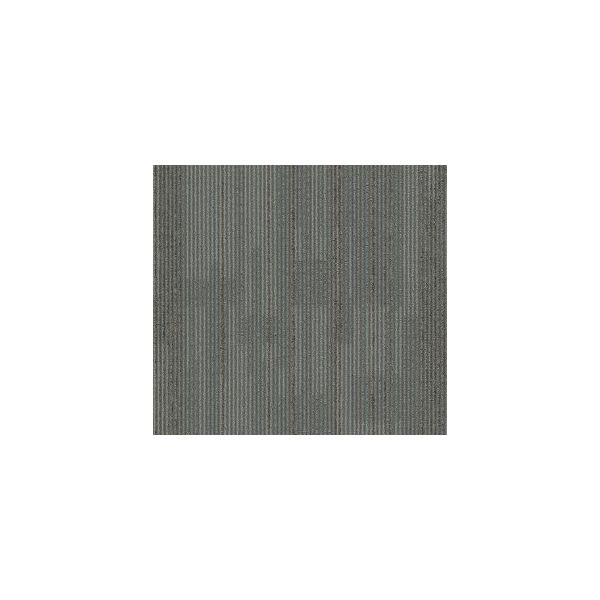
Rover is a linear-pattern carpet tile built for rooms where the floor should have some movement in it without becoming the thing people look at. Tone-on-tone stripes fade into one another across the surface, so the pattern reads as texture from standing height rather than as a graphic.
It comes in five quick-ship colorways, all subtle neutrals with the stripes placed deliberately rather than evenly. The format is an 18 by 36 inch plank rather than a square, which gives the pattern a long axis to run along. That combination — a quiet palette and a directional module — is what makes it a working floor for offices, retail and hospitality rather than a statement one.
What a Linear Tile Does Before a Large Floor Starts Reading Flat
Big floor plates have a specific problem. Run one solid neutral across an open office or a retail sales floor and the room loses its sense of scale. The floor becomes a blank field, and every scuff, seam and traffic lane shows up against it because there is nothing else for the eye to catch.
A linear design solves that quietly. The stripes give the floor direction, so a long room reads as having length and a wide one reads as having width. It is the same trick a rug uses in a residential room, applied across commercial square footage.
The tone-on-tone part matters just as much. Because the lines shift in shade rather than in color, they behave like shadows falling across the floor instead of like a printed stripe. That is what keeps the pattern from competing with furniture, signage or merchandise sitting on top of it.
The practical payoff shows up years later. Pattern and shade variation disguise ordinary soil and light wear the way a flat field never does, which means the floor keeps looking maintained for longer between deep cleanings.
Why a Tone-on-Tone Linear Design, and Why This One
Plenty of commercial carpet tiles carry a pattern. Most of them commit to it — a visible stripe, a strong texture, something with a clear repeat you have to design the room around. Rover deliberately does not.
The lines here fade and meld into each other rather than holding a crisp edge. The effect is closer to how light and shadow actually fall across a floor through a window or under a linear light fixture. You get visual interest without a pattern the room has to accommodate.
The five colorways are all subtle neutrals, which is a real constraint and worth knowing up front. This is not the tile for a bold accent floor or a branded color match. It is the tile for a palette that already exists and needs a floor that agrees with it.
All five are quick ship. On a renovation running to a fixed reopening date, that changes the calculation more than most specification details do — you are not building a schedule around a mill lead time.
Where It Belongs, and Where It Is Not the Right Tile
The natural home is a floor with a lot of square footage and a professional look to maintain: corporate offices, retail sales floors, hospitality spaces, mass merchandisers, specialty stores, pharmacies and drugstores. Educational and government interiors sit comfortably here too, where the floor has to look composed on a working budget.
Think of it as a field tile rather than a threshold one. Grit tracked in from outside is abrasive and will grind down any interior tile put directly in its path, so this belongs behind a proper entrance construction, not in place of one. Working out which tile handles which zone is exactly what the full range of carpet tiles sorts by.
Three situations point elsewhere. If you need a specific brand color on the floor, five neutral colorways will not get you there. If the space is a server room, an electronics bench or anywhere static is a live concern, that calls for a purpose-built static-control tile. And the manufacturer does not recommend these tiles over in-floor heating, because the insulation value of the tile works against the system underneath.
Three Things to Check Before You Spec It
First, plan the layout before a crew starts. The installation instructions call for turning alternate tiles 90 degrees to produce a checker pattern, and every tile carries an arrow on the back marking pile direction. On an 18 by 36 inch plank, that quarter turn is what crosses the lines into a grid instead of running them straight down the room.
Second, check the palette against the room, not against a sample board. Tone-on-tone neutrals read differently under warm retail lighting than under cool office lighting, and the shadow effect that makes this tile work is a lighting-dependent one. Get a sample into the actual space before committing to a colorway.
Third, sort your quantities and your batches at the same time. Order attic stock with the original run and store it flat and out of sunlight. On a patterned plank, a replacement from a later batch shows up faster than it would on a solid, because the lines have to align as well as the color.
Why Mats Inc.
Design-led tiles get specified from a photo more often than any other kind, and that is where floors go wrong. We have been sorting commercial floors by zone since 1964, and the question we will ask is not which colorway you like — it is what walks across that floor, and what is catching the grit before it gets there. Rover is right for a lot of interior floors and wrong at a threshold, and we would rather tell you that up front.
| Construction | Patterned scroll |
| Fiber | Solution-dyed PET |
| Dye method | Solution dyed |
| Face weight | 16 oz/sy (543 g/m²) |
| Pile density | 9,143 oz/yd³ (339.03 kg/m³) |
| Gauge | 1/12 (4.72 rows/cm) |
| Stitches | 10.2 per in. (4.02 per cm) |
| Total thickness | 0.213 in. nominal average |
| Tile size | 18 in. x 36 in. approx. (45.72 x 91.44 cm) |
| Coverage per carton | 54 sq. ft. (6 sq. yd.) |
| Packaging | 12 tiles per carton, 30.95 lbs. |
| Colorways | Five quick-ship: Solar Linen, Cosmic Blue, Interlapse Grey, Jet Lag, Standard Tan |
| Standard backing | Modular |
| Optional backing | Cushion |
| Surface treatment | Soil release |
| Standard adhesive | Commercial premium modular and LVT adhesive |
| Recycled content | 42.95% total |
| NSF/ANSI 140 | Gold certified |
| Flooring radiant panel | Class 1 |
| Smoke density | Less than 450.0 flaming (ASTM E 662) |
| Static | Less than 3.0 kV (AATCC-134) |
| Pill test | Pass |
| Light fastness | Pass |
| Accessibility | Compliant for ADA accessible routes |
| Warranty | 1-year limited (Mats Inc.) |
Frequently Asked Questions
What does a tone-on-tone linear pattern actually look like on a finished floor?
Answered by Jinna Hopson, Vice President of Marketing
Much quieter than the sample suggests. Up close you can see the stripes clearly. From standing height, the lines soften into each other and the floor reads as a textured neutral with a direction to it, closer to shadows falling across the room than to a printed pattern.
That is the reason it works in spaces full of other visual information. In a retail floor with merchandise, or an office with furniture and signage, a strong floor pattern fights everything sitting on it. This one gives the room movement and then gets out of the way.
Does the stripe direction matter when we install it?
Answered by Dustin Thompson, Owner & CEO
It matters more than on any solid tile, and the manufacturer has already made the call. The installation instructions specify turning alternate tiles 90 degrees to obtain a checker pattern, and every tile carries an arrow on the back showing pile direction. On an 18 by 36 inch plank, that quarter turn is what crosses the lines into a grid rather than running them straight down the room.
So the job is not picking a layout, it is holding the one that is specified. Mark the room, set the marker cross in the center and work outward from it, and check the arrows as you go. A crew that loses track partway through leaves a floor that reads as a mistake from across the room. Lay only tiles carrying the same batch number together.
How long should we expect a commercial carpet tile like this to last?
Answered by Dustin Thompson, Owner & CEO
As a planning range for commercial carpet tile, figure ten to fifteen years in offices and other moderate-use rooms, seven to ten years across busier retail and hospitality floors, and five to seven years in the lanes carrying constant traffic. Tell us the space and we will confirm the specifics for this tile.
What ends a floor early is soil more than wear. Abrasive grit walked in from outside cuts at the fiber every time somebody steps on it, which is why an entrance construction at the door does more for service life than anything you can change about the field tile. Rover carries a 1-year limited warranty from Mats Inc.
What colors does it come in, and can we get a custom match?
Answered by Jinna Hopson, Vice President of Marketing
Five colorways — Solar Linen, Cosmic Blue, Interlapse Grey, Jet Lag and Standard Tan — all subtle neutrals, all quick ship. That is the honest scope. This is a stock program built for speed, not a custom dye run, so if you need an exact brand color underfoot, it is not the product to push into that job.
What you can do is build variation from what exists. Two of the five in an alternating layout, or a darker one running down a corridor against a lighter open floor, gives you a designed floor with every plank still individually replaceable. Tell us the palette and we will work out which combination holds up.
How much should we order, and how do we handle replacements later?
Answered by Dustin Thompson, Owner & CEO
Each carton holds 12 planks and covers 54 square feet, or six square yards, so quantities land in 54 square foot steps. Take the room square footage, add for cuts at the walls, then add five to ten percent as attic stock on top of that. Order it all together so the whole floor comes from the same production run, and store the extra flat, dry and out of direct sunlight.
That last part earns its keep on a patterned plank. A replacement ordered three years later has to match on shade and on line alignment, and dye lots move over time. The manufacturer is explicit that only tiles from the same batch number should be laid together. Send us the room dimensions and we will work the count with cuts and attic stock included.
Would this work in a home office or a finished basement?
Answered by Jinna Hopson, Vice President of Marketing
It can, and the neutral palette suits a home better than most commercial patterns do. People choose commercial carpet tile residentially for the obvious reason: one damaged tile lifts out and gets replaced without disturbing the rest of the room.
The standard backing is a firm commercial modular backing, but a cushion backing is available on this tile, so if you want something softer underfoot in a bedroom or playroom, ask for that version rather than looking elsewhere. In a basement, check the slab for moisture before anything goes down, since that is the most common cause of a failed install below grade. If the room has in-floor heating, this is not the right floor covering for it.
By Jinna Hopson, Vice President of Marketing, Mats Inc.